








1. Introduction
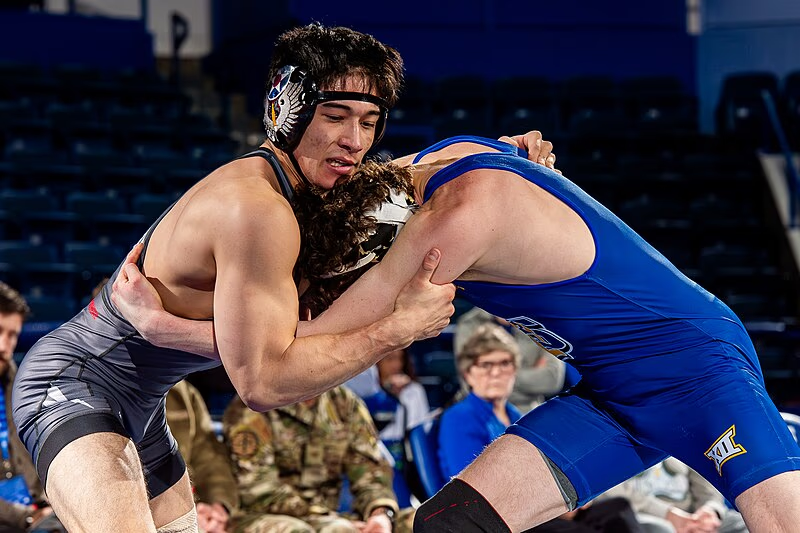
NCAA Folkstyle Wrestling, also known as Collegiate Wrestling, is the dominant style of competitive wrestling practiced in the United States at the high school, collegiate, and club levels. It is governed at the collegiate level by the National Collegiate Athletic Association (NCAA), which publishes and maintains the official rules through its Wrestling Rules Committee.
Folkstyle wrestling is fundamentally distinct from the Olympic styles — Freestyle and Greco-Roman — governed by United World Wrestling (UWW). While all three styles share the objective of pinning an opponent, folkstyle places far greater emphasis on control and riding on the mat. The concept of riding time, the use of referee's position (top/bottom starting positions), and the escape as a scoring action are all unique to folkstyle and do not exist in UWW competition.
The sport has deep roots in American wrestling tradition, evolving from catch-as-catch-can wrestling and formalized through decades of collegiate competition. NCAA Division I wrestling crowns individual national champions at ten weight classes each year, with the team trophy determined by cumulative individual placements. The sport is also contested at the Division II and Division III levels, as well as the NAIA and NJCAA.
Key philosophical differences from UWW styles include:
- Control emphasis: Folkstyle rewards sustained control on the mat through riding time, whereas UWW styles reward exposure and action.
- Bottom wrestling: The escape (1 point) and reversal (2 points) create an entire dimension of mat wrestling absent from Olympic styles.
- Single official: NCAA uses one referee, unlike UWW's three-person officiating crew (referee, judge, mat chairman).
- Pin duration: A fall requires both shoulders held on the mat for one full second, compared to UWW's instantaneous pin.
- Stalling enforcement: NCAA actively penalizes stalling with a progressive penalty structure, whereas UWW uses an activity clock and passivity system.
2. Equipment
2.1 Mandatory Wrestler Equipment
- Headgear: Protective ear guards are mandatory in NCAA wrestling. This is a critical difference from UWW, where headgear is optional for senior-level competitors. Headgear must have a chin strap and be properly fastened. It must be approved by the manufacturer for wrestling use.
- Wrestling singlet: A one-piece uniform covering the torso from mid-thigh to the chest. The singlet must be school-issued and display appropriate school colors. Two-piece uniforms (compression shirt and fight shorts) are now permitted under current NCAA rules as an alternative to the traditional singlet.
- Wrestling shoes: Light, flexible shoes that cover the ankle. Shoes must not have buckles, zippers, or any protruding hardware that could cause injury. Laces must be secured (taped or tucked).
- Kneepads: Optional but commonly worn. If worn, they must be the standard, unaltered wrestling type without rigid stays or hard surfaces.
2.2 Personal Hygiene & Appearance
- Fingernails must be trimmed short and smooth.
- Wrestlers must be clean-shaven or have facial hair that is trimmed close and not abrasive. A referee may require a face covering for facial hair.
- Hair must be contained in a legal hair cover if it extends below the earlobes in the back, below the eyebrows in the front, or beyond the earlobes on the sides. Natural hair in its natural state is permitted under current rules.
- No jewelry, watches, or hard hair accessories are permitted during competition.
- Skin checks are conducted before competition. Any communicable skin condition (ringworm, impetigo, herpes simplex, MRSA) must be cleared by a physician with a standardized skin form.
2.3 Prohibited Equipment
- Greasy or slippery substances on the body
- Any equipment with buckles, hard plastic, or metal components
- Unapproved braces or supports with exposed hard materials (must be padded and covered)
3. Playing Area
3.1 Mat Specifications
The NCAA wrestling mat is a circular competition surface with the following dimensions:
- Overall mat area: Minimum 42 feet (12.8 meters) in diameter, providing a large safety zone.
- Wrestling area: 32-foot (9.75-meter) inner circle where competition takes place. This is bounded by a 1-inch boundary line.
- Starting area: A 10-foot (3.05-meter) circle at the center of the mat, marked with starting lines for the referee's position.
- Protection area: The 5-foot apron between the wrestling area boundary and the edge of the mat serves as a safety buffer zone.
3.2 Mat Surface & Markings
- The mat must be of uniform thickness (minimum 1 inch / 2.54 cm of shock-absorbing material) and provide adequate cushioning.
- Starting lines in the center: two parallel 1-inch lines, 3 feet long, placed 12 inches apart at the center of the 10-foot circle. One line is green (for the wrestler assigned the green ankle band) and one is red.
- The wrestling area boundary is clearly marked, typically in a contrasting color from the interior surface.
- Mats must be sanitized before each session with an approved cleaning solution to prevent skin infections.
3.3 Surrounding Area
- A minimum of 5 feet of clear space must surround the mat on all sides, free of obstructions.
- Team benches and the scorer's table are positioned outside this safety zone.
- The scorer's table should be elevated or positioned for clear visibility of the mat.
4. Wrestlers & Officials
4.1 Weight Classes
NCAA Division I wrestling features ten weight classes (in pounds):
- 125 lbs (56.7 kg)
- 133 lbs (60.3 kg)
- 141 lbs (64.0 kg)
- 149 lbs (67.6 kg)
- 157 lbs (71.2 kg)
- 165 lbs (74.8 kg)
- 174 lbs (78.9 kg)
- 184 lbs (83.5 kg)
- 197 lbs (89.4 kg)
- 285 lbs (129.3 kg) — Heavyweight
A wrestler must weigh in at or below the weight class limit. A one-pound weight allowance is granted for competition on the second day of multi-day events. Each wrestler has a certified minimum weight established through the NCAA Weight Management Program.
4.2 Officials
NCAA wrestling uses a single-referee system, which is a significant departure from UWW's three-official crew (referee, judge, and mat chairman). The single referee is responsible for all scoring decisions, penalty calls, and match management.
- Referee: Controls the match from the mat, signals all scoring, awards points, calls penalties, and determines pins. The referee wears a green wristband on one arm and a red wristband on the other, corresponding to the assigned wrestler colors.
- Scorer/Timekeeper: Operates the scoreboard, tracks riding time, and manages the match clock from the scorer's table.
- Video review: Coaches may challenge scoring or near-fall situations using a coach's challenge (brick). Each coach receives one challenge per match; if the challenge is successful, the coach retains it.
4.3 Dual Meet Format
A dual meet consists of 10 individual matches, one at each weight class. The team accumulating the most points wins the dual. Points are awarded based on the manner of victory:
- Fall (pin): 6 team points
- Technical fall (15+ point lead): 5 team points
- Major decision (8–14 point margin): 4 team points
- Decision (1–7 point margin): 3 team points
- Forfeit: 6 team points
- Default: 6 team points
- Disqualification: 6 team points
5. Rules of Play
5.1 Match Structure
An NCAA wrestling match consists of three periods totaling seven minutes:
- 1st Period: 3 minutes — both wrestlers begin in the neutral (standing) position.
- 2nd Period: 2 minutes — one wrestler chooses starting position (top, bottom, neutral, or defer).
- 3rd Period: 2 minutes — the other wrestler chooses starting position.
A coin toss before the match determines which wrestler gets first choice. The winner of the coin toss may choose their position for the 2nd period or defer to the 3rd period. This strategic choice is a hallmark of folkstyle — deferring to the 3rd period is common when a wrestler wants bottom position in the final period to secure an escape or reversal.
5.2 Starting Positions
- Neutral position: Both wrestlers standing, facing each other on the starting lines. Used to begin the 1st period and when selected by choice.
- Referee's position (top/bottom): The bottom wrestler kneels on both knees with hands placed on the starting lines. The top wrestler kneels to the side with one arm around the waist and one hand on the near elbow. This position is unique to folkstyle.
5.3 In-Bounds & Out-of-Bounds
Action is considered in-bounds when the supporting parts of either wrestler remain inside or on the boundary line. If both wrestlers go out of bounds without a scoring situation in progress, the referee stops the match and restarts at the center. If a takedown or near fall is in progress near the boundary, the referee allows action to continue as long as the offensive wrestler maintains a supporting point in bounds.
5.4 Riding Time
Riding time is the defining feature of folkstyle wrestling and does not exist in any UWW style. It is the cumulative time advantage one wrestler has in the top (controlling) position over the other.
- The clock tracks net riding time throughout the match. When Wrestler A is on top controlling Wrestler B, Wrestler A accumulates riding time. When positions reverse, Wrestler B's time accumulates and Wrestler A's is reduced.
- If a wrestler has a net riding time advantage of 1 minute or more at the conclusion of the match, that wrestler is awarded 1 additional point.
- Riding time encourages dominant top wrestling and rewards wrestlers who can control their opponents on the mat — a philosophical emphasis absent from Olympic wrestling.
5.5 Overtime
If the score is tied at the end of regulation, the match proceeds to overtime:
- Sudden victory (1st overtime): One 1-minute period in neutral position. The first wrestler to score wins.
- Tiebreakers (2nd/3rd overtime): Two 30-second periods in referee's position. Each wrestler gets one period on bottom. The wrestler who scores the most points in their period wins. If still tied, the wrestler who scores first (in either period) wins (criteria-based tiebreaker).
5.6 Falls (Pins)
A fall occurs when any part of both shoulders or both scapulae are held in contact with the mat for one continuous second. In UWW, the pin is instantaneous — this longer duration in NCAA makes folkstyle pins more deliberate and gives the defensive wrestler more opportunity to escape. A fall terminates the match immediately regardless of the score.
5.7 Technical Fall
A technical fall occurs when one wrestler builds a 15-point lead at any time during the match. The match is stopped immediately. This contrasts with UWW's 10-point technical superiority rule. The higher threshold in NCAA reflects the additional scoring opportunities available in folkstyle (escapes, riding time).
6. Scoring
6.1 Individual Match Scoring
| Action | Points | Description |
|---|---|---|
| Takedown | 2 | From neutral, bringing the opponent down to the mat and establishing control. Both wrestlers must have been in a neutral position. Comparable to UWW's 2-point takedown. |
| Escape | 1 | The bottom wrestler gets away from the top wrestler and returns to a neutral position. Unique to folkstyle — this scoring action does not exist in UWW styles. |
| Reversal | 2 | The bottom wrestler reverses position and gains control of the top wrestler. The wrestler must move from a controlled position to a controlling position in one continuous motion. |
| Near Fall (2 pts) | 2 | Holding the opponent's shoulders within 45 degrees of the mat, or with one shoulder on the mat and the other at 45 degrees, for 2 continuous seconds. Also called back exposure or back points. |
| Near Fall (3 pts) | 3 | Near fall criteria held for 5 or more continuous seconds. Unlike UWW exposure points, NCAA near fall requires sustained control — fleeting exposure does not score. |
| Penalty Points | 1 or 2 | Points awarded to the opponent for rule violations (illegal holds, stalling, unsportsmanlike conduct, etc.). |
| Riding Time | 1 | Awarded at the end of the match if a wrestler has accumulated a net riding time advantage of 1 minute or more. Unique to folkstyle. |
6.2 Near Fall vs. UWW Exposure
A critical distinction: In UWW freestyle, brief exposure of the back to the mat (even momentarily) can score 2 or 4 points. In NCAA folkstyle, near fall points require the offensive wrestler to maintain control while holding the opponent in a near-fall position for a minimum of 2 seconds. This rewards sustained dominance rather than momentary positional advantage.
6.3 Team Tournament Scoring (NCAA Championships)
At the NCAA national tournament, team scoring is based on individual advancement and placement:
- Advancement points: Points for each win in the championship and consolation brackets.
- Bonus points: Additional points for falls, technical falls, and major decisions.
- Placement points: Points for finishing in the top eight (All-American status) at each weight class: 1st place (16 pts), 2nd (12), 3rd (10), 4th (9), 5th (7), 6th (6), 7th (4), 8th (3).
6.4 Match Result Categories
- Fall/Pin: Match terminated by pinning both shoulders for 1 second.
- Technical Fall: 15-point lead at any time.
- Major Decision: Win by 8–14 points.
- Decision: Win by 1–7 points.
- Default: Opponent unable to continue due to injury.
- Forfeit: Opponent fails to appear for the match.
- Disqualification: Opponent disqualified for flagrant misconduct or accumulated penalties.
- Medical Forfeit: Opponent unable to make weight or fails skin check.
7. Violations & Penalties
7.1 Stalling
Stalling is one of the most actively enforced infractions in NCAA wrestling, contrasting sharply with UWW's passivity system. A wrestler is considered stalling when they are not making a genuine effort to wrestle aggressively regardless of position.
The progressive penalty structure for stalling:
- 1st offense: Warning (no points awarded)
- 2nd offense: 1 point to opponent
- 3rd offense: 1 point to opponent
- 4th offense: 2 points to opponent
- 5th offense: Disqualification
Stalling on the feet (neutral) can include backing off the mat, circling away without engagement, or hand-fighting without attacking. On the mat, the bottom wrestler can be called for stalling by not making an honest effort to escape or reverse. The top wrestler can be penalized for not attempting to improve their position (merely riding without working for a fall or near fall).
7.2 Illegal Holds & Maneuvers
The following are illegal in NCAA wrestling:
- Full nelson: Both arms under the opponent's arms and behind the head (half nelson is legal).
- Slam: Lifting and returning the opponent to the mat with unnecessary force. The lifting wrestler is responsible for the safe return of the opponent.
- Headlock without the arm: A headlock must include the opponent's arm to be legal. Locking hands around only the head is illegal.
- Twisting knee lock: Any hold that applies twisting pressure to the knee joint.
- Straight back suplay: Throwing an opponent directly backward from a standing position onto their head or neck.
- Figure-four body scissors: A figure-four leg lock applied around the torso.
- Bending or twisting fingers: Individual finger manipulation.
- Holds over the mouth, nose, or throat: Any hold that restricts breathing.
- Locking hands around the body or both legs in neutral: Locked hands around the torso without including a leg, or clasping around both legs simultaneously from the front (while in neutral).
7.3 Locked Hands Penalty (Top Position)
When in the top position on the mat, a wrestler may not lock hands (grip one hand with the other) around the torso or both legs of the bottom wrestler unless the opponent is on their feet or within a near-fall count. This is unique to folkstyle — it prevents the top wrestler from simply clinging to the bottom wrestler without working for a fall. Violations result in 1 point to the opponent (first offense), then 2 points for subsequent offenses.
7.4 Unsportsmanlike Conduct
- 1st offense: Deduction of 1 team point (dual meets) and 1 match point awarded to opponent.
- 2nd offense: Deduction of 1 additional team point and 1 match point.
- 3rd offense: Disqualification from the match and removal from the premises.
Unsportsmanlike conduct includes taunting, excessive celebration, abusive language to officials, throwing headgear, and physical acts of aggression outside normal wrestling action. Coaches can also receive unsportsmanlike conduct penalties.
7.5 Flagrant Misconduct
Acts of flagrant misconduct (striking, kicking, biting, intentionally injuring) result in immediate disqualification and ejection. The offending wrestler's team forfeits the match (6 team points), and the individual may face further suspension from competition.
7.6 Injury Time
Each wrestler is allowed a cumulative total of 1 minute and 30 seconds of injury time per match (not per period). Blood time is tracked separately — the referee stops the match for bleeding, and the wrestler has a reasonable amount of time to control the bleeding. If bleeding cannot be controlled, the match is defaulted.
8. Safety Considerations
8.1 NCAA Weight Management Program (WMP)
The NCAA Weight Management Program is the most rigorous weight-cutting prevention system in wrestling and has been a model for other organizations. It was introduced to combat dangerous rapid weight loss practices that historically plagued the sport.
- Alpha weigh-in: Before the first competition of the season, each wrestler undergoes a body composition assessment (hydration testing and body fat measurement) to determine their certified minimum weight class.
- Minimum body fat: Males must maintain at least 5% body fat; females must maintain at least 12% body fat.
- Hydration test: Urine specific gravity must be ≤1.025 at the alpha weigh-in, confirming adequate hydration before establishing the minimum weight.
- Weekly descent rate: Wrestlers may lose no more than 1.5% of body weight per week when descending to their certified minimum weight.
- Prohibited practices: Use of saunas, rubber/plastic suits, hot boxes, excessive exercise in heated environments, diuretics, laxatives, self-induced vomiting, and IV rehydration are all strictly prohibited.
8.2 Skin Health & Communicable Disease
Skin infections are the most common health concern in wrestling. The NCAA mandates:
- Pre-participation skin checks by medical personnel before all competitions.
- A standardized physician release form (NCAA Skin Condition Report) for any wrestler with a diagnosed skin condition.
- Conditions such as herpes simplex (herpes gladiatorum), ringworm (tinea corporis), impetigo, MRSA, and molluscum contagiosum require treatment and clearance before returning to competition.
- Mat cleaning with approved disinfectant before and between sessions is mandatory.
- Athletes are encouraged to shower immediately after practice, avoid sharing towels or equipment, and report any suspicious skin lesions promptly.
8.3 Concussion Protocol
The NCAA follows a standardized concussion management protocol. Any wrestler suspected of sustaining a concussion must be immediately removed from competition and may not return until cleared by a qualified medical professional. Baseline testing and graduated return-to-play protocols are mandatory across all NCAA programs.
8.4 Headgear Requirement
Unlike UWW senior-level competition where headgear is optional, NCAA mandates headgear for all competition and practice. This requirement specifically protects against cauliflower ear (auricular hematoma), one of the most common wrestling injuries. The headgear must be properly fitted and fastened before the match begins; a wrestler may not compete without it.
8.5 Illegal Holds & Referee Responsibility
The referee has the authority and obligation to stop any potentially dangerous hold before injury occurs. If a wrestler is applying a legal hold that becomes potentially dangerous due to positioning or the opponent's flexibility, the referee will stop the action, award applicable points, and restart. The safety of the wrestlers is the referee's primary responsibility, superseding any scoring consideration.
8.6 Blood-Borne Pathogen Protocol
Any time blood is present, the referee must stop the match immediately. The bleeding wrestler must have the wound cleaned, treated, and securely covered before resuming. Any bloodied uniform must be changed or cleaned. The mat must be cleaned and disinfected before the match continues. Officials and medical staff must follow universal precautions when handling blood.
8.7 Environmental Safety
- Practice room temperatures should be maintained at a reasonable level — excessively heated practice rooms are prohibited under the weight management program.
- Adequate hydration must be available at all practices and competitions.
- Lightning protocols apply for any outdoor events.
- Emergency action plans must be in place at all competition venues with access to automated external defibrillators (AEDs).