








Section 1: Introduction
NCAA Men's Basketball is the collegiate variant of basketball played under the rules of the National Collegiate Athletic Association. NCAA men's basketball differs meaningfully from FIBA (international) and NBA (professional) rules — most notably in the use of two 20-minute halves rather than quarters, a 30-second shot clock (reduced from 35 in 2015), and a unique team-foul bonus framework. The canonical text is the NCAA Men's Basketball Rules Book, published on a two-year cycle by the NCAA Men's Basketball Rules Committee and approved by the Playing Rules Oversight Panel (PROP).
The current edition is the 2025-26 NCAA Men's Basketball Rules Book, in effect through the 2026 NCAA Division I Men's Basketball Tournament (March Madness) and through the 2026-27 regular season. This entry summarizes the major rule mechanics for educational purposes. It does not reproduce rule text and is not a substitute for the canonical NCAA Rules Book, which is authoritative in any dispute. For FIBA international rules see the sibling FIBA Official Rules entry; for NBA professional rules see the sibling NBA Official Rulebook; for 3x3 see the FIBA 3x3 Rules entry; for the women's collegiate variant see Basketball (NCAA Women).
Section 2: Equipment
The Ball
- Men's ball: size 7, circumference 29.5 inches (74.9 cm), weight 22 oz (623 g)
- NCAA-approved/NFHS-spec leather or composite cover; orange color standard
Court Equipment
- Basket: 18-inch diameter ring at 10 feet (3.05 m) height
- Backboard: 6 feet wide × 3.5 feet high, rectangular
- Net: white cord, 15-18 inches
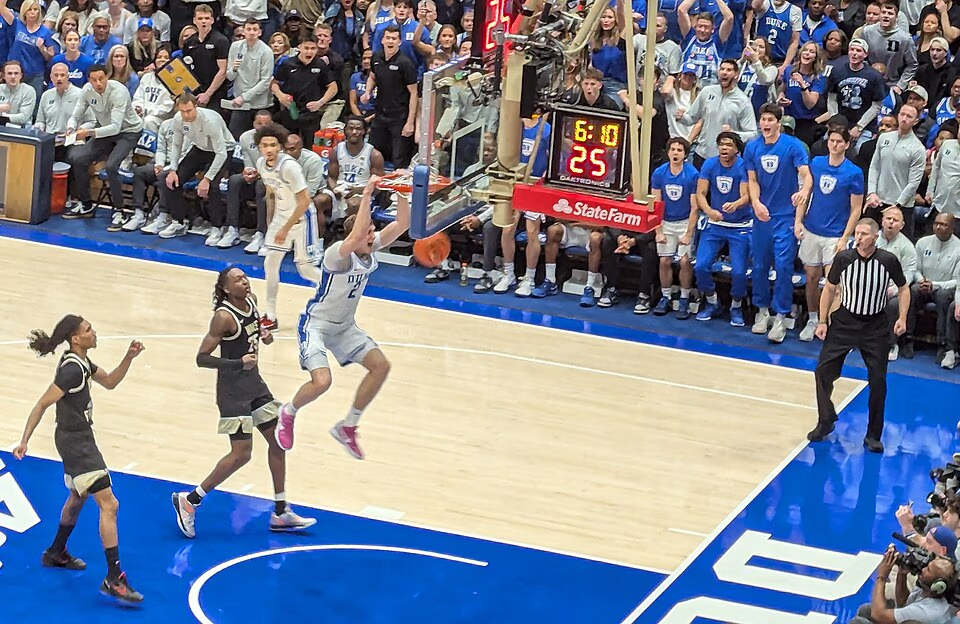
- Shot-clock visible at each end of the court (30-second)
- Game clock visible to players, officials, and spectators
Player Apparel
- Team uniform (jersey + shorts) with school logo and numerals
- Jersey numbers must be unique within the team; legible at the scoring table
- Athletic shoes appropriate to hardwood/synthetic indoor surface
- Mouthguards recommended, not required at the NCAA level
- Headbands, sweatbands, religious head coverings, knee/elbow pads permitted
- Jewelry prohibited except as accommodated by NCAA religious-exemption framework
Section 3: Playing Area
Court Dimensions
- Rectangular court, 94 feet long × 50 feet wide (28.65 m × 15.24 m)
- Painted lane (key): 12 feet wide × 19 feet from baseline to free-throw line
- Three-point arc: 22 feet 1.75 inches from the center of the basket (NCAA men's distance — expanded from 20'9" in 2019)
- Restricted-area arc: 4-foot radius from the center of the basket, used for charge/block decisions
- Center circle: 12-foot diameter, used for the opening jump ball
- Free-throw line: 15 feet from the backboard
Bench and Sideline Areas
Team bench seating along one sideline with the scoring/timing table opposite. Coach's box defined for the head coach with a 28-foot designated coaching area extending from the baseline.
Section 4: Players & Officials
Team Composition
- 5 players on the court per team at any time
- Roster: typically 13-15 players for NCAA D1 men's basketball
- Substitutions: unlimited, made at dead-ball stoppages on the scorer's signal
- Re-entry: a substituted player may return to the game
Officials
- Three-person on-court crew (referee, two umpires) for NCAA D1 games
- Scorer, timekeeper, shot-clock operator at the scorer's table
- Video-replay official for designated reviewable situations
Coaches' Challenge (2025/26 Framework)
NCAA men's basketball uses a coaches'-challenge framework allowing a head coach to request video review of designated reviewable situations (out-of-bounds calls in the last 2 minutes, basket interference, goaltending, made-basket validity, flagrant fouls, and certain shot-clock incidents). Each team has one challenge per game.
Media Timeouts
Television broadcasts of NCAA D1 games include scheduled media timeouts: 4 per half at predetermined time intervals (typically at the first dead ball under 16:00, 12:00, 8:00, and 4:00 of each half). Media timeouts do not count against team timeouts.
Section 5: Rules of Play
Game Structure
- Two 20-minute halves (distinguishes NCAA M's from FIBA quarters and NCAA W's quarters)
- 15-minute halftime intermission
- 5-minute overtime periods, unlimited until a winner is determined
Shot Clock
- 30-second shot clock (reduced from 35 in 2015-16 season)
- Resets to 30 on change of possession; resets to 20 on offensive rebound (since 2018-19)
- The team in possession must attempt a shot that contacts the rim before the shot clock expires; failure is a shot-clock violation
Starting Play
The game begins with a jump ball at the center circle. Subsequent jump-ball situations are resolved by the alternating-possession rule — the arrow indicates which team gets possession.
Movement of the Ball
- Dribble (single-hand bouncing), pass, or shoot
- Player in possession may not run with the ball without dribbling
- Closely-guarded 5-second rule when a defender is within 6 feet
- Backcourt 10-second rule: ball must be advanced past midcourt within 10 seconds of inbound
- 3-second rule: offensive player may not remain in the lane for more than 3 consecutive seconds
Bonus Free Throws
- 1-and-1 bonus: starts at the team's 7th team foul per half — the offended team shoots one free throw and, if successful, a second
- Double bonus: starts at the team's 10th team foul per half — the offended team shoots two free throws automatically
Section 6: Scoring
- Field goal inside the three-point arc: 2 points
- Field goal beyond the three-point arc: 3 points
- Free throw: 1 point
- Team with more points at the end of regulation/overtime wins
- Overtime periods: 5 minutes each, repeated until a winner
Section 7: Violations & Penalties
Personal Fouls
- A player is disqualified ("fouls out") after committing 5 personal fouls
- Common personal fouls: blocking, charging, pushing, holding, hand-checking, illegal screen
- Shooting fouls: 2 or 3 free throws depending on the foul location; and-one if the basket counts
Technical Fouls
- Class A unsporting (taunting, fighting, profanity): 2 free throws + possession to the opposing team; 2 in a game = ejection
- Class B (delay-of-game, illegal substitution, hanging on rim without play continuation): 1 free throw + possession
- Class C (administrative — coach conduct, scorebook errors): 1 or 2 free throws
Flagrant Fouls
- Flagrant 1: excessive contact, not directed at the head/neck — 2 free throws + possession; remains in game
- Flagrant 2: dangerous or intentional contact, contact to the head/neck/face — 2 free throws + possession + ejection
- Replay review used to confirm flagrant fouls
Other Violations
- Traveling, double dribble, carrying, goaltending, basket interference
- Out of bounds: ball awarded to the opposing team at the point closest to where it went out
- 5-second closely-guarded, 10-second backcourt, 3-second lane violations
Section 8: Safety Considerations
Concussion Protocol
NCAA medical observers and team medical staff have authority to remove a player from the game for actual or suspected concussion. Removed players are subject to a graduated return-to-play assessment before being cleared for subsequent competition.
Head and Neck Protections
Flagrant-2 ejection framework for contact to the head/neck protects against high-risk plays. Targeting an opponent in a defenseless position is reviewed by the on-court crew and may be confirmed via replay.
Equipment and Surface
- Backboard and goal padded to NCAA-approved specifications
- Court surface inspected for safety prior to game; wet spots cleared by the scorer's-table crew during play
- Each NCAA-sanctioned game requires at least one certified athletic trainer on the bench
- Emergency action plan covering on-court cardiac, head/neck, and orthopedic emergencies must be in effect at every venue
- Defibrillators (AEDs) positioned strategically at every NCAA D1 venue