











Section 1: Introduction
Overview and Governing Body
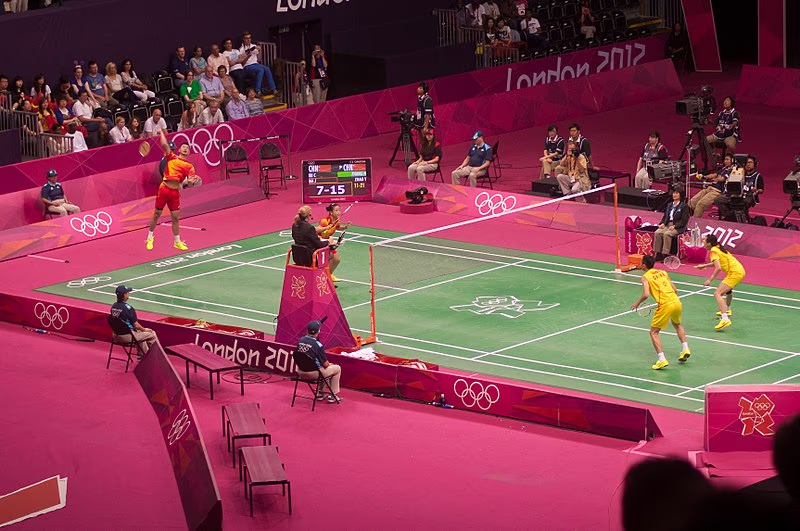
Badminton is governed internationally by the Badminton World Federation (BWF), headquartered in Kuala Lumpur, Malaysia. The rules of badminton are codified in the BWF Laws of Badminton, the edition in force being Version 5.0, effective 26 April 2025 (Version 6.0 is published and takes force 4 January 2027). All BWF sanctioned events, including the Olympic Games, BWF World Championships, Thomas & Uber Cup, Sudirman Cup, BWF World Tour, and affiliated Member Association competitions, are governed by these Laws.
History and Olympic Status
Badminton was formally included as an Olympic sport at the 1992 Barcelona Games and has been contested at every Summer Olympic Games since. Five disciplines are recognized: men's singles, women's singles, men's doubles, women's doubles, and mixed doubles. The BWF was founded in 1934 and currently comprises more than 195 member associations worldwide.
Objective of the Game
The objective of badminton is to strike the shuttlecock with a racket so that it passes over the net and lands within the opposing side's half of the court before the opposing side can return it. A rally is won when the opposing side commits a fault or the shuttlecock lands on the floor within the court boundaries on the opposing side. A match is the best of three games, with each game played to 21 points using rally-point scoring (a point is awarded on every rally regardless of which side served).
Disciplines
- Singles: One player per side.
- Doubles: Two players per side (men's doubles or women's doubles).
- Mixed Doubles: One male and one female player per side.
Source Document
All rules referenced in this document are drawn from the BWF Statutes Section 4.1 — Laws of Badminton, Version 5.0, in force 26 April 2025. Laws are cited by their official Law number (e.g., Law 1, Law 9.1). Where the BWF has issued clarifications via the BWF Umpiring Department or official Regulations, those clarifications are noted.
Section 2: Equipment
The Racket (Law 4)
The racket is governed by Law 4 of the BWF Laws of Badminton. The following specifications are mandatory for all BWF-sanctioned competition:
3.1 Frame Dimensions
- The overall length of the racket frame shall not exceed 680 mm (26.77 in) (Law 4).
- The overall width of the racket frame shall not exceed 230 mm (9.06 in) (Law 4).
- The frame, including the handle, shall be of defined construction: the handle, the string area, the throat (connecting handle to head), and the head (enclosing the string area) (Law 4).
3.2 String Area
- The strung area shall be flat and consist of a pattern of crossed strings connected to a frame (Law 4).
- The strung area shall not exceed 280 mm (11.02 in) in overall length and 220 mm (8.66 in) in overall width (Law 4).
- However, the strings may extend into an area which otherwise would be the throat, provided that the width of the extended string area does not exceed 35 mm and the overall length of the strung area does not then exceed 330 mm (Law 4).
3.3 Construction Requirements (Law 4)
- The racket shall be free of attached objects and protrusions, other than those used solely and specifically to limit or prevent wear and tear, or vibration, or to distribute weight, or to secure the handle by cord to the player's hand, provided such objects and protrusions are reasonable in size and placement for such purposes (Law 4).
- The racket shall be free of any device which makes it possible for a player to change materially the shape of the racket (Law 4).
The Shuttlecock (Law 2)
The shuttlecock may be made from natural or synthetic materials. Regardless of the material, the flight characteristics shall, in general, be similar to those produced by a natural feathered shuttlecock with a cork base covered by a thin layer of leather (Law 2).
2.1 Feathered Shuttlecock (Law 2.1)
- A feathered shuttlecock shall have 16 feathers fixed in a rounded cork base covered by thin leather (Law 2).
- The feathers shall be 62–70 mm (2.44–2.76 in) in length measured from the tip of the feather to the top of the base (Law 2).
- The tips of the feathers shall lie on a circle with a diameter ranging from 58–68 mm (2.28–2.68 in) (Law 2).
- The feathers shall be fastened firmly with thread or other suitable material (Law 2).
- The base shall be 25–28 mm (0.98–1.10 in) in diameter with a rounded bottom (Law 2).
- The shuttlecock shall weigh 4.74–5.50 g (0.167–0.194 oz) (Law 2).
2.2 Non-Feathered (Synthetic) Shuttlecock (Law 2.2)
- The skirt or simulation of feathers in synthetic materials replaces natural feathers (Law 2).
- The base shall be as described in Law 2.1 for feathered shuttlecocks (Law 2).
- Measurements and weight may vary from those in Law 2.1 to the extent permitted by the BWF, to allow for differences in material density or other physical qualities.
2.3 Shuttle Speed Testing (Law 2.3)
To test a shuttle, strike it with a full underhand stroke which makes contact with the shuttle over the back boundary line. The shuttle shall be hit at an upward angle and in a direction parallel to the side lines. A shuttle of correct speed will land not less than 530 mm and not more than 990 mm short of the other back boundary line (measured from the far back boundary line inward). At higher altitudes or in warm conditions a heavier shuttle may be required; at lower altitudes or in cold conditions a lighter shuttle (Law 3).
Equipment Approval
The BWF publishes and maintains an approved list of shuttlecocks for use in BWF-sanctioned tournaments. Rackets used in play must conform to the specifications in Law 3. The referee of a tournament has the authority to rule on equipment legality during competition.
Section 3: Playing Area
Court Dimensions (Law 1)
The court dimensions are specified in Law 1 of the BWF Laws of Badminton. The court shall be a rectangle marked out with lines 40 mm (1.57 in) wide. Lines shall be easily distinguishable and preferably white or yellow in color. All lines form part of the areas they define (Law 1).
1.1 Overall Court Size
- Length: 13.4 m (43 ft 11.5 in) (Law 1, Diagram A).
- Width (doubles): 6.1 m (20 ft 0 in) (Law 1, Diagram A).
- Width (singles): 5.18 m (17 ft 0 in) — defined by the inner side lines (Law 1, Diagram A).
1.2 Court Lines
- Back boundary lines: The outermost parallel lines at each end of the court. These serve as the long service lines in singles play (Law 1).
- Long service line for doubles: Drawn parallel to, and 0.76 m (2 ft 6 in) inside, the back boundary line (Law 1, Diagram A).
- Short service line: Drawn parallel to the net, 1.98 m (6 ft 6 in) from the net on each side, extending the full width of the court (Law 1, Diagram A).
- Center line: Drawn from the short service line on each side to the back boundary line, dividing each half of the court into a right service court and a left service court (Law 1).
- Side lines (doubles): The outermost lines on either side of the court (Law 1).
- Side lines (singles): The inner side lines, located 0.46 m (1 ft 6 in) inside the doubles side lines (Law 1, Diagram A).
1.3 Service Court Dimensions
Each player's service court is defined as follows:
- Right service court: Bounded by the short service line (front), the center line (inner side), the relevant side line (outer side), and for singles the back boundary line, or for doubles the long service line (Law 1).
- Left service court: Mirror of the right service court on the other side of the center line (Law 1).
Posts and Net (Laws 1.6–1.10)
Net Posts (Law 1.6)
- Posts shall be 1.55 m (5 ft 1 in) in height from the surface of the court and shall remain vertical when the net is strained (Law 1).
- Posts shall be placed on the doubles side lines, regardless of whether singles or doubles is being played (Law 1).
Net Specifications (Laws 1.7–1.9)
- The net shall be made of fine natural or artificial cord of dark color and even thickness, with a mesh of not less than 15 mm (0.59 in) and not more than 20 mm (0.79 in) (Law 1).
- The net shall be 760 mm (2 ft 6 in) in depth (Law 1).
- The top of the net shall be edged with a 75 mm (3 in) white tape doubled over a cord or cable running through the tape (Law 1).
- The top of the net from the surface of the court shall be 1.524 m (5 ft 0 in) at the center of the court (Law 1).
- The top of the net at the posts shall be 1.55 m (5 ft 1 in) in height (Law 1).
- There shall be no gap between the ends of the net and the posts. If necessary, the full depth of the net shall be tied at the posts (Law 1).
Court Surface and Environment
The BWF does not mandate a specific court surface material; however, international and major tournaments are played on wooden (parquet) or synthetic sport surfaces approved by the BWF. The playing area must be free from obstructions. A clear ceiling height of at least 9 m above the playing surface is recommended for international competition, ensuring unobstructed shuttle flight.
Section 4: Players & Officials
Players (Laws 4–5)
Law 4 – Toss
Before play commences, a toss shall be conducted. The side winning the toss shall exercise one of the following choices: (Law 6).
- (a) to serve or to receive first; (Law 6).
- (b) to start play at one end or the other (Law 6).
The side losing the toss shall then exercise whichever choice remains (Law 6).
Law 5 – Scoring, Service, and Ends
Players change ends at the start of the second game. In the third game (if any), players change ends when the leading score reaches 11 points (Law 8.4). In doubles, the pair that wins the toss on service decides which partner shall serve first. Thereafter, the order of serving follows Law 10 (doubles service rules).
Player Conduct
Players must conduct themselves in accordance with the BWF Code of Conduct. Players may not receive coaching from outside the court during a match except during the intervals described in Law 16 (Intervals and Suspension of Play). Players are responsible for knowing the Laws of Badminton and for verifying their own service actions, positions, and equipment compliance. (Law 16).
Match Officials
BWF-sanctioned events shall appoint the following officials to administer a match:
Referee
The referee is responsible for the overall control of the tournament and has overall authority over all umpires and service judges. The referee's decisions are final on matters of fact and on matters within the referee's jurisdiction under the Laws of Badminton. The referee may adjudicate on matters of conduct and on questions not provided for in the Laws. (Law 17).
Umpire (Law 17)
The umpire is appointed for a match and has responsibility for that match. The umpire's specific duties include: (Law 17).
- Conducting the toss (Law 6).
- Calling the score in the prescribed manner. (Law 17).
- Deciding faults that occur in the umpire's field of vision (generally the net and above). (Law 17).
- Calling "let" when required. (Law 17).
- Overruling a service judge's call when the umpire has a clearer view. (Law 17).
- Where a service judge has not been appointed, exercising the authority of the service judge. (Law 17).
- Reporting to the referee any misconduct or injury of a player. (Law 17).
Service Judge (Law 18)
The service judge calls faults made by the server or receiver from the first motion of the server's racket to the completion of the service action. The service judge is positioned at the receiver's end of the court, seated at court level. Service judge responsibilities include: (Law 17).
- Calling faults related to foot positions of server and receiver (Laws 9.6–9.7).
- Calling faults related to the service action (Laws 9.1–9.5).
- Calling faults related to the shuttle position at the moment of striking (Law 9.1).
Line Judges
Line judges are appointed to indicate whether shuttlecocks are "in" or "out" in relation to the lines they are assigned to judge. Line judges shall be positioned directly behind the line they judge. In major BWF events, the Hawk-Eye instant review system may supplement or replace human line judges. (Law 17).
Intervals and Suspension of Play (Law 16)
- A maximum of 90 seconds between games is allowed (Law 16.2).
- A maximum of 5 minutes is allowed between the second and third games (Law 16.3), during which players may leave the court. Players may also receive coaching during this interval.
- When the leading score reaches 11 points in the third game, players are entitled to a 60-second interval (Law 16.4).
- Play shall not be suspended to allow a player to recover his/her physical condition. Law 16.5 specifies that only injury time (as defined) may be granted, and such time is at the discretion of the umpire and referee. (Law 17).
Section 5: Rules of Play
General Play
The fundamental objective during play is to keep the shuttlecock in play (a rally) by striking it over the net so that it lands within the opponent's court, or to force the opponent to commit a fault. The shuttle may only be struck once by a player before crossing the net (except as described in Law 14.2 regarding the shuttle touching the net cord).
Service (Law 9)
Service is the action that initiates a rally. Law 9 governs all aspects of the service action in detail.
9.1 Positions at Service
- Both the server and the receiver shall stand within diagonally opposite service courts (Law 9.1.1).
- Some part of both feet of the server and receiver shall remain in contact with the surface of the court in a stationary position from the start of the service (Law 9.1.1) until the service is delivered (Law 9.1.2).
- The feet of the server and receiver shall not touch any line of the service court (Law 9.1.3).
9.2 Shuttle Position and Racket Angle at Service
- The server's racket shall initially hit the base of the shuttle (Law 9.1.4).
- The whole shuttle shall be below the server's waist at the instant of being hit. The waist is defined as an imaginary line around the body at the level of the lowest part of the server's bottom rib (Law 9.1.5).
- The shaft of the server's racket at the instant of hitting the shuttle shall be pointing in a downward direction to such a degree that the whole of the head of the racket is discernibly below the whole of the server's hand holding the racket (Law 9.1.6).
- The movement of the server's racket must continue forwards after the start of the service until the service is delivered (Law 9.1.7).
- The flight of the shuttle shall be upwards from the server's racket to pass over the net, so that if not intercepted it falls in the receiver's service court (Law 9.1.8).
9.3 Feinting and Delays
- Once the server and receiver are ready for the service, the first forward movement of the server's racket head shall be the start of the service (Law 9.2).
- The server shall not serve before the receiver is ready. However, the receiver shall be considered to have been ready if a return of service is attempted (Law 9.4).
- Service delivered in the wrong service court is a fault (Law 9.6). However, if the error is not discovered before the next service is delivered, the point stands (Law 9.7).
Doubles Service Order (Law 10)
- At the start of a game and each time a side gains the right to serve, the service shall be delivered from the right service court (Law 10.1.1).
- Only the receiver shall return the service (Law 10.1.2). If the shuttle is touched by or strikes the receiver's partner, it is a fault.
- When the serving side wins a rally, the server and partner do not change their respective service courts and the same server serves again from the alternate service court (Law 10.1.3).
- When the receiving side wins a rally, the receiving side becomes the new serving side (Law 10.1.4). The player of the new serving side who served last shall serve from the appropriate service court determined by the score.
- Players do not change their respective service courts until they win a point when their side is serving (Law 10.1.5).
Lets (Law 13)
A "let" is called when a rally is stopped and replayed with no point awarded. A "let" shall be called (Law 13.3) in the following circumstances:
- The shuttle is caught in the net and remains suspended on the top of the net after passing over the net (except on service).
- During service, if the receiver and server are both faulted at the same time (Law 13.3.4).
- If the server serves before the receiver is ready (Law 13.3.5).
- During play, the shuttle disintegrates and the base separates from the rest of the shuttle (Law 13.3.6).
- A line judge is unsighted and the umpire is unable to make a decision (Law 13.3.7).
- Any unforeseen or accidental situation has arisen (Law 13.3.8).
Under Law 13.1, if a "let" is called, play since the last service shall not count and the player who served shall serve again (reservice).
Shuttle in Play
Under Law 14, the shuttle is not in play once a fault has occurred, or a "let" has been called. In all other circumstances, the shuttle remains in play from the moment it is struck by the server's racket until it touches the court surface or a fault or let is called. Under Law 14.2, the shuttle may touch the net on its way over during play (not service) and continue in play, provided it lands within the correct boundary lines.
Section 6: Scoring
Match Format (Law 8)
The scoring system is governed by Law 8 of the BWF Laws of Badminton. The following rules apply to all BWF-sanctioned competition:
8.1 Rally Point Scoring
A point is scored on every rally. The side winning a rally (as defined by the opposing side committing a fault or the shuttle landing in bounds on the opposing court) shall add a point to its score and shall serve in the next rally (Law 8.1).
8.2 Game and Match Structure
- A match shall consist of the best of 3 games (Law 8.2).
- The side first scoring 21 points wins a game (Law 8.3).
8.3 Deuce and Setting
- If the score reaches 20-all, the side which gains a 2-point lead first shall win that game (Law 8.3.1).
- If the score reaches 29-all, the side scoring the 30th point shall win that game (Law 8.3.2).
- There is no "setting" or extension beyond 30 points.
8.4 Ends and Service in Each Game
- The side winning a game shall serve first in the next game (Law 8.4).
- In the third game only, when one side first scores 11 points, players shall change ends (Law 8.4). At this point, a 60-second interval is also granted (Law 16.4).
- Players change ends at the start of each new game (Law 8.4).
8.5 Calling the Score
The umpire shall call the score in the following manner: the server's score is called first, followed by the receiver's score. For example, if the server has 15 points and the receiver has 12 points, the umpire calls "15-12." At the start of a game, the umpire calls "Love all, play" (0–0). If the score is 20-20, the umpire calls "20-all." If the score reaches 29-29, the umpire calls "29-all; next point wins."
Winning the Match
A player/pair wins the match by winning two games. There is no requirement to win by a set margin of games; the first side to win two games wins the match. A retirement by the opposing side, or disqualification of the opposing side by the referee, also results in a match victory.
Section 7: Violations & Penalties
Faults (Law 13)
A "fault" is a violation of the Laws of Badminton. When a fault is committed, the rally ends immediately and the non-offending side wins the rally and a point. Law 13 defines all fault conditions.
13.1 Service Faults — Server Faults (Law 13.6.2)
- The server's feet are not in the correct service court or touch a boundary line of the service court (Law 9.1.3 / 13.6.2a).
- The server fails to hit the base of the shuttle first (Law 9.1.4 / 13.6.2b).
- The whole shuttle is not below the server's waist at the instant of being struck (Law 9.1.5 / 13.6.2c).
- The head of the server's racket is not discernibly below the server's whole hand at the moment of impact (Law 9.1.6 / 13.6.2d).
- The server's racket movement is not continuously forward from the start of the service (Law 9.1.7 / 13.6.2e).
- The shuttle does not pass over the net or falls outside the correct receiver's service court (Law 9.1.8 / 13.6.2f).
13.2 Service Faults — Receiver Faults (Law 13.6.3)
- The receiver's feet are not in the receiver's service court or touch a boundary line (Law 9.1.3 / 13.6.3a).
- The receiver moves before the server's racket makes contact with the shuttle (Law 9.4 / 13.6.3b).
13.3 In-Rally Faults (Law 13.4)
- The shuttle lands outside the boundaries of the court (i.e., not on or within the boundary lines) (Law 13.4.1).
- The shuttle passes through or under the net (Law 13.4.2).
- The shuttle fails to pass over the net (Law 13.4.3).
- The shuttle touches the roof, ceiling, or side walls (Law 13.4.4).
- The shuttle touches the person or clothing of a player (Law 13.4.5).
- The shuttle touches any other object or person outside the court. (If the court is surrounded by walls, a local rule may permit shuttles that touch walls to remain in play — Law 13.4.6.)
- A player strikes the shuttle before it crosses to the player's side of the net. However, a player may follow through on the stroke over the net, provided the shuttle was contacted on the player's own side of the net (Law 13.4.7).
- A player deliberately distracts an opponent by actions such as shouting or making gestures (Law 13.4.8).
- The shuttle is caught and held on the racket and then slung during the execution of a stroke ("sling," "carry," or "throw") (Law 13.4.10).
- The shuttle is struck twice in succession by the same player with two strokes. (However, a single stroke that results in the shuttle being hit by the frame and strings of the same racket swing is not a fault) (Law 13.4.11).
- The shuttle is struck by a player and a player's partner successively (i.e., a double hit by partners in doubles) (Law 13.4.12).
- A player touches the net or its supports with the racket, person, or clothing during play (Law 13.4.13).
- A player invades an opponent's court over the net with the racket or person (Law 13.4.14). (Exception: following through after striking the shuttle on one's own side is permitted.)
- A player invades an opponent's court under the net with the racket or person, such that the opponent is obstructed or distracted (Law 13.4.15).
- A player obstructs an opponent, preventing an opponent from making a legal return stroke where the opponent is the striker (Law 13.4.16).
- A player is guilty of flagrant, repeated, or persistent offences under Law 16 (Continuous Play, Misconduct, and Penalties) (Law 13.4.17).
Misconduct and Disciplinary Penalties (Law 16 & BWF Code of Conduct)
In addition to rally-point faults, the umpire and referee may impose disciplinary sanctions for player misconduct. The progression of sanctions under the BWF Code of Conduct is as follows:
- Yellow Card (Warning): Issued for a first minor misconduct offense. No point penalty.
- Red Card (Fault — point to opponent): Issued for a second offense, or for a more severe initial offense. A point is awarded to the opponent.
- Black Card (Disqualification): Issued for serious or aggravated misconduct, or for a third offense after two red cards. The player or pair is disqualified from the match.
Misconduct includes (but is not limited to): causing unnecessary delays to play; deliberately distorting the flight of the shuttle by any method; behaving in an offensive manner; verbal abuse; physical abuse; any other conduct that damages the reputation of the sport or is prejudicial to BWF competitions.
Continuous Play (Law 16.1)
Play shall be continuous from the first service until the match is concluded, subject only to the intervals provided under Law 16. A player must not delay play deliberately. If play is delayed by a player due to cramp, the umpire shall allow reasonable time at his discretion; however, metabolic fatigue or fitness-related issues do not constitute grounds for a medical time-out. Injury time-outs are governed by the BWF Tournament Regulations for specific events.
Section 8: Safety Considerations
Player Welfare and Medical Provisions
The BWF and member associations are responsible for player welfare at sanctioned events. All major BWF events must have qualified medical personnel available courtside or in the venue. The following protocols are observed at BWF World Tour and above:
- A physiotherapist or sports medicine professional must be accessible during all match sessions.
- Players suffering injuries during match play may request an injury time-out at the umpire's discretion (Law 16.5). Medical personnel may attend to the player on court during an authorized stoppage.
- Bleeding injuries must be treated before play resumes. If a player is bleeding, the umpire shall call a let immediately.
- In the event of a serious medical emergency, the referee has authority to suspend or abandon play.
Court and Venue Safety
- Floor surface: Courts shall have non-slip surfaces. Wet or slippery courts must be dried or treated before play commences. Players may request a delay if they consider the court surface unsafe, and the umpire shall consult the referee.
- Lighting: Adequate and uniform lighting is required across the entire court. Minimum recommended illuminance levels for international competition are published in BWF Tournament Regulations. Shadows, glare, or blinding light directed at players shall be corrected before match commencement.
- Ceiling clearance: A minimum recommended ceiling height of 9 m (29.5 ft) above court level is specified for international play. Lower ceilings may require local rules to govern shuttle contact with the ceiling.
- Surroundings: Sufficient buffer space around the court perimeter (minimum 2 m / 6.6 ft recommended on each side and end) must be maintained free of obstructions, equipment, and spectators.
Warm-Up and Shuttle Testing
Players are entitled to a warm-up period prior to the start of a match. At BWF World Tour events, a standard warm-up of 5 minutes on the match court is provided. Shuttle speed testing (as described under Law 2.3) should be conducted prior to the start of the match. If shuttles are found to be inconsistent in speed during the warm-up period, the umpire shall consult the referee and arrange for new shuttles to be tested.
Heat and Environmental Conditions
BWF Tournament Regulations include guidelines for play in high-temperature or high-humidity environments. If indoor venue temperatures exceed recommended thresholds, the tournament director and medical officer may invoke heat policy provisions, including extended interval times or match suspension. Players are encouraged to maintain adequate hydration throughout competition. The 90-second between-game interval (Law 16.2) and the 5-minute interval before the third game (Law 16.3) allow for rest, hydration, and toweling down.
Equipment Safety
- Rackets found to be broken, cracked, or structurally compromised must be replaced before the next rally. Players are responsible for maintaining their equipment in a safe condition.
- Shoes worn on court must be appropriate badminton footwear providing adequate lateral support and grip for the court surface, to reduce the risk of ankle and knee injuries.
- Protective eyewear is strongly recommended for doubles play due to the proximity of partners and the speed of the shuttlecock (which can exceed 400 km/h / 249 mph in elite men's singles smashes). At the junior level, BWF encourages member associations to mandate eyewear for players under a specified age.
Anti-Doping
All players competing at BWF-sanctioned events are subject to the BWF Anti-Doping Regulations, which conform to the World Anti-Doping Agency (WADA) Code. Testing may be conducted in-competition or out-of-competition. Violations result in sanctions as specified in the BWF Anti-Doping Regulations, which may include disqualification, suspension, and return of prize money.