


🏛️Official — NCAA
Loading OpenSourceSports…
Combat Sports
1 players
both
headgear, singlet, footwear
10 essential rules
NCAA Folkstyle Wrestling, also known as Collegiate Wrestling, is the dominant style of competitive wrestling practiced in the United States at the high school, collegiate, and club levels. It is governed at the collegiate level by the National Collegiate Athletic Association (NCAA), which publish...
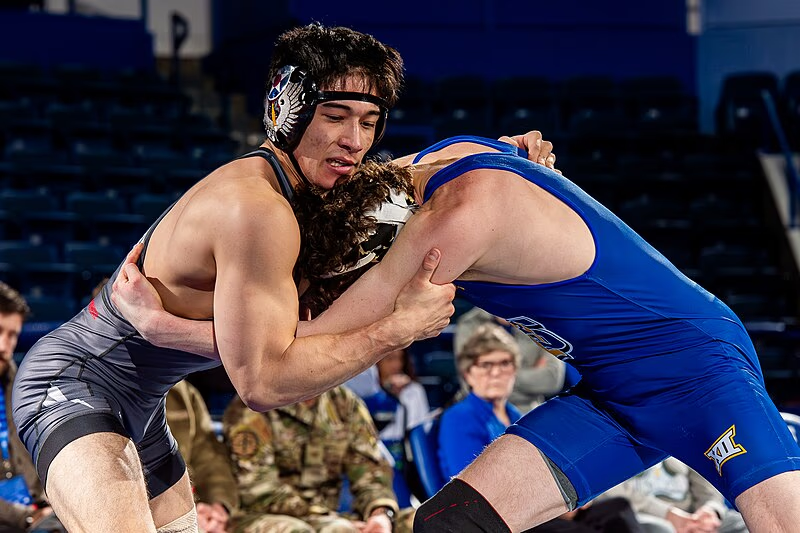
Headgear: Protective ear guards are mandatory in NCAA wrestling. This is a critical difference from UWW, where headgear is optional for senior-level competitors. Headgear must have a chin strap and be properly fastened. It must be approved by the manufacturer for wrestling use.; Wrestling singlet...
Headgear: Protective ear guards are mandatory in NCAA wrestling. This is a critical difference from UWW, where headgear is optional for senior-level competitors. Headgear must have a chin strap and be properly fastened. It must be approved by the manufacturer for wrestling use.; Wrestling singlet...
Fingernails must be trimmed short and smooth.; Wrestlers must be clean-shaven or have facial hair that is trimmed close and not abrasive. A referee may require a face covering for facial hair.; Hair must be contained in a legal hair cover if it extends below the earlobes in the back, below the ey...
Greasy or slippery substances on the body; Any equipment with buckles, hard plastic, or metal components; Unapproved braces or supports with exposed hard materials (must be padded and covered)
The NCAA wrestling mat is a circular competition surface with the following dimensions: Overall mat area: Minimum 42 feet (12.8 meters) in diameter, providing a large safety zone.; Wrestling area: 32-foot (9.75-meter) inner circle where competition takes place. This is bounded by a 1-inch boundar...
The NCAA wrestling mat is a circular competition surface with the following dimensions: Overall mat area: Minimum 42 feet (12.8 meters) in diameter, providing a large safety zone.; Wrestling area: 32-foot (9.75-meter) inner circle where competition takes place. This is bounded by a 1-inch boundar...
The mat must be of uniform thickness (minimum 1 inch / 2.54 cm of shock-absorbing material) and provide adequate cushioning.; Starting lines in the center: two parallel 1-inch lines, 3 feet long, placed 12 inches apart at the center of the 10-foot circle. One line is green (for the wrestler assig...
A minimum of 5 feet of clear space must surround the mat on all sides, free of obstructions.; Team benches and the scorer's table are positioned outside this safety zone.; The scorer's table should be elevated or positioned for clear visibility of the mat.
NCAA Division I wrestling features ten weight classes (in pounds): 125 lbs (56.7 kg); 133 lbs (60.3 kg); 141 lbs (64.0 kg)
NCAA Division I wrestling features ten weight classes (in pounds): 125 lbs (56.7 kg); 133 lbs (60.3 kg); 141 lbs (64.0 kg)
Shake hands with your opponent and the opposing coach after every match
Post-match handshakes with both the opponent and the opposing coach are the most deeply ingrained ritual in wrestling. Refusing is one of the most serious breaches of the code, has led to public censure and disciplinary action at state championships and NCAA events, and is viewed as a profound disrespect for the sport and the opponent.
Both wrestlers go to center mat after the whistle; the winner is announced, then both shake hands with each other and the opposing coach. The dual obligation — opponent and coach — is specific to wrestling culture.
Don't use injury time deceptively to rest or break momentum
Each wrestler is entitled to injury time per match. Using it opportunistically — feigning a problem to rest, cool down, or kill a clock when leading — is viewed as gaming the rules and is widely condemned within the sport. Coaches and trainers are expected to discourage it.
Distinct from legitimate injury management. The violation is deceptive use of a welfare protection as a strategic tool.
Don't taunt or showboat over a pinned or beaten opponent
Standing over a fallen opponent, flexing in their face, pointing down at them, or otherwise showboating after a pin or technical fall is a serious breach. The opponent is already in a vulnerable position; adding humiliation violates the core respect expected in a combat sport where the winner physically dominates.
Don't trash-talk during live action
The extreme physical proximity of wrestling — bodies locked together for extended periods — makes verbal taunting during live action especially offensive. Whispering insults, making demeaning comments, or taunting inside a scramble is widely considered a serious breach of mat etiquette at all levels.
The close-quarters nature of the sport makes this violation feel more personal and direct than trash talk in most other sports.
Don't show satisfaction or relief when an opponent is injured
If an opponent is hurt and requires trainer attention or cannot continue, any visible satisfaction, celebration, or relief from the other wrestler or their corner is considered deeply disrespectful. The expectation is concern or neutral composure regardless of competitive stakes.
Don't take late cheap shots as time expires
Delivering a deliberate late slam, hard shove, or cheap move after the buzzer is a serious breach. Wrestlers are expected to disengage cleanly when time expires rather than exploiting the final chaotic moments to get in a last shot under the guise of still competing.
Ready to dive deeper?