














Section 1: Introduction
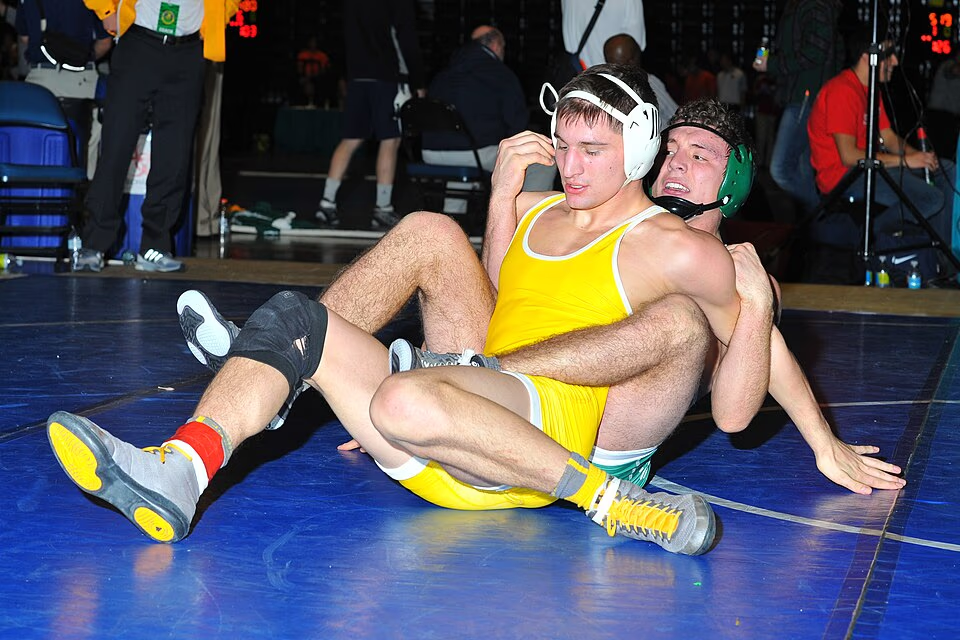
NCAA Women's Wrestling is an NCAA-emerging sport rapidly growing across NCAA Division I, II, and III institutions in the winter semester. As of 2026, NCAA Women's Wrestling has secured emerging-sport status and the National Collegiate Women's Wrestling Championship was established. NCAA Women's Wrestling uses the United World Wrestling (UWW) freestyle baseline (distinct from NCAA Men's Wrestling which uses NCAA-folkstyle rules) with NCAA-specific modifications around weight classes, championship qualifying, weigh-ins, brackets, and weight management. The current edition is the 2025-26 NCAA Women's Wrestling Rules Book. For NCAA Men's Wrestling (folkstyle) see the sibling NCAA Folkstyle Rules entry; for international UWW freestyle see UWW Wrestling Rules.
Section 2: Equipment
- Singlet: NCAA-approved (1- or 2-piece per NCAA rule)
- Wrestling shoes: NCAA-approved with secure ankle support
- Headgear: optional (different from NCAA Men's Wrestling where headgear is required)
- Mouthguard recommended
- NOCSAE-compliant athletic protective gear (knee pads, etc.)
- Hair restrained per NCAA spec (covered if extending below shirt or covering face)
Section 3: Playing Area
- Mat: 12 m × 12 m square mat with 8-9 m circular wrestling area marked in the center
- Protection zone: ≥1.5 m around the wrestling area
- Center circle: 1 m diameter at the center of the wrestling area
- Passivity zone: 1-m wide ring just inside the boundary line
- Mat thickness ≥4 cm; foam compliance per UWW spec
Section 4: Players & Officials
- NCAA W's Wrestling weight classes (10 classes per UWW): 109, 116, 123, 130, 136, 143, 155, 170, 191, 235 lb (NCAA-specific in pounds; UWW uses kg equivalents)
- Each program enters one wrestler per weight class for dual matches
- Officials: 1 referee on the mat + 1 mat chairman + 1 judge (3-official system per UWW)
- Weigh-ins: pre-event at the same scale time per the dual or championship
- Roster: typically 12-25 athletes for NCAA programs (10 starters + reserves)
Section 5: Rules of Play
- Match: 2 periods of 3 minutes with a 30-second break (UWW freestyle format; NCAA aligns)
- Tied at the end of regulation: criteria for winner — most recent technical points scored wins (not overtime)
- Periods are continuous in regulation (no clock stops for stalemates per UWW)
- Match starts neutral with both wrestlers standing
- Out-of-bounds restart: wrestlers return to the center if either steps fully outside the wrestling area
- Scoring techniques: takedowns, exposures, reversals, ippon-style throws, push-outs, gut wrenches, leg laces
Section 6: Scoring
- Takedown: 2 points (4 if a "throw" — high-amplitude lift)
- Exposure (back to mat at less than 90°): 2 points
- Reversal: 2 points
- Push-out: 1 point
- Penalty point: 1 point to opponent for opponent's caution/passivity
- Match win conditions: pin (fall), technical superiority (10+ point lead), regulation win on points, or default
- Pin: opponent's both shoulders held to the mat for ~1 second
Section 7: Violations & Penalties
- Caution: minor infraction (incorrect grip, brief illegal hold) — verbal + opportunity to correct
- Caution + 1 point: passivity, fleeing the mat, brief illegal hold
- Caution + 2 points: continued passivity, more egregious illegal hold
- Caution + 5 points / Disqualification: severe illegal action (e.g., choking, full nelson, slamming, brutality)
- Three cautions accumulated = disqualification (UWW standard)
- Weight-class violation (failure to make weight): forfeit
Section 8: Safety Considerations
Mandatory mat thickness + foam compliance; protection zone ≥1.5 m. NCAA weight management framework: official minimum weight assessment + hydration testing pre-season; weight loss limits enforced. Concussion protocol: removal + graduated return-to-play assessment for any actual or suspected concussion (head impacts from takedowns and slams are primary risks). Required: certified athletic trainer at every meet; team physician + EMT/ambulance + AED at championship-level. Skin disease screening before each match per NCAA + USA Wrestling protocol (impetigo, ringworm, MRSA exclusion).