









Section 1: Introduction
1.1 History and Founding
The International Taekwon-Do Federation (ITF) was founded on March 22, 1966, by General Choi Hong-hi, a South Korean military officer widely regarded as the principal architect of Taekwon-Do as a systematized martial art. General Choi developed the art over decades, drawing on traditional Korean martial heritage and his own military training, ultimately codifying it into a comprehensive system of patterns, techniques, and philosophical tenets. The ITF was initially headquartered in Seoul, South Korea, but relocated to Toronto, Canada, in 1972 after political disagreements with the South Korean government, and later to Vienna, Austria, where Choi spent his final years.
1.2 The ITF and World Taekwondo — Distinct Organizations
It is essential to distinguish the ITF from World Taekwondo (WT, formerly WTF), the organization recognized by the International Olympic Committee. While both govern versions of the same martial art, their competition formats, technical curricula, and philosophical emphases differ substantially. The WT system emphasizes full-contact sparring with electronic scoring and has been an Olympic sport since 2000. The ITF system emphasizes light or semi-contact sparring, traditional patterns (tul), breaking, and special technique competitions, maintaining a closer alignment with Taekwon-Do's origins as a martial art rather than purely a combat sport. The two bodies operate entirely separate competition circuits, ranking systems, and grading syllabi.
1.3 The ITF Factions
Following General Choi's death in 2002, the ITF fractured into multiple successor organizations, each claiming legitimacy. The three principal factions are typically identified by their headquarters locations: the Vienna-based ITF (led initially by Trân Triêu Quân and later successors), the Spain-based ITF (led by Pablo Trajtenberg), and the Canada-based ITF (led by Choi Jung-hwa, son of the founder). Despite organizational divisions, all three factions maintain substantially similar technical curricula based on General Choi's Encyclopedia of Taekwon-Do and follow broadly compatible competition rules. This rulebook reflects the common competition framework shared across ITF factions.
1.4 Competition Disciplines
ITF tournaments feature five distinct competition disciplines: Sparring (Matsogi) — individual and team free sparring; Patterns (Tul) — predetermined sequences of techniques; Power Breaking (Wiryok) — destruction of boards with hand, foot, and head techniques; Special Technique (T'ukgi) — jumping kicks for height and distance; and Pre-Arranged Sparring — choreographed self-defense demonstrations. Major ITF competitions include the World Championships (held biennially), Continental Championships, and various intercontinental and invitational cups.
1.5 The Five Tenets
ITF Taekwon-Do is built upon five guiding tenets that practitioners are expected to embody both in and out of competition: Courtesy (Ye-ui), Integrity (Yom-chi), Perseverance (In-nae), Self-Control (Guk-gi), and Indomitable Spirit (Baekjul-boolgool). These tenets are not merely philosophical aspirations but are actively assessed during grading examinations and can influence conduct expectations during competition. Competitors displaying unsportsmanlike behavior that contradicts these principles may face penalties or disqualification.
Section 2: Equipment
2.1 The Dobok (Uniform)
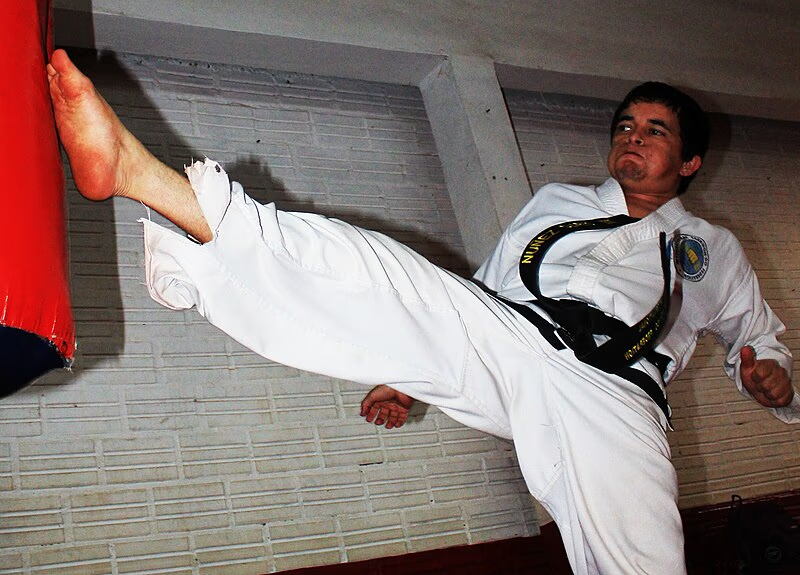
ITF competitors wear a distinctive dobok that differs visually from the WT uniform. The ITF dobok features a cross-over (overlap) front top, secured by a tie on the right side, in contrast to the V-neck pullover top used in WT competitions. The dobok is typically white, symbolizing purity of purpose, and must bear the ITF tree logo on the back and the competitor's national flag on the left chest. Black belt holders (1st Dan and above) may wear a dobok with black trim along the collar, lapels, and trouser stripes, distinguishing them from colored belt practitioners.
2.2 Belt System
The ITF belt ranking system progresses through the following colors: White (10th Gup — signifying innocence), Yellow (8th–9th Gup — the earth from which the plant grows), Green (6th–7th Gup — the growing plant), Blue (4th–5th Gup — the sky toward which the plant reaches), Red (2nd–3rd Gup — danger and proficiency), and Black (1st–9th Dan — maturity and mastery). Stripe belts (e.g., yellow stripe, green stripe) mark intermediate stages between solid colors. The highest attainable rank is 9th Dan Grand Master, reserved for practitioners with decades of service to the art.
2.3 Sparring Protective Equipment
ITF sparring does not use the electronic trunk protector (hogu) or electronic headgear employed in WT competition. Instead, the following protective equipment is mandatory:
- Dipped-foam hand protectors — open-palm gloves with foam padding over the knuckles and back of the hand
- Dipped-foam foot protectors (boots) — foam coverings for the instep and shin, leaving the sole exposed
- Head guard — foam-padded helmet covering the forehead, temples, and crown
- Mouthguard — custom-fitted or boil-and-bite, mandatory for all competitors
- Groin guard (males) — hard-shell cup worn under the dobok
- Chest protector (females) — rigid breast protector worn under the dobok
- Shin guards — mandatory in many tournaments, worn under foot protectors
All protective equipment must be ITF-approved or meet tournament-specific standards. Equipment displaying excessive wear, tears, or inadequate padding will be rejected during pre-competition inspection.
2.4 Breaking Equipment
Power breaking events use standardized wooden boards, typically pine or paulownia, of regulated thickness (approximately 2.5 cm per board for adults). Spacers may be used to separate stacked boards. The breaking stand or holder must be stable and approved by the tournament organizer. Competitors may not use pre-weakened or scored boards.
2.5 Special Technique Equipment
Special technique events require height-adjustable targets — typically small padded boards or breakable targets suspended at measured heights above the ground. For distance events, a horizontal obstacle (such as a vaulting box or rope) is placed at a specified height, and the target is positioned at a measured distance beyond it.
Section 3: Playing Area
3.1 Competition Ring Dimensions
The ITF sparring competition area is a square mat measuring 9 meters × 9 meters, clearly demarcated by boundary lines. This differs from the octagonal competition area used in WT events. The ring must be composed of approved competition mats (typically EVA foam or similar) providing adequate shock absorption and a non-slip surface. The mat surface should be a uniform color, with the boundary lines clearly visible in a contrasting color.
3.2 Safety Zone
A safety zone of at least 2 meters must surround the competition area on all sides, free from any obstacles, equipment, or spectators. The total required floor space is therefore a minimum of 13 meters × 13 meters. The safety zone should be covered with mats of similar quality to the competition area to protect competitors who may step or fall beyond the boundary.
3.3 Competitor Positions
Starting positions for the two competitors are marked at the center of the ring, approximately 1.5 meters apart, facing each other. The competitor designated as "blue" (chong) stands to the referee's right, and the competitor designated as "red" (hong) stands to the referee's left. Colored corner markers or tape indicate the respective corners.
3.4 Officials' Positions
The center referee operates within the competition area. Four corner judges are seated at the four corners of the ring, each equipped with scoring devices (flags, clickers, or electronic input pads depending on the tournament). The jury president and timekeeper sit at a designated table adjacent to the ring, with clear sight lines to the competition area.
3.5 Pattern and Breaking Areas
Pattern competitions require a flat, unobstructed area of at least 10 meters × 10 meters, covered with appropriate matting. Breaking and special technique events require additional clearance for run-up space (minimum 5 meters) and overhead clearance of at least 4 meters for jumping techniques. The breaking station must be positioned to allow judges an unobstructed view from multiple angles.
Section 4: Players & Officials
4.1 Competitor Eligibility
Competitors must hold a valid ITF rank (or equivalent recognized rank) appropriate to the division entered. Most ITF tournaments require a minimum rank of yellow belt (8th Gup) for colored belt divisions and 1st Dan for black belt divisions. Competitors must present a valid ITF identification card or equivalent federation membership documentation during registration. Age divisions typically include: Juniors (under 18), Seniors (18–35), and Veterans (35+), though specific age brackets vary by tournament.
4.2 Weight Categories (Sparring)
ITF sparring features multiple weight categories, typically including the following for senior male black belt divisions: Fin weight (under 54 kg), Fly weight (54–58 kg), Bantam weight (58–63 kg), Feather weight (63–68 kg), Light weight (68–73 kg), Welter weight (73–78 kg), Light Middle weight (78–84 kg), Middle weight (84–90 kg), and Heavy weight (over 90 kg). Female categories follow similar divisions with adjusted weight limits. Competitors must weigh in during the official weigh-in period and may not compete if they fail to make weight.
4.3 Center Referee
The center referee controls the match from within the competition area. Responsibilities include starting and stopping the bout, issuing warnings and penalties, ensuring competitor safety, and declaring the winner. The referee must hold an ITF-recognized referee certification. The referee uses standardized Korean commands: Junbi (ready), Sijak (begin), Goman (stop), Gyesok (continue), and Keuman (end).
4.4 Corner Judges
Four corner judges are positioned at the corners of the competition ring. Each judge independently awards points by raising colored flags (blue for chong, red for hong) or pressing electronic scoring devices. A point is awarded when a majority of judges (at least 3 of 4) recognize a valid scoring technique within approximately one second of each other. This majority-consensus system is a hallmark of ITF scoring, contrasting with the sensor-based automatic scoring of WT competitions.
4.5 Jury and Technical Officials
A jury president oversees the officiating panel and may intervene to correct procedural errors. The jury does not directly award points but may instruct the referee to review a decision. Additional technical officials include the timekeeper (managing round and rest period timing), recorder (maintaining the official scorecard), and medical officer (assessing competitor fitness and managing injuries).
4.6 Coaches and Seconds
Each competitor is permitted one coach seated in the designated coaching zone near their corner. Coaches may provide verbal instruction between rounds and during rest periods but must not enter the competition area during active play. Excessive coaching interference, verbal abuse of officials, or unsportsmanlike conduct by coaches may result in the competitor receiving a warning or penalty.
Section 5: Rules of Play
5.1 Sparring (Matsogi) — Match Format
Individual free sparring matches for senior competitors consist of 2 rounds of 2 minutes each, separated by a 1-minute rest period. Some tournament formats use 3 rounds. Junior divisions may use shorter rounds (1.5 minutes). Team sparring follows the same round structure, with each team fielding 5 competitors in pre-determined order, matched by weight. The team result is determined by the aggregate of individual match outcomes.
5.2 Light/Semi-Contact Principle
The defining characteristic of ITF sparring is its light or semi-contact approach. Techniques must be delivered with controlled power — sufficient to demonstrate technical proficiency and targeting accuracy, but without excessive force intended to injure. This stands in sharp contrast to WT sparring, which is full-contact and awards points based on impact force measured by electronic sensors. In ITF competition, a well-executed, accurately placed technique with controlled contact scores; a wild, excessively powerful blow may result in a warning or penalty even if it lands on target.
5.3 Legal Techniques and Target Areas
ITF sparring permits a wider range of hand techniques than WT competition. The following are legal scoring techniques:
- Hand techniques (jirugi) — punches and strikes to the mid-section (trunk) and head. This is a major distinction from WT, which only permits punches to the trunk protector, not the head.
- Foot techniques (chagi) — kicks to the mid-section and head, including turning kicks, side kicks, front kicks, back kicks, hook kicks, and spinning techniques.
Legal target areas encompass the front and side of the trunk (from the belt line to the base of the neck) and the front and side of the head (above the jaw line). Attacks to the back of the head, spine, throat, and below the belt are strictly prohibited.
5.4 Patterns (Tul) Competition
Pattern competition showcases the 24 patterns of the Chang-Hon system, developed by General Choi. The patterns range from Chon-Ji (19 movements, representing the creation of the world) through to Tong-Il (56 movements, representing the reunification of Korea). Competitors perform patterns individually before a panel of judges who evaluate: technical accuracy, power, rhythm, balance, breath control, and the correct interpretation of each movement's application. In elimination rounds, the tournament may specify required patterns or allow competitor choice within rank-appropriate sets.
5.5 Power Breaking (Wiryok) Competition
Power breaking tests a competitor's ability to generate destructive force through correct technique. Events are typically divided by technique category: hand techniques (punch, knife-hand, elbow strike), foot techniques (side kick, turning kick, back kick), and sometimes head technique (head butt through boards). Competitors attempt to break the maximum number of boards in a single attempt. Boards are standardized in size and thickness, and the number successfully broken determines the winner. Ties are broken by body weight (lighter competitor wins) or additional attempts.
5.6 Special Technique (T'ukgi) Competition
Special technique events test jumping ability and aerial kicking skill. Common events include: flying side kick (kick a target at maximum height), flying front kick (kick a target over a high obstacle), flying turning kick (kick a target at height with a mid-air turn), and flying back kick. Competitors have a limited number of attempts (typically 3) to successfully strike the target at each height. The target is progressively raised until a winner is determined. Run-up distance is standardized and may not exceed a specified maximum.
5.7 Boundary and Ring-Out Rules
A competitor is considered out of bounds when any part of their body touches beyond the boundary line. Intentionally stepping out to avoid engagement results in a warning. If a competitor is forced out by a legal technique, the action is stopped and restarted from the center. Repeatedly retreating beyond the boundary without engagement may result in a penalty for passivity.
Section 6: Scoring
6.1 Point Values (Sparring)
ITF sparring uses a tiered point system that rewards technical difficulty and accuracy:
- 1 point — Hand technique (punch/strike) to the mid-section
- 1 point — Foot technique (kick) to the mid-section
- 2 points — Foot technique (kick) to the head
- 2 points — Jumping foot technique to the mid-section
- 3 points — Jumping foot technique to the head
Note that hand techniques to the head, while legal as a target, typically score 1 point (some tournament rules award 2 points for a clean hand technique to the head). The emphasis on foot techniques to the head and jumping techniques reflects ITF Taekwon-Do's technical heritage.
6.2 Scoring Mechanism
Points are awarded by human judges using flags or clickers, not by electronic impact sensors. When a corner judge observes a valid scoring technique, they raise the appropriate colored flag or press their scoring device. A point is registered when a majority of corner judges (3 or more out of 4) acknowledge the technique within approximately the same moment. This consensus system prioritizes technique quality over raw power, as judges assess whether the technique was accurate, controlled, and properly executed.
6.3 Criteria for a Valid Scoring Technique
For a technique to score, it must meet all of the following criteria:
- Delivered to a legal target area (front/side of trunk or head)
- Executed with correct form (proper chamber, extension, and tool)
- Applied with controlled contact (sufficient to demonstrate accuracy, not excessive)
- Delivered with the appropriate attacking tool (forefist for punches, instep/ball of foot/heel for kicks)
- Competitor must be in a balanced and controlled position during delivery
6.4 Determining the Winner (Sparring)
The competitor with the higher point total at the conclusion of all rounds wins the match. In the event of a tie, the following tiebreakers apply in order: (1) the competitor with fewer warnings and penalties; (2) the competitor who scored more higher-value techniques (e.g., head kicks over body punches); (3) a sudden-death overtime round (typically 1 minute, first to score wins); (4) referee and judges' decision based on overall technical superiority, aggressiveness, and ring generalship.
6.5 Pattern Scoring
Patterns are scored by a panel of judges (typically 5 or 7) on a scale that evaluates: technical accuracy (correct stances, techniques, angles, and targets), power (appropriate tension and force in techniques), rhythm and timing (proper tempo changes between fast and slow movements), balance and stability (controlled transitions and positions), and spirit and focus (demonstrated concentration and martial intent). The highest and lowest scores are typically dropped, and the remaining scores are summed. Deductions are made for errors such as incorrect technique, loss of balance, wrong direction, or omitted movements.
6.6 Breaking and Special Technique Scoring
Breaking competitions are scored objectively: the competitor who breaks the most boards with each technique wins that event. In special technique events, the competitor who successfully strikes the target at the greatest height wins. In both disciplines, ties are broken by body weight (lighter competitor wins), reflecting the principle that generating equivalent power or height at a lower body weight represents greater technical achievement.
Section 7: Violations & Penalties
7.1 Warning (Kyong-go) Offenses
The following actions result in a verbal warning. Two warnings in the same category result in a penalty point deduction:
- Attacking a fallen opponent
- Intentionally stepping out of the ring to avoid combat
- Grabbing, holding, or pushing the opponent
- Turning the back to the opponent to avoid engagement
- Feigning injury to gain an advantage
- Excessive stalling or time-wasting
- Coaching from a competitor's second during active rounds
- Knee attacks or deliberately using the knee as a striking weapon
- Attacking below the belt line
7.2 Penalty (Gam-jeom) Offenses
The following serious violations result in an immediate penalty point deduction (1 point awarded to the opponent):
- Excessive contact — delivering techniques with force beyond controlled contact, particularly to the head. This is the most common penalty and reflects ITF's emphasis on control.
- Attacking the back of the head, spine, or throat
- Throwing or sweeping the opponent to the ground
- Headbutting (outside designated breaking events)
- Attacking after the referee's stop command (goman)
- Repeated or deliberate violations after warnings
- Verbal abuse, intimidation, or disrespectful conduct toward officials or opponents
7.3 Disqualification (Sil-gyeok)
A competitor is disqualified from the match or tournament for:
- Accumulating a specified number of penalty deductions (typically 3 full penalties, equating to -3 points)
- Intentionally injuring an opponent through excessive or reckless contact
- Refusing to comply with the referee's instructions
- Competing under false identity, rank, or weight class
- Testing positive for prohibited substances under anti-doping regulations
- Any conduct that brings the sport or the ITF into disrepute
7.4 Protests and Appeals
A coach may lodge a formal protest with the jury president if they believe a procedural error or incorrect decision has occurred. Protests must be filed immediately (typically within 1 minute of the disputed decision) and may require a protest fee. The jury reviews the protest, may consult video replay where available, and issues a final ruling. Points awarded by the consensus scoring system are generally not subject to protest, as they reflect the collective judgment of the corner judges.
Section 8: Safety Considerations
8.1 Medical Personnel and Facilities
A qualified medical officer (physician, paramedic, or certified sports medic) must be present throughout all competition sessions. A designated first aid station with appropriate emergency equipment — including ice, bandages, cervical spine immobilization equipment, and automated external defibrillator (AED) — must be accessible adjacent to the competition area. An ambulance or rapid transport to a hospital should be available for serious injuries.
8.2 Contact Control and Injury Prevention
The light/semi-contact nature of ITF sparring is itself the primary safety mechanism. The center referee is empowered and expected to stop the match immediately if a competitor loses control and delivers excessive-force techniques. Repeated excessive contact results in escalating penalties up to disqualification. This controlled-contact philosophy distinguishes ITF competition from full-contact formats and results in statistically lower rates of concussion and serious injury compared to full-contact combat sports.
8.3 Mandatory Equipment Inspection
All protective equipment must pass inspection prior to competition. Inspectors verify that hand and foot protectors have adequate foam density and coverage, head guards are properly fitted and undamaged, mouthguards are present and functional, and groin/chest protectors are worn correctly. Equipment that fails inspection must be replaced before the competitor may participate. Competitors arriving without required equipment are not permitted to compete.
8.4 Injury Protocol
When a competitor is injured during a match, the referee stops the bout and allows the medical officer to assess the competitor on the mat. The competitor is given a recovery period (typically 1 minute for minor injuries, up to 5 minutes for more serious cases) to determine if they can continue. If a competitor cannot continue due to an injury caused by a legal technique, they lose the match. If the injury was caused by an illegal technique, the offending competitor may be penalized or disqualified, and the injured competitor may win by referee's decision.
8.5 Concussion Management
Despite ITF's controlled-contact approach, head contact does occur. Any competitor suspected of sustaining a concussion — exhibiting symptoms such as disorientation, balance impairment, loss of consciousness, or amnesia — must be immediately removed from competition and assessed by the medical officer. A competitor diagnosed with or suspected of concussion may not return to competition on the same day and must obtain written medical clearance before competing in future events. Tournament organizers are encouraged to adopt the most current concussion recognition and management protocols from sports medicine authorities.
8.6 Age-Appropriate Modifications
Junior and children's divisions enforce stricter contact limitations. In many ITF tournaments, competitors under 14 or 16 are restricted to no head contact or touch contact only to the head. Younger divisions may also use shorter rounds, prohibit spinning techniques, or require additional protective equipment. Tournament organizers must clearly communicate all age-specific rule modifications before the event.
8.7 Breaking and Special Technique Safety
Breaking events carry inherent risk of hand and foot injuries. Competitors must demonstrate proper technique during warm-up, and officials may disallow a breaking attempt if the competitor's technique appears likely to result in injury. Boards must be of standardized, consistent quality — green or knotty wood is prohibited as it may cause unpredictable splinters. Special technique events require spotters near the jumping area, adequate landing mats, and sufficient overhead clearance. Competitors who lose balance during aerial techniques must be able to land safely within the matted area.
8.8 Venue Requirements
Competition venues must provide adequate lighting (minimum 500 lux over the competition area), ventilation or climate control to prevent heat-related illness, and clearly marked emergency exits. The competition floor surface must be level, clean, and free of moisture. Multiple competition rings must be separated by sufficient safety zones to prevent interference between simultaneous matches. Spectator areas must be physically separated from competition zones.