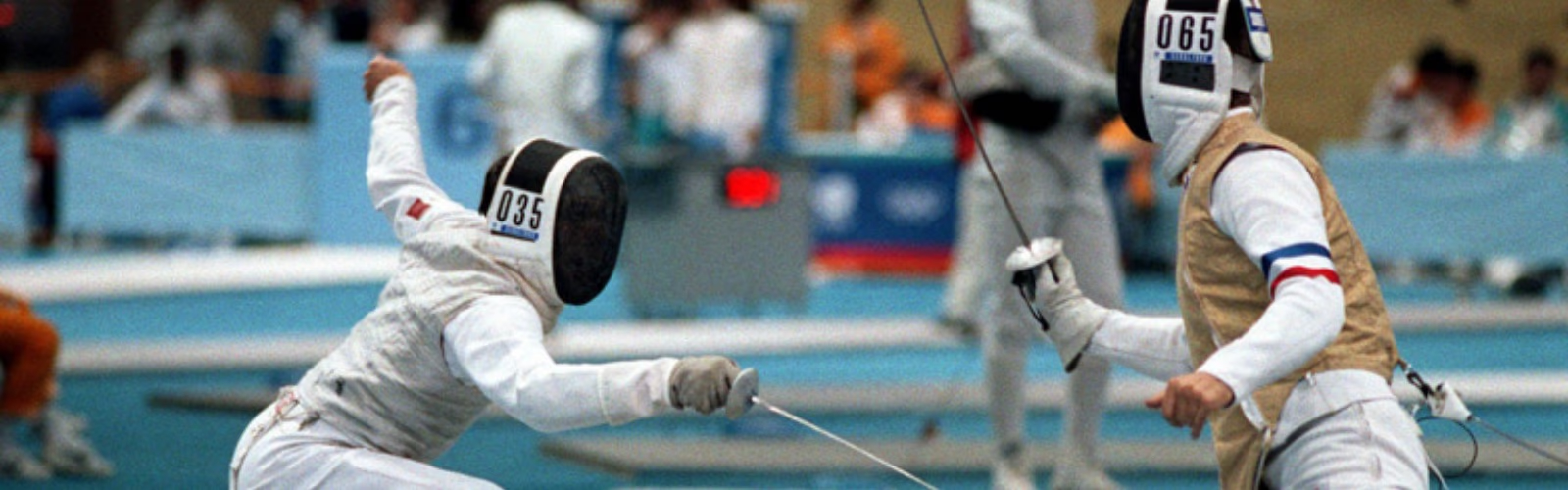
















Section 1: Introduction
1.1 Overview and Governing Body
Fencing is one of only five sports contested at every modern Olympic Games since their inception in Athens 1896. The Fédération Internationale d'Escrime (FIE), founded in Paris on November 29, 1913, serves as the global governing body. The FIE administers the sport under its Rules for Competitions, published as three books — Technical Rules, Organisation Rules, and Material Rules — which codify regulations for all three weapons, competition formats, officiating standards, and equipment specifications.
1.2 The Three Weapons
Modern fencing comprises three distinct disciplines, each with its own weapon, valid target area, and tactical philosophy:
- Foil: A thrusting weapon descended from the practice weapon of the 18th-century small sword. Valid target is the torso only (Technical Rules t.77). Governed by right of way (priority) conventions that reward initiating attacks.
- Épée: A thrusting weapon derived from the dueling sword. The entire body is valid target (Technical Rules t.91). No priority rules apply — both fencers may score simultaneously, making it the most realistic simulation of classical dueling.
- Sabre: A cutting and thrusting weapon evolved from the cavalry sword. Valid target includes everything above the waist (torso, arms, head, and mask) (Technical Rules t.97). Right of way applies, and the allowance of cuts produces the fastest, most explosive actions of the three weapons.
1.3 Olympic and Competitive Structure
The Olympic programme features 12 fencing events: individual and team competitions in each of the three weapons for both men and women. Beyond the Olympics, the FIE calendar includes the Senior World Championships, Junior and Cadet World Championships, Grand Prix series, World Cup circuit, and Zonal Championships. National federations from over 150 countries are affiliated with the FIE.
1.4 History of Electronic Scoring
Electronic scoring apparatus was introduced to eliminate judging subjectivity. Épée adopted electrical judging first in 1936, foil followed in 1956, and sabre became the last weapon to convert in 1988. The apparatus uses electrical circuits completed through the weapon and body cord to detect valid touches, with colored indicator lights replacing the human side judges of earlier eras.
Section 2: Equipment
2.1 Weapons
Each weapon has precise FIE specifications governing weight, length, blade profile, and electrical components (Material Rules m.1–m.24):
- Foil: Maximum total weight 500 g (Material Rules m.6). Maximum overall length 110 cm (m.7). Flexible rectangular-section blade, maximum blade length 90 cm (m.8.4). The blade terminates in a spring-loaded button (pointe d'arrêt) requiring more than 500 g of depression force, with a tolerance of ±2 g, to register a touch (m.11.3). The bell guard must pass through a cylindrical gauge of 9.5–12 cm diameter (m.9).
- Épée: Maximum total weight 770 g (m.14). Maximum overall length 110 cm (m.15). Stiffer triangular-section blade, maximum blade length 90 cm, maximum width 24 mm per side (m.16.3–4). The spring-loaded pointe d'arrêt requires more than 750 g of depression force, with a tolerance of ±3 g, to register a touch (m.19.2) — heavier than foil to reduce accidental registrations. The bell guard must pass through a cylindrical gauge of 13.5 cm diameter (m.17.1), larger than foil's to protect the weapon hand, which is a valid target.
- Sabre: Maximum total weight 500 g (m.22). Maximum overall length 105 cm (m.21). Approximately rectangular blade, maximum length 88 cm, that can score with the entire cutting edge, the flat, and the point (m.23). The guard must pass through a rectangular gauge measuring 15 cm by 14 cm (m.24.2). No spring-loaded tip — any contact with the blade registers.
2.2 Mask
The mask is the most critical piece of safety equipment. FIE-homologated masks must meet the manufacturing and safety standards set out in Annexe A to the Material Rules. For foil, the mask bib is non-conductive (bib is off-target, except for the small conductive strip beneath the chin per Technical Rules t.77.1). For sabre, the entire mask including the metallic mesh and conductive bib forms part of the valid target area and is wired into the scoring circuit. Épée masks have a non-conductive bib since the head is valid target regardless. All masks must display the FIE homologation mark for international competition (Technical Rules t.64.1).
2.3 Protective Clothing
- Jacket: Must cover the torso and arms to the wrists and conform to the resistance-against-perforation standards of Annexe A to the Material Rules (Section 3).
- Plastron (Underarm Protector): A mandatory protective under-plastron worn beneath the fencing jacket on the weapon-arm side, made of cloth able to resist 800 Newtons (Technical Rules t.64.5).
- Breeches (Knickers): Knee-length trousers fastened below the knee. Must also meet the Annexe A penetration-resistance standard.
- Chest Protector: A rigid or semi-rigid plastic protector worn under the plastron.
- Glove: Padded glove on the weapon hand. In sabre, the glove cuff must be conductive and connected to the lamé to form part of the valid target area.
- Long Socks and Fencing Shoes: Socks must cover the leg up to the bottom of the breeches. Fencing shoes have reinforced soles and lateral support for lunging.
At the start of every pool, team match, or direct-elimination bout, the referee must assemble both competitors and verify that the FIE guarantee label is present on all clothing and masks, that the conductive jacket conforms to the relevant article for the weapon, and that each fencer is wearing a regulation protective under-plastron (Technical Rules t.64).
2.4 Lamé (Conductive Over-Vest)
Foil and sabre require a conductive lamé worn over the jacket to define the valid target area electronically:
- Foil lamé: Covers the torso (front, sides, and back) and the groin flap, matching the valid target defined in Technical Rules t.77. When the foil tip depresses against the lamé, it completes a circuit that illuminates the colored (on-target) light on the scoring box.
- Sabre lamé: Covers everything above the waist — torso and both arms — and connects to the conductive mask and glove cuff, matching the target defined in Technical Rules t.97. Any blade contact with this conductive surface registers an on-target touch.
- Épée: No lamé is worn. The entire body is valid, and the épée tip registers against any grounded surface (the opponent's clothing or body).
2.5 Electrical Apparatus
- Body Cord: A wire running from the weapon, through the fencer's sleeve and jacket, connecting to a spring-loaded reel at the end of the piste.
- Scoring Reel: A spring-loaded cable reel at each end of the piste that maintains electrical connection while allowing free movement.
- Scoring Box (Apparatus): The central electronic unit that detects circuit completion and displays touches via colored lights. On-target touches illuminate a colored light (red or green, one per fencer). In foil, off-target touches illuminate a white light. Each weapon's apparatus applies its own registration window, set out in Annexe B to the Material Rules: at foil, once a hit is signalled the apparatus locks that side and, after 300 ms (±25 ms tolerance), stops registering further signals on it — during that window the opposing side's hit can still register (Annexe B, Foil, Principles, para. 6); at épée, hits arriving less than 40 ms apart register as a double touch, hits more than 50 ms apart register only the first, and the apparatus is calibrated with tolerance between those two limits (Annexe B, Épée, Timing); at sabre, once a hit is registered, a subsequent hit from the other fencer registers only if it arrives within a maximum of 170 ms (±10 ms) (Annexe B, Sabre, Principles, para. 8).
- Wireless Scoring: FIE-approved wireless systems may replace body cords and reels at international competitions. These systems must meet the same timing and sensitivity specifications set out in Annexe B to the Material Rules as wired apparatus.
Section 3: Playing Area
3.1 Piste Dimensions
All bouts take place on a regulation fencing strip known as the piste (Technical Rules t.16–19):
- Length: 14 m, with a total tolerance of 4 cm (t.18.2)
- Width: The combat area is 1.50 m wide (t.18.1)
- Run-back zone: Each competitor, placed 2 m from the centre line, has 5 m of retreating distance available before crossing the rear limit (t.18.2)
3.2 Piste Markings
Five lines must be drawn clearly across the piste at right angles to its length (Technical Rules t.19):
- Center line: Divides the piste into two equal halves, drawn as a broken line (t.19.1)
- En-garde lines: Two lines located 2 m from the center line on each side (t.19.2). Fencers begin each engagement standing behind their respective en-garde line.
- Rear limit lines: Two lines at the rear limits of the piste, 7 m from the centre line (t.19.3). Crossing this line with both feet results in a touch awarded to the opponent.
- Last 2 metres: The final 2 m of the piste before the rear limit lines must be clearly distinguished, if possible by a different colour, so fencers can judge their position (t.19.4).
3.3 Surface and Grounding
For foil and épée, the conductive surface must cover the whole of the length and breadth of the piste, including its run-back extension (Technical Rules t.18, Material Rules m.57). This prevents touches to the floor from registering on the scoring apparatus. The piste must be flat and give neither advantage nor disadvantage to either fencer, especially regarding light (t.16). It is typically elevated on a raised platform (maximum height 50 cm) at major competitions to improve visibility for spectators and cameras.
3.4 Lateral Boundaries
If a fencer steps off the side of the piste with one or both feet, the referee calls “Halt.” A fencer who has crossed the lateral boundaries of the piste must be placed on guard at the correct distance even if this means being placed behind the rear line and thus causes a technical hit to be awarded against them (Technical Rules t.22.10, t.35.1, t.148).
Section 4: Players & Officials
4.1 Competitors
Fencing competitions feature both individual and team events. In individual events, a single fencer competes against opponents through pool rounds and direct elimination brackets. In team events, each team consists of three fencers (plus one reserve), who fence in a relay format against the opposing team's members.
4.2 The Referee
The referee is the sole authority on the piste (Technical Rules t.46–47). Their responsibilities include:
- Calling fencers to order using the standard signals: On guard, Ready?, Play, Halt (Technical Rules t.23, illustrated in Figure 3 of the Rules)
- Analyzing the phrase to determine which fencer has right of way and therefore earns the touch (t.59, t.82ss, t.100)
- Awarding touches based on indicator lights and priority analysis
- Administering penalty cards (yellow, red, black) (t.144–157)
- Ensuring proper equipment function and safety throughout the bout (t.64–75)
- Managing the bout clock and score
4.3 Additional Officials
- Video Referee: At FIE-level competitions, a video referee reviews disputed calls. In individual events, a fencer has one possible appeal per bout in pools and two possible appeals in direct elimination bouts; if the referee agrees with the appeal, the fencer retains the right of appeal (Technical Rules t.61).
- Directoire Technique (DT): A panel of officials who oversee the overall organization of the competition, assign referees to pistes, and handle protests (Technical Rules t.137–138).
- SEMI Commission (Electrical Equipment): Technicians who verify and test all electrical scoring equipment, weapons, and body cords before and during competition, and who administer the FIE homologation process for fencing material (Annexe A to the Material Rules).
- Video Consultants: Assigned alongside referees to conduct video review at each stage of the competition (Technical Rules t.48–t.49).
4.4 Judges
Before the adoption of electronic scoring, side judges observed whether touches landed on valid or invalid target. Judges may still be called upon by the referee to assist in establishing the materiality of a hit (Technical Rules t.48, t.54.1), and two neutral judges may be designated by the Directoire Technique specifically to watch for illegal use of the non-sword arm or hand (t.30).
Section 5: Rules of Play
5.1 Bout Formats
Fencing competitions use two primary bout formats:
- Pool Bouts: In the preliminary round, fencers are divided into pools of 5–8 competitors. Each fencer meets every other fencer in the pool once. Pool bouts are fenced to 5 touches with a maximum time of 3 minutes of effective fencing time (clock stops when the referee calls “Halt”, per Technical Rules t.23). If time expires before either fencer reaches 5 touches, the fencer with the higher score wins.
- Direct Elimination (DE) Bouts: Following pool seeding, fencers compete in a single-elimination bracket. DE bouts are fenced to 15 touches over three periods of 3 minutes each, with a 1-minute rest between periods. At the start of each period, and of any additional minute of fencing time, fencers are placed on guard in the middle of the piste (t.22.8).
5.2 Right of Way (Priority) — Foil and Sabre
Right of way is the foundational convention that distinguishes foil and sabre from épée. When both lights illuminate simultaneously, the referee must determine which fencer had priority by applying the conventions of fencing (Technical Rules t.82ss for foil, t.100ss for sabre):
- The Attack: An attack is the initial offensive action made by extending the arm and continuously threatening the opponent's target, preceding the launching of the lunge or flèche (t.9.1, t.83, t.101). The attacker holds priority until the attack is completed, parried, or falls short.
- The Parry and Riposte: A defender who deflects the incoming blade with their own blade (parry) immediately gains priority for the return attack (riposte). The riposte must be executed without delay, without hesitation or pause, to maintain priority (t.86, t.105).
- Counter-Attack: A touch made against an opponent who has already initiated their attack (t.12). In compound attacks, the opponent has the right to stop-hit, but to be valid the stop hit must arrive before the attacker has begun the final movement of the attack — that is, it must precede the conclusion of the attack by one period of fencing time (t.88 for foil, t.103.2 for sabre).
- Simultaneous Actions: When both fencers initiate attacks at the same moment with no identifiable priority, the hits exchanged are annulled for both fencers (t.89.2, t.106.1).
- Point in Line: A fencer who extends the weapon arm and continually threatens the opponent's valid target has established a “point in line” (t.15). The attacker must first deflect the point in line before attacking; a mere contact of the blades is not sufficient to deflect it (t.84.1, t.102.1).
5.3 Épée: No Priority
Épée has no right of way rules (Technical Rules t.90–92). When both competitors are hit and the apparatus registers both hits as valid, there is a double touch — a hit scored against each competitor (t.92). Per Annexe B to the Material Rules, the apparatus registers a double touch when the two hits arrive less than 40 ms apart, and registers only the first hit when the interval exceeds 50 ms.
5.4 Team Relay Format
Team bouts consist of 9 individual relay bouts between the three members of each team. Each relay bout has a cumulative target score, in increments of 5 touches, up to Bout 9 fenced to 45 touches. The team reaching 45 first wins. The reserve fencer may substitute for any teammate once during the match, but the substituted fencer may not return.
5.5 Terrain and Movement
Fencers may advance, retreat, lunge, and flèche (a running attack) at foil and épée; the flèche and any forward movement in which the rear foot completely passes the front foot is forbidden at sabre and penalised as an offence of the 1st group (Technical Rules t.101.5). Corps à corps (body contact) is forbidden at all three weapons: it is an offence for a fencer to intentionally cause corps à corps to avoid being hit or to jostle the opponent (t.25.2), while a corps à corps brought about by a flèche attack or vigorous advance, without brutality or violence, commits no fault (t.25.3).
Section 6: Scoring
6.1 Touch Validity
Each valid touch scores 1 point. The electronic apparatus determines the materiality of a touch, while the referee determines (in foil and sabre) whether the touch should be awarded based on priority analysis (Technical Rules t.53–59):
- Foil: A colored light (red or green) indicates an on-target touch against the lamé. A white light indicates an off-target touch (Technical Rules t.78). Off-target touches in foil halt the action but do not score.
- Épée: Only colored lights (red/green) are used. Any touch on any surface scores, as the entire body is valid. There is no off-target indication. Per Annexe B to the Material Rules (Épée, Timing), the apparatus registers a double touch when both hits arrive less than 40 ms apart and registers only the first hit when the interval exceeds 50 ms, with the apparatus calibrated to a tolerance between those two limits.
- Sabre: A colored light indicates an on-target touch anywhere on the conductive lamé, mask, or glove cuff (Technical Rules t.97). Hits arriving on a non-valid part of the target are not registered by the apparatus and do not stop the fencing phrase (t.98). Once a hit is registered, the apparatus will register a second hit from the other fencer only if it arrives within a maximum of 170 ms, with a tolerance of ±10 ms (Annexe B to the Material Rules, Sabre, Principles, para. 8).
6.2 Individual Bout Scoring
- Pool bouts: First to 5 touches or highest score after 3 minutes (Technical Rules t.50ss).
- DE bouts: First to 15 touches or highest score after three 3-minute periods.
6.3 Team Bout Scoring
Team relay bouts accumulate to a maximum of 45 touches across 9 relay bouts. Individual relay results carry over — if Team A leads 23–20 after bout 5, bout 6 begins at that score and is fenced to a target of 30.
6.4 Video Refereeing
The referee, together with the video-referee, may review an action a maximum of four times, in real time or slow motion, at any speed (Technical Rules t.62.1). Review may occur at the referee's initiative, at the request of the athlete, in case of a tied score before the decisive hit, or at the video-referee's request (t.62.5). If the fencers' scores are equal at the end of the match, the referee must use video-refereeing for the decisive hit before giving a decision (t.62.3). Once the decision is given, it is final and no further review of the same action can be requested (t.62.5).
Section 7: Violations & Penalties
7.1 Penalty Card System
The FIE uses a structured card system to penalize infractions (Technical Rules t.144–170). Cards accumulate within a single bout and carry over across bouts in a team match:
- Yellow Card: A formal warning with no immediate scoring consequence.
- Red Card: A penalty touch is awarded to the opponent. Red cards are issued for repeat 1st-group offenses or immediately for 2nd-group offenses.
- Black Card: Immediate expulsion from the competition. Black cards are reserved for the most serious infractions (3rd and 4th groups).
7.2 Offense Groups
- 1st Group: Covering valid target with the non-weapon hand or arm (Technical Rules t.29.1); turning one's back to the opponent during a phrase (t.27.2); causing corps à corps intentionally or jostling the opponent (t.25.2); crossing the lateral boundaries of the piste (t.35); appearing with non-regulation equipment (t.71).
- 2nd Group: Substituting a non-valid part of the target for a valid part (t.29.2); making contact with electrical equipment using the non-sword hand (t.29.3); intentionally causing the apparatus to register a hit on a surface other than the opponent (t.55.2); intentionally dropping the weapon during the fencing phrase (t.56.11).
- 3rd Group: Disturbing order on the piste, including by spectators (t.109, t.133); insulting or threatening an official (t.109); smoking in competition halls (t.110); appearing with equipment that is fraudulent or bears imitated or transferred homologation marks (t.73.1.c/d).
- 4th Group: Appearing with equipment willfully altered to defeat a preliminary check, equipped to allow recording of hits or non-functioning of the apparatus at will, or fitted with electronic communication equipment permitting a person off the piste to communicate with the fencer (t.73.1.e/f/g, t.169).
7.3 Corps à Corps and Flèche Attacks
The Referee must stop the bout whenever corps à corps occurs (Technical Rules t.25.1). A flèche ending systematically in a corps à corps must not be confused with a flèche resulting in a shock which jostles the opponent, which is treated as intentional brutality and punished as a 2nd-group offence (t.26.1). A flèche made by running, even going past the opponent, without a corps à corps, is not forbidden (t.26.2).
7.4 Video Replay Appeals
At FIE-level competitions, each fencer may request video review. In individual pool bouts, a fencer has one possible appeal per bout; in direct elimination bouts, two possible appeals (Technical Rules t.61.1). If the referee agrees with the appeal, the fencer retains the right of appeal. In team events, fencers have one possible right of appeal per relay (t.61.2).
Section 8: Safety Considerations
8.1 Equipment Safety Standards
All equipment used in FIE-sanctioned competition must bear the FIE homologation mark, obtained through the certification process set out in Annexe A to the Material Rules:
- Manufacturing Standards: Blades must be made of maraging steel (Material Rules m.2.1) and comply with the mechanical and chemical composition standards in Annexe A, Section 1.
- Blade Testing: Blades undergo flexibility and curvature testing. Foil blades must bend between 5.5 and 9.5 cm under a 200 g test weight (m.8.5); épée blades between 4.5 and 7 cm (m.16.5); sabre blades between 4 and 7 cm (m.23.4). Any curve of the blade must be less than 1 cm for foil and épée, and less than 4 cm for sabre.
- Fencers' Responsibility: Fencers arm, equip, and clothe themselves and fence at their own responsibility and at their own risk. The safety measures specified in the Rules are designed to reinforce fencers' safety but cannot guarantee it (Technical Rules t.20).
8.2 Broken Blade Protocol
When a competitor against whom a hit has been registered has broken their blade, the hit must be annulled unless the break occurred clearly after the hit was registered (Technical Rules t.56.7). If a fencer's electric weapon breaks during a bout, the referee immediately calls “Halt.” A hit made during or after a fall must also be annulled (t.56.10).
8.3 Injuries and Withdrawal
The Technical Rules address injuries and withdrawal of a competitor (t.37–44), including the conditions under which the bout may be stopped and restarted, and the circumstances requiring a competitor's withdrawal from the event.
8.4 Non-Regulation Equipment
Whenever a fencer on the piste is found in possession of equipment that is non-regulation or defective, the referee confiscates the equipment and submits it to the experts on duty for examination (Technical Rules t.70). The equipment is returned only after any necessary measures are completed and, if appropriate, after payment of repair expenses, and it must be rechecked before use again.
8.5 Equipment Inspection
Before each bout, the referee conducts an inspection of both fencers' equipment (Technical Rules t.64–69), including:
- Presence of the FIE guarantee label on clothing, masks, and weapons
- Conductive jacket conformity for the relevant weapon (foil: m.28; sabre: m.34)
- Insulation of the wires inside the guard and the pressure of the spring in the point of foils and épées (t.68.1)
- Absence of any electronic communication equipment that would allow a person off the piste to communicate with the fencer (t.64.6)
At major competitions, the SEMI Commission conducts thorough pre-competition equipment checks under the homologation process described in Annexe A to the Material Rules.
8.6 Order and Discipline
All persons taking part in or attending a fencing competition, including spectators, must observe strictly and faithfully the Rules and Statutes of the FIE, and the traditional customs of courtesy and integrity (Technical Rules t.107–109). Anyone who threatens or insults an official commits an offence of the 3rd group and is penalised accordingly (t.109).