













Section 1: Introduction
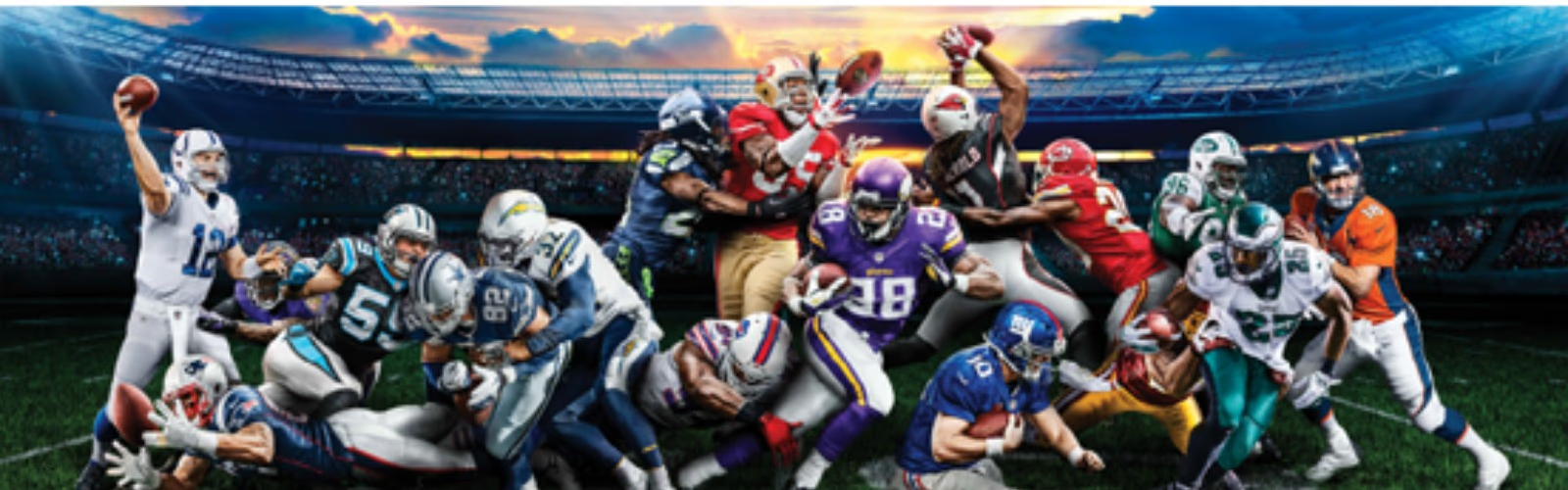
The National Football League (NFL) is the premier professional American football league in the world, consisting of 32 teams divided equally between the American Football Conference (AFC) and the National Football Conference (NFC). Founded in 1920 as the American Professional Football Association, the NFL has grown into the most-watched sports league in the United States.
The NFL rules are maintained and updated annually by the NFL Competition Committee, with rule changes voted on by team owners at the annual league meeting. The rules govern all aspects of regular season, playoff, and Super Bowl competition. The 2025 season introduced several significant rule changes including the permanent adoption of the dynamic kickoff, expanded replay review for safety-related penalties, and continued refinement of player safety protections.
Each team plays a 17-game regular season schedule across 18 weeks (each team receives one bye week). The season culminates in the NFL Playoffs, featuring 14 qualifying teams competing in a single-elimination tournament leading to the Super Bowl.
Which document governs what. Citations below use the NFL's own Rule-Section-Article convention against the 2026 Official Playing Rules of the National Football League — so (Rule 6) is Free Kicks and (Rule 16) is Overtime Procedures. Standings, playoff seeding, the concussion protocol and the Guardian Cap programme are not playing rules; they live in the NFL Constitution and Bylaws or in league medical policy, so those sections are deliberately left uncited rather than attributed to a rule that does not contain them.
Section 2: Equipment
The Football
The official NFL football (the "Duke") is made of cowhide leather with a pebble-grain texture. It must conform to the following specifications:
- Long axis: 11 to 11.25 inches (28–28.6 cm) (Rule 2)
- Short circumference: 21 to 21.25 inches (53.3–54 cm) (Rule 2)
- Long circumference: 28 to 28.5 inches (71.1–72.4 cm) (Rule 2)
- Weight: 14 to 15 ounces (397–425 g) (Rule 2)
- Inflation: 12.5 to 13.5 psi (Rule 2)
Player Equipment (Mandatory)
- Helmet: NOCSAE-certified helmet properly fitted with four-point chin strap fastened. All helmets must pass laboratory performance testing. Players may select from a list of approved helmet models ranked by the NFL/NFLPA (Rule 5).
- Guardian Cap: Mandatory for all contact practices (preseason through postseason). Optional but not required during regular season games. Soft-shell protective covers worn over helmets to reduce impact forces. The NFL reports a 52% reduction in concussions during practice since adoption.
- Shoulder Pads: Properly fitted protective shoulder pads worn under the jersey (Rule 5).
- Thigh and Knee Pads: Required for all players and must be worn under the uniform pants (Rule 5).
- Mouthguard: Required for all players during play (Rule 5).
- Athletic Supporter/Cup: Required protective equipment (Rule 5).
Uniform Requirements
All players on a team must wear matching jerseys with individual numbers (1–99). Numbers must be clearly visible on the front and back of the jersey. Players at certain positions are restricted to specific number ranges, though the NFL expanded eligible numbers in 2021 to allow more flexibility (Rule 5).
Prohibited Equipment
- Hard, abrasive, or unyielding equipment or substances on hands, wrists, forearms, or elbows (unless medically required and approved) (Rule 5)
- Stickum or any adhesive substance on body, uniform, or equipment (Rule 5)
- Face mask openings smaller than specified minimums (Rule 5)
- Jewelry of any kind during games or practice (Rule 5)
Section 3: Playing Area
The Field
The NFL playing field is a rectangle with the following dimensions:
- Overall length: 120 yards (109.7 m) — 100-yard playing field plus two 10-yard end zones (Rule 1)
- Width: 53 1/3 yards (48.8 m) (Rule 1)
- Surface: Natural grass or approved artificial turf (the NFL has encouraged a transition toward natural grass for player safety; as of 2025, most stadiums use natural grass or hybrid surfaces) (Rule 1)
Field Markings
- Yard lines: Marked every 5 yards across the width of the field, numbered every 10 yards from each goal line to the 50-yard line (Rule 1)
- Hash marks: Short lines at 1-yard intervals between the yard lines, positioned 70 feet 9 inches from each sideline. All plays begin on or between the hash marks (Rule 1).
- Goal line: The front edge of the goal line is the boundary of the end zone. A ball that breaks the plane of the goal line while in a player's possession is a touchdown (Rule 1).
- End line: The back boundary of each end zone, 10 yards behind the goal line (Rule 1)
Goal Posts
- Positioned at the center of the end line (back of the end zone) (Rule 1)
- Crossbar height: 10 feet (3.05 m) above the ground (Rule 1)
- Uprights: 18 feet 6 inches (5.64 m) apart, extending at least 30 feet above the crossbar (Rule 1)
- A ribbon attached to the top of each upright to assist officials in judging field goal attempts (Rule 1)
Team Areas
Each team occupies one sideline. The team area extends from the 32-yard line to the 32-yard line (a solid white border marks this area). Coaches, substitutes, and team personnel must remain within the designated team area during play except when entering the field for substitution (Rule 1).
Section 4: Players/Officials
Team Composition
Each NFL team carries a 53-man active roster during the regular season, with an additional 17-player practice squad. On game day, teams may activate up to 48 players (46 from the active roster plus 2 practice squad elevations per week). Each team must field exactly 11 players on the field for each play (Rule 5).
Player Positions
Offensive positions include quarterback (QB), running back (RB), fullback (FB), wide receiver (WR), tight end (TE), and five offensive linemen (center, two guards, two tackles). Defensive formations vary but typically include defensive linemen, linebackers, cornerbacks, and safeties. Special teams units include the kicker, punter, long snapper, kick returner, and punt returner (Rule 5).
Substitutions
Free substitution is permitted between plays. Any number of players may enter or leave the field between plays, provided substitutions are completed before the ball is snapped. A team is penalized for having 12 or more players on the field when the ball is snapped (illegal substitution / too many players) (Rule 5).
Game Officials (7)
- Referee: The crew chief with final authority on all rule interpretations. Positioned behind the offensive backfield. Wears a white cap (all other officials wear black caps) (Rule 19).
- Umpire: Positioned in the defensive backfield. Monitors line play, holding, and illegal use of hands (Rule 19).
- Down Judge: Positioned on the line of scrimmage at the sideline on the chain crew side. Marks the forward progress of the ball (Rule 19).
- Line Judge: Positioned on the line of scrimmage opposite the down judge. Assists with offside, encroachment, and timing (Rule 19).
- Field Judge: Positioned in the defensive backfield on the same side as the line judge. Monitors deep passes and kicks (Rule 19).
- Side Judge: Positioned in the defensive backfield on the same side as the down judge (Rule 19).
- Back Judge: Positioned deep in the defensive backfield. Monitors the play clock and deep pass plays (Rule 19).
First Down Measurement
The NFL now uses Sony Hawk-Eye technology (virtual first-down measurement) as the primary measurement system at all 30 stadiums. Traditional chain crews remain as a backup. The system provides precise, camera-based determination of whether a first down has been achieved (Rule 7).
Section 5: Rules of Play
Game Duration
An NFL game consists of four 15-minute quarters, divided into two halves with a halftime intermission of approximately 12–15 minutes (longer for special events like the Super Bowl). The game clock runs continuously during most play but stops for incomplete passes, out-of-bounds plays, penalties, timeouts, the two-minute warning, and other specified situations (Rule 4).
Downs and Distance
The offensive team has four downs (plays) to advance the ball at least 10 yards from the original line of scrimmage. Successfully gaining 10 or more yards results in a new first down. If the team fails to gain 10 yards in four downs, possession is turned over to the opposing team at the spot of the ball. Teams commonly punt on fourth down to push the opposing team farther from their own end zone (Rule 7).
Kickoffs — Dynamic Kickoff (Permanent 2025)
The dynamic kickoff format, introduced as a one-year trial in 2024, was made permanent for the 2025 season after significantly increasing return rates and reducing concussions. Key rules:
- The kicker kicks from the 35-yard line (Rule 6)
- All other kicking team players line up at the receiving team's 40-yard line (Rule 6)
- The receiving team sets up a "return zone" between their own 30- and 35-yard lines (Rule 6)
- Neither team may move until the ball hits the ground, is touched by a receiver, or reaches the landing zone (Rule 6)
- Touchback: The receiving team gets the ball at the 35-yard line (increased from 30-yard line in 2024) (Rule 6)
- Onside kicks: May now be attempted at any point in the game (previously restricted to 4th quarter for trailing teams only) (Rule 6)
The 2024 trial saw a 57% increase in kickoff return rates and a 43% reduction in concussions compared to previous seasons.
Passing
Only one forward pass is permitted per play, and it must be thrown from behind the line of scrimmage. Any player on the field may catch a forward pass if they are an eligible receiver. Lateral passes (backward passes) may be thrown by any player at any time and any number of times during a play (Rule 8).
Overtime — Unified Rules (2025)
Overtime rules were unified across regular season and postseason in 2025:
- Both teams are guaranteed at least one possession, regardless of what happens on the first possession (Rule 16)
- Overtime is a single 10-minute period (Rule 16)
- Each team receives 2 timeouts during overtime (Rule 16)
- If the score remains tied after both teams have possessed the ball, play continues in sudden death (next score wins) (Rule 16)
- In the regular season, if the score is still tied at the end of the 10-minute period, the game ends as a tie (Rule 16)
- In the postseason, additional overtime periods are played until a winner is determined (Rule 16)
Section 6: Scoring
Point Values
- Touchdown (6 points): Scored when a player carries the ball into or catches the ball in the opponent's end zone, or when a fumble is recovered in the opponent's end zone (Rule 11).
- Extra Point / Point After Touchdown (1 point): After a touchdown, the scoring team may kick the ball through the uprights from the 15-yard line (33-yard kick). Success rate is approximately 94% (Rule 11).
- Two-Point Conversion (2 points): After a touchdown, the scoring team may attempt to advance the ball into the end zone from the 2-yard line via a run or pass play (Rule 11).
- Field Goal (3 points): A place kick through the uprights may be attempted on any down from any spot on the field (Rule 11).
- Safety (2 points): Awarded to the defensive team when the ball carrier is tackled, goes out of bounds, or commits certain fouls in their own end zone (Rule 11).
Regular Season Standings
Teams are ranked by win-loss-tie record. The following tiebreakers are applied in order: head-to-head record, division record, record against common opponents, conference record, strength of victory, strength of schedule, combined ranking in conference points scored and points allowed, combined ranking in all games points scored and points allowed, net points in all games, net points in common games, net touchdowns in all games, and coin toss.
Playoff Format
14 teams qualify for the NFL Playoffs (7 per conference): the 4 division winners and 3 wild card teams in each conference. The first seed in each conference (the division winner with the best record) receives a bye in the Wild Card round. The remaining 6 teams play in the Wild Card round, followed by the Divisional round, Conference Championships, and the Super Bowl.
Section 7: Violations/Penalties
Pre-Snap Penalties (5 yards)
- False Start: An offensive player moves after setting position and before the snap (Rule 7)
- Offside: A defensive player is in or beyond the neutral zone when the ball is snapped (Rule 7)
- Encroachment: A defensive player enters the neutral zone and makes contact with an opponent before the snap (Rule 7)
- Delay of Game: Failure to snap the ball before the 40-second play clock expires (Rule 7)
- Illegal Formation: Fewer than 7 players on the line of scrimmage at the snap (Rule 7)
- Illegal Motion/Shift: More than one player in motion at the snap, or a player in motion toward the line of scrimmage (Rule 7)
- Too Many Players: More than 11 players on the field at the snap (Rule 7)
Offensive Penalties
- Holding (10 yards): An offensive player illegally restrains a defender by grabbing or restricting their movement (Rule 12)
- Offensive Pass Interference (10 yards): An offensive player physically hinders a defender's opportunity to catch the ball (Rule 12)
- Intentional Grounding (loss of down + 10 yards or safety): A quarterback throws the ball away to avoid a sack without a realistic receiver in the area (Rule 12)
- Illegal Block in the Back (10 yards): Blocking an opponent from behind above the waist (Rule 12)
Defensive Penalties
- Defensive Pass Interference (spot foul + automatic first down): A defender physically hinders a receiver's opportunity to catch a forward pass. Penalty is enforced at the spot of the foul (Rule 12).
- Roughing the Passer (15 yards + automatic first down): Hitting the quarterback after the ball has been released, or hitting with excessive force to the head/neck area (Rule 12)
- Unnecessary Roughness (15 yards): Any unnecessary contact or action that could injure an opponent (Rule 12)
- Defensive Holding (5 yards + automatic first down): A defender holds a receiver beyond 5 yards from the line of scrimmage (Rule 12)
Hip-Drop Tackle Ban (15 yards + automatic first down)
Enacted in 2024 and continued with clarified language in 2025. A defender may not grab a ball carrier with one or both hands/arms, unweight themselves by swiveling and dropping their hips and/or lower body, and land on or trap the runner's leg(s) at or below the knee. The NFL determined hip-drop tackles carry a 25 times higher injury rate than standard tackles. Violations result in a 15-yard penalty, automatic first down, and potential fines (Rule 12).
Expanded Replay Review (2025)
Replay assist may now review the following safety-related penalties when a flag has been thrown:
- Facemask fouls (Rule 15)
- Horse collar tackles (Rule 15)
- Hitting a defenseless player (Rule 15)
- Roughing the passer (head/neck contact) (Rule 15)
- Roughing the kicker (Rule 15)
- Tripping (Rule 15)
- Intentional grounding (Rule 15)
Replay can only overturn called penalties — it cannot flag fouls that were missed on the field (Rule 15).
Section 8: Safety Considerations
Concussion Protocol
The NFL operates one of the most comprehensive concussion protocols in professional sports. Any player suspected of sustaining a concussion is immediately removed from the game and evaluated by the team's medical staff in the sideline medical tent or locker room. Players must pass a five-step concussion evaluation before returning to play.
- Unaffiliated Neurotrauma Consultants (UNCs): Independent physicians are present at every NFL game with the authority to remove any player for evaluation
- Video Spotters: Trained spotters monitor broadcast feeds from a centralized location and can mandate removal of a player showing signs of concussion
- Mandatory No-Return: Any player who is diagnosed with a concussion may not return to the game and must follow the league's graduated return-to-participation protocol
- Independent Review: The concussion protocol is reviewed annually by the NFL Head, Neck, and Spine Committee in conjunction with the NFLPA
Targeting and Defenseless Player Protection
The NFL strictly prohibits forcible contact to the head or neck area of a defenseless player. Defenseless players include (but are not limited to):
- A quarterback in the act of or just after throwing a pass (Rule 12)
- A receiver attempting to catch a pass who has not had time to protect himself (Rule 12)
- A runner already in the grasp of a tackler and whose forward progress has been stopped (Rule 12)
- A kick returner attempting to field a kick (Rule 12)
- A player on the ground at the end of a play (Rule 12)
Violations result in a 15-yard penalty, automatic first down, possible ejection, and subject to fines and supplemental discipline from the league office (Rule 12).
Guardian Cap Program
Guardian caps (soft-shell helmet covers) are now mandatory for all players during contact practices throughout the preseason, regular season, and postseason. While optional during games, their adoption in practice has contributed to a reported 52% reduction in concussions during practice sessions.
Heat and Weather Safety
The NFL maintains detailed protocols for extreme weather conditions. In high-heat situations, mandatory cooling breaks are implemented, cold water immersion tubs must be available on the sideline, and game officials may stop play for additional hydration breaks. In cases of lightning, games are suspended until the threat passes.
Equipment Safety Standards
The NFL and NFLPA jointly test and rank all helmets used in the league via laboratory impact testing. Helmets that do not meet minimum performance thresholds are prohibited. Players who wear prohibited helmets are subject to fines and may be removed from practice or games until they switch to an approved model.