










Section 1: Introduction
1.1 Overview
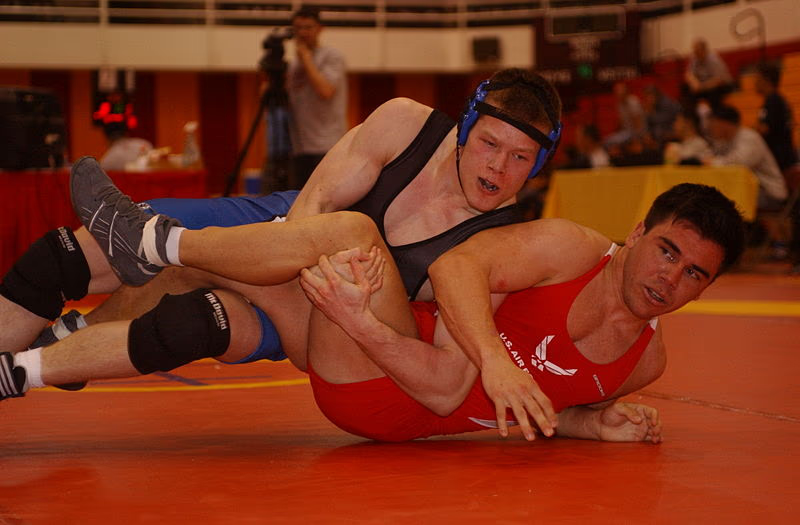
Wrestling is one of the oldest competitive disciplines in human history, depicted in cave drawings dating back 15,000 years and contested at the ancient Olympic Games from 708 BC. It has appeared at every modern Olympic Games since 1896, making it one of the foundational sports of the Olympic programme. The sport pits two athletes against each other in a contest of strength, technique, agility, and tactical awareness, with the ultimate objective of pinning the opponent's shoulders to the mat.
1.2 Governing Body
United World Wrestling (UWW) is the international governing body for Olympic wrestling. Originally founded in 1905 in Antwerp, Belgium as the International Federation of Associated Wrestling Styles (FILA), the organization rebranded to United World Wrestling in 2014. UWW is recognized by the International Olympic Committee (IOC) and oversees all international wrestling competitions, including the Olympic Games, World Championships, Continental Championships, and the global ranking system. UWW is headquartered in Corsier-sur-Vevey, Switzerland, and has over 180 affiliated national federations.
1.3 Olympic Wrestling Styles
UWW governs two Olympic wrestling styles, each with distinct tactical identities:
- Freestyle: Contested by both men and women. Athletes may attack with their entire body, including leg tackles, trips, and hooks. Single-leg and double-leg takedowns are fundamental techniques. Freestyle rewards dynamic, open wrestling with a wide variety of offensive options.
- Greco-Roman: Contested by men only. All holds and attacks must be executed above the waist. Leg attacks, leg trips, and any use of the legs for offensive or defensive purposes are strictly prohibited. Greco-Roman emphasizes powerful upper-body throws, lifts, gut wrenches, and suplex techniques, placing a premium on core strength and clinch work.
Beyond the Olympic styles, UWW also governs Beach Wrestling, Belt Wrestling, and Grappling, though these are not part of the Olympic programme.
1.4 Competition Format
Olympic and World Championship wrestling uses a single-elimination bracket with a repechage system. Wrestlers who lose to a finalist are placed into repechage rounds for the opportunity to compete for a bronze medal. Each weight category produces one gold, one silver, and two bronze medalists. Seeding is determined by the UWW world rankings.
Section 2: Equipment
2.1 Singlet
Wrestlers must wear a one-piece wrestling singlet in either red or blue, as assigned by the competition draw. The singlet must be UWW-approved, tight-fitting to the body, and made of a non-abrasive material. The tight fit is a safety requirement, preventing opponents from grabbing loose clothing during competition. Singlets must not have any zippers, buttons, or hard components. The wrestler's name and country code are displayed on the back. Undergarments may be worn beneath the singlet but must not extend beyond its edges.
2.2 Wrestling Shoes
Athletes must wear approved wrestling shoes that cover and support the ankle. Shoes must have soft, non-marking soles with no heels. Laces must be tucked into the shoe or secured with tape to prevent entanglement. The following are strictly prohibited on wrestling shoes:
- Buckles, clips, or metal components of any kind
- Hard soles or protruding sole edges
- Spikes, studs, or cleats
- Any material that could cause abrasion or injury
Shoe color should correspond to the assigned singlet color (red or blue) when possible, though this is enforced more strictly at elite-level competitions.
2.3 Headgear
Headgear (ear guards) is optional in senior international competition but strongly recommended to prevent cauliflower ear (auricular hematoma). Headgear is mandatory at Cadet (U17) and some Junior (U20) age levels, as determined by UWW regulations. All headgear must be UWW-approved, free of rigid or hard plastic components, and must not have any sharp edges or chin straps that could restrict breathing.
2.4 Additional Requirements
- Handkerchief (Blood Rag): Every wrestler must carry a handkerchief tucked into the singlet during competition. This is used for immediate blood management if bleeding occurs.
- Nails: Fingernails and toenails must be trimmed short before competition. Referees inspect nails at the pre-match equipment check.
- Body Condition: Wrestlers must not have any greasy or oily substances on their skin. Excessive perspiration must be toweled off before the match begins. All bandages and tape must be approved by the competition doctor.
- Jewelry: All jewelry, piercings, and accessories must be removed. No exceptions.
- Hair: Long hair must be secured with a soft, non-abrasive hair cover approved by the referee.
Section 3: Playing Area
3.1 Mat Specifications
All UWW-sanctioned competitions take place on a regulation wrestling mat. The mat is a square platform with a circular competition surface marked upon it. The total mat platform must measure at least 12 m × 12 m (39.4 ft × 39.4 ft). The mat consists of three distinct zones:
- Central Wrestling Area: A circle of 7 m (23 ft) diameter, marked by a solid boundary line. This is the primary competition zone where most wrestling action takes place. A small circle of approximately 1 m diameter is marked at the center for the starting position.
- Passivity Zone: An orange (or red) band 1.2 m (3.9 ft) wide surrounding the central wrestling area, bringing the total competition surface to 9 m (29.5 ft) diameter. This zone serves as a visual warning to wrestlers that they are approaching the boundary. Action in the passivity zone is still legal, but prolonged wrestling here may trigger passivity calls.
- Protection Area: A border of at least 1.5 m (4.9 ft) surrounding the entire competition surface, extending to the edge of the mat. This zone exists purely for safety, cushioning wrestlers who are thrown or pushed beyond the competition boundary. The protection area must be a contrasting color to the passivity zone.
3.2 Mat Construction
The mat must be at least 6 cm (2.4 in) thick, constructed from high-density, shock-absorbing foam covered with a smooth, non-abrasive vinyl surface. The surface must provide adequate grip without causing mat burns. Mats must be UWW-approved and inspected before each competition day. For elevated platforms used at major championships, the mat is placed on a raised podium approximately 1.1 m high, with additional safety padding on all sides.
3.3 Mat Markings
Red and blue corner marks are placed diagonally opposite each other on the mat edge, corresponding to the assigned wrestler colors. The central circle includes a starting line for each wrestler. All boundary lines must be clearly visible and maintained throughout the competition. If lines become obscured during competition, the mat chairman may pause the action for mat maintenance.
Section 4: Players & Officials
4.1 Competitors
Wrestling is an individual sport. Each match features two athletes competing one-on-one. Wrestlers are classified by weight category to ensure competitive fairness. The Olympic weight categories are:
- Freestyle Men (6 categories): 57 kg, 65 kg, 74 kg, 86 kg, 97 kg, 125 kg
- Freestyle Women (6 categories): 50 kg, 53 kg, 57 kg, 62 kg, 68 kg, 76 kg
- Greco-Roman Men (6 categories): 60 kg, 67 kg, 77 kg, 87 kg, 97 kg, 130 kg
World Championships may include additional weight categories beyond the six Olympic classes. Non-Olympic weight classes (e.g., 61 kg, 70 kg in Freestyle) are contested at World Championships and ranking series events but not at the Games.
4.2 Age Categories
UWW recognizes the following competitive age divisions, each with its own weight classes:
- Schoolboys/Schoolgirls: 14–15 years old
- Cadets: 16–17 years old
- Juniors: 18–20 years old
- Seniors (U23): 18–23 years old
- Seniors: 20 years and older (Olympic and World Championship level)
- Veterans: 35 years and older (age-group categories in 5-year increments)
4.3 Officials
Each match is overseen by a three-person officiating panel to ensure accuracy and fairness:
- Mat Referee: The primary official on the mat. The referee controls the action, starts and stops the bout, awards points, issues cautions and passivity calls, and ensures wrestler safety. The referee wears red and blue wristbands to signal point awards by raising the corresponding wrist.
- Judge: Seated at the scoring table at mat level. The judge independently scores the match and records all points on the score sheet. The judge can signal disagreement with the referee's calls by raising a colored paddle.
- Mat Chairman: The senior official, seated at an elevated position for optimal viewing. The mat chairman supervises the referee and judge, resolves disagreements between them, and has the final authority on all scoring decisions. Decisions require agreement from at least two of the three officials (majority rules).
In addition to the three-person panel, a competition doctor and timekeepers are stationed at matside. At major championships, a UWW Technical Delegate oversees the entire competition to ensure regulatory compliance.
Section 5: Rules of Play
5.1 Match Duration
A standard senior match consists of 2 periods of 3 minutes each, with a 30-second rest period between them. The clock runs continuously during each period and is stopped only by the referee for injuries, equipment issues, blood time, or official consultations. If the score is tied at the end of regulation, the criteria system (see Section 6) determines the winner without overtime.
5.2 Starting Positions
Each period begins with both wrestlers in the standing (neutral) position, facing each other at the center of the mat. The referee blows the whistle to start and restart action. After an out-of-bounds or scoring sequence, wrestlers return to the center and resume from the standing position unless a par terre order has been issued.
5.3 Fall (Pin)
The fall is the highest achievement in wrestling and results in an immediate victory regardless of the score. A fall is awarded when both of the opponent's shoulder blades are held in continuous contact with the mat long enough for the referee to observe and confirm the pin. The referee must see control and complete shoulder contact, then slap the mat to signal the fall. The match ends instantly. Scoring a fall is equivalent to the knockout in boxing or the submission in judo — the ultimate decisive finish.
5.4 Technical Superiority
If at any point during the match one wrestler establishes a lead of 10 points or more, the match is stopped and that wrestler is declared the winner by technical superiority (also called technical fall). This rule prevents unnecessarily one-sided contests and protects the trailing wrestler from prolonged dominance. The 10-point differential applies to both Freestyle and Greco-Roman at the senior level.
5.5 Freestyle-Specific Rules
In Freestyle wrestling, athletes may use their entire body for offensive and defensive techniques. Key characteristics include:
- Leg attacks: Single-leg and double-leg takedowns are core techniques, targeting the opponent's legs to bring them to the mat.
- Leg lace (ankle lace): A turning technique from the par terre position where the attacker threads the opponent's legs to expose the back to the mat.
- Leg defense: Sprawling, hip switches, and re-attacks using the legs are all permitted.
- Full body engagement: Trips, sweeps, and attacks from any body level are legal.
5.6 Greco-Roman-Specific Rules
Greco-Roman wrestling restricts all holds and attacks to the upper body only (above the waist). This creates a uniquely powerful and explosive style. Key characteristics include:
- No leg attacks: Single-leg takedowns, double-leg shots, leg trips, leg hooks, and any hold below the waist are strictly prohibited. Violations result in a caution and points to the opponent.
- No leg defense: Wrestlers may not use their legs to block, hook, or trip the opponent, even defensively.
- Clinch wrestling: Greco-Roman places heavy emphasis on tie-ups, underhooks, overhooks, and body locks in the standing position.
- Throws and suplexes: High-amplitude throws, including the suplex (lifting and arching the opponent overhead onto their back), are the hallmark techniques of Greco-Roman. These are among the most spectacular moves in all of wrestling.
- Par terre (ground position): In Greco-Roman, the par terre position is critically important. The attacking wrestler starts behind and above the defensive wrestler, who is on hands and knees. From here, the attacker executes gut wrenches (rolling the opponent repeatedly to expose the back), lifts (picking the opponent up from the ground to throw them), and other upper-body turning techniques.
- Ordered par terre: Following a passivity call in Greco-Roman, the active wrestler is awarded par terre position with the passive wrestler on the bottom, creating significant scoring opportunities.
5.7 Passivity Rule
UWW actively penalizes passive wrestling. If a wrestler is not initiating attacks or attempting to score, the following sequence occurs:
- The referee issues a verbal warning ("Red/Blue, attack!") to encourage activity.
- If passivity continues, the referee calls passivity, awarding the active wrestler 1 point and, in Greco-Roman, the choice of par terre position (top).
- In Freestyle, the passive wrestler receives a passivity mark but the active wrestler receives 1 point and the bout continues in the standing position.
The passivity system replaced the former shot clock system and is designed to ensure continuous, engaging wrestling action throughout the match.
5.8 Out of Bounds
When wrestlers move into the protection area (outside the competition surface), the referee stops the action. If a wrestler is pushed out while their opponent maintains position inside, the wrestler who forced the action out may receive 1 point (stepping out). If both wrestlers go out simultaneously, action is restarted at the center with no points awarded. A wrestler who repeatedly flees the mat to avoid engagement is penalized with a caution and 1 point to the opponent.
5.9 Challenge System
Each wrestler (or their corner coach) is entitled to one challenge per match. A challenge requests a video review of a specific call by a review jury. If the challenge is successful and the call is overturned, the wrestler retains the challenge for possible later use. If the challenge fails, the wrestler loses the challenge and 1 point is awarded to the opponent. The challenge system was introduced to improve officiating accuracy at major competitions and is available at all UWW-sanctioned events with video replay capability.
Section 6: Scoring
6.1 Point Values
Points are accumulated throughout the match. Each technique is assigned a value based on its difficulty, amplitude, and degree of control demonstrated:
- 1 Point: Reversal (moving from a defensive position to an offensive/controlling position); forcing the opponent to step out of bounds (stepping out); opponent penalized for passivity or a minor infraction.
- 2 Points: Takedown (bringing the opponent from standing to the mat with control); exposure/danger position (turning the opponent so their back faces the mat at less than 90 degrees, held briefly); correct throw of short amplitude (opponent does not leave the mat entirely).
- 4 Points: Takedown with direct and immediate exposure to a danger position in a single continuous action; a throw of short amplitude that places the opponent directly into a danger position.
- 5 Points: High-amplitude throw — any throw where the attacking wrestler lifts the opponent completely off the mat and projects them through the air in a sweeping, grand arc, landing them in a danger position. These grand throws represent the pinnacle of wrestling technique and athleticism.
6.2 Victory Conditions (Ranked by Priority)
A match can end in the following ways, listed from most decisive to least:
- Fall (Pin): Both shoulders held on the mat. Instant win. Classified as Victory by Fall (VFA).
- Default / Injury: Opponent cannot continue or does not appear. Victory by Default (VFO) or Injury (VIN).
- Technical Superiority: 10-point lead at any time. Victory by Technical Superiority (VSU).
- Disqualification: Opponent receives 3 cautions or is disqualified for misconduct. Victory by Disqualification (VDS).
- Points (Decision): Higher score at the end of 6 minutes. Victory by Points (VSU if margin is 7–9 points, VPO if margin is 1–6 points).
6.3 Tie-Breaking Criteria
If the score is tied at the end of regulation, the winner is determined by the following criteria, applied in order until a winner is identified:
- Highest-value scoring technique: The wrestler who scored the single highest-value move during the match wins. For example, if both wrestlers have 4 points but one scored a 4-point throw while the other scored four 1-point moves, the wrestler with the 4-point throw wins.
- Last point scored: If the highest-value technique is equal, the wrestler who scored the last technical point in the match is declared the winner.
- Fewest cautions: If still tied after the above criteria, the wrestler with fewer cautions wins.
This criteria system eliminates the need for overtime periods and rewards technical quality and initiative rather than defensive wrestling.
6.4 Team Scoring
In dual meet (team vs. team) competitions, classification points are awarded based on the manner of individual victories. A fall earns the maximum classification points (5), while a narrow decision earns fewer (1–3). The team with the most cumulative classification points wins the dual meet. At the World Championships and Olympics, individual results determine final standings within each weight category.
Section 7: Violations & Penalties
7.1 Cautions
A caution is a formal penalty issued by the referee for rule violations. Each caution results in 1 or 2 points awarded to the opponent, depending on the severity. Accumulating 3 cautions in a single match results in immediate disqualification. Caution-worthy offenses include:
- Illegal holds (e.g., full nelson, headlock without an arm enclosed, small joint manipulation)
- Fleeing the mat to avoid wrestling action
- Fleeing a hold to avoid being scored upon
- Unnecessary roughness (striking, butting, elbowing)
- Stalling or refusing to start wrestling when directed by the referee
- False start at the beginning of a period or after a stoppage
- Intentionally stepping out of bounds to disrupt the opponent's attack
7.2 Greco-Roman Specific Violations
In Greco-Roman wrestling, additional violations apply due to the upper-body-only restriction:
- Any leg attack (single-leg, double-leg) results in a caution and 1–2 points to the opponent
- Using the legs to hook, trip, or block the opponent, even defensively
- Holding below the waist or gripping the opponent's thighs or legs
- Scissoring the opponent's body, legs, or head with the legs (body scissors are prohibited)
These violations are called immediately, and the action is stopped. The offending wrestler receives a caution, and the opponent is awarded points and may be given a choice of position.
7.3 Brutality and Disqualification
Actions deemed brutal or dangerous carry more severe penalties:
- Caution and 2 points: A throw executed with intent to injure, slamming the opponent headfirst into the mat, or any technique performed with excessive and unnecessary force beyond what is required for the hold.
- Immediate disqualification: Intentional head-butting, biting, scratching, or striking. Unsportsmanlike conduct toward officials. Any action deemed to endanger the life or physical integrity of the opponent.
- Post-match sanctions: UWW may impose additional sanctions including suspension from future competitions, fines, and ranking point deductions for serious misconduct.
7.4 Passivity Penalties
While not a formal caution, passivity calls carry tangible consequences. A wrestler deemed passive receives a passivity mark, and their opponent is awarded 1 point. In Greco-Roman, the active wrestler additionally receives the advantageous par terre (top) position. Repeated passivity in a match can contribute to an unfavorable criteria position in case of a tied score, as it reflects negatively on the wrestler's initiative.
7.5 Coach Conduct
Coaches must remain seated in their designated chair at matside and may only communicate verbally with their wrestler. A coach who stands, enters the mat area, physically interferes, or directs abusive language at officials may be ejected from the competition area. The wrestler is not penalized for coach misconduct unless the coach's actions physically disrupt the match.
Section 8: Safety Considerations
8.1 Medical Personnel and Equipment
A qualified competition doctor and paramedic team must be present at matside for all UWW-sanctioned events. Medical personnel have the authority to examine injured wrestlers during designated stoppages. A fully equipped first aid station must be available adjacent to the competition area. At major championships, an ambulance must be on standby at the venue.
8.2 Weigh-In Procedures
Official weigh-in is conducted on the morning of competition, typically 2–3 hours before the first bout. Wrestlers must make weight on the day they compete (no day-before weigh-in). Wrestlers step on the scale wearing only their singlet or underwear. Each wrestler receives two attempts on the scale. A wrestler who fails to make weight is eliminated from the competition. UWW has implemented these same-day weigh-in rules to discourage extreme weight cutting practices that endanger athlete health.
8.3 Skin and Medical Checks
Prior to competition, all wrestlers undergo a skin check by the competition doctor to screen for communicable skin conditions such as ringworm, impetigo, herpes simplex, and other contagious infections. Wrestlers found with active skin infections are disqualified from competition to protect other athletes. Nails are inspected, and any open wounds must be properly bandaged with the doctor's approval.
8.4 Blood Time
If a wrestler begins bleeding during a match, the referee stops the clock and grants blood time for treatment. The bleeding must be controlled and the wound properly dressed before the wrestler may continue. Each wrestler is allowed a cumulative maximum of 5 minutes of blood time per match. If bleeding cannot be controlled within this limit, the match is stopped and the wrestler forfeits by injury default. Blood on the mat must be cleaned before action resumes.
8.5 Injury Time
If a wrestler is injured during a match (without blood), the referee may grant injury time of up to 2 minutes. The competition doctor evaluates the wrestler during this time. If the wrestler cannot continue after 2 minutes, the opponent wins by injury default. If the injury was caused by the opponent's illegal action, the injured wrestler may be given additional recovery time at the discretion of the mat chairman.
8.6 Prohibited Techniques for Safety
The following techniques are banned to protect wrestlers from serious injury:
- Full nelson: Applying a double nelson (both hands behind the opponent's neck) is illegal due to the risk of cervical spine injury.
- Headlock without arm: A headlock must include at least one of the opponent's arms to prevent neck hyperflexion.
- Spiking: Driving the opponent headfirst into the mat from a throw is prohibited and results in immediate disqualification.
- Small joint manipulation: Bending or twisting individual fingers or toes is illegal.
- Scissors on the head or neck: Applying a leg scissor to the opponent's head or neck is banned.
- Twisting arm locks: Hyperextending or twisting the arm behind the opponent's back beyond its natural range of motion at a forced angle is prohibited.
8.7 Mat Safety
Wrestling mats are inspected before each competition day for proper thickness (minimum 6 cm), surface integrity, and secure positioning. Mats on elevated platforms must have additional crash padding on all sides. The mat surface is cleaned and disinfected between sessions to prevent the spread of skin infections. Any tears, buckles, or separations in the mat surface must be repaired before competition resumes.