










Section 1: Introduction
1.1 Overview and Governing Body
Ice hockey has been an Olympic sport since 1920 (men's, at the Antwerp Summer Olympics) and has featured at every Winter Games since 1924. Women's ice hockey was added at the 1998 Nagano Games. The International Ice Hockey Federation (IIHF), founded in 1908 and headquartered in Zurich, governs international competition under the IIHF Official Rule Book, published in a new edition for the 2026/27 season alongside a companion 2026/27 Situation Handbook. IIHF rules apply at the Olympic Games, IIHF World Championships, and all IIHF-sanctioned tournaments. Over 80 member nations compete under IIHF governance.
1.2 Key Differences from NHL Rules
This rulebook covers international (IIHF) rules, which differ from North American NHL rules in several important areas:
- Rink size: IIHF: 60 m × 30 m (wider). NHL: 60.96 m × 25.91 m (200 ft × 85 ft, narrower).
- Icing: IIHF uses no-touch (automatic) icing — the whistle blows as soon as the puck crosses the goal line. NHL uses hybrid icing (linesman judges whether the defending or attacking player would reach the puck first).
- Two-line pass: Eliminated in both IIHF and NHL. The centre red line is not relevant for passing offside purposes.
- Fighting: IIHF imposes a match penalty (ejection + automatic minimum 1-game suspension) for fighting. NHL treats fighting as a 5-minute major with no automatic suspension.
- Overtime (preliminary rounds): IIHF: 5 minutes of 3-on-3, then shootout. NHL regular season is similar, but playoff overtime uses 5-on-5 sudden death with no shootout.
- Body checking (women): Prohibited under IIHF rules. Permitted in some NHL-affiliated women's leagues.
- Face shields: Full face protection (cage or visor) mandatory for all IIHF skaters. NHL requires only a visor.
1.3 Olympic Tournament Format
The Olympic men's tournament features 12 teams in a group stage followed by single-elimination playoffs. The women's tournament features 10 teams with a similar format. Qualification is based on IIHF World Rankings and pre-Olympic qualification tournaments.
Section 2: Equipment
2.1 Stick
- Maximum shaft length: 163 cm (64 in) from the heel of the blade to the end of the shaft.
- Blade length: 25–32 cm (9.8–12.6 in).
- Blade width: 5–7.5 cm (2–3 in).
- Blade curvature: Maximum 1.5 cm (0.59 in) measured from a straight line between the toe and heel of the blade.
- Goalkeeper stick: Wider blade permitted — maximum width 9 cm (3.5 in) for the lower 71 cm (28 in) of the shaft.
- Material: Wood, composite, or combination. No sharp edges or dangerous protrusions permitted (Rule 32, IIHF).
2.2 Skater Protective Equipment
- Helmet: IIHF-approved helmet with full face protection (cage or full visor) mandatory for all skaters. Chin strap must be fastened at all times on ice.
- Body protection: Shoulder pads, elbow pads, hockey gloves, shin guards, hockey pants (breezers), and athletic cup/jock. All protective equipment must be worn under the jersey.
- Neck guard: A certified neck laceration protector is mandatory for all players in senior-level IIHF competition, including the Olympic Winter Games, per an IIHF Council decision (on recommendation of the IIHF Medical Committee) extending the existing U20/U18 requirement to the senior categories. Neck laceration protectors have already been mandatory at U20 and U18 level under the IIHF Official Rule Book. Mandatory for goalkeepers at all levels.
- Mouthguard: Recommended but not mandatory under IIHF rules.
2.3 Goalkeeper Equipment
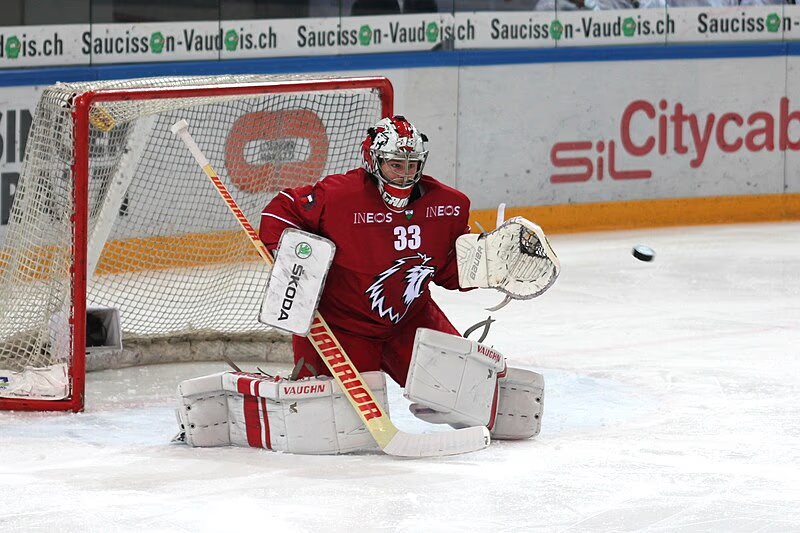
- Leg pads: Maximum width 28 cm (11 in). Maximum length measured from centre of the knee to the boot: proportional to the goalkeeper's body. No rigid external attachments that extend the blocking surface beyond pad dimensions.
- Catching glove (trapper): Maximum width 23 cm (9 in) measured across the widest point. Maximum length 41 cm (16 in).
- Blocker: Flat rectangular pad attached to the stick hand. Maximum dimensions: 28 cm × 38 cm (11 in × 15 in).
- Chest and arm protector: Must not exceed the goalkeeper's body contour by more than specified tolerances when arms are at sides.
- Mask: Full-face mask/helmet combination mandatory. Must meet IIHF certification standards for puck impact resistance.
2.4 Puck
- Material: Vulcanised rubber, solid black.
- Diameter: 7.62 cm (3 in).
- Thickness: 2.54 cm (1 in).
- Weight: 156–170 g (5.5–6 oz).
- Preparation: Pucks are frozen before use to reduce bouncing and ensure consistent play. Fresh frozen pucks are supplied throughout the game.
Section 3: Playing Area
3.1 Rink Dimensions
- Overall size: 60 m × 30 m (197 ft × 98.4 ft) for international/Olympic play. The wider surface compared to NHL rinks (200 ft × 85 ft) emphasises skating speed, passing, and positional play over physical forechecking.
- Corner radius: 7–8.5 m (23–28 ft).
- Boards: Height 1.07–1.22 m (42–48 in) above ice surface. Safety glass (tempered or polycarbonate) extends above the boards around the entire rink, with higher sections behind the goals and at player bench areas.
3.2 Ice Markings and Zones
- Centre red line: Divides the rink in half. 30 cm (12 in) wide. Used for icing determination.
- Blue lines (2): 30 cm (12 in) wide, positioned 22.86 m (75 ft) from each goal line. Blue lines divide the ice into three zones: defending zone, neutral zone, and attacking zone.
- Goal lines (2): 5 cm (2 in) wide, extending across the full width of the rink, 4 m (13 ft) from the end boards.
- Centre ice circle: 4.5 m (14.8 ft) radius with a centre dot for opening and between-period face-offs.
- Face-off circles (4): Located in each end zone with 4.5 m radius. Hash marks indicate where players must stand during face-offs.
- Neutral zone face-off dots (4): Two on each side of the centre circle, 1.5 m (5 ft) from the blue lines.
3.3 Goal and Crease
- Goal frame: 183 cm (6 ft) wide × 122 cm (4 ft) high, measured from inside of the posts. Constructed of metal tubing, painted red. Net attached to the rear of the frame.
- Goal crease: Semi-circular area in front of the goal with a radius of 1.8 m (5.9 ft), painted blue. The crease defines the goalkeeper's protected area — attacking players may not initiate contact with the goalkeeper in the crease.
- Goal line technology: Video review cameras positioned above each goal. In major IIHF tournaments, a goal-line camera is embedded in the crossbar to determine whether the puck fully crossed the goal line.
3.4 Player Benches and Penalty Box
- Team benches: Located on the same side of the rink, one for each team, separated by the penalty boxes at centre ice.
- Penalty boxes: Two boxes at centre ice (one per team) for penalised players. A third box (timekeeper's box) sits between them.
- Bench gates: Must open away from the ice surface for player safety.
Section 4: Players & Officials
4.1 Team Composition
- On-ice: 6 players per team — 5 skaters (typically 3 forwards + 2 defencemen) and 1 goalkeeper.
- Roster: Maximum 22 skaters (20 skaters + 2 goalkeepers) dressed for a game. A third goalkeeper may be available but not dressed.
- Extra attacker: Teams may pull the goalkeeper for a 6th skater (empty net) at any time, most commonly when trailing late in the game.
- Captain and alternates: One captain (C) and up to two alternate captains (A) designated. Only the captain (or alternates if captain is unavailable) may address officials regarding rule interpretations.
4.2 On-Ice Officials
- 4-official system (major tournaments): 2 referees + 2 linesmen. Both referees can call all penalties. Linesmen handle icing, offside, and face-offs, and may report certain infractions to the referees.
- 3-official system: 1 referee + 2 linesmen. Used at lower-level IIHF events.
- Referee authority: Referees have final authority on all penalty calls and game management decisions on the ice.
4.3 Off-Ice Officials
- Goal judges: Positioned behind each goal to signal when the puck crosses the goal line (advisory; referee makes final determination).
- Timekeeper: Controls the game clock, records penalties, and manages intermission timing.
- Penalty timekeeper: Tracks penalty duration and signals when penalised players may return to the ice.
- Statisticians: Record all game events (goals, assists, shots, penalties, face-off wins).
- Video review supervisor: Located in a video review room with access to all camera angles. May be consulted by referees for goal/no-goal decisions and major penalty reviews.
Section 5: Rules of Play
5.1 Game Duration
- Regulation: 3 periods × 20 minutes of running time (clock stops on whistles). 15–18 minute intermissions between periods with ice resurfacing.
- Overtime (preliminary rounds): 5 minutes of 3-on-3 sudden-death play. If still tied, a shootout determines the winner.
- Overtime (elimination/medal games): 20-minute periods of 5-on-5 sudden-death until a goal is scored. No shootout in elimination games.
- Shootout: Best of 3 shooters per team. If still tied after 3 rounds, sudden-death single rounds until one team scores and the other does not.
5.2 Offside
An attacking player may not precede the puck into the attacking zone (beyond the blue line). If an attacking player's skates are in the attacking zone before the puck completely crosses the blue line, offside is called. Play is stopped and a face-off is held in the neutral zone. Delayed offside: if the puck is shot into the attacking zone and all attacking players clear the zone (tag up by touching the blue line), play continues without a stoppage.
5.3 Icing
Icing occurs when a team shoots the puck from their own side of the centre red line across the opposing team's goal line without it being touched. Under IIHF rules, no-touch icing is in effect: the whistle blows automatically when the puck crosses the goal line, regardless of which player would reach it first. This is stricter than NHL hybrid icing. Exceptions: icing is not called if the team shooting the puck is short-handed (penalty kill), or if the puck passes through the goal crease.
5.4 Face-Offs
Face-offs restart play after stoppages. The visiting team's centre places their stick first. Players other than the two centres must remain outside the face-off circle or behind the hash marks until the puck is dropped. Violation results in the centre being replaced by a teammate.
5.5 Body Contact
- Men's hockey: Body checking is permitted. A legal body check requires shoulder-to-shoulder or hip-to-body contact on an opponent who possesses or has just played the puck.
- Women's hockey: Body checking is prohibited under IIHF rules. Incidental contact is permitted, but deliberate checking results in a penalty.
- Checking from behind: Always illegal in both men's and women's hockey. Results in a minor + misconduct, or a major + game misconduct depending on severity.
- Head contact: Any check targeting or making primary contact with the head is penalised — typically a major penalty + game misconduct.
5.6 Fighting
Under IIHF rules, fighting is treated as a match penalty: the player is ejected from the game and receives an automatic minimum 1-game suspension. Instigators receive additional suspensions. This is significantly stricter than NHL rules, where fighting is a 5-minute major with no automatic suspension. The IIHF zero-tolerance approach to fighting reflects the international standard that prioritises skill-based play.
Section 6: Scoring
6.1 Goal Criteria
A goal is scored when the entire puck crosses the goal line between the posts and below the crossbar by legal means. The puck may deflect off any player (including an attacking player's skate, provided there is no distinct kicking motion) and still count. A puck directed into the goal by a hand, a high stick (above the crossbar height), or a deliberate kicking motion is disallowed.
6.2 Video Review
All goals at IIHF major tournaments are subject to video review. The video review supervisor may initiate a review for:
- Puck crossing the goal line (did the entire puck cross?)
- High stick (was the puck contacted above the crossbar?)
- Kicking motion (was the puck deliberately kicked into the net?)
- Goaltender interference (was the goalkeeper impeded in the crease before the goal?)
- Offside on the play leading to the goal
- Hand pass in the attacking zone leading to the goal
In IIHF tournaments, the video review supervisor (not the on-ice referee) initiates reviews. This differs from the NHL coach's challenge system.
6.3 Power-Play Goals
When a goal is scored against a short-handed team (due to a minor or bench minor penalty), the penalised player is released from the penalty box and returns to full strength. Major penalties (5 minutes) are not terminated by a goal — the penalised player serves the full 5 minutes regardless of goals scored.
6.4 Tournament Standings
In group-stage play, teams earn 3 points for a regulation win, 2 points for an overtime/shootout win, 1 point for an overtime/shootout loss, and 0 points for a regulation loss. Tiebreakers include: head-to-head record, goal difference, goals scored, and IIHF World Ranking.
Section 7: Violations & Penalties
7.1 Minor Penalties (2 Minutes)
The penalised player sits in the penalty box for 2 minutes of playing time. Their team plays short-handed (e.g., 5-on-4). The penalty expires after 2 minutes or when the opposing team scores, whichever comes first. Common minor penalties include:
- Tripping, hooking, holding, slashing, interference, cross-checking, high-sticking (no injury), roughing, delay of game, too many players on ice
7.2 Double Minor Penalties (4 Minutes)
Two consecutive 2-minute penalties served by the same player. If the opposing team scores during the first 2 minutes, the first penalty is terminated, but the second 2-minute period remains. Common double minor: high-sticking that draws blood.
7.3 Major Penalties (5 Minutes)
Five minutes served in full regardless of goals scored. Often accompanied by a game misconduct (ejection). Common major penalties include:
- Boarding (violent check into the boards), charging (excessive strides before a check), checking from behind, fighting (IIHF: match penalty instead)
7.4 Misconduct and Game Misconduct
- Misconduct (10 minutes): The player serves 10 minutes, but the team does NOT play short-handed (a substitute serves any concurrent minor/major). Typically for unsportsmanlike conduct or abusive language.
- Game misconduct: Player is ejected for the remainder of the game. Substitute may take their roster spot after any concurrent minor/major time expires. Reported to IIHF for potential supplementary discipline.
- Match penalty: Player ejected for deliberate intent to injure or fighting. Automatic minimum 1-game suspension. The team plays short-handed for 5 minutes.
7.5 Penalty Shot
Awarded when a clear scoring opportunity is illegally denied, typically:
- Fouling a player on a breakaway from behind
- Displacing the goal during a scoring attempt
- A defending player (other than the goalkeeper) covering the puck in the crease
- A defending player deliberately throwing a stick or object at the puck in the defending zone
The fouled player (or a player chosen by the captain) takes the puck from centre ice and attempts to score in a one-on-one with the goalkeeper. The play ends when the puck is shot, stopped by the goalkeeper, or passes the goal line.
Section 8: Safety Considerations
8.1 Protective Equipment Standards
- Full face protection: Mandatory for all IIHF skaters (cage or full visor). This differs from the NHL, which only requires a visor. Greatly reduces facial and dental injuries.
- Neck guard: Mandatory for goalkeepers at all levels. Following an IIHF Council decision, on recommendation of the IIHF Medical Committee, a certified neck laceration protector is now also mandatory for skaters in senior-level IIHF competition — extending a requirement already in force at U20 and U18 level — effective from the 2026/27 season, including the Milano Cortina 2026 Olympic Winter Games. The mandate follows high-profile blade-laceration incidents in the sport.
- Equipment inspection: Referees may inspect player equipment at any time. Non-compliant equipment results in a minor penalty for delay of game.
8.2 Head Contact and Concussion Protocol
- Head contact rule: Any check where the head is the principal point of contact is penalised, regardless of whether the checker intended head contact. Penalties range from minor + misconduct to match penalty depending on severity.
- Concussion protocol: Any player suspected of a concussion must immediately leave the ice and be evaluated by the tournament physician in the quiet room. The player may not return to the game until cleared through the IIHF concussion protocol, which includes cognitive testing, balance assessment, and symptom monitoring.
- Return to play: A player diagnosed with a concussion must follow a graduated return-to-play protocol supervised by medical staff before being cleared for competition.
8.3 Blood Rule and Medical Emergencies
- Blood rule: Any player with visible bleeding must leave the ice immediately and may not return until the bleeding is controlled and all blood-stained equipment is cleaned or replaced.
- Emergency equipment: A defibrillator (AED) and emergency medical equipment must be immediately accessible at all IIHF competitions. The arena must have an emergency action plan with direct ambulance access to the ice surface.
- Blade laceration: The most serious acute injury risk. Emergency protocols include immediate pressure, on-ice first aid, and pre-arranged hospital transport routes.
8.4 Rink Safety
- Safety glass: Tempered glass or polycarbonate shielding above the boards protects spectators from errant pucks while allowing visibility. Higher sections behind the goals (typically 2.4 m / 8 ft above boards).
- Netting: Protective netting above the safety glass behind both goals to prevent pucks from entering spectator areas.
- Bench and penalty box gates: Must open away from the ice surface. Bench doors must have secure latches to prevent accidental opening during play.
- Ice surface: Resurfaced during each intermission. Divots and damage repaired by the ice crew. Competition may be delayed if ice quality compromises player safety.