














Section 1: Introduction
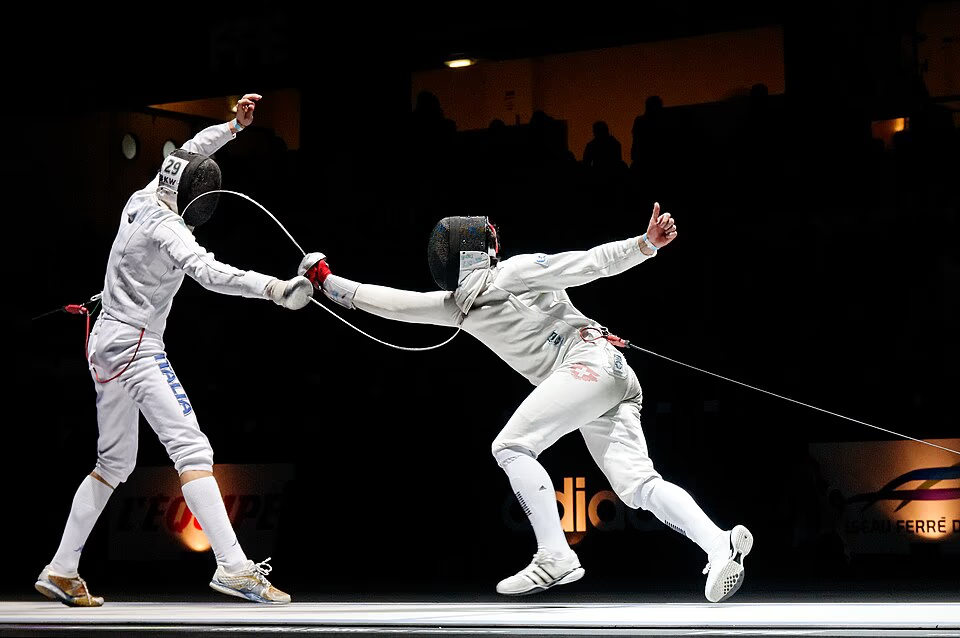
NCAA Fencing is one of two NCAA-sanctioned co-educational team sports (alongside Rifle) — men's and women's fencers compete on a single varsity roster during the regular season. Contested in the winter semester at NCAA Division I institutions; ~25 NCAA D1 programs as of 2026. NCAA Fencing uses the USA Fencing + FIE (International Fencing Federation) technical baseline with NCAA-specific modifications around team format, dual-meet structure, and scoring. Beginning with the 2026 championships, the NCAA awards separate National Collegiate Women's Team Fencing Championship and National Collegiate Men's Team Fencing Championship titles — the first standalone women's team championship of the modern three-weapon era, and the first time since 1990 that the NCAA has crowned separate men's and women's team champions in fencing — replacing the single combined team championship contested through the 2025 championships. Both championships are held in March at a common host site. The current edition is the 2026-27 NCAA Fencing Rules Book. For the international FIE framework see the sibling FIE Fencing Rules entry.
Section 2: Equipment
- Three weapons: foil (point-only target = torso), épée (point-only target = entire body), sabre (point + cut target = above waist)
- Each weapon has FIE-approved spec for length (max 110 cm) and weight
- Mandatory protective gear: jacket (FIE-approved 350N or 800N), plastron (underarm protector), mask (FIE-approved 1600N), glove, knickers, socks, fencing shoes
- Underarm chest protector required; women's chest protector additionally required per FIE
- Body-cord + electronic scoring apparatus connecting fencer to the scoring box
- Reel for body-cord wire management
Section 3: Playing Area
- Strip (piste): 14 m long × 1.5-2 m wide
- Center line + 2-m on-guard lines on each side of center
- End lines and warning lines (2 m from each end line)
- Multiple strips arranged in parallel for simultaneous bouts at championships
- Director's stand alongside the strip
Section 4: Players & Officials
- NCAA team: 9 fencers per gender (3 per weapon × 3 weapons)
- Dual-meet format: 27 individual bouts per dual (each fencer in each weapon faces each opponent fencer)
- Officials: director (referee) on each strip, scoring keeper at the box, judges (when manual scoring used)
- NCAA Championship: 24 fencers per weapon advance to the championship from qualifying
- Since 2026, the NCAA Women's and NCAA Men's Fencing Championships are contested as separate events, each with its own qualified field of fencers per weapon
Section 5: Rules of Play
Foil
- Target: torso (front + back)
- Right-of-way (priority) determines who scores when both touch simultaneously
- Touch with point only
Épée
- Target: entire body
- No right-of-way — both fencers may score simultaneously (double touch)
- Touch with point only
- Hardest weapon to score — full-body target with no priority
Sabre
- Target: entire body above the waist (including arms + head)
- Right-of-way determines simultaneous touches
- Touch with cut OR point
- Fastest weapon — emphasizes speed + tactical preemption
Bout Format
- Individual bout: first to 5 touches (3-minute time limit; if tied, 1-minute sudden-death OT)
- Team bout (regular-season dual relay format): 9 bouts × 5 touches each, accumulating to 45 (or until time limit); the NCAA Championship uses a different round-robin structure — see Section 6, Scoring
Section 6: Scoring
- Bout: first fencer to 5 touches wins (or higher score after time expires)
- Team dual: most bouts won out of 27 wins the dual (best of 14)
- NCAA Championship: since the 2026 championships, contested as separate National Collegiate Women's Team Fencing Championship and National Collegiate Men's Team Fencing Championship events rather than a single combined co-educational team title; each weapon squad fences a round-robin of 5-touch bouts, and each school earns one team point per individual bout won, with no separate team bracket
- Tiebreakers: aggregate touches received vs scored
Section 7: Violations & Penalties
- Yellow card: warning (no penalty); 2 yellow = red card
- Red card: 1 touch awarded to opponent; subsequent red = black card
- Black card: ejection from the competition
- Common card-worthy: leaving the strip with both feet, body contact, blocking with non-weapon hand, dishonest behavior, refusal to fence
- Equipment violation (broken equipment, illegal weapon length): yellow card + replacement
Section 8: Safety Considerations
Mandatory FIE-approved protective gear (mask 1600N, jacket 350N or 800N) reduces puncture risk. Equipment inspection pre-bout. Mask must remain in place; loss of mask = stop bout, replace gear. Concussion protocol: removal + graduated return-to-play assessment. Required: certified athletic trainer at every meet; team physician + EMT at championship-level. AED + emergency action plan at every venue.