











Section 1: Introduction
1.1 Overview and Governing Body
Biathlon combines cross-country skiing and precision rifle marksmanship into a single gruelling competition. The sport has been on the Olympic programme since 1960 (men) and 1992 (women). It is governed by the International Biathlon Union (IBU) under the IBU Event and Competition Rules (ECR). The IBU, headquartered in Salzburg, Austria, oversees the World Cup circuit, World Championships, and Olympic qualification. Biathlon's roots trace to Scandinavian and northern European military patrol traditions dating to the 18th century.
1.2 Olympic Events
- Individual: 20 km (men), 15 km (women). The original and longest biathlon event with 4 shooting stages and 1-minute time penalties per miss.
- Sprint: 10 km (men), 7.5 km (women). Two shooting stages with penalty loops for misses.
- Pursuit: 12.5 km (men), 10 km (women). Staggered start based on Sprint results. Four shooting stages.
- Mass Start: 15 km (men), 12.5 km (women). All 30 athletes start simultaneously. Four shooting stages.
- Relay: 4×7.5 km (men), 4×6 km (women). Each team member completes 2 shooting stages.
- Mixed Relay: 2 women + 2 men. Women ski 6 km each, men 7.5 km each.
1.3 Historical Development
Biathlon evolved from the military patrol event, which appeared at the 1924 Winter Olympics but was not included regularly until 1960. The sport transitioned from large-calibre military rifles to standardised .22 LR small-bore rifles in 1978, making the shooting component safer and more precise. The introduction of electronic target systems in the 1980s replaced manual target marking, enabling real-time scoring and television-friendly presentation. Women's events were first contested at the World Championships in 1984 and entered the Olympics in 1992.
Section 2: Equipment
2.1 Biathlon Rifle
- Calibre: .22 Long Rifle (LR) rimfire, 5.6 mm bore diameter. This is the only calibre permitted in biathlon competition.
- Action: Bolt-action (straight-pull bolt is standard for speed). No automatic or semi-automatic actions permitted.
- Minimum weight: 3.5 kg (7.7 lb) including the carrying harness and magazine.
- Magazine: Capacity of 5 rounds. One magazine loaded per shooting stage. Athletes must manually load additional rounds from spare magazines for relay spare shots.
- Sights: Open/iron sights only. No optical sights, telescopic sights, lens systems, or red-dot sights permitted. Diopter rear sight and ring/post front sight are standard.
- Trigger: No minimum trigger pull weight specified, but the mechanism must be safe (no hair triggers that could fire from impact or vibration).
- Stock: Custom-fitted to the athlete. May include adjustable cheekpiece and buttpad. No electronic components permitted in the stock.
2.2 Ammunition
- Type: .22 LR rimfire cartridges. Athletes select and test their own ammunition for optimal accuracy and reliability in cold conditions.
- Quantity per stage: 5 rounds loaded in the magazine. In relay events, athletes carry 3 additional spare rounds per shooting stage (loaded manually one at a time after the initial 5 are fired).
- Cold weather performance: Ammunition must function reliably at temperatures as low as −20°C (−4°F). Athletes often warm ammunition in body-heat pockets before loading.
2.3 Skis and Poles
- Technique: Free technique (skating) is used in all biathlon events. Classical technique is not used in modern competition.
- Ski specifications: Per FIS cross-country regulations. Minimum ski length based on athlete height.
- Wax restrictions: Fluorocarbon waxes are banned (environmental regulation adopted in 2022–2023 season).
- Poles: Standard cross-country skating poles. No restrictions beyond FIS specifications for pole length and construction.
2.4 Carrying Harness and Shooting Mat
- Rifle harness: Custom-fitted harness worn on the back. Rifle must be secured with the barrel pointing upward at all times during skiing. Quick-release mechanism for rapid transition to shooting position.
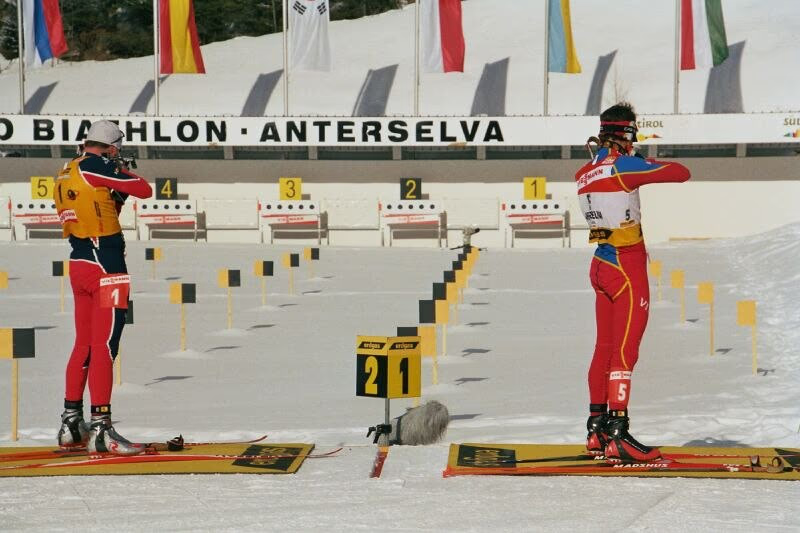
- Shooting mat (prone): Athletes may use a personal shooting mat for prone stages. The mat provides a stable, dry surface and is positioned at the firing lane. Maximum dimensions specified by IBU to fit within the firing lane width.
Section 3: Playing Area
3.1 Shooting Range
- Distance: 50 m (164 ft) from the firing line to the targets.
- Lanes: Minimum 30 firing lanes for World Cup and Olympic competitions. Each lane is approximately 2.75 m (9 ft) wide.
- Prone targets: 5 circular metal plates, each 45 mm (1.77 in) in diameter. The target falls (closes) when hit, providing immediate visual feedback.
- Standing targets: 5 circular metal plates, each 115 mm (4.53 in) in diameter. Larger targets compensate for the inherent instability of standing shooting after intense physical exertion.
- Electronic target system: All IBU-level competitions use electronic target systems that register hits/misses in real time and transmit data to the timing and display system. Manual backup targets are maintained.
- Wind indicators: Wind flags positioned near the targets to help athletes judge crosswind conditions. No wind compensation in scoring — athletes must adjust their aim based on real-time conditions.
3.2 Cross-Country Course
- Sprint course: Loops of 2.5 km (men) or 2.5 km (women), with the course passing through the stadium and shooting range area between loops.
- Individual course: Loops of 4 km or 5 km depending on the venue, with 4 passes through the shooting range.
- Terrain profile: Designed per IBU specifications with a mix of uphill (approximately one-third), downhill (one-third), and flat/undulating (one-third) terrain. Maximum climb per loop should not exceed the IBU altitude difference standards.
- Course width: Minimum 6 m (20 ft) at the start/finish area, minimum 4 m (13 ft) on the course for safe overtaking.
3.3 Penalty Loop and Stadium
- Penalty loop: 150 m (492 ft) circuit located adjacent to the shooting range. Athletes ski one loop for each missed target (in Sprint, Pursuit, Mass Start, and Relay events). Completing one loop adds approximately 20–25 seconds to the athlete's total time.
- Stadium layout: Encompasses the start/finish area, shooting range, penalty loop, warm-up area, wax cabins, and spectator zones. The stadium design must allow television cameras to capture shooting, penalty loops, and finish simultaneously.
- Altitude: Competition venues are typically located at 800–1800 m (2600–5900 ft) elevation, though no strict altitude limits apply.
Section 4: Players & Officials
4.1 Competitors
- Individual events: Nations may enter up to 4 athletes per gender at the Olympics (based on IBU qualification rankings).
- Mass Start: Limited to 30 athletes based on current World Cup or Olympic standings.
- Pursuit: Top 60 from the Sprint qualify. Start intervals based on Sprint finish time gaps.
- Relay: Each nation fields a team of 4 athletes. Substitutions may be made up until the team captains' meeting.
4.2 Competition Jury and Officials
- Technical Delegate (TD): Appointed by IBU. Oversees rule compliance, course homologation, and equipment controls.
- Chief of Competition: Manages the organising committee and event logistics.
- Range Officer: Controls access to the shooting range, manages firing lane assignments, and ensures safety protocols are followed at all times.
- Course Chief: Responsible for course preparation, grooming, and safety inspections.
- Shooting Judges: Monitor electronic target displays and verify hit/miss registration. May be called upon to resolve disputed shots (e.g., simultaneous hit from adjacent lane).
- Timing and Data: Electronic timing to 1/10th of a second for all events. Photo finish available for close results.
4.3 Start Procedures
- Individual/Sprint: Interval start. Athletes start at 30-second or 1-minute intervals. Start order determined by bib number (often based on World Cup ranking).
- Pursuit: Time-gap start based on Sprint results. The Sprint winner starts first; subsequent athletes start with their time deficit from the Sprint.
- Mass Start: Simultaneous start for all 30 athletes. Grid positions on the start line based on standings.
- Relay: Mass start for the first leg athletes. Subsequent legs begin with a tag in the exchange zone.
Section 5: Rules of Play
5.1 Individual Event (20 km Men / 15 km Women)
The longest and most traditional biathlon event. Athletes ski 5 loops (4 km each for men, 3 km each for women, though course loop lengths vary by venue) with 4 shooting stages in alternating order: prone, standing, prone, standing. Each missed target adds a 1-minute time penalty to the athlete's total ski time. There is no penalty loop — the time addition is applied to the final result. This format rewards both skiing speed and shooting precision equally, as one missed target is roughly equivalent to losing 1 minute of skiing time.
5.2 Sprint Event (10 km Men / 7.5 km Women)
Three skiing loops with 2 shooting stages: first prone, then standing. Each missed target requires the athlete to ski one 150 m penalty loop (approximately 20–25 seconds per loop). The Sprint is the most-attended event and serves as the qualification race for the Pursuit.
5.3 Pursuit Event (12.5 km Men / 10 km Women)
The top 60 finishers from the Sprint start at intervals corresponding to their time gaps from the Sprint winner. Five skiing loops with 4 shooting stages: prone, prone, standing, standing. Penalty loops for misses. The first athlete across the finish line wins regardless of combined time — it is a head-to-head chase format where the Sprint advantage carries forward.
5.4 Mass Start (15 km Men / 12.5 km Women)
All 30 athletes start simultaneously in a mass start. Five skiing loops with 4 shooting stages: prone, prone, standing, standing. Athletes must use their assigned shooting lane (determined by bib number in the first stage; by arrival order for subsequent stages). Penalty loops for misses. The first across the finish line wins.
5.5 Relay (4×7.5 km Men / 4×6 km Women)
Each team of 4 athletes skis one leg consisting of 3 skiing loops and 2 shooting stages (prone, standing). In relay, athletes have 3 spare rounds per shooting stage in addition to the 5 in the magazine (8 total per stage). Spare rounds must be loaded manually, one at a time, from a magazine on the shooting mat. After all 8 rounds are fired, any remaining misses result in penalty loops. The exchange between team members occurs in a designated tag zone; the incoming athlete must physically tag the outgoing athlete.
5.6 Mixed Relay
Two women ski the first two legs (6 km each), followed by two men (7.5 km each). Same relay shooting rules apply: 5 loaded + 3 spare per stage. The Mixed Relay is typically the shortest biathlon event (under 1 hour total), making it spectator-friendly and fast-paced.
5.7 Shooting Procedure
Upon arriving at the range, athletes enter their assigned lane, remove the rifle from the harness, assume the shooting position (prone or standing), and engage 5 targets from left to right (or in any order). In prone shooting, the athlete lies flat with both elbows and the rifle's forend supported. In standing shooting, the athlete stands unsupported — no resting the rifle against the lane dividers or any structure. After firing, athletes secure the rifle, re-harness, and continue skiing (or enter the penalty loop for each miss).
Section 6: Scoring
6.1 Time-Based Results
All biathlon events are determined by total elapsed time. The fastest time wins. Times are recorded to 1/10th of a second. Penalties (time additions or penalty loop skiing time) are included in the total elapsed time.
6.2 Individual Event Penalties
In the Individual event, each missed target adds 1 minute (60 seconds) to the athlete's total time. With 20 possible targets across 4 stages, a perfect shooting score adds 0 penalty minutes, while a worst-case scenario adds 20 minutes. Elite athletes typically miss 0–3 targets. The 1-minute penalty is calibrated so that one miss roughly equals the time difference between a top-10 and a top-30 skiing performance on a given day.
6.3 Penalty Loop Time Cost
In Sprint, Pursuit, Mass Start, and Relay events, each missed target requires skiing one 150 m penalty loop. Elite athletes complete the loop in 20–25 seconds, depending on course conditions and fatigue. With 5 targets per stage and 2–4 stages per event, misses accumulate rapidly: 3 total misses cost approximately 1 minute; 5 misses cost approximately 1 minute 40 seconds.
6.4 Relay Scoring
The team's total time is the elapsed time from the first-leg start to the final-leg finish. All penalty loop time is included. The spare-round system in relay means that misses cost time (loading individual rounds is slower than magazine shooting) but may avoid the even greater cost of a full penalty loop.
6.5 World Cup Points
World Cup points are awarded based on finishing position (1st = 60 points, 2nd = 54, etc., down to 40th = 1 point). Points accumulate over the season to determine the Overall World Cup standings, discipline standings (Sprint, Pursuit, etc.), and Nations Cup rankings used for Olympic quota allocation.
Section 7: Violations & Penalties
7.1 Range Safety Violations
- Pointing rifle incorrectly: Rifle must be pointed downrange at all times when loaded and at the firing point. Violation results in immediate disqualification and potential competition ban.
- Loaded rifle outside range: Carrying a loaded rifle outside the designated shooting area results in DSQ.
- Accidental discharge: Firing a round outside the shooting lane or before assuming the proper position — DSQ and investigation.
7.2 Competition Violations
- Early start: Starting before the signal — 1-minute time penalty in interval-start events or restart.
- Wrong shooting lane: Shooting at targets in the wrong lane — hits do not count, time penalty applied, and the athlete must complete the correct number of penalty loops for the actual misses.
- Skipping a shooting stage: Failing to stop and shoot at a required stage — DSQ.
- Equipment violation: Rifle weight below minimum, prohibited sights, suit or ski violations — DSQ.
- Course cutting: Leaving the marked course or failing to complete all designated loops — DSQ.
7.3 Disciplinary Cards
- Yellow card: Warning for unsportsmanlike conduct, minor obstruction, or non-dangerous rule violations.
- Red card: Immediate DSQ for repeated yellow-card offences or serious unsportsmanlike conduct.
- IBU disciplinary proceedings: Serious violations (doping, deliberate safety breaches, equipment fraud) may result in multi-event suspensions, fines, or permanent bans.
Section 8: Safety Considerations
8.1 Range Safety Protocols
- Range Officer authority: The Range Officer has absolute authority to halt competition if any safety concern arises on the range. All athletes must comply immediately.
- Barrel direction: When carrying the rifle on the harness, the barrel must point straight up at all times. When transitioning to/from the shooting position, the rifle must remain pointed downrange.
- Rifle inspection: All rifles are inspected before competition for mechanical safety, proper bolt function, and compliance with IBU specifications.
- Range clearance: The range is cleared and inspected between competition groups. No personnel may be forward of the firing line during live shooting.
- Backstop: Behind the targets, a bullet-proof backstop (earth berm or engineered stop) is required to contain all rounds.
8.2 Course Safety
- Course marking: Entire course marked with coloured flags and directional arrows. Sharp corners and steep descents marked with additional caution signs.
- Medical stations: Medical personnel positioned at regular intervals along the course with radio communication to the stadium medical facility.
- Temperature limits: Competition may be postponed or cancelled if the ambient temperature falls below −20°C (−4°F) at the coldest point on the course. Wind chill is factored into the assessment.
- Visibility: Minimum visibility requirements for both skiing (course navigation) and shooting (target identification at 50 m).
8.3 Ammunition Handling
- Storage: Ammunition transported and stored per IBU safety regulations. Athletes are responsible for their own ammunition supply and must ensure no loose rounds are on the course.
- Cold-weather reliability: Athletes test ammunition in competition-temperature conditions during training. Misfires must be safely ejected and reported to the Range Officer.
- Lead-free ammunition: IBU is evaluating lead-free rimfire options for environmental and health reasons, though conventional lead-core .22 LR remains the competition standard as of 2026.