


🏛️Official — IIHFIn Season
Loading OpenSourceSports…
Winter Sports
6 players
indoor
puck, stick, goal
10 essential rules
Ice hockey has been an Olympic sport since 1920 (men's, at the Antwerp Summer Olympics) and has featured at every Winter Games since 1924. Women's ice hockey was added at the 1998 Nagano Games. The International Ice Hockey Federation (IIHF), founded in 1908 and headquartered in Zurich, governs in...
Maximum shaft length: 163 cm (64 in) from the heel of the blade to the end of the shaft.; Blade length: 25–32 cm (9.8–12.6 in).; Blade width: 5–7.5 cm (2–3 in).
Helmet: IIHF-approved helmet with full face protection (cage or full visor) mandatory for all skaters. Chin strap must be fastened at all times on ice.; Body protection: Shoulder pads, elbow pads, hockey gloves, shin guards, hockey pants (breezers), and athletic cup/jock. All protective equipment...
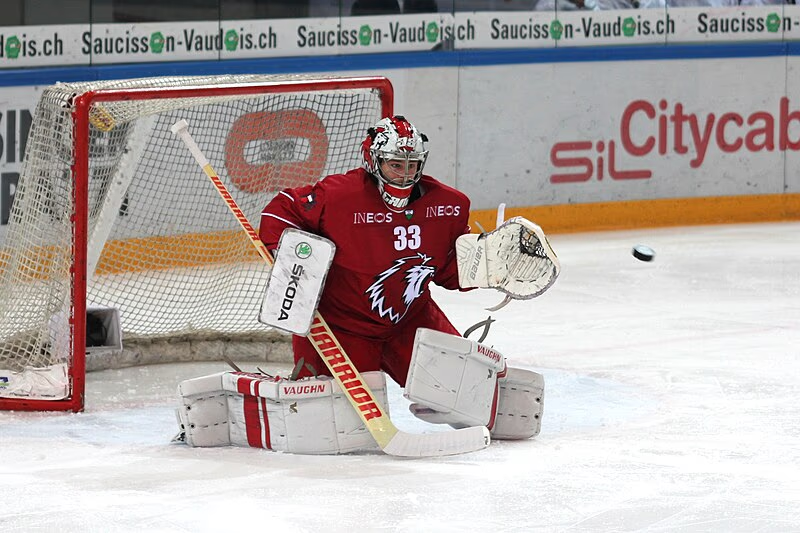
Leg pads: Maximum width 28 cm (11 in). Maximum length measured from centre of the knee to the boot: proportional to the goalkeeper's body. No rigid external attachments that extend the blocking surface beyond pad dimensions.; Catching glove (trapper): Maximum width 23 cm (9 in) measured across th...
Material: Vulcanised rubber, solid black.; Diameter: 7.62 cm (3 in).; Thickness: 2.54 cm (1 in).
Overall size: 60 m × 30 m (197 ft × 98.4 ft) for international/Olympic play. The wider surface compared to NHL rinks (200 ft × 85 ft) emphasises skating speed, passing, and positional play over physical forechecking.; Corner radius: 7–8.5 m (23–28 ft).; Boards: Height 1.07–1.22 m (42–48 in) above...
Centre red line: Divides the rink in half. 30 cm (12 in) wide. Used for icing determination.; Blue lines (2): 30 cm (12 in) wide, positioned 22.86 m (75 ft) from each goal line. Blue lines divide the ice into three zones: defending zone, neutral zone, and attacking zone.; Goal lines (2): 5 cm (2 ...
Goal frame: 183 cm (6 ft) wide × 122 cm (4 ft) high, measured from inside of the posts. Constructed of metal tubing, painted red. Net attached to the rear of the frame.; Goal crease: Semi-circular area in front of the goal with a radius of 1.8 m (5.9 ft), painted blue. The crease defines the goal...
Team benches: Located on the same side of the rink, one for each team, separated by the penalty boxes at centre ice.; Penalty boxes: Two boxes at centre ice (one per team) for penalised players. A third box (timekeeper's box) sits between them.; Bench gates: Must open away from the ice surface fo...
On-ice: 6 players per team — 5 skaters (typically 3 forwards + 2 defencemen) and 1 goalkeeper.; Roster: Maximum 22 skaters (20 skaters + 2 goalkeepers) dressed for a game. A third goalkeeper may be available but not dressed.; Extra attacker: Teams may pull the goalkeeper for a 6th skater (empty n...
4-official system (major tournaments): 2 referees + 2 linesmen. Both referees can call all penalties. Linesmen handle icing, offside, and face-offs, and may report certain infractions to the referees.; 3-official system: 1 referee + 2 linesmen. Used at lower-level IIHF events.; Referee authority:...
Never Run the Goalie
Deliberately targeting an opposing goaltender with a big hit — especially when they're set in the crease — is one of hockey's most serious code violations. Even when technically legal, going out of your way to hit the goalie signals disrespect for the game and guarantees immediate retaliation from the opposing team.
Goalies are considered protected figures in hockey culture; the code predates modern goalie interference rules.
Protect Your Goalie — Or Someone Answers
If an opponent runs your goaltender, at least one teammate must immediately confront the offender. Allowing your goalie to be hit without response is considered a failure of team character and signals the team can be intimidated. This duty often falls to the team's enforcer or toughest player.
More prominent in the pre-instigator-rule NHL era but persists at all competitive levels.
The Playoff Handshake Line Is Sacred
After a playoff series, both teams line up at center ice and shake hands with every opponent. Refusing to participate, going through it half-heartedly, or skipping players is considered one of hockey's gravest sportsmanship failures. The tradition is observed from youth playoffs through the Stanley Cup Finals and IIHF tournaments.
Uniquely hockey — no equivalent tradition exists quite like this in other major team sports.
Ready to dive deeper?
No Cheap Shots After the Whistle
Continuing to hit, slash, cross-check, or agitate an opponent after the referee blows the whistle is a serious breach of the code beyond whatever penalty it may draw. It is widely seen as cowardly — attacking when the player is no longer defending themselves — and guarantees a retaliatory response.
The Code of Fighting: Consent, Fairness, One-on-One
Staged fights follow implicit rules: both players must agree (drop gloves together), fight fairly (no sucker punches, no hitting a downed opponent), and teammates stand clear. Jumping someone from behind, attacking a player already engaged, or continuing to punch a fallen opponent are serious violations within the fighting code.
Most prominent in NHL culture; IIHF international play carries automatic game ejection for fighting, limiting its role there.
Don't Run Up the Score
When a team holds a commanding lead late in the game, they are expected to ease off — pulling star players, cycling the puck rather than shooting, avoiding additional scoring. Aggressively pursuing goals in a lopsided game is seen as showing up the opposition and will be remembered in the next meeting.
More rigidly observed in league play between rivals who face each other repeatedly.
Enforcers Protect Stars — They Are Off Limits for Cheap Shots
Skilled players are understood to be under the implicit protection of the team's enforcer. Taking unnecessary runs at a star player signals willingness to escalate and the enforcer is expected to respond. Teams without a credible physical presence are seen as vulnerable to opponents targeting their top players.
The canonical example: Dave Semenko and Marty McSorley's presence made targeting Wayne Gretzky prohibitively costly for opponents throughout the 1980s.
No Diving or Embellishment — Play Through Contact
Embellishing contact to draw a penalty is widely condemned in hockey culture. Players are expected to absorb physicality and demonstrate toughness. Being labeled a diver carries lasting reputational damage — officials and opponents give less benefit of the doubt on all future plays, making it strategically self-defeating as well as culturally scorned.
More sharply stigmatized in hockey than most contact sports due to the sport's deep identity around physical toughness.