









Section 1: Introduction
NCAA Women's Bowling is a championship-only NCAA sport contested by NCAA Division I, II, and III institutions in the winter semester. Unlike most NCAA sports, NCAA Women's Bowling is a single national championship covering all three divisions (no separate D1/D2/D3 brackets). The NCAA Women's Bowling Championship is contested in late March / early April. NCAA Women's Bowling uses the United States Bowling Congress (USBC) equipment and lane-conditioning standards with NCAA-specific competition format including the Baker format, oil pattern selection, and team-vs-team match-play structure.
The current edition is the 2025-26 NCAA Women's Bowling Rules Book. Bowling at the NCAA level is exclusively women's; men's collegiate bowling exists outside the NCAA framework (e.g., USBC Intercollegiate). This entry models the NCAA championship competition framework specifically.
Section 2: Equipment
- Bowling ball: per USBC specifications — max diameter 8.595", max weight 16 lb (per ball), drilled to fit individual bowler
- Each bowler may register up to 6 balls per tournament; balls must pass USBC inspection (oil absorption, hardness, surface)
- Bowling shoes: required, with the sliding shoe (left for right-handed bowlers, right for left) and the braking shoe
- Wrist and finger accessories permitted per USBC: tape, finger inserts, thumb sockets, wrist supports
- Apparel: NCAA-approved team uniform; restrictions on advertising/decoration
Section 3: Playing Area
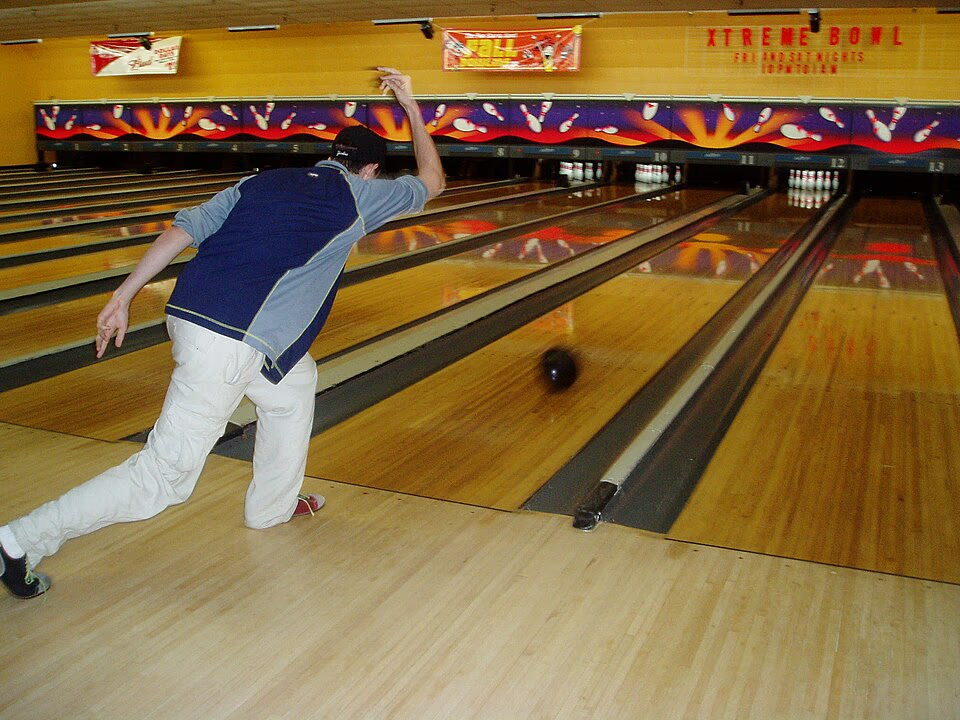
- Lane: 60 feet from foul line to head pin, 41-42" wide, with 39 boards across
- Approach: 15 feet from end of approach to foul line
- Pin deck: 7 ft beyond head pin; 10 pins set in triangular formation, 12" apart center-to-center
- Gutter (channel): on each side of the lane; ball in gutter = 0 pins for that ball
- Lane surface: maple or synthetic; oil-conditioned per the NCAA-published lane oil pattern for the meet
Oil Patterns
NCAA Women's Bowling uses a published list of oil patterns rotated through the championship. Common NCAA patterns include "U.S. Open," "World Championship," "Atlantic City," and venue-specific patterns. The pattern is announced before the round and applied uniformly across all lanes.
Section 4: Players & Officials
- Roster: 5 bowlers per team active for each match (additional bowlers may be substituted in/out depending on format)
- Substitutions: permitted between games per the published rule book
- Officials: tournament director, head official, lane officials, score keepers
- Coaches: head coach + assistant(s) in the team area; NCAA-specific on-deck coaching rules apply
Section 5: Rules of Play
Formats Used at NCAA Championship
- Traditional team format: each of the 5 bowlers bowls 10 frames; team total = sum of individual scores; 5 frames per game
- Baker format: 5 bowlers rotate through frames — bowler 1 bowls frames 1+6, bowler 2 bowls frames 2+7, etc.; team total per game; tactical depth comes from bowler order
- Match play: NCAA championship uses head-to-head match play in elimination rounds, where the winning team is the one with more games won (best of 7 typically)
Frame Rules
- 10 frames per game; first 9 frames: bowler gets 2 balls per frame (or until all pins down)
- 10th frame: bonus rolls if a strike or spare is rolled (up to 3 balls in the 10th)
- Bowler must release the ball before crossing the foul line (foul = 0 pins for that ball)
Order of Play
Bowlers alternate from the lane pair (each match is contested on a lane pair, with bowlers crossing back and forth between the two lanes for each frame).
Section 6: Scoring
- Strike (X): all 10 pins down on first ball; score = 10 + the next 2 balls' pin totals
- Spare (/): all 10 pins down across 2 balls; score = 10 + the next 1 ball's pin total
- Open frame: pins remaining after 2 balls; score = pin total
- 10th frame: strike → 2 bonus balls; spare → 1 bonus ball; open → no bonus
- Maximum game score: 300 (12 strikes in a row including the 10th-frame bonus)
- Team game score: sum of individual scores in traditional format; combined total in Baker format
- Match: best of N games; the team winning more games wins the match
Section 7: Violations & Penalties
- Foul: any part of the body crosses the foul line during release — 0 pins counted for that ball; pin reset
- Lofting: throwing the ball more than a defined distance past the foul line in the air — at the official's discretion may be a foul
- Illegal ball: ball not on USBC-approved list, ball failing post-tournament inspection — game scores adjusted retroactively per rule book
- Equipment violation: unapproved finger inserts, wrist supports, tape — warning + correction; subsequent violation = score adjustment
- Slow play / unsporting conduct: NCAA Sportsmanship Code applies; ejection at the meet referee's discretion
Section 8: Safety Considerations
Bowling has relatively low injury risk compared to most NCAA sports, but cumulative repetitive-strain injuries (shoulder, wrist, lower back, knee) are common. NCAA-mandated equipment standards (USBC-approved balls, properly fitted shoes) reduce slip-and-fall and ball-drop incidents. Lane-condition safety: lanes inspected pre-meet; oil applied per pattern uniformly to prevent unexpected ball behavior. Concussion protocol applies to any actual or suspected concussion (rare in bowling but possible from slip-and-fall on the approach). Medical coverage: certified athletic trainer at every NCAA-sanctioned meet. AED + emergency action plan at every venue.