



Section 1: Introduction
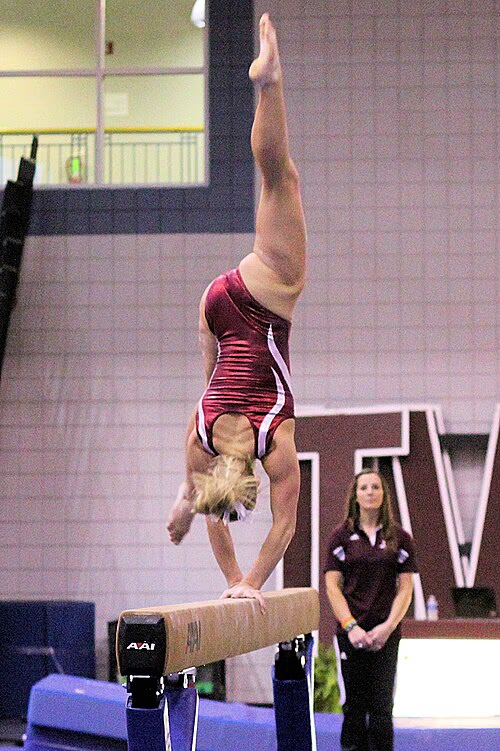
NCAA Gymnastics is the collegiate variant of artistic gymnastics contested by NCAA Division I, II, and III institutions in the winter semester. NCAA Women's Gymnastics is the larger competition and culminates in the NCAA Women's Gymnastics Championship in mid-April; NCAA Men's Gymnastics is contested by a smaller cohort of D1 programs (limited to ~12 schools as of 2026) culminating in the same week. NCAA Gymnastics uses the USA Gymnastics + FIG (International Gymnastics Federation) technical baseline with NCAA-specific modifications around scoring scale, lineup composition, and difficulty requirements. The current governing document is the 2025-26 NCAA Gymnastics Rules Modifications, which took effect for the 2026 competitive season and materially changed the Women's National Qualifying Score (NQS) formula, the postseason roster cap, Men's element-difficulty requirements, and judge-conference authority (see Sections 4-6 below). For the international FIG framework see the sibling FIG Code of Points entry.
Section 2: Equipment
- Apparatus per FIG specs (vault table, uneven bars, balance beam, floor exercise spring floor for W's; floor, pommel horse, rings, vault, parallel bars, high bar for M's)
- Personal equipment: leotard (W) / singlet+shorts (M); chalk; grips for bar events; springboard for vault
- NCAA-approved competition apparel; modesty standards apply
Section 3: Playing Area
- Competition area per FIG spec for each apparatus
- Vault runway: 25m
- Floor exercise: 12m × 12m sprung floor
- Balance beam: 5m × 10cm × 1.25m height
- Uneven bars: 1.7m + 2.5m heights
- Indoor venue with regulation gymnastics flooring
- Warm-up area + competition area + judges' tables
Section 4: Players & Officials
- NCAA W's team: 6 gymnasts compete per event; top 5 scores count toward team total (drop the lowest)
- NCAA M's team: 5 gymnasts compete per event; all 5 scores count (no drop)
- Regular-season roster: typically 15-20 athletes for D1; only 6 (W's) or 5 (M's) compete per event on a given apparatus
- Postseason roster cap (2026 season): the number of athletes a team may bring into postseason competition (regionals/championships) was raised from 15 to 20, reflecting the broader NCAA roster-size changes that took effect ahead of the 2025-26 academic year. Per the 2025-26 NCAA Gymnastics Rules Modifications.
- Officials: 2-4 judges per apparatus + chief judge; lineup official; meet referee
- Judge-conference authority (2026 season, NCAA Women's Gymnastics): a judging conference may now be called by either the chief judge or a panel judge — previously only the chief judge could initiate one. Valid grounds for a conference explicitly include an "impossible" score (e.g., a result inconsistent with the routine's start value), a score outside the possible range, a misapplied "up-to-the-level" (UTL) deduction, or an incorrectly recorded/input score. Per the 2025-26 NCAA Women's Gymnastics Rules Modifications.
- NCAA Championship advances 8 teams + individual qualifiers
Section 5: Rules of Play
- Each event: gymnast performs a routine demonstrating required elements + connections + dismount
- Routines must include specified number of "Special Requirements" per the NCAA Code (e.g., dance + acrobatics on floor)
- Time limits per apparatus: vault one attempt; bars/beam/floor: 30 sec - 1:30 limits per FIG/NCAA spec
- Falls: deduction + remount allowed if time/apparatus permit
- Touch warm-up before competition; salute judges before + after routine
- Men's element group requirements (2026 season): each of the five element groups (EG) must now include at least one D-level element to earn the full 0.5 Element Group Requirement (EGR) credit from the D-Jury, up from the C-level threshold used through the 2025 season — aligning NCAA Men's difficulty scoring with the FIG Code of Points. The exception is Element Group I on every apparatus, where any lettered element (A and above) still satisfies the 0.5 EGR credit. Per the 2025-26 NCAA Men's Gymnastics Rules Modifications.
Section 6: Scoring
- NCAA scoring: 10.0 maximum scale per routine (different from FIG open-ended Code of Points)
- Composed of D-Score (difficulty/composition) + E-Score (execution); NCAA caps at 10.0 by combining
- Each routine evaluated by 2-4 judges; high+low dropped; remaining averaged
- Team total: sum of 6 individual event totals; W's drops lowest of 6 per event = 5 scores; M's all 5 count
- National Qualifying Score (NQS) formula overhaul (2026 season, NCAA Women's Gymnastics): NQS — used to rank and seed teams for postseason qualification — now requires a minimum of nine meets, replacing the prior formula's fixed count of six meets regardless of schedule size. Up to five home-meet scores are counted (if a team has more than five home meets, only the lowest five home scores are retained and the rest are dropped), plus all road-meet scores; the single highest and single lowest scores across that pool are then dropped and the remainder are averaged. A minimum of five away meets is required to generate an NQS. Per the 2025-26 NCAA Women's Gymnastics Rules Modifications and the accompanying NQS Detail and Examples document.
- All teams are ranked by NQS beginning in week seven of the season, regardless of how many road meets a given team has completed by that point. Per the 2025-26 NCAA Women's Gymnastics Rules Modifications.
- NCAA Championship: top 4 teams in semifinals advance to "Super Six" final (W's) / similar M's bracket
Section 7: Violations & Penalties
- Form deductions: bent legs, separated legs, body position, height of skill
- Composition deductions: missing required elements, insufficient difficulty
- Falls: 0.5 deduction per fall (NCAA standard)
- Time over limit: 0.1 per second over
- Out of bounds: 0.1-0.3 deduction
- Coach interference during routine: 0.2-0.5 deduction
- Apparel violations: 0.1 deduction per violation
- Unsporting conduct: NCAA Sportsmanship Code; ejection + disciplinary review
Section 8: Safety Considerations
Spotters required at coach's discretion for high-risk skills. NCAA-mandated safety mats meeting FIG spec. Apparatus inspection pre-meet. Concussion protocol: removal + graduated return-to-play assessment for any actual or suspected concussion (apparatus falls and rotation-related impacts are primary risks). Spinal-injury emergency action plan required (vault and bars dismounts have highest spinal-injury risk). Required: certified athletic trainer at every meet; team physician + EMT/ambulance + AED at championship-level. Mental health support emphasized given the high-pressure nature of judged competition.