









Section 1: Introduction
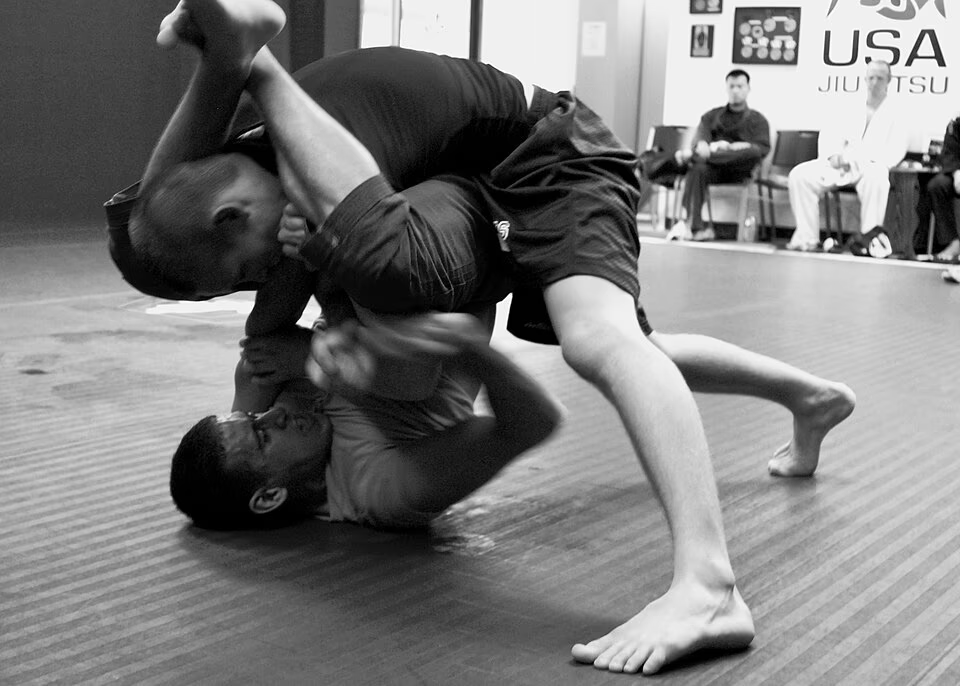
The International Brazilian Jiu-Jitsu Federation (IBJJF) is the most widely recognized governing body for sport Brazilian Jiu-Jitsu (BJJ), administering the World Championships ("Mundials"), Pan-American Championships, European Championships, and the IBJJF World Pro circuit. IBJJF rules govern both gi (traditional uniform) and no-gi formats, with separate rulesets and weight classes. BJJ is a grappling sport where competitors aim to control position, accumulate points through positional advancement, and ideally achieve submission (joint lock or choke) for an instant win. See sibling AJP Jiu-Jitsu Rules entry for the alternative Abu Dhabi-based ruleset.
Section 2: Equipment
- Gi (Kimono): IBJJF-approved gi (jacket + pants); minimum thickness; colored belt (white/blue/purple/brown/black + adult black-belt degrees) indicating rank
- No-Gi: rashguard + shorts (or grappling pants); rashguard must cover torso, no shoes
- Gi colors: white, blue, or black only; no patches in non-IBJJF locations
- Mouthguard recommended; protective cup permitted (no women's protective cup)
- No shoes, no jewelry, nails trimmed, hair tied back
Section 3: Playing Area
- Mat: minimum 8m × 8m IBJJF-approved competition mat with marked center + outer safety border
- Match area defined by colored mat edge
- Mat material: minimum 4 cm tatami-style thickness
- Multiple mats arranged in parallel at major championships
Section 4: Players & Officials
- Two competitors per match
- Weight classes (Adult Male, kg, gi): Rooster (-57.5), Light Feather (-64), Feather (-70), Light (-76), Middle (-82.3), Medium Heavy (-88.3), Heavy (-94.3), Super Heavy (-100.5), Ultra Heavy (+100.5)
- Belt classification: White, Blue, Purple, Brown, Black
- Age categories: Juvenile, Adult, Master 1-7 (30-65+)
- Officials: 1 mat referee + 1 scoring official + 1 timekeeper per match
Section 5: Rules of Play
Match Length
- White Belt: 5 min; Blue/Purple: 6 min; Brown: 7 min; Black: 10 min
- If tied at time, ref-decided victory based on advantages, penalties, position
Points (positional)
- 2 points: Sweep (from bottom to top), Knee-on-Belly
- 3 points: Guard Pass
- 4 points: Mount, Back Mount (back-control with hooks/body-triangle)
- 4 points: Back Take (entering back-control position)
Submission Wins
- Joint locks: armbar, kimura, americana, omoplata, kneebar (brown/black only), ankle locks (legal subset)
- Chokes: rear-naked, triangle, guillotine, etc.
- Opponent taps with hand, foot, or verbally → instant win
Advantages + Penalties
- Advantage: awarded for near-completion (e.g., near-submission, near-sweep); used as tiebreaker only
- Penalty: stalling, fleeing, unsportsmanlike — accumulated → opponent advantage
Section 6: Scoring
- Match decision priority: submission > points > advantages > penalties > referee decision
- Tournament: single-elimination bracket within each weight + belt + age group
- Absolute: open-weight category at championship level (all weights together)
- Gold/Silver/Bronze per category
Section 7: Violations & Penalties
- Stalling: verbal warning → penalty (gives opponent advantage); 4 penalties = DQ
- Fleeing match area: penalty
- Illegal submissions: any submission not permitted at the belt level → DQ if applied; e.g., heel hooks illegal in gi, knee reaps illegal in many categories
- Slamming: DQ (lifting + slamming opponent to escape submission)
- Unsportsmanlike conduct: penalty → DQ
- Gi-grip violations: grabbing inside the pants/sleeve cuff → penalty
- Anti-doping: IBJJF anti-doping program; WADA Code aligned
Section 8: Safety Considerations
BJJ injury profile: joint injuries (shoulder, elbow, knee), neck strain, occasional concussion. IBJJF prohibits slamming. Belt-graded submission restrictions: heel hooks, knee reaps, twisters, and other high-risk submissions only legal at brown/black belt levels (and only in no-gi, often). Referee may stop match for safety concerns. On-site EMT required at IBJJF events; medical doctor + ambulance at world-championship level. AED on-site. Concussion protocol: medical clearance required to return to competition after head impact. Pre-match medical check + mat inspection. Anti-skin-infection screening (skin checks before mat use to prevent ringworm/MRSA spread).