











Section 1: Introduction
1.1 Origins and Philosophy
Judo was founded in 1882 by Professor Jigoro Kano in Tokyo, Japan. Drawing from the traditional Japanese martial art of jujutsu, Kano distilled its most effective techniques into a refined system built on two core principles: Seiryoku Zen'yo (maximum efficiency with minimum effort) and Jita Kyoei (mutual welfare and benefit). Kano established the Kodokan as judo's founding institution, and the art rapidly spread worldwide during the early twentieth century. The word "judo" translates literally as "the gentle way," reflecting its emphasis on using an opponent's force and momentum rather than brute strength.
1.2 Governing Body
The International Judo Federation (IJF) is the sole worldwide governing body for the sport of judo, recognized by the International Olympic Committee (IOC). Founded in 1951 and headquartered in Budapest, Hungary, the IJF oversees competition rules, referee standards, athlete rankings, and anti-doping enforcement. The IJF publishes and annually updates the Sport and Organization Rules (SOR), which serve as the authoritative rulebook for all sanctioned international competitions. National federations affiliated with the IJF implement these rules at the domestic level.
1.3 Olympic History
Judo made its Olympic debut as a demonstration sport at the 1964 Tokyo Games, where men's events were contested in four weight categories. It became a permanent Olympic sport for men from 1972 onward. Women's judo was introduced as a demonstration event at the 1988 Seoul Games and gained full medal status at the 1992 Barcelona Olympics. The 2020 Tokyo Games introduced the Mixed Team Event, in which national teams of three men and three women compete in head-to-head elimination rounds across designated weight categories. Today, the Olympic judo program comprises seven men's individual weight classes, seven women's individual weight classes, and the mixed team event, totaling fifteen gold medals.
1.4 Technique Classification
Judo techniques are classified into three broad families:
- Nage-waza (Throwing Techniques): Subdivided into standing techniques (tachi-waza) and sacrifice techniques (sutemi-waza). Standing techniques include hand throws (te-waza), hip throws (koshi-waza), and foot/leg throws (ashi-waza). Sacrifice techniques include front sacrifice (ma-sutemi-waza) and side sacrifice (yoko-sutemi-waza).
- Katame-waza (Grappling Techniques): Includes pinning/hold-down techniques (osaekomi-waza), joint lock techniques (kansetsu-waza, restricted to the elbow joint in competition), and strangling/choking techniques (shime-waza).
- Atemi-waza (Striking Techniques): Practiced only in kata (pre-arranged forms) and prohibited in competitive randori or shiai (matches).
Section 2: Equipment
2.1 Judogi (Competition Uniform)
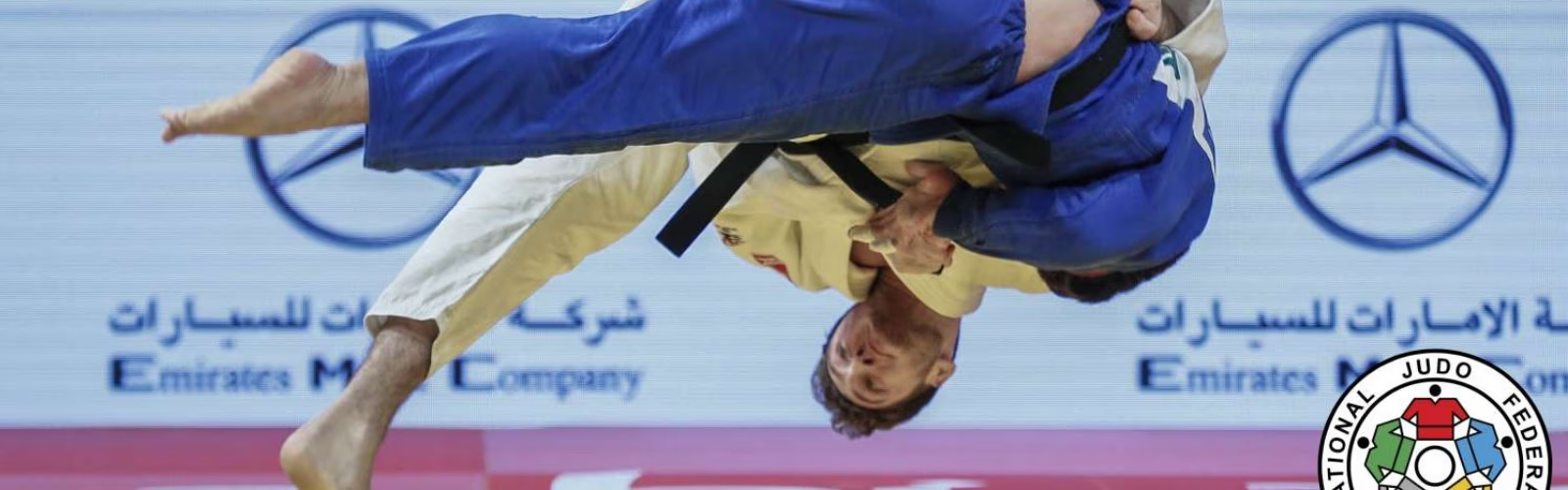
Athletes must bring both a white judogi and a blue judogi to competition. The color is assigned by draw: the first-called competitor wears white, the second wears blue. The judogi must conform to IJF size and material specifications:
- Jacket (Uwagi): Must be long enough to cover the thighs and reach the wrists when arms are extended downward along the sides of the body. The jacket must overlap the body by at least 20 cm (8 in) at chest level when the belt is tied. The fabric must be of sufficient thickness and rigidity to allow a standard grip (SOR 8.3).
- Sleeves: Must leave a minimum gap of 5 cm (2 in) between the end of the sleeve and the wrist joint. Sleeves must not be rolled up during competition (SOR 8.3).
- Trousers (Zubon): Must reach the ankle bone, with a minimum gap of 5 cm (2 in) above the ankle. Trousers must be loose enough to allow free movement of the legs (SOR 8.3).
- Belt (Obi): Width of 4–5 cm (1.6–2 in), tied with a flat square knot sitting firmly over the jacket. The free ends of the belt must be 20–30 cm (8–12 in) long after the knot is tied. Belt color indicates rank but does not affect competition uniform compliance.
- Material: The judogi must be made of cotton or similar natural fiber material. IJF-approved judogi bear a specific label certifying they meet density, shrinkage, and grip-resistance standards. Only judogi appearing on the IJF-approved manufacturer list may be worn at World Tour events (SOR 8.3).
2.2 Personal Equipment and Hygiene
- Fingernails and toenails must be cut short to prevent injury.
- Long hair must be tied back so it does not obstruct the opponent's face or interfere with gripping.
- Hard objects (rings, piercings, bracelets, watches) are strictly prohibited during competition.
- Religious or medical headwear may be worn if approved by the IJF and secured so it cannot come loose during combat.
- Female athletes must wear a plain white t-shirt beneath the jacket. Male athletes may not wear anything under the jacket.
2.3 Competition Equipment
- Scoreboard: Electronic scoreboard visible to athletes, coaches, and spectators displaying scores, penalties, osaekomi time, and match clock.
- Video Review System: The IJF CARE (Computer Assisted Referee Evaluation) system provides instant video replay to assist referees on contested calls.
- Timing Devices: Electronic clock for match time (4:00), osaekomi timer (counts to 20 seconds for ippon), and Golden Score timer (counts upward).
Section 3: Playing Area
3.1 Tatami Specifications
All IJF-sanctioned competitions take place on a regulation tatami (competition mat) meeting the following dimensional requirements:
- Total Platform: Minimum 14 m × 14 m (46 ft × 46 ft), encompassing the contest area and the safety area — the IJF rules no longer define a separate "danger zone", which was removed from the Sport and Organisation Rules (SOR 8.7).
- Contest Area: a minimum of 8 m × 8 m and a maximum of 10 m × 10 m; Olympic and World Championship finals typically use 10 m × 10 m (SOR 8.7).
- No danger zone: The 1 m red border strip inside the contest area was abolished and does not appear in the current Sport and Organisation Rules. The mat is defined as contest area plus safety area only, so there is no intermediate zone governing whether an action counts (SOR 8.7).
- Safety Area: Minimum 3 m wide surrounding the contest area, with a free zone of at least 50 cm (SOR 8.7). When two mats are placed adjacent, the combined safety zone between them must be at least 4 m (13 ft).
3.2 Mat Construction and Approval
Tatami mats must be IJF-approved, constructed from high-density foam (typically EVA or compressed polyurethane) with a textured, non-slip vinyl surface. Mat firmness must allow safe breakfalls (ukemi) while providing enough friction to prevent uncontrolled sliding. The contest area and safety zone are distinguished by color: typically green or yellow for the contest area and red for the danger zone. Mats must be laid flat without gaps, ridges, or overlapping seams that could cause tripping (SOR 8.7).
3.3 Venue Requirements
- Minimum ceiling height of 4 m (13 ft) above the mat surface (SOR 8.7).
- Adequate lighting of at least 1,500 lux at mat level for competition and broadcast requirements (SOR 8.7).
- Warm-up area adjacent to the competition hall with sufficient mat space for athletes to prepare (SOR 8.7).
- Designated coaching chairs positioned at two diagonal corners of the competition area, one per athlete (SOR 8.7).
- Medical station with stretcher access within 30 seconds of any competition mat (SOR 8.7).
Section 4: Players & Officials
4.1 Weight Categories
Individual events are contested in seven weight categories per gender. Athletes must weigh in on the morning of competition (official weigh-in) and may not exceed the upper limit of their category:
- Men: −60 kg, −66 kg, −73 kg, −81 kg, −90 kg, −100 kg, +100 kg (SOR 2.2, 6.1)
- Women: −48 kg, −52 kg, −57 kg, −63 kg, −70 kg, −78 kg, +78 kg (SOR 2.2, 6.1)
There is no minimum weight. Athletes who fail the official weigh-in are disqualified and may not compete. A tolerance of zero grams applies at IJF World Tour and Olympic events. Random weight checks may be conducted after weigh-in and before the first match (SOR 6.2–6.3).
4.2 Mixed Team Event
The Olympic mixed team event features national teams of six athletes: three men and three women. Matches are contested in a fixed weight order:
- Women −57 kg (SOR 2.2.2)
- Men −73 kg (SOR 2.2.2)
- Women −70 kg (SOR 2.2.2)
- Men −90 kg (SOR 2.2.2)
- Women +70 kg (SOR 2.2.2)
- Men +90 kg (SOR 2.2.2)
Each match is a standard 4-minute bout. The team winning the majority of matches (first to four wins) advances. If tied at 3–3, a random draw selects one of the six weight categories for a deciding "golden match." (SOR 2.2.2)
4.3 Referees and Judges
Each match is officiated by a panel of three:
- Mat Referee (Shushin): Stands on the contest area, directs the match, announces scores and penalties, and has primary authority over all decisions (IJF Refereeing Rules, Articles 1–4).
- Two Side Judges (Fukushin): Seated at diagonal corners of the mat with access to video review monitors. They may signal disagreement with the referee's call by raising a flag or pressing a buzzer (IJF Refereeing Rules, Articles 1–4).
Decisions are made by majority rule: if two of the three officials agree, the call stands. The IJF CARE system (Computer Assisted Referee Evaluation) provides instant multi-angle video replay. Referees may initiate a video review at any time, and the CARE commission supervisor may intervene on clear errors. All IJF referees must hold current certification and attend annual rules seminars (IJF Refereeing Rules, Articles 1–4).
4.4 Coaches
Each athlete is permitted one coach seated in the designated coaching chair. Coaches may offer verbal encouragement but may not physically approach the mat, interfere with officials, or use electronic devices to communicate tactical instructions during the match. Coaches who violate decorum rules may be issued a warning or removed from the competition venue.
Section 5: Rules of Play
5.1 Match Duration
All individual matches at IJF-sanctioned events are 4 minutes in duration for both men and women. The clock is stopped during "matte" (halt) calls and other stoppages. If the match is tied at the end of regulation time, it proceeds to Golden Score: an unlimited overtime period with no time limit, where the first score of any kind (ippon, waza-ari, or the opponent receiving a third shido) immediately wins the match. The clock in Golden Score counts upward from 0:00 (SOR 2.4; Refereeing Rules Article 6).
5.2 Starting and Resuming
Athletes begin each match standing at their designated marks on the mat, approximately 4 m apart. The referee calls "Hajime" (begin) to start and "Matte" (wait/stop) to halt action. After matte, athletes return to their starting positions before the referee restarts with hajime. The referee calls "Sore-made" (that is all) to end the match (Refereeing Rules Article 9).
5.3 Standing Techniques (Tachi-waza)
The primary objective in standing combat is to execute a throwing technique that projects the opponent onto their back. Athletes establish grips (kumi-kata) on the opponent's judogi and attempt to create off-balance (kuzushi) before executing a throw. Key standing rules include:
- Athletes must make genuine attempts to attack. Prolonged periods without attack are penalized as non-combativity (passivity).
- Standard grip: one hand on the lapel, one hand on the sleeve. Non-standard grips (cross-grip, belt grip, back grip, pocket grip) are permitted but the athlete must attack immediately or transition to a standard grip.
- One-hand gripping without immediate attack, or breaking grip with two hands on the same arm, is penalized by shido.
- Pistol grip (gripping the end of the sleeve by rolling it) and pocket grip (inserting fingers inside the sleeve or trouser leg) are prohibited.
5.4 Ground Techniques (Ne-waza)
Ground work is permitted when there is a legitimate transition from standing to ground, including:
- A throw attempt that brings both athletes to the ground (Refereeing Rules Article 17).
- One athlete falling or being pulled to the ground through a legitimate technique (Refereeing Rules Article 17).
- One athlete skillfully transitioning from a standing position to a ground position while maintaining contact (Refereeing Rules Article 17).
Once on the ground, athletes may apply pins (osaekomi-waza), arm locks (kansetsu-waza), or chokes (shime-waza). The referee calls "Osaekomi" when a valid pin is established, starting the pin timer. The referee calls "Toketa" if the pinned athlete escapes. If neither athlete makes progress on the ground, the referee calls matte and returns both athletes to standing (Refereeing Rules Article 17).
5.5 Leg Grab Ban
Since the 2013 rule revision, all direct attacks to the opponent's legs using the hands or arms are strictly prohibited. Any attempt to grab, block, or attack the opponent's legs below the belt line — whether as a primary attack, counter-attack, or in combination — results in immediate hansoku-make (disqualification). This rule was introduced to promote dynamic, upright judo and clearly distinguish competitive judo from wrestling styles. The ban applies to techniques such as morote-gari (two-hand reap), kuchiki-taoshi (single-leg takedown), kibisu-gaeshi (heel pick), and kata-guruma executed by grabbing the legs (Refereeing Rules Article 18).
5.6 Boundary Rules
A technique initiated inside the contest area remains valid even if the athletes land in the safety zone, provided the attacking action began while at least one foot of the attacker was inside or on the danger zone boundary. If both athletes step fully outside the contest area without a technique in progress, the referee calls matte. Deliberately stepping outside to avoid an attack or to stall is penalized by shido (Refereeing Rules Article 5).
Section 6: Scoring
Judo scores at three levels — ippon, waza-ari and yuko. Yuko was removed from the scoring table in the 2017 revision and has since been reinstated: in the rules in force from 21 January 2026, Article 15 is titled "Waza-ari and Yuko" and defines yuko in both standing and groundwork phases (Article 15). Any description of modern judo as a two-score sport reflects the 2017–2025 period, not the current rules.
6.1 Ippon (Full Point — Instant Win)
The four criteria for ippon are speed, force, landing on the back, and skilful control maintained until the end of the landing (Article 14). Scoring requires a continuous action: if there is a stop in the action, there is no score, and the technique must be identifiable among the Kodokan classified techniques or their recognised variations (Article 14). An ippon immediately ends the match. It is awarded for:
- Throw: Throwing the opponent on the back with considerable ability and maximum efficiency. All four criteria must be present; the absence of one reduces the score to waza-ari or yuko (Article 14).
- Pin (Osaekomi): Holding the opponent with osaekomi-waza for 20 seconds (Articles 15, 17).
- Submission: Forcing the opponent to tap out by verbal signal, tapping the mat or the opponent's body, or tapping with the foot. Submissions result from arm locks (elbow hyperextension) or chokes (Article 14).
- Waza-ari-awasete-ippon: On a second waza-ari in the contest the referee announces waza-ari-awasete-ippon — two waza-ari score ippon — ending the match (Article 16).
6.2 Waza-ari (Near Ippon)
Waza-ari is announced when the technique lands the opponent more than 90 degrees of the shoulder axis but not on the back, or when the four ippon criteria are not fully achieved (Article 15). A score is given for a whole side of the body landing even when the elbow is out; only the shoulder position is considered, and anything outside that range is yuko or no score (Article 15).
- A throw landing beyond 90 degrees of the shoulder axis but short of the back (Article 15).
- A throw missing one of the four ippon criteria (Article 15).
- A pin held for 10 seconds or more but less than 20 seconds (10–19 seconds) (Articles 15, 17).
The second waza-ari ends the contest as waza-ari-awasete-ippon (Article 16).
6.3 Yuko
Yuko — glossed in the IJF terminology as "nearly waza-ari" — is awarded in tachi-waza for (Article 15):
- A side landing at 90 degrees, or more toward the front landing (Article 15).
- Landing on the upper back (Article 15).
- Landing on the side on the shoulder axis with one elbow or one hand (Article 15).
- Landing on both buttocks, close to 90 degrees to the front or 90 degrees or more to the rear — yuko, and no shido (Article 15).
- Landing on one buttock, with or without the elbows or arms touching the mat (Article 15).
- Landing on the neck (Article 15).
Yuko is not awarded if the front of the stomach, the front of both hips, or both knees touch the mat before a side landing of 90 degrees or more toward the front (Article 15). In ne-waza, yuko is awarded for an osaekomi held 5 seconds or more but less than 10 seconds (5–9 seconds) (Articles 15, 17).
Yuko scores are counted individually (1, 2, 3, and so on) but never add up to a waza-ari (Article 15). No quantity of yuko can promote itself into a higher score — this is what separates the reinstated yuko from the pre-2017 accumulating scores.
6.4 Score Hierarchy and Match Outcome
If a match reaches the end of regulation time without an ippon, the athlete with the higher score wins. The levels rank:
- Ippon — immediate victory; the match does not reach time (Article 14).
- Waza-ari — outranks any number of yuko (Articles 15, 16).
- Yuko — counted, but never aggregating into waza-ari (Article 15).
- Fewer penalties — with scores equal, the athlete with fewer shido wins (Article 18).
- Golden Score — with scores and penalties identical, the contest is decided by a golden score period (Article 16).
The relative weight of the three levels is explicit in the IJF's own round-robin classification, which values ippon and waza-ari-awasete-ippon at 100, waza-ari at 10, yuko at 1, and hantei at 0. There is no draw in judo; every match must produce a winner.
Section 7: Violations & Penalties
7.1 Shido (Minor Penalty)
A shido is a minor penalty assessed for rule violations that do not endanger the opponent. Shidos accumulate during the match: the first and second serve as warnings, while the third shido results in hansoku-make (disqualification). Penalties do not carry over between matches. Common shido infractions include:
- Non-combativity (passivity): Failing to make genuine attacking efforts within approximately 30–45 seconds. The referee may signal a warning gesture before awarding the shido (Refereeing Rules Article 18).
- Defensive posture: Adopting an excessively bent-over posture (head down) to prevent the opponent from gripping or attacking, or locking the opponent in a bear hug without attempting a technique (Refereeing Rules Article 18).
- False attack: Executing a technique with no genuine intent to throw, solely to reset the passivity clock or create an appearance of activity (Refereeing Rules Article 18).
- Intentional exit: Deliberately stepping outside the contest area or pushing the opponent out to avoid combat (Refereeing Rules Article 18).
- Grip violations: Maintaining a non-standard grip (cross-grip, one-sided, belt, back) for more than 5 seconds without attacking. Breaking the opponent's grip with two hands on the same arm. Using a "pistol grip" on the sleeve end (Refereeing Rules Article 18).
- Stalling on the ground: Holding the opponent down without establishing a valid osaekomi, or deliberately preventing ground-work progress (Refereeing Rules Article 18).
- Judogi adjustment: Repeatedly requesting matte to fix the judogi without legitimate need, or deliberately disarranging the judogi (Refereeing Rules Article 18).
- Head defense: Inserting fingers inside the opponent's sleeve or trouser leg, or using the head as a primary blocking tool against throws (Refereeing Rules Article 18).
7.2 Hansoku-make (Disqualification)
Hansoku-make is assessed in two forms:
- Accumulated hansoku-make: Results from receiving a third shido in a single match. The athlete loses the match but retains eligibility for repechage (bronze medal contest) in the tournament (Refereeing Rules Article 18).
- Direct hansoku-make: Awarded for a serious rule violation. The athlete loses the match and is eliminated from the entire tournament (no repechage eligibility). Direct hansoku-make offenses include:
- Any leg grab attack (morote-gari, kuchiki-taoshi, kibisu-gaeshi, or any hand/arm contact below the belt to execute a throw) (Refereeing Rules Article 18).
- Dangerous techniques such as kawazu-gare (wrapping leg throw) or head-diving throws (dropping headfirst into the mat while throwing) (Refereeing Rules Article 18).
- Applying kansetsu-waza (joint locks) to any joint other than the elbow (Refereeing Rules Article 18).
- Lifting an opponent who is applying an arm lock or choke and slamming them to the mat (Refereeing Rules Article 18).
- Falling directly backward when the opponent is clinging to the back (Refereeing Rules Article 18).
- Scissor takedowns (kani-basami) applied to the standing opponent's legs (Refereeing Rules Article 18).
- Unsportsmanlike conduct, disrespecting the opponent or officials, or acting against the spirit of judo (Refereeing Rules Article 18).
7.3 Mate and Video Review Challenges
Coaches may not formally challenge a referee's decision. However, the CARE system supervisors may intervene if a clear factual error is detected on video review. The mat referee retains ultimate authority on subjective judgment calls (e.g., whether a throw constitutes ippon or waza-ari). Video review is primarily used to verify landing positions, boundary calls, and whether a technique was initiated before a matte call (SOR 7.3; Refereeing Rules Article 11).
Section 8: Safety Considerations
8.1 Age-Based Technique Restrictions
To protect developing athletes, the IJF and most national federations enforce strict age-based technique restrictions:
- Cadets (Under 18): Kansetsu-waza (arm locks) and shime-waza (chokes) are completely prohibited. Any attempt, even in a playful or accidental manner, results in matte and a warning or penalty.
- Younger age groups (Under 13/Under 15): Additional technique restrictions may apply per national federation rules, including bans on certain sacrifice throws and restrictions on ne-waza duration.
- Seniors (18+): All legal techniques are permitted, including arm locks and chokes.
8.2 Medical Protocols
- Medical Staff: At least one qualified doctor must be present at each competition mat. Major events require a full medical team with emergency resuscitation equipment (SOR 8.8; Refereeing Rules Article 20).
- Blood Rule: If an athlete is bleeding, the referee immediately calls matte. The athlete has a maximum of 5 minutes of cumulative medical treatment time per match. If the bleeding cannot be controlled, the match is forfeited (SOR 8.8; Refereeing Rules Article 20).
- Concussion Protocol: If a referee or doctor suspects a concussion (loss of consciousness, disorientation, inability to stand), the match is stopped immediately. The athlete may not continue and must undergo mandatory medical evaluation before being cleared to compete again. An athlete who is knocked unconscious is automatically withdrawn from the tournament (SOR 8.8; Refereeing Rules Article 20).
- Injury Timeout: An injured athlete may receive on-mat medical attention. If the athlete cannot continue, the match is awarded to the opponent. The referee, in consultation with the medical staff, has sole authority to determine if an athlete is fit to continue (SOR 8.8; Refereeing Rules Article 20).
8.3 Mat and Facility Safety
- Tatami mats must be inspected before each competition day for proper alignment, firmness, and absence of tears or seam gaps (SOR 8.7).
- The safety zone must be kept clear of chairs, equipment, bags, and spectators at all times (SOR 8.7).
- When multiple competition areas are in use, adjacent safety zones must not overlap in a way that could cause collisions between athletes on different mats (SOR 8.7).
- Temperature and humidity in the competition hall must be maintained at levels that prevent excessive sweating that could compromise grip safety (SOR 8.7).
8.4 Breakfall Training (Ukemi)
All competitive judoka must be proficient in ukemi (breakfall techniques) before entering competition. Proper ukemi — including back falls (ushiro-ukemi), side falls (yoko-ukemi), front falls (mae-ukemi), and rolling falls (zenpo-kaiten-ukemi) — is the primary defense against injury from throws. Referees may stop a match if they determine an athlete is unable to fall safely, indicating insufficient preparation for competition.
8.5 Anti-Doping
The IJF adheres to the World Anti-Doping Agency (WADA) Code. All athletes at IJF-sanctioned events are subject to in-competition and out-of-competition testing. Violations result in suspension, stripping of results, and potential lifetime bans for repeat offenses.