


🏛️Official — UWW
Loading OpenSourceSports…
Combat Sports
1 players
both
singlet, footwear, handkerchief
10 essential rules
Wrestling is one of the oldest competitive disciplines in human history, depicted in cave drawings dating back 15,000 years and contested at the ancient Olympic Games from 708 BC. It has appeared at every modern Olympic Games since 1896, making it one of the foundational sports of the Olympic pro...
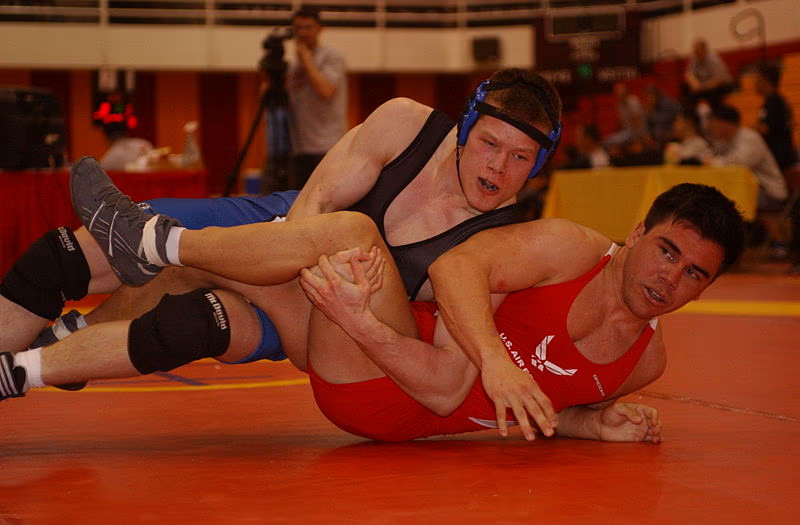
Wrestlers must wear a one-piece wrestling singlet in either red or blue, as assigned by the competition draw. The singlet must be UWW-approved, tight-fitting to the body, and made of a non-abrasive material.
Athletes must wear approved wrestling shoes that cover and support the ankle. Shoes must have soft, non-marking soles with no heels.
Headgear (ear guards) is optional in senior international competition but strongly recommended to prevent cauliflower ear (auricular hematoma). Headgear is mandatory at Cadet (U17) and some Junior (U20) age levels, as determined by UWW regulations.
Handkerchief (Blood Rag): Every wrestler must carry a handkerchief tucked into the singlet during competition. This is used for immediate blood management if bleeding occurs.; Nails: Fingernails and toenails must be trimmed short before competition. Referees inspect nails at the pre-match equipme...
All UWW-sanctioned competitions take place on a regulation wrestling mat. The mat is a square platform with a circular competition surface marked upon it.
The mat must be at least 6 cm (2.4 in) thick, constructed from high-density, shock-absorbing foam covered with a smooth, non-abrasive vinyl surface. The surface must provide adequate grip without causing mat burns.
Red and blue corner marks are placed diagonally opposite each other on the mat edge, corresponding to the assigned wrestler colors. The central circle includes a starting line for each wrestler.
Wrestling is an individual sport. Each match features two athletes competing one-on-one.
UWW recognizes the following competitive age divisions, each with its own weight classes: Schoolboys/Schoolgirls: 14–15 years old; Cadets: 16–17 years old; Juniors: 18–20 years old
Each match is overseen by a three-person officiating panel to ensure accuracy and fairness: Mat Referee: The primary official on the mat. The referee controls the action, starts and stops the bout, awards points, issues cautions and passivity calls, and ensures wrestler safety. The referee wears ...
Always complete the post-match handshake
After every match, competitors are expected to shake hands with the opponent and the referee. Refusing or giving a disrespectful handshake — even after a disputed loss — is considered one of the gravest breaches of wrestling etiquette and has triggered international incidents at World Championships and Olympic Games.
Several high-profile refusals at international competitions, often politically motivated, have been widely condemned by wrestling communities and governing bodies regardless of the underlying dispute.
Don't sandbag or manipulate brackets
Deliberately underperforming in preliminary rounds to land in a more favorable bracket position, or losing intentionally to avoid a difficult opponent, is considered deeply dishonorable. Wrestling culture places strong value on competing honestly every match. High-profile sandbagging accusations have damaged reputations significantly.
More relevant at team competitions or multi-day tournaments where bracket positioning creates strategic incentives.
Win with dignity — no excessive celebration
Taunting, prolonged celebration, or showboating after pinning or defeating an opponent is strongly frowned upon. The expectation is to acknowledge the win briefly and immediately show respect to your opponent. This norm is especially strong after a pin, where the defeated wrestler is already in a physically and psychologically vulnerable position.
Ready to dive deeper?
No trash talk or verbal taunting on the mat
Wrestling is culturally a silent competition. Verbal taunting, intimidation, or trash talk directed at an opponent during a match is considered dishonorable. The mat is understood as a space where the contest speaks for itself. Coaches may communicate to their athlete, but wrestler-to-wrestler verbal aggression violates the culture strongly.