













Section 1: Introduction
1.1 Overview and Governing Body
Luge is governed by the Fédération Internationale de Luge de Course (FIL), founded in 1957 and headquartered in Berchtesgaden, Germany. The sport operates under the FIL International Luge Regulations (ILR), updated before each competition season. With over 50 member nations, the FIL oversees artificial track luge, natural track luge, and roller luge disciplines.
1.2 Olympic History
Luge became an Olympic sport at the 1964 Innsbruck Winter Games, following a tragic training accident that prompted significant safety reforms. The initial Olympic programme featured Men's Singles and Women's Singles. Doubles (open event, historically contested by men) was added in 1964 as well. The Team Relay was introduced at the 2014 Sochi Games, bringing the total to four Olympic events. Luge has been contested at every Winter Olympics since 1964.
1.3 The Sport
Luge athletes ride feet-first in a supine (face-up) position on a small, flat sled with no mechanical steering or braking mechanism. This distinguishes luge from skeleton (head-first, prone) and bobsled (seated, enclosed sled with steering and braking). Luge is the fastest of the three sliding sports, with top speeds regularly exceeding 140 km/h (87 mph) and reaching over 150 km/h (93 mph) on certain tracks. Athletes experience gravitational forces of up to 5G through banked curves while lying millimetres above the ice surface.
Section 2: Equipment
2.1 The Sled
The luge sled consists of two runner assemblies (called "steels") connected by two bridges (cross-members) known as "kufens." The sled has no mechanical steering, braking, or aerodynamic fairings. Key specifications:
- Singles (men): Maximum sled weight 23 kg (50.7 lb). Maximum length 150 cm (59 in). Maximum width 55 cm (21.7 in).
- Singles (women): Maximum sled weight 21 kg (46.3 lb). Same dimensional limits as men's.
- Doubles: Maximum sled weight 27 kg (59.5 lb). Maximum length 167 cm (65.7 in). Maximum width 60 cm (23.6 in).
The combined weight of athlete(s) plus sled is also regulated. Lighter athletes may add ballast weight (lead plates secured to the sled or worn in a weight vest) up to a specified limit. This ensures heavier athletes do not gain an unfair gravitational advantage.
2.2 Runners (Steels)
- Material: tempered steel with a specific hardness range regulated by the FIL
- Runner temperature: must not exceed the ice surface temperature by more than 5°C (9°F) at pre-race inspection. Artificial heating is prohibited.
- Runner profile: standardised gauge dimensions. Athletes may polish and prepare the running surface within FIL tolerances but may not alter the profile geometry beyond permitted limits.
- Runner curvature: slight bow is permitted within FIL template specifications, allowing athletes to customise their sled's response characteristics.
2.3 Athlete Equipment
- Helmet: Aerodynamic visor helmet mandatory, conforming to FIL specifications. Full face shield required. Helmets must pass impact testing standards.
- Racing suit: Skin-tight aerodynamic suit with maximum material thickness regulated to prevent concealed weight or aerodynamic modifications. Suits must be FIL-homologated.
- Spiked gloves: Used during the paddle start to propel the sled. Maximum spike length 4 mm (0.16 in). Spike material and pattern regulated.
- Booties: Aerodynamic foot covers (booties) are worn over the racing shoes to reduce drag. Must conform to FIL specifications.
Section 3: Playing Area
3.1 Track Specifications
Luge competitions take place on the same artificially refrigerated tracks used for bobsled and skeleton. However, luge athletes start from different (often higher) positions on the track. Key dimensions for luge:
- Men's singles track length: 1,000–1,350 m (3,281–4,429 ft)
- Women's singles/doubles track length: 800–1,100 m (2,625–3,609 ft)
- Vertical drop: 85–130 m (279–427 ft)
- Number of curves: 13–20, with a mix of left and right turns
- Average gradient: 8–11%
- Wall height: Up to 6 m (20 ft) in high-speed banked curves
3.2 Start Area
The luge start area is fundamentally different from bobsled. Athletes begin seated on the sled, gripping fixed start handles mounted alongside the track. On the signal, the athlete rocks the sled back and forth to build momentum, releases the handles, and paddles with spiked gloves on the ice surface for approximately 30–50 m to accelerate. Start handles are standardised by the FIL and positioned identically at all competition tracks.
3.3 Finish Area
The finish area includes electronic timing beams that capture finish times to 1/1000th of a second (more precise than bobsled's 1/100th). A deceleration zone follows the finish, with an uphill incline and braking area to bring sleds to a safe stop. Crash padding and run-off areas are provided at the finish zone.
3.4 Track Sharing Protocol
Because luge, bobsled, and skeleton share tracks, competition scheduling requires careful coordination. Luge training and competition sessions alternate with the other disciplines. Ice conditions are maintained between sessions by track crews who apply water and allow it to freeze under controlled refrigeration. Track temperature, ice quality, and ambient conditions are recorded and published for all sessions.
Section 4: Players & Officials
4.1 Competition Categories
- Men's Singles: One athlete per sled. Athletes must meet minimum age requirements (typically 16 for World Cup, 18 for Olympics) and hold a valid FIL licence.
- Women's Singles: One athlete per sled. Same licensing and age requirements as men's.
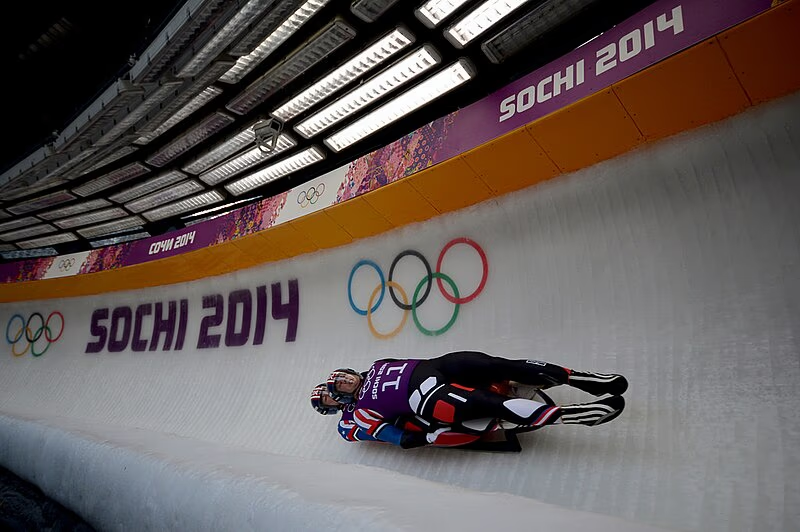
- Doubles: Two athletes on one sled, one lying on top of the other. The top athlete provides additional steering input through subtle body movements. Historically a men-only event, doubles is now designated as an open event by the FIL.
- Team Relay: One women's singles sled, one men's singles sled, and one doubles sled from the same nation. Athletes race sequentially.
4.2 Athlete Weight Regulations
To maintain competitive fairness, the FIL sets maximum combined weights (athlete + sled):
- Men's singles: maximum 115 kg (253.5 lb) combined
- Women's singles: maximum 92 kg (202.8 lb) combined
- Doubles: maximum 180 kg (396.8 lb) combined
Athletes below these limits may add compensating weight (lead ballast), secured to the sled or in an FIL-approved weight vest. The total may not exceed the maximum combined weight.
4.3 Officials and Jury
- Race Director: Oversees the entire competition, controls start intervals, and has authority to delay, suspend, or cancel runs for safety.
- Technical Delegate: FIL-appointed official responsible for equipment inspection, runner temperature checks, and sled weight verification.
- Track Chief: Manages ice conditions, maintenance crews, and track safety inspections.
- Start referee: Monitors the start procedure and signals any irregularities.
- Timing officials: Operate the electronic timing system, recording start, intermediate, and finish times to 1/1000th of a second.
Section 5: Rules of Play
5.1 Competition Format
- Singles: 4 runs over 2 days (2 runs per day). Combined cumulative time determines the final ranking.
- Doubles: 2 runs over 1 day. Combined cumulative time determines the ranking.
- Team Relay: 1 run per sled, raced sequentially in a single session. Combined cumulative time of all three sleds determines the national team ranking.
5.2 Start Procedure
Athletes sit on the sled at the start position, feet on the ice, gripping the fixed start handles. When the green start light illuminates, the athlete has 30 seconds to initiate the run. The start involves rocking the sled for momentum, releasing the handles, and paddling with spiked gloves on the ice surface for 30–50 m. The start time is electronically measured from the first timing beam and is a critical competitive factor — a 0.01-second difference at the start can translate to 0.03 seconds at the finish.
5.3 Steering and Technique
Luge athletes steer exclusively through body movements — there is no mechanical steering mechanism. Techniques include:
- Calf pressure: Pressing the left or right calf against the sled's runner bracket (kufen) to flex the runner and initiate a turn.
- Shoulder pressure: Shifting upper body weight to one side to adjust the sled's trajectory.
- Head position: Keeping the head back and chin tucked for aerodynamic efficiency. Raising the head to look creates drag and is avoided except briefly to orient.
The optimal riding position is completely flat with the body streamlined to minimise air resistance. Arms are held tight against the body, and toes are pointed.
5.4 Team Relay Mechanics
In the Team Relay, the women's singles slider goes first, followed by the men's singles slider, then the doubles team. As each sled crosses the finish line, it activates an electronic touch pad that opens a start gate for the next sled at the top of the track. The next athlete must start within a designated time window after the gate opens. The nation's final time is the cumulative total of all three runs.
5.5 Contact with the Sled
Athletes must maintain contact with the sled throughout the run. Separation from the sled (e.g., falling off) results in disqualification. If the athlete separates but immediately regains the sled and continues, the run may be completed but the time is typically uncompetitive. An athlete who cannot complete a run safely must attempt to bring the sled to a stop against a track wall.
Section 6: Scoring
6.1 Timing and Rankings
All times are recorded electronically to 1/1000th of a second. The final ranking is determined by cumulative total time across all runs. In the event of an exact tie, athletes share the same placement (tied medals are awarded at the Olympics).
6.2 Timing Points
Multiple timing points are recorded during each run:
- Start time: Measured from the first timing beam to a point approximately 50–100 m down the track. Provides a direct measure of starting technique and power.
- Intermediate splits: 3–5 timing points at designated curves along the track. Used to analyse driving performance through specific sections.
- Finish time: Total elapsed time from start beam to finish beam.
6.3 World Cup Points
In the FIL World Cup circuit, athletes earn points based on finishing position: 1st = 100 points, 2nd = 80, 3rd = 65, descending through the top 30. Season-long point totals determine the Overall World Cup standings. Sprint events (single-run format at select venues) also award World Cup points. Top-ranked athletes on the World Cup circuit secure quota places for their national federations at the Olympics and World Championships.
Section 7: Violations & Penalties
7.1 Equipment Violations
- Runner temperature: If runners exceed ice temperature by more than 5°C at pre-race inspection, the athlete is disqualified for that run.
- Sled weight: If the sled exceeds the maximum weight limit, the athlete is disqualified.
- Combined weight: If athlete + sled exceeds the maximum combined weight, the athlete is disqualified.
- Modification after inspection: Any alteration to the sled or runners after official scrutineering results in disqualification and potential suspension.
- Unauthorised weight: Adding weight to the athlete or sled beyond FIL-regulated ballast limits results in disqualification.
7.2 Competition Violations
- Separation from sled: Complete loss of contact with the sled during a run results in disqualification (DSQ).
- Start violation: Failure to start within 30 seconds of the green light results in a DNS (Did Not Start) for that run.
- Obstruction: If an athlete's actions on the track endanger another slider (e.g., failing to clear the track), penalties up to suspension may be imposed.
- Unsportsmanlike conduct: Any attempt to interfere with another athlete's equipment, preparation, or run is subject to immediate disqualification and referral to the FIL Disciplinary Commission.
7.3 Protests and Appeals
Teams may file a written protest against results or technical decisions within 15 minutes of the official results being posted. A protest fee must be deposited. The Race Jury reviews the evidence and renders a decision. Further appeals may be escalated to the FIL Court of Arbitration within 24 hours.
Section 8: Safety Considerations
8.1 Track Safety Features
- Curve walls are profiled with smooth ice surfaces to guide sleds and reduce the risk of ejection. Overflow lips at the top of walls act as containment barriers.
- Crash padding (deformable material) is installed at particularly dangerous curves and transition zones.
- Speed-monitoring sensors are placed throughout the track. If speeds exceed safe thresholds, the race director may modify start positions or add artificial chicanes.
- Track inspections are conducted before every training and competition session by the track chief and marshals.
8.2 Athlete Safety Requirements
- Full-face visor helmet mandatory during all training and competition runs.
- Athletes must complete a minimum number of training runs on the specific track before competing (typically 3–6 runs).
- Novice athletes must progress through the FIL licensing system, starting on lower-speed tracks before advancing to Olympic-calibre venues.
- Annual medical examination is mandatory for all FIL-licensed athletes.
- Athletes experiencing dizziness, concussion symptoms, or impaired motor function are immediately withdrawn from competition pending medical clearance.
8.3 Medical and Emergency Provisions
A medical team is stationed at the finish area at all times during training and competition. Additional medical spotters are positioned at high-risk sections of the track. Ambulance access must be available within 3 minutes to any point on the track. In the event of a crash, track marshals immediately signal to halt subsequent starts and clear the scene before competition resumes.
8.4 Environmental Conditions
Ambient temperature, wind speed, humidity, and ice surface temperature are continuously monitored. If conditions deteriorate to the point where athlete safety is compromised (excessive wind, ice deterioration, poor visibility), the race director may delay, suspend, or cancel runs. All environmental readings are logged and made available to teams.