












Section 1: Introduction
1.1 Overview and Governing Body
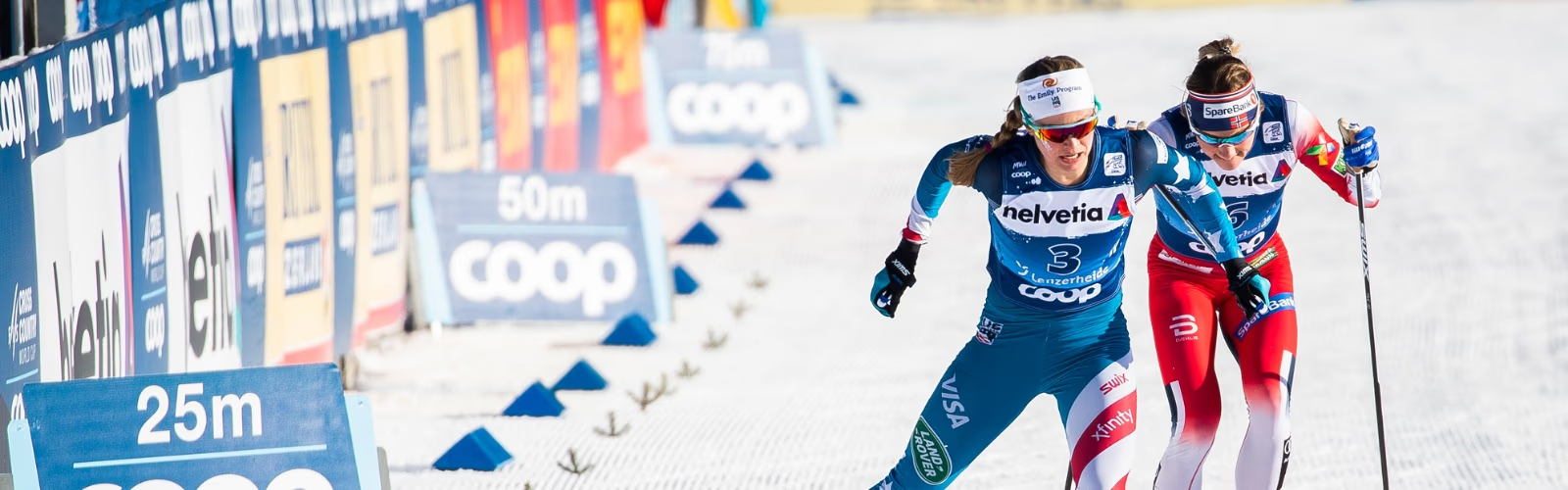
Cross-country skiing is one of the founding Olympic winter sports, contested at every Winter Games since Chamonix 1924. Governed by the International Ski and Snowboard Federation (FIS) under ICR Book II — Cross-Country, the discipline demands exceptional aerobic endurance and technical mastery across varied terrain. Cross-country skiing consistently produces some of the highest VO2 max measurements in all of sport, with elite athletes recording values above 90 ml/kg/min.
1.2 Techniques: Classic and Free
Two distinct techniques define the sport, defined under ICR 310.2:
- Classic technique (ICR 310.2.2): Diagonal stride (alternating arms and legs), double poling, herringbone (uphill), kick-and-glide. Skis must remain within set tracks on flat and uphill terrain. Single or double skating is not allowed (ICR 310.2.2.5).
- Free technique (ICR 310.2.3): Includes all cross-country skiing techniques, including skating sub-techniques such as V1 skate (offset), V2 skate (every-stride), and V2 alternate (one-side), as well as any classic movements.
1.3 Olympic and World Championship Events
Under ICR 310.3.1.1 (June 2026 edition), the programme for the Olympic Winter Games (OWG) and FIS World Ski Championships (WSC) is identical for men and women:
- Interval Start: 10 km, technique (classical/free) alternating between OWG and WSC
- Mass Start: 50 km, technique alternating between OWG and WSC
- Skiathlon: 10 km classical + 10 km free technique
- Relay: 4 × 7.5 km, first two legs classical technique and the last two legs free technique
- Individual Sprint and Team Sprint: 1.0–1.8 km, technique alternating between OWG and WSC and between the two sprint formats
Norway, Sweden, Finland, and Russia have historically dominated, though nations like Italy, Germany, France, and the United States have produced Olympic medalists.
1.4 World Cup and FIS Points
The FIS Cross-Country World Cup runs annually from November through March, with competitions across Scandinavia, Central Europe, and North America. The Tour de Ski (multi-stage race in late December/early January) is a marquee event. FIS points determine athlete rankings and start-group assignments, calculated using a formula comparing race times to the winner’s time and course difficulty (ICR 341.2).
Section 2: Equipment
2.1 Skis
- Classic skis: Minimum length = competitor’s height minus 20 cm. Maximum width 48 mm (1.89 in). Feature a “wax pocket” or “kick zone” under the foot for grip wax or mechanical grip patterns (fish scales, skin inserts). Relatively soft flex to engage the kick zone underfoot.
- Skating skis: Minimum length = competitor’s height minus 10 cm. No maximum width restriction. Full glide base (no kick zone). Stiffer camber than classic skis for edge-to-edge stability during skating pushoff.
- Ski base material: Sintered polyethylene (P-Tex), stone-ground for optimal glide structure matching snow conditions
- Binding system: Must be FIS-approved. Common systems: NNN (New Nordic Norm), SNS (Salomon Nordic System), Turnamic, Prolink
2.2 Poles
- Classic (ICR 343.8.1): Maximum pole length = 83% of body height (measured with the athlete standing in ski boots on a flat surface), except in Popular Cross-Country Competitions
- Skating: Maximum pole length = 100% of body height
- Pole baskets must not exceed 100 cm² (15.5 in²) in area
- Carbon fiber or composite construction standard at elite level; aluminum for entry-level
- Pole straps must be detachable under load for safety (prevents wrist injury in falls)
2.3 Boots and Clothing
- Classic boots: Low-cut, flexible sole for ankle articulation during diagonal stride
- Skating boots: High-cuff design with ankle support for lateral stability during skating push
- Must be commercially available models (no custom prototypes at World Cup level without prior FIS approval)
- Race suit: One-piece or two-piece lycra suit. No aerodynamic aids, fairings, or modifications. Bib number worn over suit.
- Gloves, hat/headband, and sunglasses/goggles as conditions require
2.4 Waxing and Fluorocarbon Ban
- Kick wax (classic only): Applied to the grip zone; must be matched to snow temperature and humidity. Harder waxes for cold/dry, softer waxes (klisters) for warm/wet conditions.
- Glide wax: Applied to tips and tails (classic) or full base (skating). Ironed into the base structure for maximum speed.
- Fluorocarbon ban (Article 343.10, ICR): Since the 2023–2024 season, all fluorinated wax products (including powder overlays and blocks) are prohibited. Spot checks are conducted using portable X-ray fluorescence (XRF) spectrometers. Detection of fluorine above the threshold results in DSQ and equipment confiscation.
- Teams employ dedicated wax technicians who prepare 8–15 pairs of skis per athlete for testing on race day
Section 3: Playing Area
3.1 Course Design Principles
FIS-homologated courses must provide a balanced test of uphill, flat, and downhill ability. Under ICR 311.1.2, the course profile should include approximately one-third uphills (gradient between 9% and 18%, with some short climbs steeper than 18%), one-third undulating/rolling terrain, and one-third varied downhills, ensuring no single physical attribute dominates.
3.2 Course Specifications by Distance
- Sprint (1.0–1.8 km): Total climb 30–60 m (98–197 ft). Maximum single climb 30 m (98 ft). Course designed for spectator-friendly layout with multiple passing opportunities.
- 10 km: Total climb 250–420 m (820–1378 ft). Maximum single climb 50–80 m (164–262 ft). Laps of 2.5–5.0 km.
- 15 km: Total climb 400–600 m (1312–1968 ft). Maximum single climb 80 m.
- 30 km: Total climb 800–1200 m (2625–3937 ft). Laps of 7.5–15.0 km.
- 50 km: Total climb 1400–2000 m (4593–6562 ft). Maximum single climb 100 m (328 ft).
- Altitude restriction (ICR 311.2.7): At OWG, WSC, JWSC and WC competitions, the highest point of a course must not exceed 2000 m above sea level.
3.3 Track and Course Width
- Classic technique (Interval Start, ICR 311.2.6): Minimum 3 m (9.8 ft) wide, with machine-set parallel tracks
- Free technique (Interval Start, ICR 311.2.6): Minimum 4 m (13.1 ft) wide, groomed flat surface without set tracks; mass-start free technique courses require a minimum of 9 m
- Course marked with directional arrows and distance markers every 1 km (ICR 311.4)
3.4 Stadium Area
- Stadium must accommodate: start area, finish area with electronic timing, penalty loop (for sprint), warm-up area, wax cabins, and spectator zones (ICR 312)
- Finish straight: minimum 50 m long, with photo-finish camera and electronic timing mat (ICR 312.3.1)
- Exchange zone (relay): minimum 30 m long, clearly marked (ICR 312.4, 327.2.1)
- Transition zone (skiathlon): pit box area sized so each competitor has a designated, bib-marked box with a bypass corridor to minimize interference (ICR 312.5.1)
Section 4: Players & Officials
4.1 Athlete Entry and Quotas
- Olympic: maximum 4 athletes per nation per individual event (based on FIS points ranking and continental quotas)
- World Cup: nation quotas based on FIS Nations Cup standings; top nations may enter 8–10 athletes
- Athletes must hold a valid FIS license and meet minimum FIS points thresholds for entry
- Age restrictions (ICR 341.1.5): competitors must have reached their 16th birthday before the end of the calendar year in which the season ends to compete at any FIS competition; minimum age is 18 for World Cup and Olympic competition
4.2 Start Formats
- Interval start: Athletes depart individually at 30-second intervals (standard) or 15-second intervals (sprint qualification). Start order determined by FIS points (best athletes start later for optimal course conditions).
- Mass start: All competitors start simultaneously. Grid positions assigned by ranking (front row for top seeds).
- Pursuit start: Athletes start at time gaps based on results from a previous competition (used in stage races and skiathlon).
- Sprint heats: Quarterfinals (5 heats of 6), semifinals (2 heats of 6), final (6 athletes). Top 2 per heat advance plus “lucky losers” by time. Under new ICR 325.4.3 (June 2026 edition), organizers may instead use heat selection: qualified athletes choose their own quarterfinal heat in an order based on qualification ranking, and any athlete not present for the heat-selection and bib distribution loses the right to choose and receives the last available spot.
4.3 Competition Officials
- Competition jury: FIS Technical Delegate (TD), Chief of Competition, Competition Secretary (ICR 303.1)
- Technique controllers: Stationed along the course in classic races to detect skating violations; equipped with video cameras
- Track controllers: Positioned along the course to monitor course conditions and athlete safety
- Timekeeping: Electronic timing to 1/10th second for distance races, 1/100th second for sprints, backed by independent hand timing (ICR 316)
- Wax controllers: Perform fluorinated-wax controls on skis before and during competition
4.4 Team Support Personnel
- Wax technicians: prepare race skis, test multiple pairs on course snow, apply final structure
- Coaches: stationed at designated feed zones; may provide drinks but no physical assistance
- Feed/drink zones: located at approximately 5 km intervals on longer courses; athletes may take drinks from a table or from team personnel at designated points
- No pacing, pulling, or physical drafting assistance from non-competitors permitted (ICR 343.7)
Section 5: Rules of Play
5.1 Classic Technique Rules
- Skating movements strictly prohibited on flat and uphill terrain; both skis must remain in the set tracks
- Herringbone (V-step without glide) permitted on steep uphills only
- Snowplow permitted for downhill braking
- Stepping out of the track to pass is permitted; the overtaking skier must return to a track after passing
- Double-poling (using only arms without kick) is permitted as a classic technique
- Technique violations detected by controllers stationed along the course with video equipment
5.2 Free Technique Rules
- Any technique permitted, including skating (V-skate, marathon skate) and classic movements
- No set tracks on the course; athletes choose their own line within the groomed corridor
- Overtaking: the athlete being overtaken must yield the preferred line when the faster athlete comes alongside
5.3 Skiathlon Format
- First half raced in classic technique; second half in free technique (ICR 323.1)
- Transition zone: athletes remove classic skis and boots, switch to skating equipment in a designated pit box. No time added; clock runs continuously.
- Per ICR 343.12.5 (June 2026 edition), each competitor may have only one pair of replacement skis in the pit box, and the replacement skis must be placed in the pit box before the competition unless the Jury directs otherwise.
- Athletes must complete the classic leg before entering the transition zone
5.4 Relay Rules
- Men and women (ICR 327.1.1–327.1.2): Relay teams consist of four competitors; the first two legs are raced in classical technique and the last two legs in free technique.
- Exchange: a tap of the hand on any part of the next competitor’s body while both are in the relay exchange zone constitutes a valid exchange (ICR 343.13.1)
- All teams start simultaneously (mass start for the first leg)
- Separate colors are used for start numbers for each relay leg: at OWG, WSC and WC, 1st leg=red, 2nd leg=green, 3rd leg=yellow, 4th leg=blue (ICR 327.4.4)
5.5 Team Sprint
- Teams of 2 athletes alternate legs (ICR 326.1)
- Sprint distance per leg: 1.0–1.8 km (free or classic technique per the event programme)
- Qualification round (Interval Start) followed by a final organized as a relay of 3–6 legs per athlete
- Body-contact exchange in the exchange zone required
5.6 Overtaking and Obstruction
- Competitors in front have the right to choose their best line but shall not obstruct competitors coming from behind; competitors intending to pass shall do so without obstructing the competitor being passed (ICR 343.10.2)
- In sections with marked corridors, competitors should choose a corridor but may leave it as long as ICR 343.9 and 343.10 are upheld
- Deliberate obstruction is a violation subject to a time penalty, rank penalty, or DSQ (see Section 7)
- In sprint heats, athletes may not make lateral movements to block overtaking
Section 6: Scoring
6.1 Distance Event Results
- Interval start races: final ranking by elapsed time (finish time minus start time), recorded to 1/10th of a second (ICR 317.2)
- Mass start and pursuit races: final ranking by order of finish (first across the line wins); photo-finish for ties
- Ties in interval start: if athletes have identical times, they share the same rank
6.2 Sprint Event Results
- Qualification round: competitors advance based on time (timed to 1/100th second, or 1/1000th for Level 0 competitions to break lucky-loser ties per ICR 317.2)
- Quarterfinals: heats of 6 athletes; top 2 per heat advance automatically, plus “lucky losers” (fastest non-qualifying times) (ICR 325.4.2)
- Semifinals: heats of 6; top 2 per heat advance, plus lucky losers
- Final: 6 athletes; finish order determines final ranking (1st through 6th)
- Athletes eliminated in earlier rounds are ranked by their times in that round (ICR 325.5)
6.3 FIS Points System
- FIS points calculated for each race:
F = (Tx / T0 - 1) × FIS Factorwhere Tx is the athlete’s time and T0 is the winner’s time - Lower FIS points = better ranking
- Athletes’ best results over a rolling period determine their FIS points list ranking (ICR 341.2, Rules and Guidelines of the FIS Points)
- FIS points determine start-group assignments and entry quotas for major competitions
6.4 World Cup Scoring
- World Cup points: 100-80-60-50-45-40-36-32-29-26-24-22-20-18-16-15-14-13-12-11 (1st through 20th), then 10-9-8-7-6-5-4-3-2-1 (21st through 30th)
- Overall World Cup, Distance World Cup, and Sprint World Cup standings maintained separately
- Tour de Ski awards bonus seconds and a separate overall classification
Section 7: Violations & Penalties
7.1 Technique Violations (Classic)
- Sanctions for technique-rule violations can be given by a unanimous decision of two Jury members, including the TD, without requiring video evidence (ICR 352.1.3)
- The Jury decision chart (ICR 352.1.1.1) weighs the specific circumstances, any gain or advantage, and impact on other competitors to select between a verbal warning, written reprimand, competition suspension, or disqualification
- Video evidence from course cameras used to confirm violations
7.2 Obstruction and Interference
- Failure to yield when being overtaken, or otherwise obstructing another competitor, is subject to sanction under the ICR 352 decision chart, ranging from a written reprimand up to disqualification
- Under new ICR 352.8 (June 2026 edition), in Mass Start, Skiathlon, Pursuit, and mass-start Popular Cross-Country competitions the Jury may substitute a Rank Penalty for a disqualification arising from obstruction: the sanctioned competitor is re-ranked immediately behind the competitor they obstructed and is credited with that competitor’s time (ICR 352.8.2). If more than one competitor was affected, the sanctioned competitor is ranked last within the affected group and is credited with the time of the last-placed athlete in that group (ICR 352.8.3). A Rank Penalty is always accompanied by a written reprimand (ICR 352.8.5).
- Contact causing a fall: penalty applied to the responsible athlete; review by jury
- In sprint heats, athletes may not make lateral movements to block overtaking
7.3 Equipment and Substance Violations
- Fluorocarbon wax detection: A competitor whose skis are found positive for fluorinated wax at controls before the start is not permitted to start; a positive control after the competition results in DSQ and equipment confiscation (ICR 351.4)
- Pole length exceeding limits: equipment must be replaced before start or DSQ
- Ski length below minimum: DSQ if discovered during pre-race inspection; post-race detection also results in DSQ
- Unauthorized equipment modifications during the race: DSQ
7.4 Unauthorized Assistance
- Receiving physical assistance (pushing, pulling, pacing from non-competitors): DSQ
- Unauthorized coaching from outside designated zones: warning to the team; repeat offense may result in team sanctions
- Equipment exchange outside designated zones (relay exchange, transition): DSQ
Section 8: Safety Considerations
8.1 Weather Cancellation Criteria
- Per ICR 315.9, if the temperature is below -20 °C (-4 °F), measured at the coldest point of the course, a competition will be postponed or cancelled by the Jury
- With difficult weather conditions (strong wind, high air humidity, heavy snowfall, or high temperature), the Jury may, in consultation with the Team Captains and the Chief of Medical and Rescue Service, postpone or cancel the competition
- Competition jury has authority to shorten, postpone, or cancel at any point if conditions deteriorate
- Snow conditions assessed: if the course becomes dangerously icy or bare, the jury may halt competition
8.2 Course Safety
- Directional arrows and course markings mandatory at every junction and turning point; forks and intersections must be marked and unused parts of the course fenced (ICR 311.4.3)
- Safety netting or padding on dangerous downhill curves and at bridge abutments
- Emergency access routes for snowmobiles or rescue vehicles must reach all course sections
- Track controllers stationed along the course to monitor athlete safety and course conditions (ICR 302.3.6)
- Radio communication network linking all controllers, start/finish, and medical team
8.3 Medical Support
- Medical team with ambulance stationed at the stadium area; first aid and medical services must be fully operational during all official training times (ICR 302.3.8)
- Mobile medical personnel on snowmobiles positioned along the course
- Nearest hospital identified in competition plan; helicopter evacuation plan for remote venues
- Athletes showing signs of hypothermia, frostbite, or collapse are removed from the course by medical personnel
- Anti-doping controls conducted per WADA guidelines; selected athletes tested post-competition
8.4 Athlete Responsibility
- Per new ICR 351.3 (June 2026 edition), a competitor who does not wear the competition bib, or who wears it with any part covered, is not permitted to start; no part of the bib may be covered.
- Athletes are responsible for knowing the course and respecting course markings
- Athletes who abandon the race must notify a track controller
- Proper cold-weather clothing is the athlete’s responsibility; the jury may prohibit a start if clothing is deemed insufficient