













Section 1: Introduction
1.1 Overview and History
Diving has been a continuous Olympic sport since the 1904 St. Louis Games (men's platform) and the 1912 Stockholm Games (women). Originally part of gymnastics-related aquatic events, competitive diving evolved into a standalone discipline governed by World Aquatics (formerly FINA, rebranded in 2022) under the World Aquatics Diving Rules (DR). The sport demands exceptional body control, spatial awareness, and courage, with athletes performing acrobatic maneuvers from elevated springboards or rigid platforms into a diving well below.
1.2 Olympic Events
The current Olympic programme includes eight diving events:
- Individual 3 m Springboard — men and women
- Individual 10 m Platform — men and women
- Synchronized 3 m Springboard — men and women
- Synchronized 10 m Platform — men and women
Synchronized diving was introduced at the 2000 Sydney Olympics. Team events appear at World Championships but are not currently on the Olympic programme.
1.3 Dive Groups and Numbering
Every dive is classified into one of six groups, each identified by the leading digit of its numerical code:
- Group 1 — Forward: Diver faces forward, rotates toward the water. Codes begin with 1 (e.g., 107B = forward 3.5 somersaults, pike).
- Group 2 — Back: Diver stands backward on the board, rotates away from the board. Codes begin with 2.
- Group 3 — Reverse: Diver faces forward, rotates back toward the board. Codes begin with 3.
- Group 4 — Inward: Diver stands backward, rotates toward the board. Codes begin with 4.
- Group 5 — Twisting: Any forward, back, reverse, or inward dive that includes axial twists. Codes begin with 5; the second digit indicates the underlying group.
- Group 6 — Armstand (platform only): Diver begins from a stationary handstand on the platform edge. Codes begin with 6.
1.4 Body Positions
Divers adopt one of four recognized body positions during flight:
- Straight (A): Body fully extended, no bend at hips or knees. Highest aesthetic difficulty.
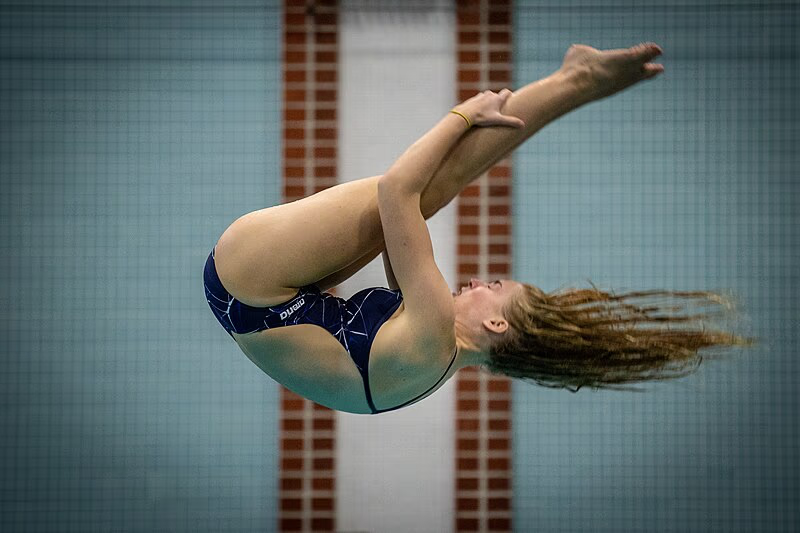
- Pike (B): Body bent at the hips, legs straight and together. Arms reach toward toes or wrap behind calves.
- Tuck (C): Body folded compactly, knees drawn to chest, hands gripping shins. Fastest rotation speed.
- Free (D): Combination of positions used during twisting dives, allowing the diver to transition between straight, pike, and tuck as needed.
Section 2: Equipment
2.1 Springboard Specifications
- Heights: 1 m and 3 m above the water surface. The 3 m board is used in Olympic competition; the 1 m board is used in NCAA and other domestic events.
- Board dimensions: Length 4.87 m (16 ft), width 0.50 m (1 ft 8 in). Constructed from extruded aluminum alloy (typically Maxiflex Model B or equivalent).
- Fulcrum: Adjustable roller fulcrum positioned under the board. Divers set the fulcrum position to control board flexibility — further forward for a stiffer feel, further back for more spring. Range of adjustment approximately 0.45 m (1.5 ft).
- Surface: Non-slip textured coating applied to the board surface. Divers may also use a chamois towel to dry the board between dives.
- Overhang: The board must extend at least 1.50 m (4 ft 11 in) beyond the edge of the pool deck.
2.2 Platform Specifications
- Olympic height: 10 m (32 ft 10 in) above the water surface. Training and junior platforms available at 5 m and 7.5 m.
- Dimensions: Minimum length 6.0 m (19 ft 8 in), minimum width 2.0 m (6 ft 7 in). Multiple platforms may be installed on the same tower.
- Construction: Rigid concrete or reinforced synthetic structure. The platform must not vibrate or deflect under the diver's weight.
- Surface: Non-slip finish mandatory. Some facilities use rubberized matting for additional grip.
2.3 Diver Attire and Accessories
- Swimwear: Competitive swimwear conforming to World Aquatics regulations. No loose-fitting fabric; suits must be form-fitting. Two-piece suits permitted for women but must not be excessive in coverage.
- Chamois (shammy): Small synthetic towel used to dry skin and hands between dives. Helps maintain grip during takeoff. Typically carried on the board or platform and placed aside before the approach.
- Tape and support: Wrist guards, athletic tape, and small braces permitted for injury management. Must not provide competitive advantage.
Section 3: Playing Area
3.1 Diving Well Dimensions
- Minimum depth: 5.0 m (16 ft 5 in) below the 10 m platform; 3.5 m (11 ft 6 in) below the 3 m springboard; 3.0 m (9 ft 10 in) below the 1 m springboard.
- Minimum area: The clear water zone directly below each board or platform must be at least 5.0 m x 4.0 m free from obstructions.
- Ceiling height: Minimum 5.0 m (16 ft 5 in) of clearance above the 10 m platform.
3.2 Surface Agitation Systems
A mechanical surface agitation system is mandatory at all World Aquatics-sanctioned competitions. This system produces a visible disturbance on the water surface (bubbles, spray jets, or drip jets) so divers can judge their height and distance from the water during flight. Without agitation, the flat water surface can appear featureless and disorient divers during rapid rotations.
3.3 Supporting Facilities
- Hot tub / shower area: Located adjacent to the pool for divers to maintain body temperature between dives. Water temperature typically 37–40 °C (99–104 °F).
- Dry-land training: Purpose-built dryland facility with overhead spotting rigs (harnesses), trampolines, and foam pits for learning new dives safely before attempting them from height.
- Scoreboard: Electronic display visible to divers, judges, and spectators showing dive code, DD, judge scores, and running totals.
Section 4: Players & Officials
4.1 Individual Events
Each diver competes alone, performing a prescribed number of dives from a published dive list. Preliminary rounds narrow the field to 18 (semifinal) and then 12 (final). Scores do not carry over between rounds — the final is a clean-slate competition.
4.2 Synchronized Events
A pair of divers from the same country performs the same dive simultaneously. Partners are assessed both on their individual execution and on how closely they match each other in takeoff, height, rotation speed, and entry angle. Eight pairs compete directly in a single final — no preliminaries or semifinals.
4.3 Judging Panel — Individual
Seven judges score each dive. The two highest and two lowest marks are discarded, leaving three counting scores. This trimmed-mean approach reduces the impact of outlier judging. Judges are seated at water level along one side of the pool, each with an unobstructed view of the takeoff, flight, and entry.
4.4 Judging Panel — Synchronized
Eleven judges are used: three assess execution of diver A, three assess execution of diver B, and five assess synchronization. The execution panels each drop the high and low mark (one counting score per panel). The synchronization panel drops the high and low mark (three counting scores). Synchronization judges evaluate simultaneity of takeoff, matching height and distance from the board, identical rotation speed, and coordinated entry timing.
4.5 Referee and Announcer
The referee supervises the competition, signals when the diver may proceed, and resolves disputes. The announcer calls each dive by number, position letter, and degree of difficulty before the diver approaches.
Section 5: Rules of Play
5.1 Number of Dives
- Men's 3 m Springboard: 6 dives in the final (no DD limit).
- Women's 3 m Springboard: 5 dives in the final (no DD limit).
- Men's 10 m Platform: 6 dives in the final (no DD limit).
- Women's 10 m Platform: 5 dives in the final (no DD limit).
- Synchronized events: 5 dives — 2 with a DD limit of 2.0, plus 3 without DD limit.
5.2 Dive List Submission
Each diver submits a dive list specifying every dive they intend to perform in each round. The list must include the dive number, position letter, and degree of difficulty. Once submitted, the list cannot be changed. In individual events, a diver may not repeat a dive from the same group across their list (e.g., cannot perform two forward dives).
5.3 Degree of Difficulty (DD)
The DD is a numerical coefficient calculated from a formula published in the World Aquatics DR tables. It accounts for the dive group, number of somersaults, number of twists, body position, and starting position (running approach, standing, or armstand). Values range from approximately 1.2 (basic forward dive, straight) to 4.1+ (quad somersaults with twists). Higher DD amplifies the raw execution score, rewarding technical ambition.
5.4 Approach and Takeoff
- Forward approach (springboard): Minimum 3 steps plus a hurdle (final jump onto the end of the board). The approach must appear smooth, confident, and controlled.
- Standing takeoff (back, inward): The diver stands at the end of the board, arms at sides or above the head, and initiates the dive from a stationary position.
- Armstand (platform only): The diver assumes a controlled handstand at the platform edge and holds it momentarily before initiating the dive.
5.5 Entry
The entry into the water is the final phase of every dive and critically affects scores. The ideal "rip entry" is perfectly vertical (head-first or feet-first depending on the dive), with the body fully extended and aligned, creating minimal splash. Judges look for hands clasped and flat (head-first) or toes pointed and together (feet-first). Excessive splash, body angle deviations, or separation of limbs result in deductions.
Section 6: Scoring
6.1 Judge Scoring Scale
Each judge awards a score from 0 to 10 in half-point increments. The descriptive scale is:
- 0: Completely failed
- 0.5–2.0: Unsatisfactory
- 2.5–4.5: Deficient
- 5.0–6.0: Satisfactory
- 6.5–7.0: Good
- 7.5–8.0: Very Good
- 8.5–10.0: Excellent
6.2 Individual Score Calculation
From 7 judges, the 2 highest and 2 lowest marks are dropped. The remaining 3 marks are summed and multiplied by the DD. This product is the dive score. Example: judges award 7.5, 7.0, 7.5, 7.0, 7.5, 8.0, 6.5. Drop 8.0, 7.5 (high) and 6.5, 7.0 (low). Remaining: 7.5 + 7.0 + 7.5 = 22.0. If DD = 3.0, dive score = 22.0 x 3.0 = 66.0.
6.3 Synchronized Score Calculation
Execution scores: each panel of 3 (for diver A and diver B) drops its high and low, leaving 1 counting mark per panel. Synchronization panel of 5 drops high and low, leaving 3 counting marks. Total of 5 counting marks are summed and multiplied by DD, then multiplied by 0.6 to normalize the score range.
6.4 Final Standings
The competition score is the sum of all dive scores across the round. The diver (or pair) with the highest total wins. There are no tiebreaker dives; tied scores result in shared placement.
6.5 Scoring Strategy
Athletes must balance difficulty against execution risk. A dive with DD 3.5 performed with mediocre execution (average judge score of 6.0) yields 3 × 6.0 × 3.5 = 63.0 points, while a simpler dive with DD 2.5 performed excellently (average 8.5) yields 3 × 8.5 × 2.5 = 63.75 points. Elite divers maximize total scores by selecting the highest DD dives they can execute consistently with scores above 7.5.
Section 7: Violations & Penalties
7.1 Failed Dive
A dive is declared failed and scored 0 if the executed dive differs significantly from the announced dive — for example, performing the wrong number of somersaults, wrong group, or wrong position. The referee makes this determination.
7.2 Balk (Springboard)
A balk occurs when the diver begins the approach but stops or restarts without completing the dive. On the first balk, the referee instructs the judges to deduct 2 points each from their scores for that dive. On a second balk for the same dive, the dive is scored 0.
7.3 Restart and Timing Violations
- Divers must begin their approach within one minute of the referee's signal. Failure to do so results in a warning; continued delay may result in the dive being declared failed.
- On platform, a diver who loses balance during the armstand may restart once. A second failed armstand start results in a 0 score.
7.4 Position and Execution Deductions
- Incorrect starting position (e.g., arms not in specified position) results in judge deductions of 0.5–2.0 points per judge.
- Excessive splash on entry: deductions at judges' discretion, typically 0.5–1.5 points.
- Insufficient distance from the board (dangerously close pass): judges deduct for unsafe execution, and the referee may issue a caution.
7.5 Unsportsmanlike Conduct
Disruptive behavior, deliberate delays, or attempts to influence judges are grounds for disqualification by the referee.
Section 8: Safety Considerations
8.1 Water Surface Agitation
Mechanical agitation (bubbles or spray) is mandatory during all competition and practice sessions. The system must produce visible surface disturbance directly below all boards and platforms in use. This helps divers orient during high-speed rotations and prevents disorientation injuries.
8.2 Pool Depth and Clearance
Minimum pool depths are strictly enforced: 5.0 m under the 10 m platform, 3.5 m under the 3 m springboard. Adjacent platforms must have minimum horizontal separation of 2.50 m to prevent collision. The distance from the end of the board to the pool wall must be at least 1.80 m (springboard) or 1.50 m (platform).
8.3 Medical and Emergency Protocols
- A qualified medical team must be present at poolside for all sanctioned competitions and training sessions.
- Spinal injury immobilization equipment (backboard, cervical collar) must be immediately accessible.
- Underwater rescue divers are stationed at major competitions in case of unconscious entry.
8.4 Training Progression
New dives are first learned using dry-land equipment (trampoline, foam pit, overhead harness rig), then progressed to 1 m springboard, then 3 m, and finally 10 m platform. Water bubbler machines can be activated at maximum output during training to soften the water surface for higher-impact entries while athletes are learning.
8.5 Lighting and Environmental Conditions
- Lighting: Indoor venues must provide uniform illumination of at least 1,500 lux at the water surface, with no glare on the water that could impair a diver's ability to see the surface during flight.
- Water temperature: Pool water must be maintained at 26–28 °C (79–82 °F). Excessively cold water increases the risk of muscle cramping and injury on entry.
- Air temperature: Venue air temperature should be maintained at 24–28 °C (75–82 °F) to prevent divers from becoming chilled while waiting between dives.
- Outdoor venues: Wind speed and sun glare must be monitored. Competition may be delayed if conditions impair the safety or fairness of judging.
8.6 Common Injuries and Prevention
- Wrist and hand injuries: Repeated high-speed entries can cause stress fractures and sprains. Proper hand-clasp technique (flat-hand entry) distributes impact forces.
- Shoulder injuries: Overhead entry forces stress the rotator cuff. Conditioning programs focus on shoulder stability and range of motion.
- Back injuries: Impact forces from "short" (over-rotated) or "flat" (under-rotated) entries compress the spine. Progressive training and core strengthening reduce risk.
- Eye injuries: Entry splash can cause corneal abrasion. Some divers wear goggles during training but not competition.
8.7 Anti-Doping
World Aquatics enforces WADA anti-doping regulations. In-competition and out-of-competition testing is conducted at all major championships. Athletes in the Registered Testing Pool must provide quarterly whereabouts information. Violations result in suspension and potential disqualification of results.