













Section 1: Introduction
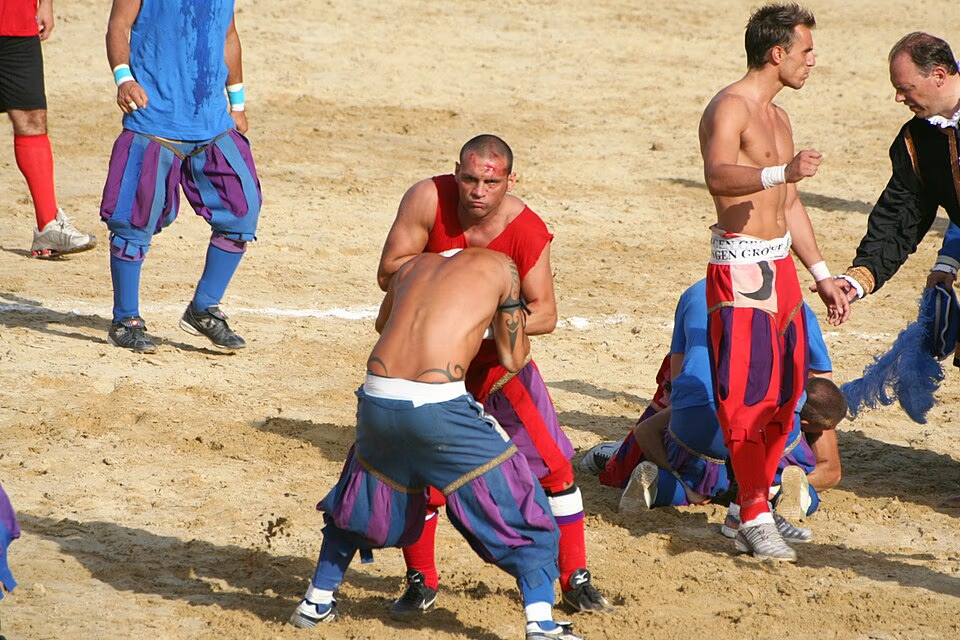
Calcio Storico Fiorentino ("Historic Florentine Football") is a 16th-century combat-football tradition unique to the city of Florence, Italy. The sport pre-dates modern association football and survives today as an annual June tournament organized by the Comune di Firenze (Municipality of Florence), regulated by official municipal rules (the Regolamento). Four teams representing Florence's historic quartieri compete in a single-elimination bracket: Bianchi (Santo Spirito, White), Azzurri (Santa Croce, Blue), Rossi (Santa Maria Novella, Red), and Verdi (San Giovanni, Green). Matches combine soccer, rugby, wrestling, and bare-knuckle boxing — historians describe it as one of the world's most physical traditional sports.
Section 2: Equipment
- Ball: leather "palla" (similar to medieval European football); slightly smaller than modern soccer ball
- Player uniform: traditional 16th-century costume in team color (white, blue, red, or green) — long pantaloons + headscarf, no shoes or modern athletic gear
- No helmets, no pads — bare-knuckle, bare-foot, traditional dress only
- Mouthguards permitted (modern adaptation, not historical)
Section 3: Playing Area
- Piazza Santa Croce, Florence — the central piazza is converted to a sand-covered playing field for the annual tournament
- Field dimensions: ~80 m × ~40 m
- Marked goal lines at each end of the piazza (low netted goals, span the full width)
- Sanded surface (typically 30+ cm of compacted sand) to soften falls + grappling impact
- Spectator stands erected on perimeter
Section 4: Players & Officials
- 27 players per side on the field (one of the largest team formats in any organized sport)
- Positions: 4 datori indietro (defenders, "back-givers"), 3 datori innanzi (sweepers), 5 sconciatori (midfielders), 15 innanzi/corridori (forwards)
- Officials: 1 main referee (Giudice Commissario) + 6 line judges + medical officials + crowd marshals
- Players must have residency or family ties to the quartiere they represent
- Modern era: men only, age 18+; medical fitness pre-clearance required
Section 5: Rules of Play
Match Length
- 50 minutes (single continuous period — no halftime)
- No substitutions: players who exit (injury, ejection) are not replaced
- Reduced-team play continues if one side has fewer players
Object of the Game
- Score a "caccia" (goal) by getting the ball over the opposing team's full-width goal at the end of the piazza
- Goals can be scored by carrying, throwing, or kicking the ball over the goal line — any method
- Throwing the ball over the goal-line but missing → counted as half-caccia (mezzo caccia) to opponent (severe penalty)
Permitted Physical Contact
- Wrestling (one-on-one only): a player may grapple an opponent who is currently in possession or actively involved with the ball
- Punching (one-on-one only, modern rule restriction): no group attacks; modern rules limit head-shots
- Body checks + tackles fully legal
Prohibited Techniques (Modern Era)
- No kicks to the head
- No striking from behind
- No ganging up (multiple players attacking one opponent)
- No striking a player who is on the ground
Section 6: Scoring
- 1 point per caccia (goal)
- −0.5 points per mezzo caccia (missed throw over goal-line) — incentivizes careful ball-handling
- Team with most cacce after 50 minutes wins; tie = match goes to extra time or "draw" depending on bracket round
- Tournament final winner: prize is a Chianina white-cow steak (Bistecca di Chianina) — traditional reward
Section 7: Violations & Penalties
- Ganging up (multiple players attacking one): ejection from match
- Strikes from behind, head-kicks, hitting downed opponents: ejection from match
- Unsportsmanlike conduct / fighting outside ball-play: ejection
- Ejected players cannot be replaced — team plays short for remainder
- Persistent rule violation across multiple matches: tournament expulsion
- No anti-doping testing currently (traditional/local-tournament status; not WADA-affiliated)
Section 8: Safety Considerations
Calcio Storico Fiorentino is one of the most physically dangerous traditional sports actively played — injuries during the annual tournament typically include broken noses, dental damage, fractures, dislocations, and concussions. Pre-event medical clearance required. Comune di Firenze mandates: full medical team on-site (multiple physicians + paramedics + ambulances staged at piazza), pre-match medical screening, on-the-field stretcher and medical extraction protocol, on-call hospital (Santa Maria Nuova) advised of tournament dates. Players sign waivers acknowledging the historic-combat nature of the sport. Modern rule restrictions (no ganging-up, no head-kicks, no hits on downed opponents) were introduced to reduce mortality + serious injury rates — but Calcio Storico remains a high-injury-rate sport even relative to professional combat sports.