











Section 1: Introduction
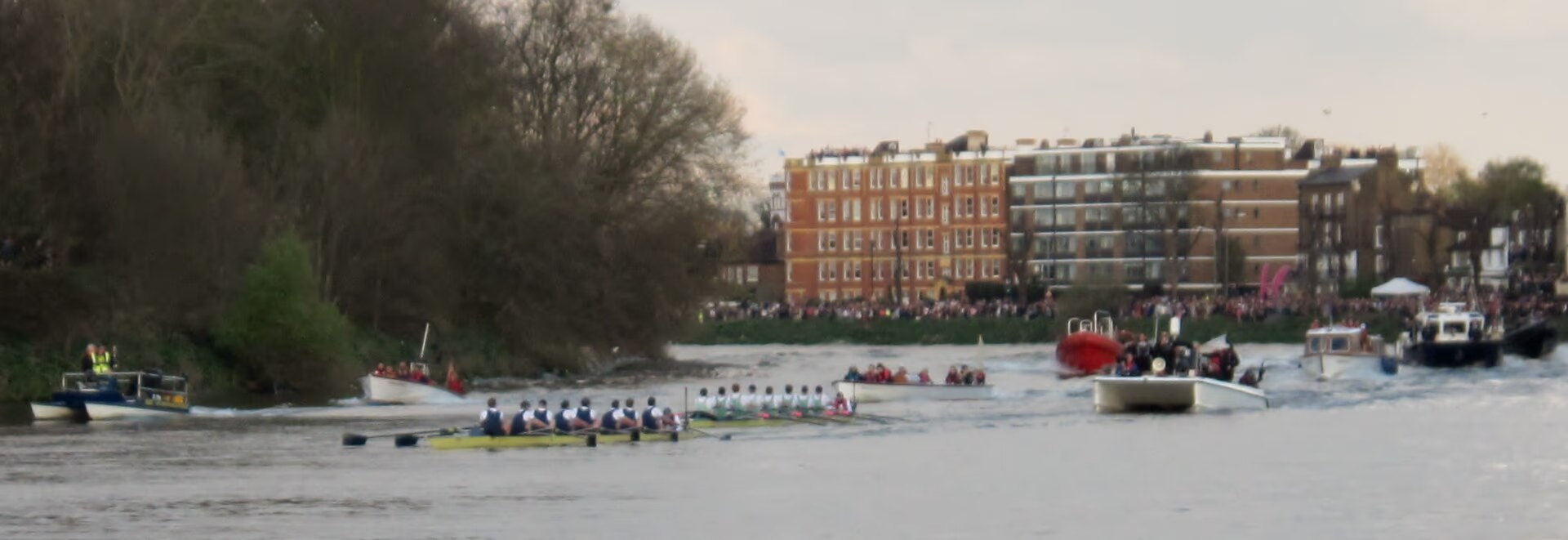
NCAA Rowing is the collegiate variant of women's rowing contested by NCAA Division I, II, and III institutions in the spring semester. NCAA Women's Rowing is the NCAA-sanctioned discipline (men's collegiate rowing is contested outside the NCAA framework via the IRA — Intercollegiate Rowing Association). NCAA Women's Rowing uses the USRowing + World Rowing technical baseline with NCAA-specific modifications around shell classes contested, championship qualifying, and team scoring. The current edition is the 2025-26 NCAA Women's Rowing Rules Book. The NCAA Rowing Championship is contested over Memorial Day weekend (late May) at varying venues. For the international framework see the sibling World Rowing Rules entry.
Section 2: Equipment
- Shell (boat): light carbon-fiber composite hull per World Rowing/USRowing weight + dimension specs
- Oars: sweep oar (one per rower, used in pairs/fours/eights) or sculling oars (two per rower, used in singles/doubles/quads)
- NCAA primarily contests sweep events: 8+ (eight with coxswain), 4+ (four with coxswain), 4- (four without coxswain)
- Riggers, slides, foot stretchers per individual rower
- Splash guards at the bow + stern
- Coxswain electronic equipment (microphone, stroke watch) per NCAA spec
Section 3: Playing Area
- Standard race distance: 2000 m (NCAA championship)
- Conference dual races may use 1500 m or 2000 m
- Course: straight 2000-m water-course with 6-8 lanes (lanes typically 13.5 m wide for safety)
- Buoy markers at each end + at 500 m intervals
- Starting platforms at the start line; finish line marked by aligned banks/structures
- Course must be sheltered from significant wind/wave conditions for fair racing
Section 4: Players & Officials
- Crew composition per shell class (8 rowers + 1 coxswain for 8+; 4 rowers + 1 coxswain for 4+; 4 rowers + no coxswain for 4-)
- NCAA Championship: each program enters multiple boats — Varsity 8+, Second Varsity 8+, Varsity 4+ (and additional boats per division)
- Officials: starter, finish judges, lane judges, course umpires, jury
- Coaches in launch boats observe but cannot coach during the race
Section 5: Rules of Play
- Crews approach the start line; align via the aligner ("aligner" official sets the bows even on the start line)
- Starter announces the start sequence: "All ready... attention... GO" (or starter pistol)
- False start: 1st = warning; 2nd by same crew = DQ from the heat
- Crews row in their lane the full 2000 m
- Crossing into another lane impeding another crew = DQ (race umpire's discretion)
- Equipment failure (broken oar, broken shell): crew may stop and request a re-row at the umpire's discretion
Section 6: Scoring
- Race: lowest finish time wins; ties co-place
- NCAA Championship team scoring: cumulative points across all boats and all races
- Heat / repechage / final structure at championship for full bracket
Section 7: Violations & Penalties
- False start (2nd by same crew): DQ
- Lane infringement causing impedance: DQ
- Equipment standard violation (un-approved shell/oars): DQ
- Coaching from launch during the race (other than safety direction): DQ
- Unsporting conduct: NCAA Sportsmanship Code; ejection + disciplinary review
Section 8: Safety Considerations
Course safety: launch boats with safety crew (coxswain, EMT) on the water during all races. Each crew member required to demonstrate swimming ability per USRowing protocol. Race-day weather thresholds: race may be cancelled for high wind, lightning, fog, or unsafe water conditions. Concussion protocol: removal + graduated return-to-play assessment. Heat exposure managed via hydration breaks pre-race; cold-water exposure (early-season) requires safety launches with thermal blankets. Required: certified athletic trainer + EMT/ambulance + AED at all NCAA-sanctioned regattas. Emergency action plan including water-rescue procedures.