
















Section 1: Introduction
1.1 Governing Body
World Aquatics (formerly known as FINA — Fédération Internationale de Natation) is the international federation recognised by the International Olympic Committee (IOC) for administering international competitions in aquatic sports, including Swimming, Diving, Water Polo, Artistic Swimming, Open Water Swimming, and High Diving. World Aquatics was officially rebranded in 2022. The current operative document for competitive swimming is the World Aquatics Technical Rules — Swimming (SW Rules), with the latest edition effective as of the 2024–2025 revision cycle.
1.2 Scope of the Rules
The World Aquatics Technical Rules govern all aquatic events conducted under World Aquatics jurisdiction, including the World Aquatics Championships, World Cup Series, Olympic Games, and all sanctioned national federation competitions that adopt these rules by reference. The SW Rules address pool construction, equipment standards, stroke technique, starts, turns, finishes, relay exchanges, officiating, and swimwear compliance.
1.3 Competition Formats
Competitive swimming is conducted in two primary formats:
- Long Course (LC): 50-metre pool, used for major international championships including the Olympic Games and World Aquatics Championships.
- Short Course (SC): 25-metre pool, used for the World Aquatics Swimming World Cup and Short Course World Championships.
World records are maintained separately for long course and short course events. Open water swimming (10 km, marathon) is governed under separate Open Water rules (OW Rules) and is not covered in this document.
1.4 Individual Events
Standard individual events contested under World Aquatics rules include:
- Freestyle: 50m, 100m, 200m, 400m, 800m, 1500m (LC); 50m, 100m, 200m, 400m, 800m, 1500m (SC)
- Backstroke: 50m, 100m, 200m
- Breaststroke: 50m, 100m, 200m
- Butterfly: 50m, 100m, 200m
- Individual Medley: 200m, 400m
- Relay events: 4×100m Freestyle, 4×200m Freestyle, 4×100m Medley (including Mixed Medley Relay)
Section 2: Equipment
2.1 Swimwear — General Requirements
World Aquatics regulates swimwear through its Swimwear Approval Programme. All swimwear worn in World Aquatics-sanctioned competitions must appear on the World Aquatics Approved Swimwear List. Swimwear must be made of textile material (woven or knitted fabric). The use of rubberised, polyurethane, or neoprene materials that provide buoyancy or reduce drag beyond approved standards is prohibited.
2.2 Swimwear Coverage — Men (SW Rule BL 1)
Male competitors may wear swimsuits covering the body from the top of the hips to the knee. The swimsuit may not extend above the navel nor below the knee. No zippers or other fastening devices are permitted on the front of the suit. Only one swimsuit may be worn.
2.3 Swimwear Coverage — Women (SW Rule BL 1)
Female competitors may wear one-piece or two-piece swimsuits. The suit must not cover the neck, extend past the shoulder, or cover any part of the arms. The suit may not extend below the knee. Only one swimsuit may be worn.
2.4 Starting Blocks (SW Rule SW 1.4)
Starting blocks must be firmly fixed and shall not move during use. The top surface of the block shall be covered with a non-slip material. Dimensions and specifications:
- Height above water surface: minimum 0.5 m (19.7 in), maximum 0.75 m (29.5 in)
- Top surface: minimum 0.5 m × 0.5 m (19.7 in × 19.7 in)
- The block must include a backstroke ledge of minimum length 0.15 m (5.9 in) above the water surface at the starting end for backstroke events
- The starting handle for backstroke must be horizontal or slightly angled toward the water, not inclined upward
2.5 Automatic Officiating Equipment — Touchpads (SW Rule SW 2)
Automatic Officiating Equipment (AOE) touchpads are required at World Aquatics sanctioned events. Touchpads must be positioned at both ends of each lane. Specifications:
- Width: minimum 2.4 m (7.9 ft), sufficient to span the full lane width
- Height: 0.9 m (2.95 ft), with 0.3 m (11.8 in) above the water surface and 0.6 m (23.6 in) below
- Touchpad thickness: maximum 0.01 m (0.39 in)
- Activation force: minimum 6.8 N (1.5 lbf) to prevent false triggers from wave action
2.6 Lane Lines (SW Rule SW 1.3)
Lane lines shall be continuous from start end to finish end and shall be attached to anchors in the walls. Lane lines consist of individual buoys or floats assembled on a wire or rope. Colour coding requirements:
- Lanes 1 and 8 (outermost): Green or dark blue
- Lanes 2 and 7: Green or dark blue
- Lanes 3, 4, 5, and 6 (central): Yellow or red (with a different colour band at the 15 m mark from each end to assist swimmers during underwater phases)
2.7 False Start Rope (SW Rule SW 4.6)
A recall rope must be stretched across the course at a distance of 15 m (49.2 ft) from the starting end. The rope shall be at least 1.2 m (3.9 ft) above the water surface. Upon a false start, the rope is dropped into the water to signal swimmers to stop and return to the start.
2.8 Goggles and Caps
Goggles may be worn in competition. Swimmers may wear not more than two swimming caps simultaneously. Caps must be made of textile, rubber, latex, silicone, or neoprene material. No electronic devices, tracking hardware, or non-compliant materials may be incorporated into caps worn during competition without prior World Aquatics approval.
Section 3: Playing Area
3.1 Pool — Long Course (SW Rule SW 1.1)
The long course pool shall measure 50 metres (164 ft 1 in) in length. The tolerance for pool length is 0 cm (no shortfall permitted); pools may not be shorter than 50 m at any point. The length is measured 0.3 m (11.8 in) below the water surface between the touchpads at both ends.
3.2 Pool — Short Course (SW Rule SW 1.1)
The short course pool shall measure 25 metres (82 ft) in length, measured under the same conditions as the long course pool.
3.3 Pool Width and Lanes (SW Rule SW 1.2)
Competition pools for World Aquatics events must have a minimum of eight lanes. Lane specifications:
- Lane width: minimum 2.5 m (8 ft 2 in) per lane
- Two spaces outside lanes 1 and 8: minimum 0.5 m (1 ft 8 in) each
- Total minimum pool width for 8 lanes: 21 m (68 ft 11 in)
- Lane numbering: Lane 1 is on the right side when facing the pool from the starting end
3.4 Pool Depth (SW Rule SW 1.1)
The minimum depth of the pool throughout shall be 2.0 m (6 ft 7 in). A depth of at least 2.0 m is required for the entire length of the pool. For pools with moveable floors, the floor must be secured at competition depth before events begin.
3.5 Water Temperature (SW Rule SW 1.1)
The water temperature shall be maintained between 25°C and 28°C (77°F and 82.4°F) during competition. The temperature must be measured and recorded before the session and displayed to team officials upon request.
3.6 Lighting
Illumination of the competition pool must be uniform and sufficient for officials to observe swimmer technique throughout the race. World Aquatics recommends minimum illumination levels of 1500 lux at water level for televised events.
3.7 Bulkheads and Moveable Walls (SW Rule SW 1.1)
Bulkheads used to divide a pool or create the 25 m short course distance must be rigidly fixed during competition. Touchpads must be mounted on both faces of a bulkhead when used as a turning and finishing wall. The wall surface at 0.3 m depth must be vertical and unobstructed.
3.8 Target Lines and Markings (SW Rule SW 1.6)
Each lane must have a clearly marked target line on the floor of the pool, centred in the lane, running the full length of the pool. The target line shall be a contrasting dark colour and:
- Width: 0.2–0.3 m (7.9–11.8 in)
- Length: ending 2.0 m (6 ft 7 in) from each end wall
- A cross (T-mark) of minimum 1.0 m (3 ft 3 in) in width shall mark the 2.0 m point from each wall
3.9 The 15-Metre Mark
Flags must be suspended across the pool at a height of 1.8 m (5 ft 11 in) above the water surface, positioned 5.0 m (16 ft 5 in) from each end wall. These backstroke flags allow backstroke swimmers to gauge their proximity to the wall. Additionally, a mark on the lane lines at 15 m from each end wall indicates the maximum underwater distance permitted after starts and turns.
Section 4: Players & Officials
4.1 The Referee (SW Rule SW 3.1)
The Referee has full control and authority over all officials and enforces all rules and decisions made by World Aquatics. The Referee shall:
- Ensure all equipment meets World Aquatics specifications before competition begins
- Assign and instruct all officials
- Intervene in the competition at any stage to enforce the rules
- Disqualify any swimmer for any violation observed personally or reported by another authorised official
- Make the final decision in any dispute and may make exceptions in cases of manifest error
4.2 The Starter (SW Rule SW 3.2)
The Starter has full control of the swimmers from the time the Referee turns the swimmers over to the Starter (until the race commences). The Starter:
- Gives the starting commands and signal
- Reports any swimmer who is guilty of delaying the start, wilful misbehaviour, or committing a false start to the Referee
- May delay the start if a swimmer is not ready or if conditions are unsafe
4.3 Chief Timekeeper (SW Rule SW 3.3)
The Chief Timekeeper assigns lanes to all timekeepers, collects and checks their recorded times, and resolves discrepancies when AOE times are unavailable. At World Aquatics Championships, AOE times are official; manual times serve as backup.
4.4 Timekeepers (SW Rule SW 3.3)
Three timekeepers are assigned to each lane using calibrated stopwatches. When AOE is not available, the middle time of the three recorded times is the official time. If two times agree and one differs, the agreed time is official. If all three differ, the median time is used.
4.5 Chief Inspector of Turns (SW Rule SW 3.4)
The Chief Inspector of Turns is responsible for ensuring all Turn Inspectors are at their assigned positions and carry out their duties correctly. The Chief Inspector receives disqualification reports from Turn Inspectors and forwards them to the Referee.
4.6 Inspectors of Turns (SW Rule SW 3.4)
One Inspector of Turns is assigned to each lane at each end of the pool (two inspectors per lane for a 10-lane pool). Turn Inspectors observe compliance with all applicable stroke and turning rules. They signal the swimmer's acknowledgment of the touch and submit disqualification reports in writing to the Chief Inspector.
4.7 Chief Finish Judge and Finish Judges (SW Rule SW 3.5)
Finish Judges observe the order of finish when AOE is not functioning. Each lane has one Finish Judge stationed at the finish end at deck level. The Chief Finish Judge compiles the order of finish from individual judges' reports and submits the result to the Referee.
4.8 Stroke and Turn Judges (SW Rule SW 3.6)
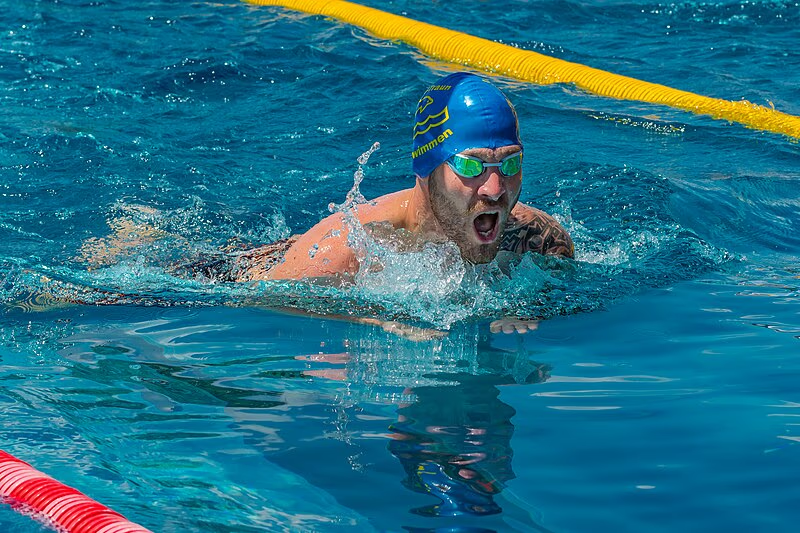
Stroke and Turn Judges observe and enforce all stroke rules throughout the race, including:
- Correct arm and leg technique for the specific stroke being swum
- Legal touches on the walls at each turn and at the finish
- Compliance with underwater distance restrictions after starts and turns
- Legal relay exchanges
4.9 Competitor Eligibility
To compete in World Aquatics sanctioned events, athletes must be registered members of their national member federation. Age group competitions have defined age brackets. In relay events, all four members must be registered to the same national team or club. Mixed relays require two male and two female swimmers (order may vary).
4.10 Team Composition — Relays (SW Rules SW 10, SW 11)
Each relay team consists of exactly four swimmers. A swimmer who has competed in a preliminary relay may be replaced by a different swimmer in the final, provided a declaration of names and order of swimming is submitted before the event. A swimmer may only compete in one relay team per event.
Section 5: Rules of Play
5.1 The Start (SW Rule SW 4)
All individual freestyle, butterfly, breaststroke, and individual medley events start with a dive from the starting block. The start procedure is as follows:
- The Referee blows one long whistle, directing swimmers to step onto the starting block (or enter the water for backstroke).
- The Starter gives the command "Take your marks". Swimmers immediately assume a stationary starting position with at least one foot at the front edge of the starting block.
- When all swimmers are stationary, the Starter gives the starting signal (audible and visual simultaneously via speakers in each starting block per SW Rule SW 4.2).
The starting signal is transmitted through speakers in or below each starting block to eliminate sound travel delay across lanes.
5.2 Backstroke Start (SW Rule SW 8.1)
For backstroke events and the backstroke leg of the medley relay, swimmers shall line up in the water facing the starting end before the starting signal. Swimmers grasp the starting handles with both hands and place their feet (including toes) below the water surface against the wall. Toes may not be placed over the lip of the gutter. The use of the backstroke ledge is permitted but not mandatory.
5.3 Freestyle Rules (SW Rule SW 5)
In freestyle events, a swimmer may swim any style. The following apply:
- SW 5.1: In individual events designated "Freestyle," the swimmer may swim any style. In the freestyle leg of a medley relay, the swimmer must use a style other than backstroke, breaststroke, or butterfly.
- SW 5.2: Some part of the swimmer must touch the wall upon completion of each length, including the finish.
- SW 5.3: Some part of the swimmer must break the surface of the water throughout the race, except that a swimmer is permitted to be completely submerged during the turn and for a distance of not more than 15 m after the start and each turn. By that point, the head must have broken the surface.
5.4 Breaststroke Rules (SW Rule SW 6)
Breaststroke is the most technically prescribed stroke. Key rules include:
- SW 6.1: After the start and each turn, one full arm stroke and one leg kick may be taken while the swimmer is wholly submerged. The head must break the surface before or at the widest point of the second arm stroke.
- SW 6.2: Throughout the race, the body shall be kept on the breast (no rolling onto the back).
- SW 6.3: All movements of the arms shall be simultaneous and in the same horizontal plane without alternating movement.
- SW 6.4: Hands shall be pushed forward together from the breast on, under, or over the water. Elbows shall be under water except for the final stroke at the finish. Hands shall not be brought back beyond the hip line, except during the first stroke after the start and each turn.
- SW 6.5: At each turn and at the finish, the touch shall be made with both hands simultaneously, at, above, or below the water surface.
- SW 6.6: The legs shall be drawn up simultaneously and symmetrically. The feet shall be turned outwards during the propulsive part of the kick. A scissors, flutter, or downward butterfly kick is not permitted.
- SW 6.7: During each complete cycle of one arm stroke and one leg kick, some part of the swimmer's head shall break the surface of the water.
5.5 Butterfly Rules (SW Rule SW 7)
- SW 7.1: Both arms must be brought forward simultaneously over the water and pulled back simultaneously throughout the race.
- SW 7.2: All up and down movements of the legs and feet must be simultaneous. The legs and feet need not be at the same level, but they shall not alternate relative to one another. A breaststroke kick is not permitted.
- SW 7.3: At each turn and at the finish, the touch shall be made with both hands simultaneously at, above, or below the water surface. The shoulders shall be in line with the water surface when the touch is made.
- SW 7.4: Some part of the swimmer must break the surface throughout the race, except that the swimmer is permitted to be wholly submerged during the turn and for a distance of not more than 15 m after the start and each turn.
5.6 Backstroke Rules (SW Rule SW 8)
- SW 8.2: The swimmer shall push off from the wall and swim on the back throughout the race, except at turns as provided in SW 8.4.
- SW 8.3: Some part of the swimmer must break the surface of the water throughout the race, except the swimmer may be wholly submerged during the turn and for a distance of not more than 15 m after the start and each turn.
- SW 8.4: At the turn, the swimmer may leave the back position in order to execute the turn. The swimmer must have left the back position before the touch on the wall. The swimmer must return to the back position upon leaving the wall.
- Any part of the swimmer may touch the wall during a backstroke turn (including contact with the feet without touching with the hands first, in a flip turn).
5.7 Individual Medley (SW Rule SW 9)
In Individual Medley events, the swimmer performs the four strokes in the following order:
- Butterfly
- Backstroke
- Breaststroke
- Freestyle
Each stroke covers one quarter of the total distance (e.g., 50 m of each stroke in a 200 m IM). Stroke rules for each section are the same as for the individual event for that stroke. The freestyle leg must not be backstroke, breaststroke, or butterfly.
5.8 Medley Relay (SW Rule SW 10)
In the Medley Relay, four swimmers each swim one quarter of the total distance in the following order:
- Backstroke
- Breaststroke
- Butterfly
- Freestyle
5.9 Relay Exchanges (SW Rule SW 11)
In relay events, a swimmer may not leave the starting platform before the preceding swimmer has touched the wall. Any swimmer other than the designated swimmer who enters the water before the completion of the race by all swimmers is grounds for disqualification. Once a team is disqualified by the Referee, the disqualification takes effect immediately and cannot be reversed by the AOE result.
5.10 Turns — General (SW Rule SW 6.5, SW 7.3, SW 8.4)
At all turns, the swimmer must touch the wall. After a legal touch, the swimmer may turn in any manner, push off, and resume the prescribed stroke. The swimmer may be fully submerged during the turn sequence, but must resurface within 15 m of leaving the wall (the 15 m rule).
Section 6: Scoring
6.1 Determination of Results — Individual Events
The winner of each event is the swimmer who completes the prescribed distance in the shortest time. Results are determined by the Automatic Officiating Equipment (AOE) touchpad system as the primary source. AOE times are recorded to 0.001 seconds (one thousandth of a second); however, official results are presented and ranked to 0.01 seconds (hundredths of a second) per SW Rule SW 2.3. Any digit beyond 0.01 s is truncated (not rounded) for official rankings.
6.2 Ties in Individual Events
When two or more swimmers record identical official times (to 0.01 s), they are declared tied and both receive the same place. If a tie occurs for a qualifying position in a final, the tied swimmers shall both advance. If lane availability does not permit all tied swimmers to advance, a swimoff shall be conducted. World Aquatics may prescribe specific swimoff procedures for its championships.
6.3 Relay Results
Relay results are determined the same way as individual results using AOE. The team time is measured from the starting signal to the final swimmer's touch on the touchpad. Relay exchange legality is verified by the AOE relay judging system (where available) or by Stroke and Turn Judges.
6.4 World Records (SW Rule SW 3 — World Record Requirements)
To be eligible for a World Record ratification, the following conditions must be met:
- The performance must be achieved in a World Aquatics-sanctioned competition.
- A full doping control must be conducted for the swimmer(s) involved within the window specified by World Aquatics Anti-Doping Rules.
- The pool must be FINA/World Aquatics certified; the AOE must be Omega or equivalent certified.
- The swimsuit worn must appear on the World Aquatics Approved Swimwear List at the time of the performance.
- World Records are maintained for both long course (50 m) and short course (25 m) for all standard events.
- Any record set in relay leadoff legs (backstroke, breaststroke, butterfly, freestyle) is eligible as an individual world record if the swimmer performs a legal start and completes the full relay leg distance.
6.5 Championship Points — Team Scoring
At World Aquatics Championships, individual event results contribute points to national team totals based on final placement. World Aquatics publishes the specific points table for each championship. Relay events typically carry higher point values reflecting the team nature of the effort. Disqualified swimmers score no points.
6.6 Heat Seeding and Lane Assignments
In preliminary heats, swimmers are seeded by submitted entry times. The fastest swimmer is placed in lane 4 of the final heat (in an 8-lane pool). Lane assignments proceed outward from lane 4 in an alternating pattern: 4, 5, 3, 6, 2, 7, 1, 8. Slower heats are conducted first; the fastest heat is last. In finals, lane assignments are determined by placing finalists by their heat times using the same seeding pattern.
Section 7: Violations & Penalties
7.1 False Start (SW Rule SW 4.4)
A swimmer who moves from the stationary starting position before the starting signal is given has committed a false start. Under the current World Aquatics rules, any swimmer committing a false start shall be disqualified. There is no "one warning" system at the international level; a single false start results in immediate disqualification for the offending swimmer. The recall rope is dropped to stop the remaining swimmers, and the offending swimmer is removed from competition. The race is then restarted.
7.2 Freestyle Violations (SW Rule SW 5)
- Failure to touch the wall at the completion of each length: Disqualification (DQ)
- Remaining completely submerged beyond 15 m after start or turn: DQ
- Walking on the bottom of the pool (permitted, but use of the bottom to gain an advantage is prohibited): DQ at the Referee's discretion
- Pulling on the lane rope for advantage: DQ
7.3 Breaststroke Violations (SW Rule SW 6)
- Alternating arm or leg movement: DQ
- Failure to bring both hands forward from the breast simultaneously: DQ
- Arms pulled back beyond the hip line (except first stroke after start/turn): DQ
- Scissors kick, flutter kick, or downward butterfly kick: DQ
- Feet not turned outward during propulsive phase: DQ
- One-handed touch at the wall: DQ
- Head failing to break the surface within each complete cycle: DQ
- Head submerged after the first arm stroke on the pullout (underwater breaststroke): DQ, unless the head broke the surface before or at the widest point of the second arm stroke
7.4 Butterfly Violations (SW Rule SW 7)
- Arms not brought forward simultaneously over the water: DQ
- Alternating leg movement (flutter kick): DQ
- Breaststroke kick during butterfly: DQ
- One-handed touch at the wall: DQ
- Remaining submerged beyond 15 m after start or turn: DQ
7.5 Backstroke Violations (SW Rule SW 8)
- Rotating past vertical (90°) toward the breast, except during a legal turn: DQ
- Finishing on the breast (not returning to back position after the turn): DQ
- Remaining submerged beyond 15 m after start or turn: DQ
- Toes placed over the gutter lip at the start: DQ (determined by the Starter)
7.6 Individual Medley Violations (SW Rule SW 9)
- Failure to complete each stroke segment in the correct order: DQ
- Using a different stroke than required for the applicable leg: DQ
- Any stroke-specific violation applicable to the segment being swum: DQ
7.7 Relay Violations (SW Rules SW 10, SW 11)
- Relay swimmer leaves the starting block before the incoming swimmer touches the wall: DQ (entire team)
- Swimming in the wrong order (medley relay): DQ (entire team)
- Any swimmer other than the four designated swimmers entering the water during the race: DQ (entire team)
- Failure to submit a valid declaration of relay team members: DQ (entire team) at the meet director's discretion
7.8 General Conduct Violations (SW Rule SW 4)
- Wilful delay of the start after the command "Take your marks": The swimmer may be reported to the Referee for delaying the start; the Referee may disqualify the swimmer at their discretion.
- Interfering with another swimmer during the race (e.g., grabbing lane ropes): DQ of the interfering swimmer.
- Obstructing or impeding another swimmer: DQ.
- Use of non-approved swimwear: DQ and removal from competition. The athlete may be allowed to change and re-enter if time permits at the Referee's discretion.
7.9 Disqualification Procedure
All disqualifications must be reported in writing by the official who observed the violation to the Chief Inspector of Turns (for turn/stroke violations) or directly to the Referee (for start violations). The Referee makes the final ruling. Disqualification reports must specify the exact rule violated and the nature of the infraction. Disqualifications are posted officially as "DQ" with the applicable rule number.
Section 8: Safety Considerations
8.1 Deck Safety — General
World Aquatics requires that all competition venues maintain safe deck conditions throughout all sessions. Non-slip surfaces must be maintained on pool decks, starting block platforms, and all walkways. Wet deck areas adjacent to the pool must be clearly delineated. Competitors, coaches, and officials must wear appropriate footwear on deck except during active competition.
8.2 Lifeguard Requirements
A minimum number of trained lifeguards must be on duty at all times during practice and competition sessions in World Aquatics sanctioned events. Lifeguards must be positioned to observe the entire pool. Lifeguards must not serve simultaneously as officials, coaches, or competitors. Rescue equipment (reaching poles, rescue tubes, and a spine board) must be immediately accessible at poolside.
8.3 Medical Personnel
A qualified medical professional (physician or emergency medical technician) must be present or immediately available for all World Aquatics sanctioned competitions. An Automated External Defibrillator (AED) must be located at the venue and accessible within a maximum of 3 minutes response time. Medical personnel must be identified and their location known to all officials before competition begins.
8.4 Head Injuries and Concussion Protocol
World Aquatics has adopted a concussion recognition and management protocol consistent with international sports concussion guidelines. Any swimmer suspected of having sustained a head injury or concussion must be immediately removed from competition and evaluated by medical personnel. A swimmer removed for suspected concussion may not return to competition in the same session without written medical clearance. Return-to-sport protocols must follow World Aquatics published concussion management guidelines.
8.5 Anti-Doping
World Aquatics operates under the World Anti-Doping Agency (WADA) Code and the World Aquatics Anti-Doping Rules. All swimmers competing at World Aquatics events are subject to in-competition and out-of-competition testing. Swimmers ranked in the top 10 in the world in any event, or selected at the discretion of World Aquatics Doping Control, may be tested at any sanctioned competition. Refusal to submit to a doping control constitutes a doping violation with consequences equivalent to a positive test.
8.6 Water Quality
Pool water must meet public health standards for competition and training. Chlorine, pH, turbidity, and microbial counts must comply with standards established by the relevant national health authority and World Aquatics venue certification requirements. Water quality reports must be available to World Aquatics officials upon request during sanctioned events. Competitions may be suspended or cancelled if water quality poses a health risk to competitors.
8.7 Thunder and Lightning Protocol
All outdoor aquatic competitions must have a lightning/thunder safety plan. The standard protocol requires evacuation of all swimmers from the water at the first observed lightning or heard thunder, with a minimum 30-minute delay after the last lightning strike before resuming competition. Indoor facilities with metal roofs or exposed structural elements must also have a documented protocol for electrical storm conditions.
8.8 Dive Safety
Diving from starting blocks is only permitted in pools with a minimum depth of 1.35 m (4 ft 5 in) at the starting end and 1.80 m (5 ft 11 in) preferred for internationally sanctioned events. Shallow-water starts (in-water or push-off from the wall) must be used when pool depth at the starting end is below 1.35 m. World Aquatics strongly recommends a minimum depth of 2.0 m throughout for all competitive pools (as also required by SW Rule SW 1.1). Diving practices outside of competition or supervised coaching sessions are prohibited.
8.9 Swimmer Welfare During Extreme Conditions
World Aquatics reserves the right to modify competition schedules, postpone events, or implement additional safety measures in response to extreme environmental conditions including, but not limited to: extreme heat, air quality concerns, or water temperature outside the permitted range of 25–28°C. Athlete welfare committees may advise the Technical Delegate on such conditions during major championships.