


🏛️Official — World Aquatics
Loading OpenSourceSports…
Water Sports
1 players
both
board, pool, swimwear
10 essential rules
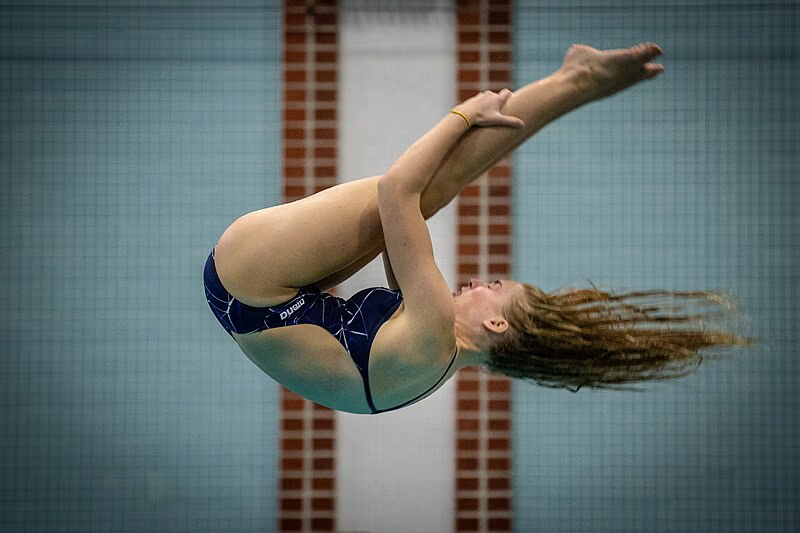
Diving has been a continuous Olympic sport since the 1904 St. Louis Games (men's platform) and the 1912 Stockholm Games (women). Originally part of gymnastics-related aquatic events, competitive diving evolved into a standalone discipline governed by World Aquatics (formerly FINA, rebranded in 20...
Heights: 1 m and 3 m above the water surface. The 3 m board is used in Olympic competition; the 1 m board is used in NCAA and other domestic events.; Board dimensions: Length 4.87 m (16 ft), width 0.50 m (1 ft 8 in). Constructed from extruded aluminum alloy (typically Maxiflex Model B or equivale...
Olympic height: 10 m (32 ft 10 in) above the water surface. Training and junior platforms available at 5 m and 7.5 m.; Dimensions: Minimum length 6.0 m (19 ft 8 in), minimum width 2.0 m (6 ft 7 in). Multiple platforms may be installed on the same tower.; Construction: Rigid concrete or reinforced...
Swimwear: Competitive swimwear conforming to World Aquatics regulations. No loose-fitting fabric; suits must be form-fitting. Two-piece suits permitted for women but must not be excessive in coverage.; Chamois (shammy): Small synthetic towel used to dry skin and hands between dives. Helps maintai...
Minimum depth: 5.0 m (16 ft 5 in) below the 10 m platform; 3.5 m (11 ft 6 in) below the 3 m springboard; 3.0 m (9 ft 10 in) below the 1 m springboard.; Minimum area: The clear water zone directly below each board or platform must be at least 5.0 m x 4.0 m free from obstructions.; Ceiling height: ...
A mechanical surface agitation system is mandatory at all World Aquatics-sanctioned competitions. This system produces a visible disturbance on the water surface (bubbles, spray jets, or drip jets) so divers can judge their height and distance from the water during flight.
Hot tub / shower area: Located adjacent to the pool for divers to maintain body temperature between dives. Water temperature typically 37–40 °C (99–104 °F).; Dry-land training: Purpose-built dryland facility with overhead spotting rigs (harnesses), trampolines, and foam pits for learning new dive...
Each diver competes alone, performing a prescribed number of dives from a published dive list. Preliminary rounds narrow the field to 18 (semifinal) and then 12 (final).
A pair of divers from the same country performs the same dive simultaneously. Partners are assessed both on their individual execution and on how closely they match each other in takeoff, height, rotation speed, and entry angle.
Seven judges score each dive. The two highest and two lowest marks are discarded, leaving three counting scores.
Eleven judges are used: three assess execution of diver A, three assess execution of diver B, and five assess synchronization. The execution panels each drop the high and low mark (one counting score per panel).
Never interrupt a competitor's pre-dive mental routine
Competitive divers invest years developing specific visualization and mental rehearsal sequences before each dive. Speaking to, jostling, or deliberately distracting a competitor who is in their pre-dive routine — whether in the ready area or on the platform — is one of the most serious breaches of sportsmanship in the sport.
The danger inherent in difficult dives makes this doubly serious — mental errors caused by distraction can lead to injury.
Silence while a diver is preparing and executing
Coaches, competitors, and spectators maintain complete silence once a diver steps to the end of the board or platform to begin their approach. Any noise — shouting instructions, cheering, commentary — during the diver's mental preparation and execution is considered a serious breach of the competition environment.
Applies in training pools and competition venues alike. Distinct from the crowd noise after entry.
Synchro partners present a united front after a poor dive
In synchronized diving, it is expected that partners never visibly blame each other — through looks, words, or body language — after a badly synchronized or failed dive. Whatever frustration exists is handled privately. Public expressions of blame toward a partner are considered a serious breach of the partnership contract and the sport's respect culture.
Applies in both training and competition. Partners are expected to immediately re-focus and support each other.
Ready to dive deeper?