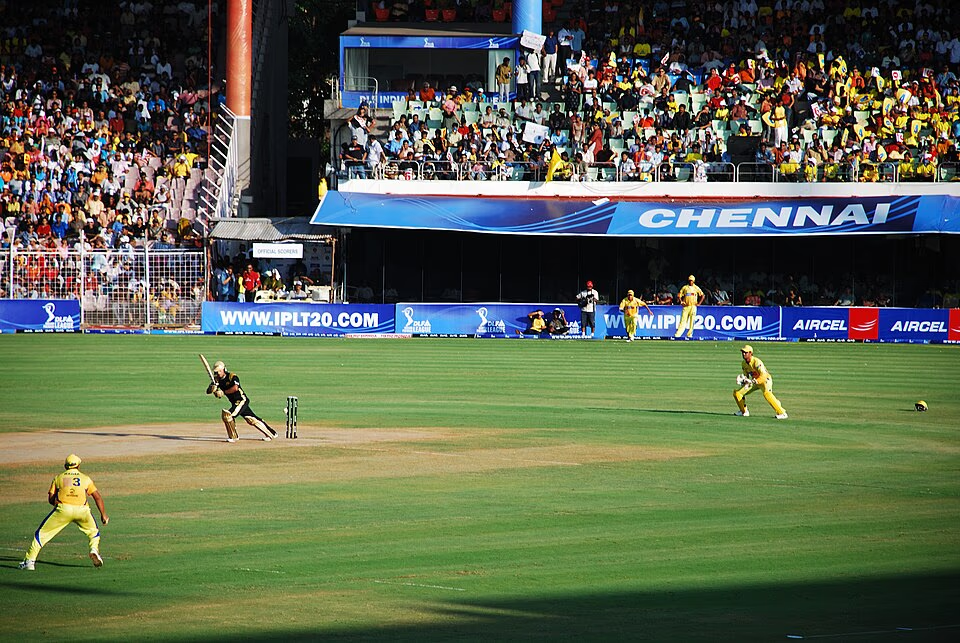















Section 1: Introduction
Twenty20 (T20) is the shortest format of international cricket, with each side batting for 20 overs. Introduced as an international format in 2005 and as a World Cup in 2007, T20 is the format selected for cricket's return to the Olympic program at the 2028 Los Angeles Games — cricket's first Olympic appearance since 1900 in Paris. The ICC publishes the ICC Men's Twenty20 International Playing Conditions, which modify the MCC Laws of Cricket for the T20I format; these playing conditions are the authoritative ruleset for international T20 play. Domestic T20 leagues (IPL, BBL, PSL, etc.) have their own playing conditions that broadly mirror ICC rules with league-specific exceptions (e.g., Impact Player, free hits expanded). For the long-format laws, see the sibling ICC Laws of Cricket entry.
Section 2: Equipment
- Ball: white leather ball (4-piece construction) at international level; weight 5.5-5.75 oz (155.9-163 g)
- Bat: max 38" length × 4.25" width; willow blade; max thickness 67 mm edge, 60 mm depth
- Pads: batting pads, thigh pads, arm guards, helmet with grille, abdominal guard, gloves
- Wicket keeper: additional inner glove + wicket-keeping gloves with webbing
- Stumps: three wooden stumps + two bails, 28" tall, 9" wide at top
- Players wear team-coloured kit (white-ball cricket uses coloured uniforms vs. whites in Test cricket)
Section 3: Playing Area
- Field: oval; boundary diameter typically 130-170 yards (120-155 m)
- Pitch: central 22 yards (20.12 m) strip of compacted earth/grass
- Crease markings: bowling crease, popping crease (4 ft from stumps), return creases
- 30-yard fielding circle drawn for power-play and fielding-restriction enforcement
- Wicket at each end (3 stumps + 2 bails)
Section 4: Players & Officials
- 11 players per side
- Captain, wicket-keeper, batters, bowlers, all-rounders, fielders
- Officials: 2 on-field umpires, 1 TV (third) umpire, 1 reserve umpire, 1 match referee
- DRS (Decision Review System): teams have 2 reviews per innings (3rd umpire reviews via ball-tracking, ultra-edge, hot-spot)
Section 5: Rules of Play
Match Format
- Two innings — each side bats once for 20 overs (or until all-out)
- Each over = 6 legal deliveries; each bowler max 4 overs per innings
- Match target ~75-90 minutes per innings; total ~3-3.5 hours
Fielding Restrictions
- Power-play (overs 1-6): only 2 fielders allowed outside the 30-yard circle
- After power-play (overs 7-20): maximum 5 fielders outside the 30-yard circle
- At most 4 fielders on leg side at any time
Bowling Restrictions
- Max 4 overs per bowler
- No-ball: bowler oversteps front popping crease → free hit (next ball cannot dismiss batter except run-out)
- Wide ball: outside off-stump (per umpire judgment) → extra run + re-bowled
Batting
- Batter dismissed by: bowled, caught, LBW, run out, stumped, hit wicket, obstructing field, timed out, retired
- Free hit ball: batter cannot be dismissed except run out
- When a batter is dismissed Caught, the incoming batter takes strike at the end where the striker was standing at the moment of the catch, regardless of whether the striker and non-striker had crossed before the catch was completed (ICC Men's Twenty20 International Playing Conditions, mirroring MCC Law 18.11 — previously, if the batters had crossed, the non-striker took strike instead).
Section 6: Scoring
- Runs scored by: running between wickets (1, 2, 3 runs per ball typical) or boundaries (4 along the ground, 6 over the boundary on the fly)
- Extras: byes, leg-byes, wides, no-balls, penalty runs
- Team total: sum of runs across innings (vs. wickets lost)
- Tie: if scores level after both innings → Super Over (1 over per side; if Super Over also tied → another Super Over until decided)
- Tournament: round-robin pool + knockout (T20 World Cup); Olympic format TBD
Section 7: Violations & Penalties
- Slow over-rate: fielding side penalized 5 runs to opponent per missed over; captain banned if persistent
- Ball tampering: 5-run penalty to opponent + match-suspension fine for offender
- Saliva on the ball: use of saliva to polish or otherwise change the condition of the ball is permanently prohibited under the ICC Playing Conditions (the clause mirroring MCC Law 41.3, "The match ball – changing its condition"); polishing is permitted only with sweat or a plain cloth against the ball. Applying saliva is treated the same as applying any other artificial substance to the ball — the umpires award 5 penalty runs to the batting side and change the ball if it is deemed to have been unfairly altered.
- Dissent / unsportsmanlike: match referee may issue suspension or match-fee deduction
- Mankad (running out non-striker): permitted — recategorized from "Spirit" to "Run Out" in 2022; not penalized
- Anti-corruption: ICC Anti-Corruption Code; full investigation + suspension powers
- Anti-doping: WADA Code; ICC-administered testing
Section 8: Safety Considerations
Following the death of Phillip Hughes (2014), helmet standards for batters facing fast bowling were upgraded to British Standard BS7928:2013 — neck-protector ("Stem Guard") strongly recommended. ICC requires: certified match-day medical team (team physician + ambulance + medical center), concussion-substitute system (2019-onwards: like-for-like replacement if on-field concussion); player removal for SCAT-5 evaluation. Helmets mandatory for batters facing fast bowling, wicket-keepers standing up to stumps, and close-in fielders within 8 yards of the bat. Weather + light: match referee + umpires authorize stoppage for poor light, rain, or lightning. DLS (Duckworth-Lewis-Stern) method recalculates targets in rain-shortened games. Heat-stress protocols at hot venues. AED on-site at every ICC-sanctioned match. The permanent saliva prohibition (see Section 7) originated as a player-safety measure — the ICC Medical Advisory Committee recommended against saliva on the ball to reduce disease-transmission risk between fielders — and remains in force as a standing playing condition rather than a temporary COVID-era rule.