Section 1: Introduction
Open Water Swimming is the discipline of competitive long-distance swimming in rivers, lakes, seas, oceans, water channels, or any other body of open water, governed internationally by World Aquatics (renamed from FINA in January 2023). This rulebook reflects the World Aquatics Competition Regulations, in force as from February 2026 (effective 2026-02-18), Part Three: Open Water Swimming Rules, which supersedes the prior 2026-01-01 edition referenced by this site. Article 1.2 of Part Three defines Open Water Swimming as any swimming event that takes place in rivers, lakes, seas, oceans, water channels, or any other body of open water.
The Olympic Games program consists of a single event per sex: the 10 km race for men and women (Article 1.3 of Part Three). The World Aquatics Championships program is broader and now comprises the 10 km and 5 km individual races for men and women, the 3 km Knockout Sprint for men and women, and the Mixed Team Event — a 4 x 1500 m relay (Article 1.4 of Part Three). The 3 km Knockout Sprint is a new event format introduced under this edition (Article 7 of Part Three), and the team relay is now formally named the Mixed Team Event with each of the four Athletes completing a 1.5 km leg (Article 6.1.4 of Part Three) rather than the shorter 1.25 km legs used previously. The World Aquatics Junior Open Water Swimming Championships program runs age-banded 5 km, 7.5 km, and 10 km races, plus its own 3 km Knockout Sprint and relay events (Article 1.5 of Part Three).
Open water differs from pool swimming in several core ways codified in Part Three: navigation of the course is the Athlete's own responsibility (Article 4.1.2), limited contact and drafting are tolerated provided they are not unsporting (Article 4.2.4), and weather, tide, and water-quality conditions are directly regulated as part of the competition (Article 13 of Part Three).
Section 8: Safety Considerations
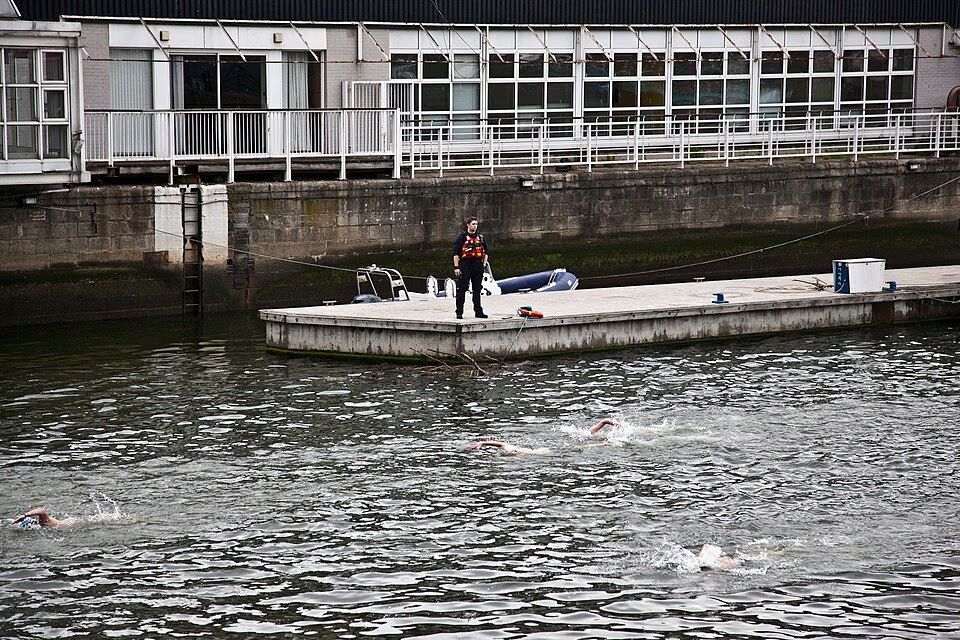
Open water swimming carries risks not present in pool swimming — hypothermia, hyperthermia, exhaustion, marine hazards, and waterborne illness from contaminated water. Part Three requires the competition organiser to submit a site-specific Safety Plan to World Aquatics for approval four weeks before the competition, which a World Aquatics Safety Delegate reviews and may approve, modify, or reject; no competition may be sanctioned without an approved Safety Plan (Articles 14.2.1.1–14.2.1.6 of Part Three).
The Safety Plan must cover a Technical/Team Leaders' Meeting briefing on course hazards, tides, currents, marine life, and the evacuation plan (Article 14.3.1 of Part Three); continuous monitoring of every Athlete by at least one Safety Crew member or Referee at all times, with a stationary, CPR- and life-support-trained Safety Craft positioned at intervals of roughly every 400 metres along the course (Articles 14.3.3.1–14.3.3.3 of Part Three); an instant two-way safety communication system linking the Safety Delegate, Safety Officer, Safety Crew, Chief Medical Officer, and Chief Referee, with a dedicated emergency channel and backup (Articles 14.3.4.1–14.3.4.4 of Part Three); and a course evacuation plan for removing all Athletes, officials, and personnel from the water in an emergency (Article 14.3.11 of Part Three).
Medical requirements include a Chief Medical Officer experienced in endurance-event care, sufficient medical personnel trained in basic life support and CPR, onsite emergency and trauma equipment plus automated external defibrillators, and an ambulance available onsite or on call within five minutes (with a recommended backup within fifteen minutes); where travel time to the nearest hospital exceeds one hour, the Safety Plan must provide for helicopter transport (Articles 14.3.9.1–14.3.9.4 of Part Three).
Water temperature is checked at three points around the course, at a depth of 40 cm, two hours before the race and again at ten minutes before and every thirty minutes during the race; if the water measures below 16.0°C or above 31.0°C at any interval, the Chief Referee, on advice of the Safety and Medical Officers, may delay, postpone, or cancel the event, and may only restart a stopped race once the temperature is back within that 16.0–31.0°C range (Articles 12.2.3.3–12.2.3.7 of Part Three). Venue suitability is also gated on documented water quality — organisers must submit water-quality analysis reports at two months, seven days, and within 48 hours of the competition, and World Aquatics considers a venue in the "fair" or "poor" sanitary/bacterial category unsuitable for safe competition or training (Articles 13.1.4.1, 13.2.6.4 of Part Three).