









Section 1: Introduction
1.1 Overview and Governing Body
Canoeing has been part of the Olympic programme since the 1936 Berlin Games (canoe sprint) and the 1972 Munich Games (canoe slalom). The International Canoe Federation (ICF), founded in 1924, governs all forms of competitive paddling worldwide under the ICF Canoe Sprint Competition Rules, the ICF Canoe Slalom Competition Rules, and the ICF Extreme Canoe Slalom Competition Rules. The ICF is headquartered in Lausanne, Switzerland, and oversees more than 170 member national federations.
1.2 Olympic Disciplines
Three canoeing disciplines are contested at the modern Olympic Games:
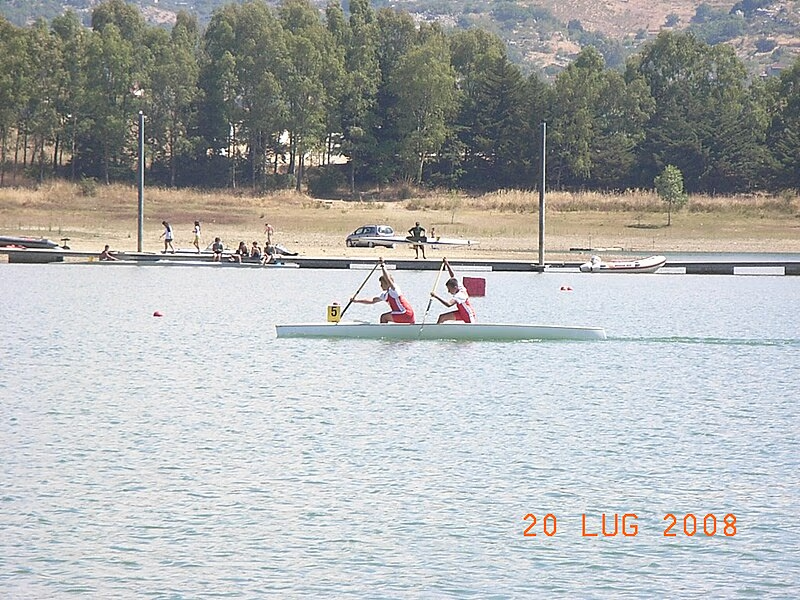
- Canoe Sprint (Flatwater): Athletes race in a straight line on calm water over distances of 200 m, 500 m, or 1000 m. Speed, power, and paddling technique are paramount. Events include single, double, and quad boats in both kayak (K) and canoe (C) categories.
- Canoe Slalom (Whitewater): Athletes navigate a course of suspended gates on a whitewater channel, combining speed with technical precision. Penalty seconds are added for touching or missing gates. Events are individual time trials in K1 (kayak) and C1 (canoe).
- Kayak Cross (Extreme Slalom): Added at the 2024 Paris Olympics. Four athletes race simultaneously on a modified whitewater course with a rolling start from a ramp. Head-to-head elimination format with the top 2 finishers advancing each round. Features an Eskimo roll section where athletes must intentionally capsize and recover.
1.3 Kayak vs. Canoe Distinction
The two craft types reflect different paddling traditions and body positions:
- Kayak (K): Athlete sits in a low, enclosed cockpit facing forward and uses a double-bladed paddle, alternating strokes on each side. The kayak is descended from the Inuit qajaq used for hunting in Arctic waters.
- Canoe (C): Athlete kneels on one knee (sprint) or both knees (slalom) and uses a single-bladed paddle on one side only (sprint) or alternating sides (slalom). The canoe is descended from North American Indigenous watercraft.
1.4 Olympic Events
The current Olympic programme includes the following canoeing events (16 medal events total):
- Sprint: K1 200m (W), K1 500m (W), K1 1000m (M), K2 500m (M/W), C1 200m (W), C1 1000m (M), C2 500m (M/W)
- Slalom: K1 (M/W), C1 (M/W)
- Kayak Cross: K1X (M/W)
Section 2: Equipment
2.1 Sprint Boats
Sprint boats are long, narrow, and designed for maximum speed on flat water. ICF regulations specify maximum length and minimum weight:
- K1 (single kayak): Maximum length 520 cm (17 ft 1 in), minimum weight 8 kg (17.6 lb)
- K2 (double kayak): Maximum length 650 cm (21 ft 4 in), minimum weight 12 kg (26.5 lb)
- K4 (quad kayak): Maximum length 1100 cm (36 ft 1 in), minimum weight 30 kg (66.1 lb)
- C1 (single canoe): Maximum length 520 cm (17 ft 1 in), minimum weight 10 kg (22.0 lb)
- C2 (double canoe): Maximum length 650 cm (21 ft 4 in), minimum weight 14 kg (30.9 lb)
- Construction: Typically carbon fiber, Kevlar, or composite layup for competition boats. Hull shape is unrestricted beyond length/weight limits. Rudder (kayak) or fin (canoe) permitted for steering.
2.2 Slalom Boats
Slalom boats are shorter and more maneuverable to navigate whitewater and gates:
- K1 Slalom: Maximum length 350 cm (11 ft 6 in), minimum weight 9 kg (19.8 lb), minimum width 60 cm (23.6 in)
- C1 Slalom: Maximum length 350 cm (11 ft 6 in), minimum weight 8 kg (17.6 lb), minimum width 60 cm (23.6 in)
- Kayak Cross (K1X): Identical specifications to K1 Slalom. Must be equipped with a grab handle at bow and stern for safety.
- Design: Rounded hull profile with rocker (curved bow-to-stern profile) for maneuverability. Volume distribution affects how the boat responds in whitewater features.
2.3 Paddles
- Kayak paddle: Double-bladed. No restrictions on length, blade size, or material. Typically 210–220 cm for sprint, 196–200 cm for slalom. Carbon fiber shaft and blade standard at elite level. Blades may be offset (feathered) at various angles.
- Canoe paddle: Single-bladed. No restrictions on length, blade size, or material. Typically 150–160 cm. T-grip handle at the top for control.
2.4 Safety Equipment
- Helmet (Slalom/Kayak Cross): Mandatory. Must meet ICF safety standards. Full-cut design covering temples and back of head. Ear protection required in Kayak Cross.
- Buoyancy aid/PFD (Slalom/Kayak Cross): Mandatory. Minimum buoyancy 6 kg (13.2 lb). Must be worn at all times on the water. Cannot restrict paddling motion.
- Spray deck (Slalom): Covers the cockpit opening to prevent water entry. Must have a grab loop for emergency release.
- Nose and tail bumpers: Required on slalom boats to protect against impacts with rocks and other boats
2.5 Attire
- Competition bib or number vest worn over the buoyancy aid (slalom) or directly (sprint)
- National federation uniform required at Olympic events
- No restrictions on footwear (many slalom paddlers wear neoprene booties)
- GPS transponder may be required for sprint events (attached to the boat for real-time tracking)
Section 3: Playing Area
3.1 Sprint Course
A purpose-built regatta course on calm, flat water. Specifications:
- Distances: 200 m (sprint), 500 m, and 1000 m. The 200 m course uses the final 200 m of the 1000 m course, with a separate start area.
- Lanes: 9 racing lanes, each 9 m (29.5 ft) wide. Lane markers (buoys) spaced at 10 m intervals along the course. Lanes are numbered 1–9 from the nearest shore outward.
- Water depth: Minimum 3 m (9.8 ft) across the entire course to prevent wave reflection from the bottom affecting boat speed
- Start system: Mechanical alignment system holds the sterns of all boats until the start signal. Boats are aligned flush at the stern, not the bow, to prevent advantage from boat length differences.
- Finish: Photo finish system with cameras aligned perpendicular to the finish line. Transponder timing records to 1/1000th of a second. The bow of the boat must cross the finish line.
- Wind protection: Venues are ideally sheltered from cross-winds that create unequal conditions across lanes. Wave-damping systems may be used.
3.2 Slalom Course
- Length: 200–400 m (656–1,312 ft) of whitewater channel
- Water: Artificial (pump-recirculated) or natural river. Artificial channels allow consistent, repeatable water conditions for fair competition. Water flow rate typically 10–15 m³/s.
- Gates: 18–25 gates suspended from overhead wires by adjustable cords. Each gate consists of two poles hanging 15–25 cm (6–10 in) above the water surface, set 1.2 m (3.9 ft) minimum apart.
- Gate colors: Green/white striped poles indicate downstream gates (paddled in the direction of water flow). Red/white striped poles indicate upstream gates (paddled against the flow). Minimum 6 upstream gates on the course.
- Gate numbering: Gates are numbered sequentially and must be negotiated in order. Gate numbers are displayed on boards above each gate.
- Course features: Eddies (calm water behind obstacles), waves, holes (recirculating hydraulics), drops, and current differentials. Course designers use movable obstacles or adjustable water flow to create challenging features.
3.3 Kayak Cross Course
- Length: Approximately 250–350 m modified slalom course
- Start ramp: Elevated platform where 4 athletes launch simultaneously on the start signal, sliding down a ramp into the water
- Eskimo roll gate: A mandatory section where athletes must capsize and perform an Eskimo roll (self-righting maneuver) before continuing. A cross-beam is positioned above the water to force submersion.
- Gates: Fewer gates than traditional slalom (typically 6–12), positioned to create a racing line with multiple possible routes
- Contact zone: Designated sections where incidental boat-to-boat contact is expected and permitted. Deliberate obstruction remains prohibited.
Section 4: Players & Officials
4.1 Sprint Competitors
- Boat classes: K1 (1 paddler), K2 (2), K4 (4), C1 (1), C2 (2). Olympic events cover a subset of these per programme cycle.
- Competition format: Heats → Quarterfinals (if needed) → Semifinals → Finals (A final for medals, B final for places 9–17). The fastest qualifiers from each round advance.
- Seeding: Athletes are seeded into heats based on world rankings to avoid top athletes meeting too early
- Lane allocation: Fastest qualifiers placed in center lanes (4, 5) for the final, as center lanes are least affected by reflected waves from shore
4.2 Slalom Competitors
- Boat classes: K1 (men/women), C1 (men/women), K1X Kayak Cross (men/women)
- Format (K1/C1): Qualification (2 runs, best counts) → Semifinal (1 run) → Final (1 run). Each run is a timed individual descent through all gates.
- Start interval: Athletes start individually at intervals of approximately 90–120 seconds in slalom. Two athletes are never on the course simultaneously in traditional slalom.
- Format (Kayak Cross): Time trial for seeding → Head-to-head rounds (4 athletes per heat). Top 2 advance each round through to the final.
4.3 Sprint Officials
- Starter: Gives the start commands ("Ready... Set..." + electronic tone or gun). Monitors for false starts via the alignment system.
- Aligner: Ensures all boats are properly positioned in the alignment system before the start signal
- Umpires: Travel alongside the race in motorboats, observing for lane violations, interference, and other infractions
- Finish judges: Operate the photo finish system and verify transponder timing results
- Boat control officials: Inspect boats before and after races to verify compliance with length and weight regulations
4.4 Slalom Officials
- Gate judges: Positioned at each gate (or group of gates) to observe whether the paddler correctly negotiates the gate and whether any touches occur. Each gate has 2 judges who must agree; disagreements are reviewed by the section chief.
- Section chiefs: Supervise groups of gate judges and resolve disputes about touches or missed gates
- Chief Judge: Overall authority on the course. Reviews video evidence for disputed gate judgments.
- Timekeepers: Electronic timing from start to finish, recorded to 1/100th of a second
- Video review: All gates are covered by cameras. Official video review is used for protests and may overturn gate judge decisions.
Section 5: Rules of Play
5.1 Sprint Racing Rules
- Start: All boats held in the alignment system. On the start signal (electronic tone after "Ready... Set..."), boats are released simultaneously. Standing start (no rolling start).
- Lane discipline: Each boat must remain within its 9 m lane for the entire race. Crossing into another lane results in disqualification unless the offending crew was clearly not gaining an advantage and not interfering with another crew.
- Drafting: Not explicitly prohibited, but lane rules and 9 m lane width make it impractical. Wake effects between lanes are considered a natural part of the race.
- Capsizing: If a crew capsizes, they are out of the race. No restart is granted. Safety boats assist with recovery.
- Finish: The bow of the boat must cross the finish line. Photo finish determines the order. If the margin is less than 5/1000ths of a second, a dead heat may be declared.
5.2 Sprint False Start Rules
- A false start occurs when a boat moves before the start signal while in the alignment system
- First false start: Warning issued to the offending crew. All boats return to the alignment system for a restart.
- Second false start (by any crew): The crew that committed the second false start is excluded from the race. Under current ICF rules, the "one warning per race" system means any crew committing a false start after the general warning is excluded.
- Electronic detection systems record boat movement in the alignment cradles to objectively determine false starts
5.3 Slalom Racing Rules
- Gate negotiation: The paddler's head must pass between the two poles of the gate in the correct direction (downstream for green gates, upstream for red gates). The entire head must cross the gate line.
- Gate sequence: Gates must be negotiated in numerical order. Skipping a gate or negotiating out of sequence results in a 50-second penalty for the missed gate(s).
- Gate touches: 2-second penalty for touching one or both poles of a gate with the body, paddle, or boat. Only one 2-second penalty is assessed per gate regardless of how many touches occur at that gate.
- Missed gate: 50-second penalty if the paddler fails to negotiate the gate correctly (not passing the head between the poles in the correct direction). A deliberately skipped gate also receives 50 seconds.
- Intentional displacement: If a paddler intentionally pushes a gate pole aside to create more space, a 50-second penalty is assessed
5.4 Kayak Cross Racing Rules
- Start: 4 athletes launch simultaneously from a start ramp into the water on the signal. Lane selection is based on seeding (fastest time trial gets first lane choice).
- Contact: Incidental boat-to-boat contact is permitted and expected. Deliberate blocking, holding, or grabbing another athlete's boat or paddle is prohibited and results in disqualification from the heat.
- Eskimo roll: Athletes must perform a complete capsize and roll at the designated roll gate. Failure to complete the roll (exiting the boat) results in a time penalty or disqualification from the heat.
- Advancement: The first 2 athletes to cross the finish line advance to the next round. Rounds continue until the 4-person final, where 1st = gold, 2nd = silver. A small final determines bronze.
- Protests: Protests may be filed within 5 minutes of the heat finishing. Video review is used to determine deliberate obstruction.
Section 6: Scoring
6.1 Sprint Scoring
- Result determination: First boat across the finish line wins. Photo finish cameras and transponder timing record results to 1/1000th of a second (0.001 s).
- Qualification advancement: In heats and semifinals, the top finishers advance directly (e.g., top 2 from each heat go to the semifinal). Additional "fastest losers" may also advance based on time.
- Dead heats: If the photo finish cannot separate two boats, a dead heat is declared and both crews receive the same ranking. In a final, shared medals are awarded.
- GPS tracking: Modern sprint events may use GPS transponders to provide real-time speed and positioning data for broadcast, though official results are determined by the photo finish.
6.2 Slalom Scoring
- Total time = course time + penalty seconds
- Course time: Measured from the start signal to the paddler's bow crossing the finish line, recorded to 1/100th of a second
- Gate touch penalty: +2 seconds per gate touched (maximum one penalty per gate, even for multiple touches at the same gate)
- Missed gate penalty: +50 seconds per gate missed or negotiated incorrectly
- Qualification: 2 runs in qualification, best time (including penalties) counts for advancement. Semifinal and final each have 1 run.
- Winning: Lowest total time (course time + penalties) in the final wins the gold medal
6.3 Kayak Cross Scoring
- Placement-based: No times recorded for ranking. Finishing position (1st, 2nd, 3rd, 4th) in each heat determines advancement.
- Time trial: An initial time trial run (similar to slalom) seeds athletes into the head-to-head bracket
- Bracket: Top 2 from each heat advance. Rounds continue through quarterfinals, semifinals, and the final. A small final determines the bronze medal.
- Disqualification in a heat: If an athlete is disqualified (e.g., for deliberate obstruction), they are ranked last in that heat and do not advance
Section 7: Violations & Penalties
7.1 Sprint Violations
- False start: Warning on first offense. Exclusion on second offense (by any crew after the general warning).
- Lane violation: Boat enters another crew's lane. If interference occurred, the offending crew is disqualified. If no interference, a warning is issued.
- Interference: Creating wake or physical contact that impedes another crew. Penalty ranges from a warning to disqualification.
- Illegal equipment: Boat exceeds maximum length or falls below minimum weight. Result is disqualified and all results from the competition voided.
- Unsportsmanlike conduct: Warning, exclusion from event, or suspension depending on severity
7.2 Slalom Violations
- Gate touch: +2 seconds. Assessed when the body, boat, or paddle contacts one or both gate poles while negotiating the gate. Only one penalty per gate.
- Missed gate: +50 seconds. Gate not negotiated (paddler does not pass head between poles in correct direction). This is typically a run-ending penalty in terms of competitiveness.
- Incorrect negotiation: +50 seconds. Gate negotiated in the wrong direction (e.g., going downstream through an upstream gate, or entering from the wrong side).
- Intentional gate displacement: +50 seconds. Deliberately pushing a gate pole to create a wider opening.
- Capsizing without recovery: Run continues only if the paddler successfully rolls. Exiting the boat = did not finish (DNF).
7.3 Kayak Cross Violations
- Deliberate obstruction: Intentionally blocking, holding, or impeding another athlete's forward progress. Penalty: disqualification from the heat.
- Grabbing: Grabbing another athlete's boat, paddle, body, or equipment. Penalty: disqualification.
- Missing the roll gate: Failure to perform the mandatory Eskimo roll at the designated section. Penalty: 50-second time addition or disqualification (depending on the specific rules in effect).
- False start: Launching from the ramp before the start signal. Penalty: disqualification from the heat.
7.4 Protests and Appeals
- Sprint protests must be filed within 15 minutes of the official results being posted
- Slalom protests must be filed within 5 minutes of the run being completed, accompanied by a protest fee
- Video review is the primary tool for resolving gate judgment disputes in slalom
- The Chief Judge or Competition Committee makes the final decision. Further appeal to the ICF is possible for violations of the rules themselves (not judgement calls).
Section 8: Safety Considerations
8.1 Personal Safety Equipment
- Buoyancy aid/PFD: Mandatory for all slalom and Kayak Cross competitors whenever on the water (practice and competition). Minimum buoyancy 6 kg. Must allow full range of paddling motion.
- Helmet: Mandatory for slalom and Kayak Cross. Must cover temples, forehead, and back of head. Chin strap must be fastened at all times on the water.
- Spray deck: Must have a visible, accessible grab loop at the front for emergency release (pulling the loop detaches the spray deck from the cockpit rim, allowing the paddler to exit the boat).
- Swimming ability: All competitors must demonstrate the ability to swim 50 m unaided in open water before being permitted to compete
8.2 On-Water Safety Personnel
- Slalom safety kayakers: Positioned at key points throughout the whitewater course (below each major rapid or technical section). Trained in swiftwater rescue techniques. Carry throw bags and rescue equipment.
- Sprint rescue boats: Motorized safety boats positioned along the course. Crew trained in capsize recovery. Boats must reach any point on the course within 30 seconds.
- Kayak Cross safety: Additional safety kayakers positioned at the roll gate section and contact zones where capsizes are most likely
- Downstream safety net/boom: A physical barrier at the end of the slalom course prevents athletes from being swept into hazardous downstream areas
8.3 Water and Environmental Safety
- Water quality: Must meet local health authority standards for recreational water. Water is tested for bacterial contamination, pH levels, and temperature before competition.
- Water temperature: If water temperature drops below 12°C (54°F), organizers must provide additional thermal protection guidance. In extreme cold, events may be modified or suspended.
- Flow rate monitoring (Slalom): Artificial channels maintain consistent pump flow rates throughout competition. Flow rate is monitored and recorded; competition may be paused if significant changes occur.
- Lightning protocol: All water activities are immediately suspended when lightning is detected within a specified radius (typically 10 km). Athletes must exit the water and seek shelter. A 30-minute clear period is required before resuming.
- Medical team: On-site medical personnel with swift-water rescue capability for slalom/Kayak Cross. Ambulance on standby. Nearest hospital identified and emergency transport route pre-planned.
8.4 Boat Safety
- All slalom boats must have adequate flotation (built-in or foam blocks) to prevent sinking in the event of capsizing
- Bow and stern of slalom boats must have rubber or foam bumpers to protect against collisions
- Grab handles or loops at bow and stern are mandatory for rescue personnel to grip during recovery
- Sprint boats must pass a stability test before the first race day to ensure they are seaworthy