

🏛️Official — ITF
Loading OpenSourceSports…
Combat Sports
1 players
both
uniform, glove, foot protector
10 essential rules
The International Taekwon-Do Federation (ITF) was founded on March 22, 1966, by General Choi Hong-hi, a South Korean military officer widely regarded as the principal architect of Taekwon-Do as a systematized martial art. General Choi developed the art over decades, drawing on traditional Korean ...
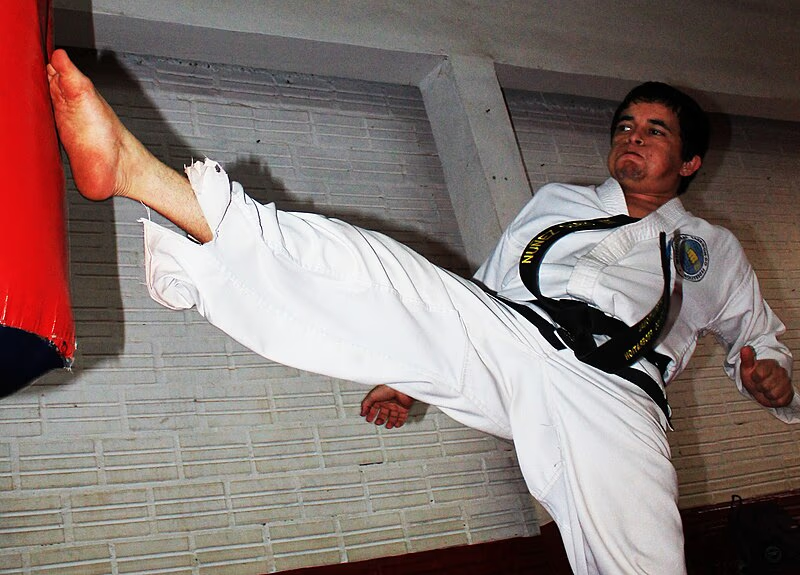
ITF competitors wear a distinctive dobok that differs visually from the WT uniform. The ITF dobok features a cross-over (overlap) front top, secured by a tie on the right side, in contrast to the V-neck pullover top used in WT competitions.
The ITF belt ranking system progresses through the following colors: White (10th Gup — signifying innocence), Yellow (8th–9th Gup — the earth from which the plant grows), Green (6th–7th Gup — the growing plant), Blue (4th–5th Gup — the sky toward ...
ITF sparring does not use the electronic trunk protector (hogu) or electronic headgear employed in WT competition.
Power breaking events use standardized wooden boards, typically pine or paulownia, of regulated thickness (approximately 2.5 cm per board for adults). Spacers may be used to separate stacked boards.
Special technique events require height-adjustable targets — typically small padded boards or breakable targets suspended at measured heights above the ground. For distance events, a horizontal obstacle (such as a vaulting box or rope) is placed a...
The ITF sparring competition area is a square mat measuring 9 meters × 9 meters, clearly demarcated by boundary lines. This differs from the octagonal competition area used in WT events.
A safety zone of at least 2 meters must surround the competition area on all sides, free from any obstacles, equipment, or spectators. The total required floor space is therefore a minimum of 13 meters × 13 meters.
Starting positions for the two competitors are marked at the center of the ring, approximately 1.5 meters apart, facing each other. The competitor designated as "blue" (chong) stands to the referee's right, and the competitor designated as "red" (hong) stands to the referee's left.
The center referee operates within the competition area. Four corner judges are seated at the four corners of the ring, each equipped with scoring devices (flags, clickers, or electronic input pads depending on the tournament).
Pattern competitions require a flat, unobstructed area of at least 10 meters × 10 meters, covered with appropriate matting. Breaking and special technique events require additional clearance for run-up space (minimum 5 meters) and overhead clearance of at least 4 meters for jumping techniques.
Bow sincerely — never perfunctorily
The opening and closing bows (charyot/kyongye) before and after a match or sparring session must be slow, deliberate, and genuine. A fast or shallow bow is considered an insult to the opponent and to the art. This applies both in competition and in the dojang.
Rooted in ITF's founding philosophy — Choi Hong Hi embedded Confucian courtesy (ye) as the first of the five tenets.
Accept the referee's decision without protest
Visibly arguing, gesturing in disgust, or verbally contesting a scoring decision violates the tenet of self-control and is considered deeply dishonorable. Coaches may formally appeal through designated channels; competitors themselves must not react.
Stems from the 'do' (the Way) philosophy that the martial artist's character is judged more by how they lose than by how they win.
Senior belts control power against junior opponents
Higher-ranked competitors and practitioners are expected to calibrate their power downward when sparring against significantly lower ranks. Overwhelming a junior with full force is considered a failure of self-control — one of the five tenets — not a display of skill.
Particularly enforced in dojang training; at open competitions the principle still applies when a senior faces a clearly outmatched junior.
Ready to dive deeper?
Do not celebrate excessively after scoring
Pumping fists, yelling at an opponent, or performing overt celebrations after a point is scored is considered contrary to the tenet of courtesy. A brief, controlled kihap (spirit yell) at the moment of technique is acceptable; theatrics directed at the opponent are not.