


🏛️Official — World Aquatics
Loading OpenSourceSports…
Individual Sports
1 players
both
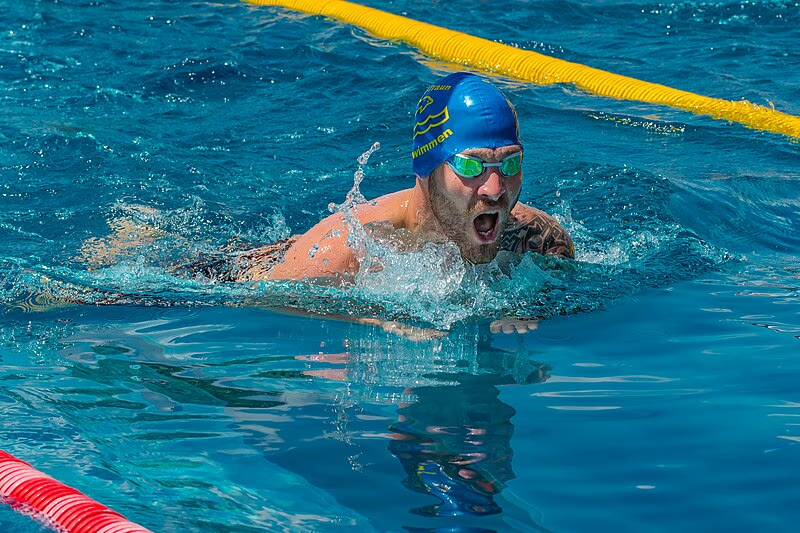
swimwear, cap, goggles
10 essential rules
World Aquatics (formerly known as FINA — Fédération Internationale de Natation) is the international federation recognised by the International Olympic Committee (IOC) for administering international competitions in aquatic sports, including Swimming, Diving, Water Polo, Artistic Swimming, Open W...
World Aquatics regulates swimwear through its Swimwear Approval Programme. All swimwear worn in World Aquatics-sanctioned competitions must appear on the World Aquatics Approved Swimwear List.
Male competitors may wear swimsuits covering the body from the top of the hips to the knee. The swimsuit may not extend above the navel nor below the knee.
Female competitors may wear one-piece or two-piece swimsuits. The suit must not cover the neck, extend past the shoulder, or cover any part of the arms.
Starting blocks must be firmly fixed and shall not move during use. The top surface of the block shall be covered with a non-slip material.
Automatic Officiating Equipment (AOE) touchpads are required at World Aquatics sanctioned events. Touchpads must be positioned at both ends of each lane.
Lane lines shall be continuous from start end to finish end and shall be attached to anchors in the walls. Lane lines consist of individual buoys or floats assembled on a wire or rope.
A recall rope must be stretched across the course at a distance of 15 m (49.2 ft) from the starting end. The rope shall be at least 1.2 m (3.9 ft) above the water surface.
Goggles may be worn in competition. Swimmers may wear not more than two swimming caps simultaneously.
The long course pool shall measure 50 metres (164 ft 1 in) in length. The tolerance for pool length is 0 cm (no shortfall permitted); pools may not be shorter than 50 m at any point.
The short course pool shall measure 25 metres (82 ft) in length, measured under the same conditions as the long course pool.
Circle swim in shared lanes
When two or more swimmers share a lane during training, always swim counterclockwise circles (clockwise in some countries) rather than splitting the lane. Swimmers new to a pool are expected to observe the established direction before entering and to confirm with others already in the lane.
Direction varies by country — counterclockwise is standard in the US; clockwise is common in Australia and parts of Europe.
Tap feet to signal a pass
If you catch the swimmer ahead of you during a training set and need to pass, gently tap their feet once or twice. The lead swimmer is then expected to stop at the next wall and let the faster swimmer go. Tapping repeatedly or aggressively is considered rude; failing to stop when tapped is equally frowned upon.
Do not push off early during a training set
During timed intervals, leaving the wall even a second early to gain a fake advantage over teammates is considered a serious breach of trust and training integrity. Coaches and senior swimmers view this as undermining the purpose of the set and disrespecting lane-mates.
More intensely observed at elite club and collegiate levels where set times are used to gauge fitness and set competition standards.
Ready to dive deeper?
Never touch another swimmer's personal equipment
Goggles, swim caps, tech suits, and fins are considered personal and off-limits. Borrowing without asking is a significant violation; touching a competitor's goggles or suit on the pool deck before a race — even accidentally — is taken very seriously and can create lasting animosity.
Do not dive or push off into an occupied lane without looking
Before entering the water or pushing off the wall, always check that no one is approaching from the opposite direction. Entering blindly and colliding with an oncoming swimmer is considered a serious lapse in pool awareness and basic courtesy, regardless of whose legal right-of-way it may be.
Do not celebrate before your hand touches the wall
Raising a fist, pointing, or showboating before completing the finish is strongly frowned upon and is associated with the risk of a poor touch or disqualification. Beyond the rules risk, premature celebration is seen as disrespectful to the effort of other finishers still in the water.
Partially reinforced by official rules around finish completion, but the cultural expectation extends beyond legal compliance to general restraint until the race is unambiguously over.