




Section 1: Introduction
Track and Field is governed internationally by World Athletics (formerly the International Association of Athletics Federations, IAAF), headquartered in Monaco. The primary rules document is the World Athletics Technical Rules, published in editions aligned with the two-year competition calendar. The current edition is the World Athletics Competition and Technical Rules 2026 Edition, as amended by the Council amendments of March 2026, which took effect immediately — so the 2026 Edition document alone is not the complete current state of the rules. These rules govern all World Athletics Series competitions, Area Championships, and provide the standard adopted by national member federations worldwide.
Athletics encompasses four broad families of events conducted at the same competition meeting:
- Track Events: Sprints (100m, 200m, 400m), middle distance (800m, 1500m), long distance (5000m, 10,000m), hurdles (100m/110m, 400m), steeplechase (3000m), and relays (4×100m, 4×400m).
- Field Events – Jumps: High Jump, Pole Vault, Long Jump, Triple Jump.
- Field Events – Throws: Shot Put, Discus Throw, Hammer Throw, Javelin Throw.
- Combined Events: Decathlon (men), Heptathlon (women), and Pentathlon (indoor).
- Road Events: Marathon, Race Walking (20km, 35km), Half Marathon — governed by supplementary Road Race Rules.
World Athletics Technical Rule 1 establishes that competitions shall be conducted in accordance with the Technical Rules and any supplementary regulations issued by the Technical Committee. Rule 2 defines the categories of competition (World Athletics Series, Area Championships, National Championships, etc.) and their respective regulatory frameworks. The rules are binding on all athletes, officials, and member area federations.
The sport has been part of the modern Olympic Games since Athens 1896. World Athletics organises the World Athletics Championships (biennial), World Indoor Championships (biennial), World Road Running Championships, World Cross Country Championships, World Athletics Relays, and the Diamond League circuit, among other sanctioned events.
Section 2: Equipment
2.1 Implements – Throws
All throwing implements must be approved by World Athletics and appear on the official Approved Implements List. Specifications are set out in Technical Rule 33 (Shot Put), Technical Rule 34 (Discus), Technical Rule 36 (Hammer), and Technical Rule 38 (Javelin) (Technical Rule 32).
Shot Put (Technical Rule 33)
- Men (Senior/U20): Weight 7.260 kg (16 lb), minimum diameter 110 mm, maximum diameter 130 mm (Technical Rule 33).
- Women (Senior/U20): Weight 4.000 kg (8 lb 13 oz), minimum diameter 95 mm, maximum diameter 110 mm (Technical Rule 33).
- U18 Men: 6.000 kg; U18 Women: 3.000 kg (Technical Rule 33).
- The shot shall be made of solid iron, brass, or any metal not softer than brass, or a shell of such metal filled with lead or other material (Technical Rule 33).
- Surface finish shall be smooth (maximum roughness Ra 1.6 µm).
Discus (Technical Rule 34)
- Men (Senior/U20): Weight 2.000 kg, diameter 219–221 mm (Technical Rule 34).
- Women (Senior/U20): Weight 1.000 kg, diameter 180–182 mm (Technical Rule 34).
- U18 Men: 1.500 kg; U18 Women: 1.000 kg (Technical Rule 34).
- The discus shall consist of a metal rim and two identical sides, constructed of wood, plastic, fibreglass, or carbon fibre. Rim edges shall be smooth and rounded (Technical Rule 34).
Hammer (Technical Rule 36)
- Men (Senior/U20): Weight 7.260 kg, overall length 117.5–121.5 cm (Technical Rule 36).
- Women (Senior/U20): Weight 4.000 kg, overall length 116.5–119.5 cm (Technical Rule 36).
- The hammer consists of three parts: a metal head (sphere), a steel wire, and a handle. The head shall be made of solid iron or other metal not softer than brass, or of a shell filled with lead or other material (Technical Rule 36).
- Handle: a single loop of spring steel wire, minimum diameter 3 mm. The grip shall be rigid and without springs (Technical Rule 36).
Javelin (Technical Rule 38)
- Men (Senior/U20): Weight 800 g, overall length 2.600–2.700 m, metal tip minimum 25 mm penetration (Technical Rule 38).
- Women (Senior/U20): Weight 600 g, overall length 2.200–2.300 m (Technical Rule 38).
- U18 Men: 700 g, 2.300–2.400 m; U18 Women: 500 g, 2.000–2.100 m (Technical Rule 38).
- The javelin shall be constructed of metal or other suitable material. The binding grip covers the centre of gravity and must be between 150 mm and 160 mm wide (men), or 140 mm and 150 mm wide (women) (Technical Rule 38).
2.2 Hurdles (Technical Rule 22)
Hurdles shall be made of metal or other suitable material with a wooden or plastic top bar. The maximum weight is 10 kg. The hurdle must be constructed so that a force of at least 3.6 kg applied horizontally to the centre of the top edge of the top bar is required to overturn it. Heights by event:
- Men 110m Hurdles (Senior/U20): 1.067 m (3 ft 6 in) (Technical Rule 22).
- Men 400m Hurdles (Senior/U20): 0.914 m (3 ft) (Technical Rule 22).
- Women 100m Hurdles (Senior/U20): 0.838 m (2 ft 9 in) (Technical Rule 22).
- Women 400m Hurdles (Senior/U20): 0.762 m (2 ft 6 in) (Technical Rule 22).
- U18 Boys 110m Hurdles: 0.991 m; U18 Girls 100m Hurdles: 0.762 m (Technical Rule 22).
2.3 Vaulting Pole (Technical Rule 28)
The vaulting pole may be made of any material or combination of materials and of any length or diameter. The surface may be smooth or have a wrapping of adhesive tape in a single layer over the entire length or part of the pole (Technical Rule 28).
2.4 Relay Baton (Technical Rule 24)
The baton shall be a smooth hollow tube made of wood, metal, or other rigid material. It must be circular in cross-section; length 28–30 cm, circumference 12–13 cm, weight at least 50 g (Technical Rule 24).
2.5 Steeplechase Barriers and Water Jump (Technical Rule 23)
- Barrier height (men): 0.914 m; (women): 0.762 m (Technical Rule 23).
- Top bar cross-section: 127 mm × 127 mm, rounded corners radius 5–6 mm (Technical Rule 23).
- The water jump pit is 3.66 m × 3.66 m; maximum water depth at the barrier 0.70 m, sloping to 0 m at far end (Technical Rule 23).
2.6 Starting Blocks (Technical Rule 15)
Starting blocks shall be used for all races up to and including 400m (including the first leg of relays). Blocks must be constructed solely of rigid materials and must not provide any undue advantage. They must be fixed to the track surface using two pointed pegs. Starting blocks fitted with sensors for the False Start Detection System must be used in all World Athletics Series competitions (Technical Rule 15).
2.7 Athlete Shoes and Spikes (Technical Rule 5)
Shoes must not give an athlete any unfair assistance or advantage. The construction of shoes must not be altered during competition. From 1 January 2025, World Athletics requires that all athletics shoes used in competition at World Athletics Series events and Area Championships must appear on the World Athletics Approved Shoes List prior to competition. Sole thickness limits (effective 1 January 2025): Track events up to 400m including hurdles — maximum sole thickness 25 mm; 800m and above on track — 25 mm; field events (jumps, throws) — 20 mm (long jump, triple jump run-up shoe 25 mm). Spike pin length: maximum 9 mm for track events; maximum 12 mm for field events (cross country excepted).
Section 3: Playing Area
3.1 Track (Technical Rule 14)
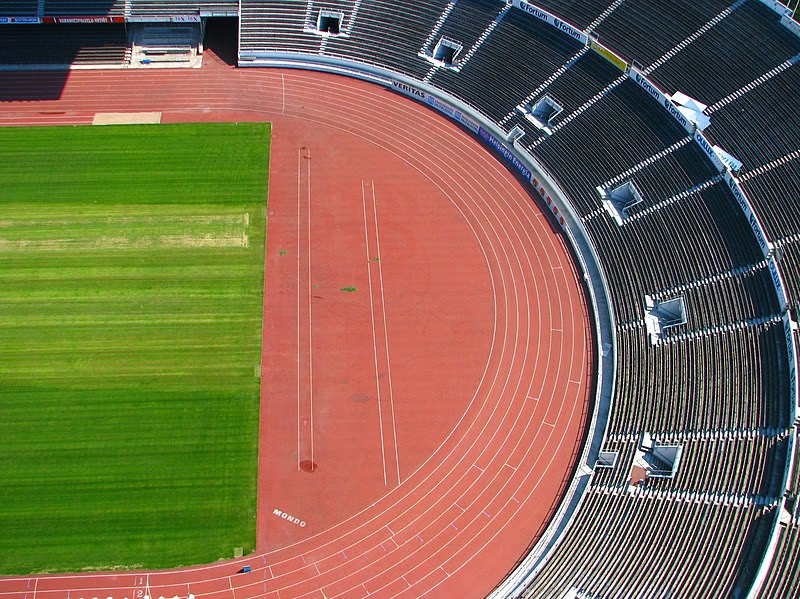
The standard outdoor athletics track has a circumference of 400 metres. The track shall have a minimum of six lanes for all World Athletics Series competitions; eight lanes are required for World Athletics Championships and Olympic Games track events. Each lane shall be 1.22 m wide (minimum 1.22 m, maximum 1.25 m), including the lane line to the right. Lane lines shall be white, 5 cm wide (Technical Rule 14).
The track surface must be all-weather (synthetic) for all World Athletics Series and Area Championship competitions. The track shall have a maximum cross-fall of 1:100 (1%) and a maximum overall inclination in the running direction of 1:1000 (0.1%).
The inside edge of the track shall be bordered by a kerb (raised or flat) of white or another colour. Where a kerb is not used, a painted line 5 cm wide delineates the inside edge, and the inside measurement is taken 20 cm from that line (Technical Rule 14).
3.2 Lanes and Measurements
All races up to and including 400m, and the first leg of relays up to and including the 4×400m, shall be run entirely in separate lanes. The 800m shall be run in lanes to the end of the first bend. Distances are measured 20 cm from the outer edge of the lane line for Lane 1 (where no raised curb exists), and 20 cm from the inner edge of each outer lane line for all other lanes (Technical Rule 14).
3.3 Start and Finish Lines (Technical Rule 16)
The start and finish lines shall be 5 cm wide, painted white, and form part of the measured distance of the race. The finish post shall be placed at least 30 cm beyond the outer edge of the outermost lane (Technical Rule 16).
3.4 High Jump Area (Technical Rule 27)
The runway shall be a minimum of 15 m in length (no maximum) with a maximum cross-fall of 1:100. The landing area shall be a minimum of 5 m × 3 m. The crossbar is of circular cross-section, maximum 30 mm diameter, total length 4.00 m ± 2 mm (±4 mm at World Athletics Series level).
3.5 Pole Vault Area (Technical Rule 28)
The runway shall be a minimum of 40 m in length (45 m preferred) and minimum 1.22 m wide. The landing area shall be a minimum of 6 m × 6 m (excluding the front section nearest the box). The plant box shall be 1.00 m long, 60 cm wide at the top, tapering to 15 cm at the bottom, set at an angle of 105° to the runway. The crossbar is circular, maximum 30 mm diameter, length 4.50 m ± 2 mm.
3.6 Long Jump and Triple Jump Area (Technical Rules 30 and 31)
The runway shall be a minimum of 40 m in length (45 m preferred) and minimum 1.22 m wide. The takeoff board is 20 cm wide and flush with the runway surface. The landing area shall be a minimum of 2.75 m wide and filled with moist sand, the surface of which is level with the takeoff board. For Long Jump, the takeoff board is placed at least 1 m from the near edge of the landing area. For Triple Jump, the men's takeoff board is 13 m from the near edge of the landing area (11 m for women at World Athletics Series level).
3.7 Shot Put Circle (Technical Rule 33)
The circle is made of steel or iron, internal diameter 2.135 m ± 5 mm. The top of the rim shall be flush with the ground outside, and no higher than 26 mm above the ground inside. A stop board (arc) of wood or metal, internal height 10 cm, radius approximately 1.067 m, is placed at the front of the circle. The throwing sector angle is 34.92° (a chord drawn between the two sector lines at 1 m from the centre of the circle is approximately 60 cm).
3.8 Discus and Hammer Circles (Technical Rules 34 and 36)
- Discus: Internal diameter 2.500 m ± 5 mm. Throwing sector 34.92° (Technical Rules 34 and 36).
- Hammer: Internal diameter 2.135 m ± 5 mm. Throwing sector 34.92°. A protective cage must surround the throwing area to protect officials, athletes, and spectators (Technical Rule 37). The cage must be capable of stopping a 7.260 kg ball travelling at 32 m/s.
3.9 Javelin Runway and Sector (Technical Rule 38)
The runway shall be a minimum of 30 m in length (33.5 m preferred) and 4 m wide, with a maximum cross-fall of 1:100. The scratch line is an arc of radius 8 m. The throwing sector is 29°.
3.10 Steeplechase Water Jump (Technical Rule 23)
The water jump shall be located on the inside or outside of the track. It is 3.66 m × 3.66 m, with maximum water depth at the barrier of 0.70 m sloping uniformly to 0 m at the far end. The barrier at the water jump is fixed (not adjustable) and set flush with the front of the water (Technical Rule 23).
Section 4: Players & Officials
4.1 Athletes
Athletes must be members in good standing of a national member federation of World Athletics. To be eligible for international competition, an athlete must meet citizenship/representation eligibility requirements under World Athletics Eligibility Rules (Book C). Age group classifications are: Under 18 (U18), Under 20 (U20), Senior, and Masters (35+ for World Masters Athletics competitions).
Athletes in World Athletics Series competitions are required to wear approved competition numbers on both chest and back, as assigned by the competition organiser (Technical Rule 5). Numbers may not be folded, cut, or otherwise altered.
4.2 Competition Officials — Field of Play
Each competition shall be under the technical control of the following officials (Competition Rule 12):
- Technical Delegate(s): Appointed by World Athletics for Series events; oversee technical preparation and compliance (Competition Rule 12).
- Referee: A Chief Referee and separate Referees for Track Events, Field Events, and Combined Events. Referees have authority to make final decisions on all disputes not subject to video review or protest (Competition Rule 12).
- Judges: Appointed for each event, responsible for measurements, take-off board validity, lane compliance, etc (Competition Rule 12).
- Starter and Recallers: Manage the start of all track events. Starters use a starting pistol or electronic equivalent triggering a World Athletics-approved False Start Detection System. A minimum of one Recaller is required at all World Athletics Series events (Competition Rule 12).
- Timekeepers: A Chief Timekeeper and a minimum of three Timekeepers per race. Fully Automatic Timing (FAT) is mandatory at all World Athletics Series events (Technical Rule 19).
- Wind Gauge Operator: Manages the anemometer for events requiring wind measurement (Competition Rule 12).
- Umpires: Positioned around the track to observe rule compliance (lane encroachment, exchange zone compliance, etc.) (Competition Rule 12).
4.3 Jury of Appeal (Competition Rule 12)
A Jury of Appeal shall be appointed for all World Athletics Series competitions, comprising a minimum of three members. The Jury rules on all protests lodged after the Referee's decision. Decisions of the Jury of Appeal are final on all technical matters under these Rules. The composition of the Jury must not include any official whose decision is under appeal (Competition Rule 12).
4.4 Medical and Anti-Doping Officials
A Medical Delegate and medical personnel must be on site for all World Athletics Series events. Anti-Doping Control Officers operate under the World Athletics Anti-Doping Rules (separate from Technical Rules). All World Athletics Series athletes are subject to both in-competition and out-of-competition testing under the World Anti-Doping Code and World Athletics regulations.
4.5 Photo Finish and Video Review Officials
A Photo Finish Judge reads finishing positions from FAT equipment. A Video Review Official (VRO) may review incidents at World Athletics Series events using approved video evidence for specified rule violations (Technical Rule 12), including false starts, lane violations, relay exchange zone violations, and throwing/jumping violations.
Section 5: Rules of Play
5.1 Track Event Starts (Technical Rule 15)
All races up to and including 400m (including hurdles at those distances) shall be started by the report of the starting pistol or approved device. Commands are: "On your marks" and "Set" (for races up to and including 400m). For 800m and above, the command is "On your marks" only, after which the pistol is fired when all athletes are stationary. Athletes must start from a stationary position with at least one hand and one foot in contact with the ground behind and not touching the start line. Feet must be in contact with the starting blocks.
5.2 False Start (Technical Rule 16)
A false start occurs when an athlete starts before the starting signal. The World Athletics False Start Detection System triggers if an athlete produces a reaction time of less than 0.100 seconds after the gun. One false start is allowed per race in aggregate; the athlete causing a false start is warned. Any athlete who causes a subsequent false start in the same race is disqualified. If a false start occurs before the gun, the Starter recalles the athletes without disqualifying anyone, and the false start is not charged (Technical Rule 16).
5.3 Lane Rules (Technical Rule 24)
In lane races, athletes must stay within their designated lane from start to finish. An athlete who runs outside their lane, or steps on or over a lane line in a curve, shall be disqualified unless no material advantage is gained and no other athlete is obstructed (Technical Rule 14). In non-lane races, once athletes break from lanes (at the break line), they may run freely. Obstruction and jostling that causes a fall or impedes progress is prohibited under Technical Rule 17.
5.4 Relay Rules (Technical Rule 24)
In relay races, the baton must be passed within the exchange zone, which is 20 m in length. For the 4×100m, there is an additional 10 m acceleration zone prior to each exchange zone. The baton must be carried in the hand throughout; if dropped, it may be recovered by the athlete who dropped it. The outgoing athlete must not leave the zone before receiving the baton. A team is disqualified if the baton is not exchanged within the zone, an athlete runs outside their lane (unless caused by another athlete), or interference occurs (Technical Rule 24).
5.5 Hurdle Events (Technical Rule 22)
Athletes must not run around, under, or deliberately knock over hurdles. An athlete is disqualified if they trail a foot or leg below the plane of the top of any hurdle, or if they deliberately knock a hurdle over with their hand or foot. Knocking a hurdle over accidentally (e.g., with the thigh or knee) does not result in disqualification, provided the foot or leg does not trail below the hurdle plane (Technical Rule 22).
5.6 Steeplechase Rules (Technical Rule 23)
In the 3000m Steeplechase, athletes shall clear 28 hurdles and 7 water jumps (5 laps of a 400m track for men; adapted for women). Athletes must go over, or through the water at, each water jump. Athletes may place a hand or foot on top of a barrier when clearing it; they may not pass under or between barriers.
5.7 High Jump (Technical Rule 27)
Athletes must take off on one foot. Each athlete is allowed three attempts at each height. An athlete is eliminated after three consecutive failures at the same height. Failure is recorded if: the bar falls after the attempt, the athlete dislodges the bar, or the athlete passes under the bar or touches the ground or landing area beyond the plane of the near edge of the uprights without first clearing the bar. The bar shall be raised by a minimum of 2 cm for each successive round (Technical Rule 27).
5.8 Pole Vault (Technical Rule 28)
The athlete may place the vaulting pole in the box at any angle. Once the vaulting pole has been placed in the box at the start of the attempt, the athlete may, while holding the pole, touch the ground beyond the stop board with the pole or a part of the body without it being counted as a failure, provided no advantage is gained. A failure is recorded if: the bar is knocked off, the athlete lets go of the pole in flight and then touches the bar before or during the fall, or the athlete deliberately moves the uprights inward (where not permitted). The athlete or the vaulting pole may touch the uprights during the vault without failure unless the crossbar is dislodged (Technical Rule 28).
5.9 Long Jump (Technical Rule 30)
The athlete takes off from behind or on the takeoff board. The jump is measured from the nearest mark in the landing area made by any part of the athlete's body to the takeoff line (extended), at right angles to the takeoff line. The athlete must not step on or over the takeoff board. Failure is recorded if the athlete takes off from outside the board area (beyond the takeoff line), falls backward into the landing area touching the sand closer to the board than the measured point, or leaves the landing area in a manner not conforming to Technical Rule 30 (must walk out forwards from the nearest point of take-off) (Technical Rule 30).
5.10 Triple Jump (Technical Rule 31)
The Triple Jump consists of a hop, a step, and a jump. The hop is made so that the athlete lands first on the same foot as the take-off foot; in the step, the athlete lands on the other foot; from there the jump is completed. An athlete who, while hopping, touches the ground with the non-hop foot commits a foul (Technical Rule 31).
5.11 Throwing Events – General Rules (Technical Rules 33, 34, 36 and 38)
The athlete must start an attempt from a stationary position within the circle or behind the scratch line. The athlete may touch the top of the stop board (Shot Put) but must not touch the top of the rim of the throwing circle or the ground outside. A valid throw is recorded only if the implement lands within the landing sector and the athlete leaves the circle correctly — from the rear half of the circle, after the implement has landed. Implements must land within the sector lines (not on them). In all throwing events, athletes are permitted to stop a throw, place the implement on the ground, and start again, provided no rule has been violated (Technical Rules 33, 34, 36 and 38).
5.12 Wind Readings (Technical Rules 17 and 30)
A wind reading is required and recorded for all individual sprint and hurdle events up to and including 200m, and for long jump and triple jump. The wind gauge is placed parallel to the track for running events; parallel to the runway for jumps. Only performances with a wind reading of +2.0 m/s or less (tailwind) are valid for record purposes (Technical Rules 17 and 30).
Section 6: Scoring
6.1 Timing and Results — Track Events (Technical Rule 19)
At all World Athletics Series events, times must be recorded by Fully Automatic Timing (FAT) measured to 1/1000th of a second and displayed to 1/100th of a second. Where a photofinish system is used, a photograph showing the order of arrival must be used to determine results. All performances are ranked by time; in the event of identical times to 1/100th of a second, the photo finish image is used to determine the order (Technical Rule 19).
For record purposes, times are taken to 1/100th of a second unless the FAT system records to 1/1000th of a second (in which case that reading is used). Times manually held to 1/10th of a second are rounded up to the next 1/5th of a second for records and rankings (Technical Rule 19).
6.2 Measurement of Field Events (Technical Rule 25)
All measurements in field events are made with a calibrated steel measuring tape or an approved Electronic Measurement Device (e.g., total station or laser distance meter). Each measurement must be made immediately after each valid attempt. The result is recorded to the nearest centimetre below the distance measured (i.e., truncated, not rounded). The best valid attempt of each athlete is used for final classification (Technical Rule 25).
6.3 Horizontal Jumps and Throws — Attempts Allocation
- In competitions with more than eight athletes: All athletes take three attempts; the top eight after three rounds take three more attempts (six total). The best mark from all six attempts determines the final ranking (Technical Rule 25).
- In competitions with eight or fewer athletes: All athletes take six attempts from the start (Technical Rule 25).
- If a tie for eighth place occurs after three rounds, all tied athletes advance to the final three rounds (Technical Rule 25).
6.4 High Jump and Pole Vault — Progression and Ties (Technical Rule 26)
Athletes attempt heights in order. The winner is the athlete who clears the greatest height. Ties are broken as follows:
- The athlete with the fewest failures at the height at which the tie occurs is ranked higher (Technical Rule 26).
- If still tied, the athlete with the fewest total failures throughout the competition up to and including the height last attempted is ranked higher (Technical Rule 26).
- If still tied in a final, athletes who are tied have one more attempt at the lowest height at which they failed; if they all clear or all fail, the bar is raised or lowered alternately by the minimum increments until the tie is broken (Technical Rule 26).
- For non-first-place ties in qualifying rounds, no jump-off is held (Technical Rule 26).
6.5 Combined Events Scoring (Technical Rule 39)
The Decathlon (men, 10 events over two days) and Heptathlon (women, 7 events over two days) are scored using the IAAF Scoring Tables for Combined Events (2022 edition, effective from 1 January 2023). Each performance is converted to points using the event-specific formula; the athlete with the greatest total of points wins. Day order for Decathlon: Day 1 — 100m, Long Jump, Shot Put, High Jump, 400m; Day 2 — 110m Hurdles, Discus, Pole Vault, Javelin, 1500m. Day order for Heptathlon: Day 1 — 100m Hurdles, High Jump, Shot Put, 200m; Day 2 — Long Jump, Javelin, 800m.
6.6 Qualifying Rounds and Automatic Qualifying Marks
In multi-round competitions (qualifying round → final), athletes may advance either by achieving an Automatic Qualifying Standard (Q) or as one of the next-best performers (q). The specific standards and numbers advancing are set for each World Athletics competition. Where fewer than the specified number of athletes achieve the Q standard, places are filled by next-best performances. If fewer than three athletes achieve the automatic standard in a field event, at least three athletes shall advance to the final (Technical Rule 25).
Section 7: Violations & Penalties
7.1 False Start (Technical Rule 16)
Any athlete who commits a false start is given a warning (Yellow Card). The first false start per race is charged to the field collectively; thereafter, any individual false start results in disqualification of that athlete. Athletes are disqualified immediately for any individual false start if they were already warned in that race. Disqualified athletes must leave the competition area promptly (Technical Rule 16).
7.2 Lane Violation (Technical Rule 14)
In lane races, running outside the assigned lane on a bend, or stepping on or over the lane line on a bend, results in disqualification unless the athlete was clearly impeded by another runner or a non-track obstruction. In field events requiring a runway (jumps), touching the ground outside the defined runway/circle/lane boundaries after a valid start of an attempt results in a foul. The Referee may disqualify an athlete for a lane violation based on umpire reports, video evidence, or direct observation (Technical Rule 14).
7.3 Obstruction and Jostling (Technical Rule 17)
An athlete who jostles, runs across, or obstructs another athlete so as to impede progress may be disqualified. If the obstruction is caused by an athlete other than the affected athlete, the Referee may order a re-run excluding the offending athlete, or allow the affected athlete to run in the next round (Technical Rule 17).
7.4 Foul Attempts in Field Events
A foul attempt (no valid performance) is recorded and counts as one of the athlete's allocated attempts in the following cases:
- Throws: Implement lands outside the sector lines; athlete touches the top of the rim or the ground outside the circle before the implement lands; athlete leaves the circle incorrectly (from the front half or without waiting for the implement to land) (Technical Rule 25).
- High Jump/Pole Vault: Bar dislodged by athlete during or after the attempt; athlete passes under the bar or takes off on two feet (Technical Rule 25).
- Long Jump/Triple Jump: Athlete touches or goes beyond the takeoff board; incorrect sequence of legs in Triple Jump (Technical Rule 25).
7.5 Disqualification from an Event (Technical Rule 7)
An athlete may be disqualified from an individual event for: three consecutive failures in High Jump or Pole Vault (all three attempts at a single height fail); deliberate destruction of competition apparatus; failure to compete in a round of the combined events without valid medical excuse; or receiving physical assistance during competition. An athlete disqualified from an event may still compete in subsequent events in combined events, unless disqualified under Rule 7.7 (Technical Rule 7).
7.6 Relay Disqualification (Technical Rule 24)
A relay team is disqualified if: the baton is exchanged outside the exchange zone; a team member runs outside their lane in a manner that impedes another team; a team member deliberately interferes with another team; or an athlete runs an extra leg. If interference is caused by an athlete from another team, the affected team may be reinstated (Technical Rule 24).
7.7 General Disqualification (Technical Rule 7)
An athlete may be disqualified from the entire competition (all events) for: doping rule violations (subject to World Athletics Anti-Doping Rules); flagrant misconduct or breach of the spirit of fair play; failure to attend or compete without adequate justification in combined events; abuse or threatening behaviour toward officials or athletes. Doping violations are subject to separate procedures and may result in period of ineligibility of 2–4 years or lifetime ban for repeat offences (Technical Rule 7).
7.8 Protest and Appeals (Competition Rule 12)
A protest regarding an event result must be made verbally to the Referee immediately after the event. A written protest must be submitted within 30 minutes of the official posting of the result. A deposit (amount set by the organiser) must accompany the written protest; this is forfeited if the protest is unsuccessful. The Referee rules first; the athlete may then appeal to the Jury of Appeal within 30 minutes of the Referee's decision. The Jury of Appeal's decision is final on all technical matters. Appeals concerning anti-doping, eligibility, or ethical matters go to the Athletics Integrity Unit or Court of Arbitration for Sport (CAS) (Competition Rule 12).
Section 8: Safety Considerations
8.1 Throwing Events Safety (Technical Rules 33, 34, 36 and 38)
World Athletics Technical Rule 37 requires that a protective cage be used for all hammer competitions (and strongly recommends one for discus at World Athletics Series events). The cage must be able to stop a 7.260 kg hammer ball travelling at 32 m/s and must be positioned so that it fully encloses the throwing circle and the potential sector of a misdirected implement. Standard cage designs are described in the World Athletics Technical Regulations. Entry to the throwing sector is strictly prohibited whenever an athlete is in the circle preparing or executing an attempt. Flags or barriers must be used to prevent spectators and uninvolved athletes from entering the sector (Technical Rules 33, 34, 36 and 38).
All implements used in competition must be checked and approved by judges before the competition begins and may be re-checked at any time during competition. Damaged or non-conforming implements must be removed immediately. Athletes may use personal implements subject to inspection and approval (Technical Rules 33, 34, 36 and 38).
8.2 Steeplechase Water Jump Safety (Technical Rule 23)
The water jump barrier must be fixed firmly to the ground. The water surface must be clear of debris before each race. First-aid personnel must be available trackside for all steeplechase events. The water depth must be verified prior to competition. Athletes with physical conditions that increase risk of harm from the water jump must be cleared to compete by the Medical Delegate (Technical Rule 23).
8.3 Pole Vault Safety (Technical Rule 28)
The landing area must be a minimum of 6 m × 6 m (not including the front extension) and the padding must meet World Athletics specifications. The box and plant area must be free of debris. A minimum of two uprights must be inspected before competition. The crossbar uprights must extend a minimum of 10 cm beyond each end of the crossbar. Uprights may be moved up to 40 cm toward the landing area and up to 80 cm away from the landing area from the stop board line, at the athlete's request (Technical Rule 28).
Pole vault competitions may not be conducted in winds exceeding certain thresholds; the Referee has authority to suspend competition for safety reasons including high wind, lightning, or other adverse conditions (Technical Rule 28).
8.4 Adverse Weather and Suspension of Competition
The Technical Delegate and Referee jointly have authority to suspend or delay competition in the event of lightning, severe wind, heavy rain, or other conditions that threaten the safety of athletes or officials. If competition is suspended, athletes in field events retain any valid marks already achieved. Track event heats may be rerun or continued from the point of suspension. All decisions about suspension are final at the competition level; they may only be overturned by the Jury of Appeal where a clear rule violation occurred.
8.5 Medical Support Requirements
World Athletics requires that all World Athletics Series events have on-site medical support including qualified physicians, paramedics, and equipment for emergency cardiac intervention (including defibrillators). Ambulance access routes to the field of play must be planned and kept clear throughout competition. Medical staff must be briefed on competition schedule and high-risk events (steeplechase water jump, pole vault, long distance races) (Technical Rule 6).
8.6 Anti-Doping Controls
World Athletics Anti-Doping Rules, in force from 1 January 2021 and updated in alignment with the World Anti-Doping Code 2021, require all athletes at World Athletics Series events to be subject to doping control. Athletes selected for in-competition testing must report to the Doping Control Station within one hour of notification. Refusal to submit to testing, tampering with the process, or providing an adverse analytical finding constitute anti-doping rule violations. Prohibited substances and methods are listed in the WADA Prohibited List, updated annually, effective 1 January each year.
8.7 Athlete Well-Being — Race Walking
Race walking events (20 km, 35 km) conducted in extreme heat conditions are subject to additional safety protocols per World Athletics Technical Regulation and the Heat Stress Policy. Refreshment/sponging stations must be provided at defined intervals. Judges are required to issue caution cards for loss of contact and bent knee violations prior to disqualification, consistent with the requirement of three red cards from different judges. In extreme heat (WBGT above 28°C), the Medical Delegate may recommend modifications to competition procedures.