








Section 1: Introduction
NCAA softball is the collegiate form of fastpitch softball, played by member institutions of the National Collegiate Athletic Association across Divisions I, II, and III. Competition is conducted under the NCAA Softball Rules of the Game, published as a rules book on a two-year cycle (the current edition being the 2026-2027 NCAA Softball Rules Book) and overseen by the NCAA Softball Rules Committee and the NCAA Playing Rules Oversight Panel.
While college softball shares its origins and much of its structure with USA Softball and high-school (NFHS) fastpitch, the NCAA maintains its own rules book with collegiate-specific provisions — most notably the Designated Player / Flex (DP/Flex) substitution system, charged-conference limits, the run-ahead rule, and the extra-innings tiebreaker. Where the NCAA rules are silent, the committee's interpretations and the rules book's appendices govern.
The sport is fast and compact: a regulation game is seven innings, the pitcher delivers underhand from 43 feet, and bases are 60 feet apart, producing a game in which pitching, slap hitting, bunting, and aggressive base running are all central. The Division I season runs through the spring and culminates in the NCAA Division I Softball Championship — regionals and super regionals leading to the Women's College World Series (WCWS) in Oklahoma City.
This document summarizes the structure of the NCAA rules: equipment standards, the field, players and officials, the rules of play, scoring, violations and penalties, and the safety provisions that the committee has built into the collegiate game.
Section 2: Equipment
The Ball
- Size: A 12-inch (30.5 cm) circumference fastpitch softball.
- Construction and color: Optic yellow cover with contrasting (red) stitching, built to the NCAA-specified coefficient of restitution and compression standard so that ball performance is consistent across the game.
- Only balls bearing the required certification marking may be used in NCAA competition.
Bats
- Certification: Bats must bear the certification mark recognized by the NCAA and appear in compliance with the approved-bat standards. Aluminum and composite bats are permitted within those standards.
- Bat testing: At NCAA championships, and at the discretion of the host, bats are subject to compression/bat testing before games. A bat that fails testing is removed from play.
- Dimensions: Bats are limited in length, diameter, and weight by the rules book's specifications and must be free of dents, cracks, or alterations.
Gloves and Protective Equipment
- Gloves and mitts: Fielders use gloves within the size limits of the rules; the catcher and first baseman may use mitts.
- Batting helmets: All batters, on-deck batters, and base runners must wear a double-ear-flap batting helmet equipped with a face mask/guard. Helmets must not be altered.
- Catcher's gear: The catcher must wear a helmet and mask with a throat protector, chest protector, and shin guards.
- Pitcher and corner infielders: Defensive face masks/guards are permitted (and commonly worn) by the pitcher and corner infielders for protection against line drives.
Uniforms and Bases
- Uniforms: Teammates wear like-colored uniforms with unique numbers. Jewelry and equipment that could be dangerous are prohibited.
- Footwear: Cleats are worn; shoe regulations follow the rules book.
- Bases: The bases are anchored at the corners of the diamond. A double base (a colored "safety" portion in foul territory alongside the white portion) is used at first base so the batter-runner and the fielder use separate parts of the bag, reducing collisions.
Section 3: Playing Area
The Diamond
- Base paths: 60 feet (18.29 m) between bases.
- Pitching distance: 43 feet (13.11 m) from the front edge of the pitcher's plate to the back point of home plate.
- Home plate: A five-sided rubber plate with batter's boxes marked on each side.
- Foul lines: Extend from the back point of home plate through the outside edges of first and third base to the outfield fence.
The Pitcher's Plate and Circle
- Pitcher's plate ("rubber"): A rubber slab set into the ground at the pitching distance, from which the pitcher must deliver.
- Pitcher's circle: A 16-foot (4.88 m) diameter circle centered on the pitcher's plate. The circle defines where the look-back rule applies once the pitcher has possession of the ball within it.
The Outfield and Fences
- Outfield fence: Home-run fence distances are set within the rules book's range — generally on the order of 190 to 235 feet (about 58 to 72 m) down the lines and to center, with a recommended range for new fields.
- The outfield must be a clear, level playing surface free of hazards out to the fence.
Surrounding Areas
- On-deck circles: Marked areas where the next batter prepares.
- Coaches' boxes: Marked near first and third base for the base coaches.
- Dugouts / team areas: Enclosed and, where possible, screened for protection from foul balls.
- Warning track: Where present, a warning track alerts outfielders as they approach the fence.
Section 4: Players/Officials
Team and Lineup
- Each team plays nine defensive players: pitcher, catcher, four infielders (first, second, third base, and shortstop), and three outfielders (left, center, right).
- The batting order lists the players who will bat; it must be followed in order through the game.
The Designated Player / Flex (DP/Flex)
- The NCAA permits a Designated Player (DP) who bats for a defensive player known as the Flex. The DP occupies a spot in the batting order; the Flex plays defense and does not bat (unless entered into the DP's batting spot).
- The DP and Flex give coaches flexibility to separate offensive and defensive roles, with specific rules governing when each may enter, leave, and re-enter.
Substitutions and Re-Entry
- Substitutes enter by being reported to the plate umpire.
- Starter re-entry: A starting player who is substituted for may re-enter the game once, but must return to the same spot in the batting order.
- A substitute (non-starter) who leaves the game may not return.
- Pinch hitters and pinch runners are substitutions and are governed by the same re-entry rules.
Officials
- Umpires: Games are worked by an umpire crew — a plate umpire plus one to three base umpires (two-, three-, or four-umpire crews). The plate umpire calls balls and strikes and has general charge of the game; base umpires rule on plays on the bases and in the outfield.
- Official scorer: Keeps the official record of the game — runs, hits, errors, and the line score.
- Head coach: Responsible for the conduct of the team and is the point of contact with the umpires for lineup changes, conferences, and appeals.
Section 5: Rules of Play
Game Length
- A regulation game is seven innings. The home team does not bat in the bottom of the seventh if it is already ahead.
- If the score is tied after seven innings, the game continues into extra innings.
Pitching
- The pitch is delivered underhand, typically with a windmill motion. The pitcher must begin with the required contact with the pitcher's plate and deliver in one continuous motion to the batter.
- The rules govern the legal start position, the step, and the permitted drag of the pivot foot; a delivery that does not meet these requirements is an illegal pitch.
- The pitcher is allowed a set number of warm-up pitches between innings and when entering as a substitute.
- Pace-of-play provisions limit the time the pitcher and batter may take between pitches.
Base Running
- No leadoffs: A base runner may not leave the base until the pitch is released by the pitcher. Leaving early is an out (or the play is otherwise penalized as provided in the rules).
- Stealing: Once the pitch is released, runners may attempt to steal.
- Look-back rule: When the pitcher has possession of the ball within the pitcher's circle, a runner off a base must immediately and continuously move to a base; failing to commit results in the runner being declared out.
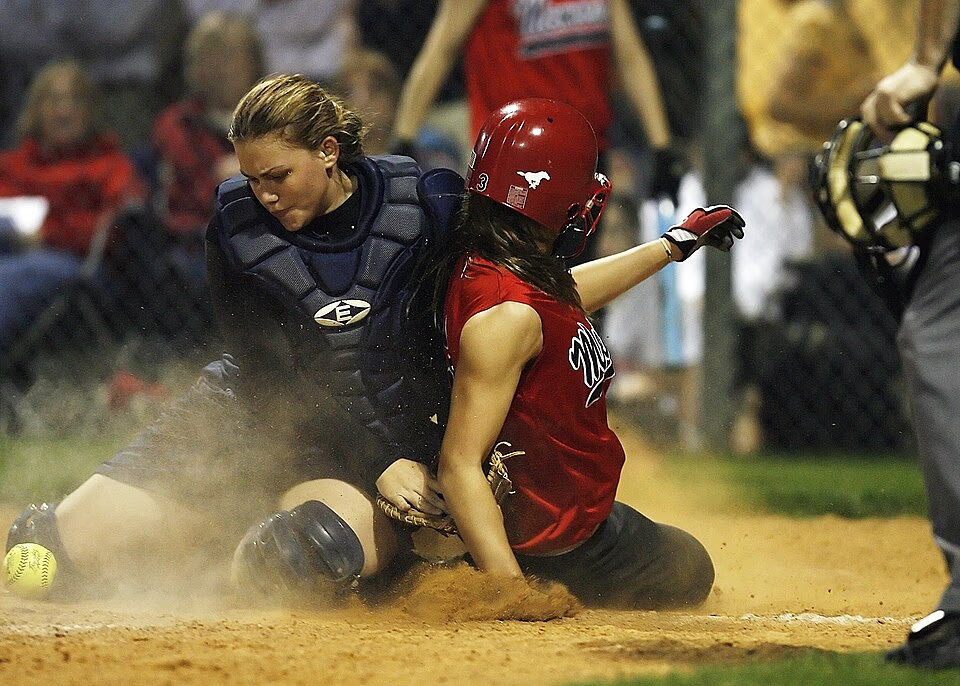
- Collision / must-avoid contact: A runner must avoid malicious or deliberate contact with a fielder; the rules require the runner to slide or seek to avoid a fielder making a play, and flagrant contact results in the runner being declared out and possibly ejected.
Batting
- Batters hit in the order listed on the lineup card. A strikeout, a fly ball caught, or being thrown or tagged out retires the batter; reaching base safely keeps the inning alive.
- Bunting and slap hitting are legal offensive techniques and are common in the college game.
- A batter must remain within the batter's box as defined by the rules while hitting.
Conferences
- The rules limit the number of charged conferences — both defensive (coach visits to the pitcher) and offensive — a team may take in a game. Exceeding the defensive-conference limit requires the pitcher to be removed from the pitching position.
Run-Ahead Rule and Extra Innings
- Run-ahead ("mercy") rule: If one team is ahead by the rule's margin after the prescribed number of innings — commonly 8 or more runs after 5 innings — the game is ended.
- Extra-innings tiebreaker: Beginning in the prescribed extra inning, each half-inning starts with a base runner placed on second base (the player who made the last out of the previous inning, or a substitute), to speed the resolution of tied games.
Section 6: Scoring
Scoring Runs
- A run scores each time a runner legally touches first, second, third, and home before the third out of the inning.
- A run does not count if the third out is a force out, is made on the batter-runner before reaching first, or is the result of a preceding runner failing to touch a base on an appeal.
Determining the Winner
- The team with more runs at the end of a regulation (or extra-innings) game wins.
- A game ended early by the run-ahead rule is complete, and the score stands.
- Called and suspended games: If a game is stopped for weather or darkness, the rules define when it is a complete game, when it is suspended for later completion, and when it must be replayed.
The Box Score
The official scorer records each at-bat, run, hit, error, and the line score by inning. The scorer's rulings on hits versus errors and on earned versus unearned runs follow the scoring rules in the rules book.
Championship Format
- The NCAA Division I Softball Championship is a bracketed postseason: 16 four-team double-elimination regionals, then best-of-three super regionals, leading to the eight-team Women's College World Series, which is itself a double-elimination tournament followed by a best-of-three championship series.
- Divisions II and III conduct their own NCAA championships under the same rules book.
Section 7: Violations/Penalties
Pitching Violations
- Illegal pitch: A delivery that does not meet the legal-pitch requirements. The penalty is a ball awarded to the batter, and base runners are awarded as provided by the rule.
Equipment Violations
- Illegal or non-compliant bat: Use of a bat that is altered, non-certified, or that fails bat/compression testing carries a penalty that can include calling the batter out, ejection, and removal of the bat from play.
- Helmet and equipment requirements: Failure to wear required protective equipment is corrected by the umpire and can carry penalties for repeated or willful violations.
Batting and Base-Running Violations
- Batting out of order: An appealable violation; the proper penalty (an out and adjustment of the order) depends on when the appeal is made.
- Leaving a base early: A runner who leaves before the pitch is released is penalized as provided in the rules.
- Interference: When a runner, batter, or coach illegally hinders a fielder making a play, the offending player is declared out and other runners return.
- Obstruction: When a fielder without the ball illegally impedes a runner, the umpire awards the runner the base(s) that would have been reached absent the obstruction.
- Malicious / flagrant contact: A runner who deliberately initiates flagrant contact is declared out and is ejected.
Conduct and Ejections
- Unsportsmanlike conduct by players or coaches — abusive language, throwing equipment, contact with an official — results in warnings, ejection, and, where applicable, further disciplinary action by the conference or the NCAA.
- An ejected individual must leave the playing area; the head coach is responsible for compliance.
Section 8: Safety Considerations
Protective Equipment
- Double-ear-flap batting helmets with face masks/guards are mandatory for all batters, on-deck batters, and base runners.
- The catcher's full protective set (helmet and mask with throat protector, chest protector, shin guards) is required.
- Defensive face masks/guards are permitted for the pitcher and corner infielders, who are most exposed to hard-hit line drives.
Bat Compliance Testing
- Bat certification requirements and championship bat/compression testing keep batted-ball speeds within the intended performance window — a safety measure as much as a competitive one.
Collision Avoidance
- The must-avoid-contact and malicious-contact rules, together with the double base at first, are designed to reduce collisions between runners and fielders.
- The look-back rule keeps base running orderly once the pitcher controls the ball in the circle.
Weather and Environmental Safety
- Lightning: Games are suspended and the field cleared when lightning is in the area, following the NCAA's lightning-safety guidance, and resume only after the prescribed all-clear interval.
- Heat: Hydration and heat-management practices are followed during hot-weather competition.
- Play is also suspended for unplayable field conditions or darkness where lighting is inadequate.
Player Health
- NCAA concussion-management protocols require removal from play and clearance before return for any athlete with a suspected concussion.
- Athletic trainers and medical personnel are present at competition, and venues maintain emergency action plans.
- Field maintenance — level infield, safe outfield, secured bases, and screened dugouts — is part of the host institution's safety responsibility.