










Section 1: Introduction
The FIA Formula 1 Technical Regulations (Section C of the 2026 FIA F1 Regulations) define the design, construction, and homologation rules for every F1 car. Unlike the Sporting Regulations (which govern race procedure, qualifying, penalties on track), the Technical Regulations govern what teams can build: chassis dimensions, aerodynamic surfaces, power unit architecture, fuel, tyres, electronics, and safety structures. The 2026 Technical Regulations are a generational reset — the largest single-season rule change since 2014. Key shifts: new power unit (50/50 electric/internal-combustion split, no MGU-H), 100% sustainable advanced fuel, narrower and lighter cars, and active aerodynamics. Following pre-season and early-season track running, the FIA issued mid-season amendments (Issue 18, 7 May 2026, and Issue 19, 25 June 2026) tightening compression-ratio measurement and revising how power deployment behaves in wet and low-grip conditions; both are reflected in Section 5 below. See the sibling FIA Sporting Regulations entry for race-day procedure.
Section 2: Equipment
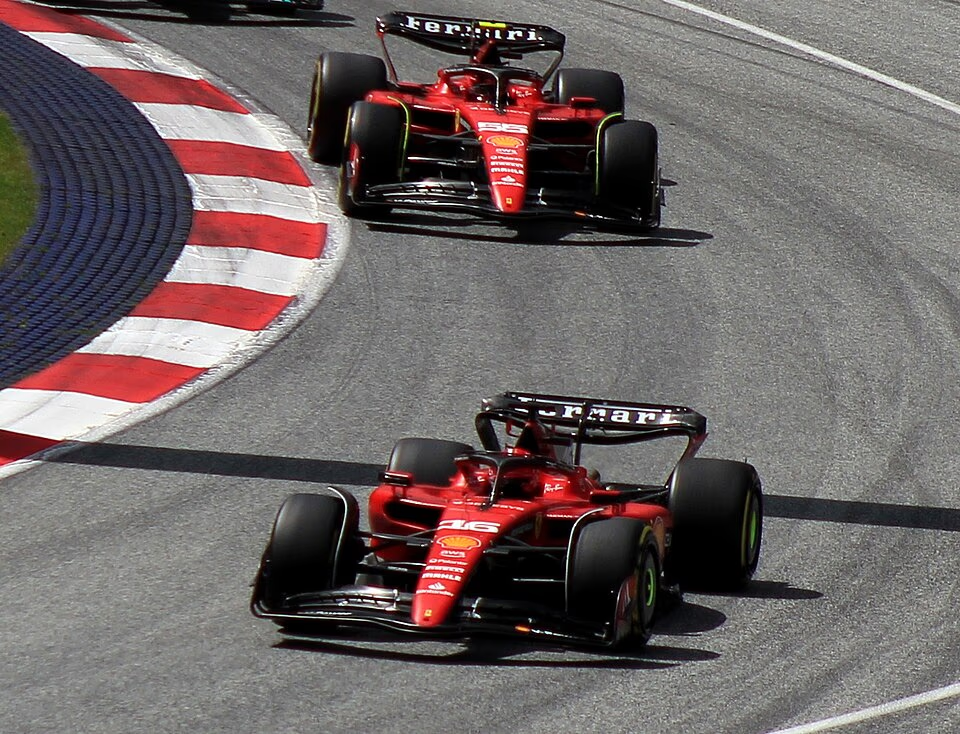
- Chassis: single-seat open-cockpit monocoque with halo cockpit protection device
- Minimum weight (car + driver, no fuel): 768 kg for 2026 (down from 798 kg)
- Maximum dimensions: 1900 mm wide (down from 2000 mm), 3400 mm wheelbase (down from 3600 mm), 950 mm overall height
- Power unit: 1.6 L V6 turbo + Energy Recovery System; ~350 kW from ICE + ~350 kW from electric (vs. ~120 kW pre-2026)
- Fuel: 100% sustainable advanced bio/synthetic — mandated for 2026
- Tyres: Pirelli; reduced front width (370 mm → 355 mm), narrower rears for 2026
- Aerodynamics: ground-effect underfloor retained; new active front + rear wings with driver-actuated "Z-mode" (high downforce) and "X-mode" (low drag)
Section 3: Playing Area
- FIA Grade 1 circuits only (homologation required); 23+ circuits on the 2026 calendar
- Pit lane speed limit: 80 km/h (race), enforced by car-side limiter
- Track-edge kerbs, sausage kerbs, and run-off areas defined per circuit homologation
- Garage / pit equipment standards: fuel rig flow rate (capped at 2.4 L/s under sporting regs), wheel-gun specs
Section 4: Players & Officials
- 10 constructor teams × 2 cars = 20 drivers on the 2026 grid
- Each car: 1 driver, plus reserve driver entitlement per team
- FIA officials enforce Technical Regulations: Technical Delegate, scrutineers, technical commissioners
- Each team submits design drawings + finished-car homologation pre-season; cars are inspected pre-race for technical conformance
Section 5: Rules of Play
Power Unit Architecture (2026)
- 1.6 L V6 turbocharged ICE retained; MGU-H removed; MGU-K output tripled
- 50/50 ICE-to-electric split (target ~750 kW combined peak power)
- Energy deployment limits: 4 MJ per lap from MGU-K (up from 2 MJ)
- Fuel flow rate cap: 3000 MJ/h (energy-based, replacing 100 kg/h mass-based cap)
- Compression ratio (Article C5.4.3, as amended by Issue 19): no cylinder may have a geometric compression ratio higher than 16.0, and any component, assembly, mechanism, or integrated arrangement designed or functioning to increase the compression ratio beyond 16.0 in operating conditions is prohibited. Following pre-season and Barcelona/Bahrain test findings that some designs behaved differently once heat-soaked, Issue 19 requires the compression ratio to be measured both at ambient temperature and with the engine heated to 130°C from 1 June 2026 through 31 December 2026, closing a measurement loophole; from the 2027 season the check reverts to the 130°C operating-condition measurement only.
- Boost mode and wet/low-grip running (Issue 19): after early-season concerns that full driver-selected "boost mode" torque delivery could cause loss of control on a wet or low-grip track, the FIA amended the regulations so that in wet or low-grip conditions with poor visibility, boost mode is available only in a restricted form that prevents a reduction in power output without permitting any increase above the harvested-energy baseline. In the same wet/low-grip conditions, the driver-operated "overtake mode" push-to-pass function is disabled for safety.
Aerodynamics
- Active aerodynamics: driver-operable wing-flap actuators (front + rear) — Z-mode for cornering downforce, X-mode for straight-line drag reduction
- Ground-effect Venturi underfloor retained from 2022-onward regulations
- DRS (Drag Reduction System) replaced by the active rear-wing element
Materials & Construction
- Composite chassis must pass FIA crash tests (front impact, side intrusion, rear impact, rollover)
- Power unit elements limited per season (penalties for exceeding allocation — covered in Sporting Regulations)
Section 6: Scoring
The Technical Regulations do not govern race scoring (handled by the Sporting Regulations: 25-18-15-12-10-8-6-4-2-1 for P1–P10, plus 1 bonus point for fastest lap in top 10). Technical scrutineering produces a binary pass/fail outcome — non-compliant cars are excluded from the session results.
Section 7: Violations & Penalties
- Failed scrutineering: car may be excluded from session/race results (e.g., underweight, plank wear excess, fuel sample non-conformance)
- Power unit allocation exceeded: grid penalties (10 places per additional element)
- Parc fermé violation: pit-lane start required
- Cost cap breach: financial penalty + sporting penalty (e.g., reduced wind tunnel hours)
- Design protest: FIA Technical Department issues binding Technical Directives during the season; teams may protest competitor cars after a race
Section 8: Safety Considerations
Mandatory halo cockpit protection (since 2018) — must pass 116 kN static load test. Carbon-fibre monocoque survival cell with anti-intrusion panels and impact-absorbing nose. HANS device + fireproof Nomex suit + full-face helmet (FIA 8860-2018 or 8859-2015) required. ECU and accident data recorder (ADR) capture impact telemetry. New for 2026: revised side intrusion panel standards reflecting increased focus on T-bone scenarios. The Issue 19 restrictions on boost mode and overtake mode in wet or low-grip conditions were themselves adopted on driver-safety grounds, following feedback that full torque delivery on a slippery track increased the risk of a loss of control. FIA Medical Car follows the grid for the first lap of every race. Marshals, extrication teams, and on-site medical centre required at every Grade 1 circuit.