









Section 1: Introduction
The NTT INDYCAR SERIES is the premier open-wheel motor racing championship in North America. It is sanctioned and governed by INDYCAR, the company that owns and operates the series, and competition is conducted under the annually published INDYCAR Rulebook, which covers the rules and regulations for the series as well as the developmental categories that lead to it.
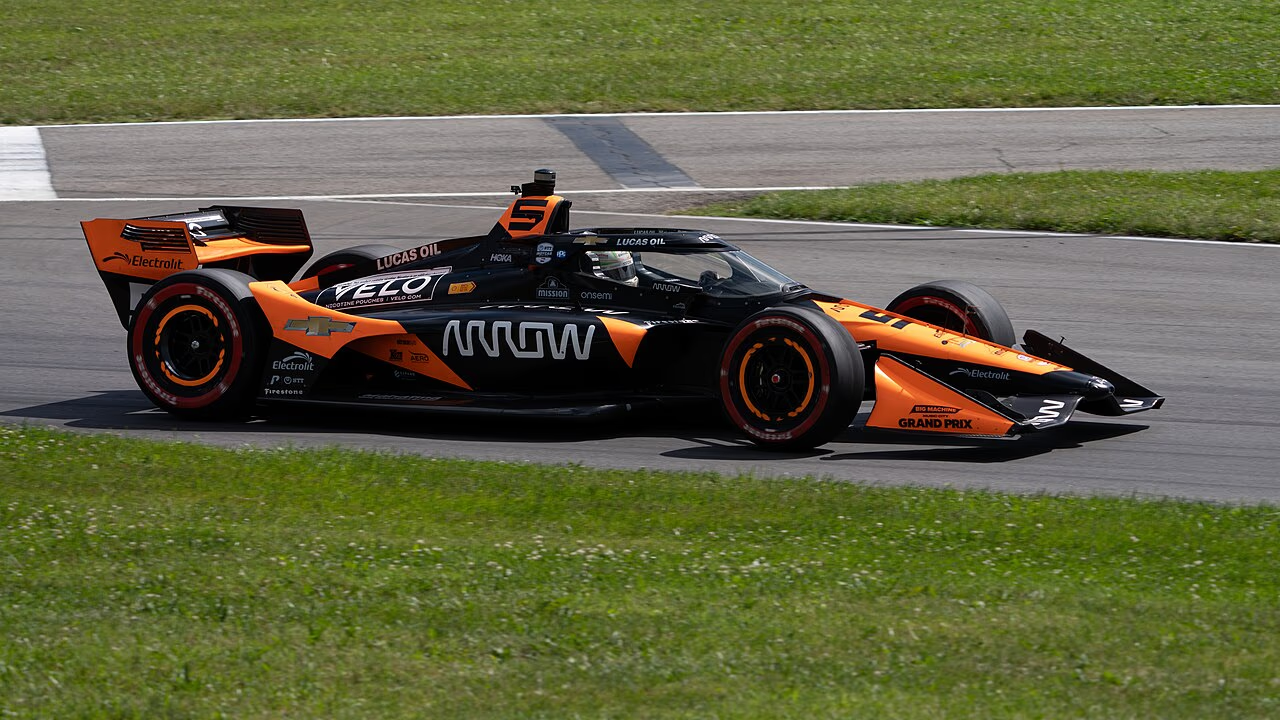
INDYCAR racing traces its modern lineage to the unification, in 2008, of the two open-wheel championships (Champ Car and the Indy Racing League) that had split the sport in the 1990s. The series races a "spec" formula: all teams use a common chassis supplied by Dallara, fitted with a hybrid powertrain and one of two engine manufacturers' twin-turbocharged V6 engines, with bodywork (aero kits) configured for the type of circuit. Because the cars are closely matched, INDYCAR is known for tight, competitive racing across a wide variety of track types.
The season runs from spring into late summer and is contested on three distinct kinds of circuit — superspeedway and short ovals, permanent road courses, and temporary street circuits — making INDYCAR one of the most varied championships in motorsport. The driver who accumulates the most championship points across the season wins the Astor Challenge Cup as series champion.
The centerpiece of the calendar is the Indianapolis 500, run each year over the Memorial Day weekend at the Indianapolis Motor Speedway. The "500" is a race within the championship — it awards championship points like any other round — but it carries unique history, a dedicated qualifying format, and a 33-car field. It is treated in this rulebook as a marquee event of the series, not as a separate sport.
Section 2: Equipment
The Car
All entries use a common Dallara chassis (the IR-18 generation) built to INDYCAR specification. Teams may not deviate from the homologated design except as permitted by the rulebook.
- Chassis: A carbon-fiber monocoque "survival cell" with front and rear impact-absorbing structures and a closed cockpit protected by the aeroscreen.
- Aero kits: Bodywork is configured for the circuit type — a low-downforce superspeedway kit, a high-downforce road/street and short-oval kit — within INDYCAR's homologated parts list.
- Spec components: Many parts (gearbox internals, dampers within limits, electronics, the data logger) are controlled or standardized to keep the formula close and costs contained.
Powertrain
- Engine: A 2.2-liter twin-turbocharged V6, supplied by one of the series' engine manufacturers (Honda or Chevrolet), built to INDYCAR specification with controlled boost levels.
- Hybrid system: INDYCAR cars run a hybrid energy-recovery unit packaged with the engine; it captures and deploys electrical energy and also provides on-board restart capability.
- Fuel: The series uses a renewable race fuel. Refueling is performed in the pits under controlled procedures.
Tires
- Firestone is the series' tire supplier. Dry tires are provided in a primary compound and a softer alternate compound on road and street courses, and oval-specific constructions for ovals.
- On road and street courses, rules require the use of both dry compounds during the race. Wet-weather tires are provided for road and street events.
- Tire allocations per event are defined in the rulebook and event bulletins.
Driver Safety Equipment
- Helmet and head-and-neck restraint: An approved racing helmet plus a head-and-neck restraint (HANS-type) device are mandatory.
- Fire-resistant gear: Multi-layer fire-resistant suit, underwear, gloves, socks, and shoes meeting motorsport standards.
- Restraint system: A multi-point harness secures the driver in the survival cell; the seat and headrest are fitted to the driver.
- Aeroscreen: A ballistic screen with a titanium frame mounted around the cockpit opening, protecting the driver from debris and impacts while preserving an open-wheel car's character.
Section 3: Playing Area
Circuit Types
INDYCAR is unusual among major championships in racing on three fundamentally different kinds of circuit within a single season:
- Ovals: Ranging from the 2.5-mile Indianapolis Motor Speedway superspeedway to short ovals under one mile. Cars run the low-downforce superspeedway aero kit on the fastest ovals.
- Permanent road courses: Purpose-built circuits with left and right corners, elevation change, and run-off areas.
- Temporary street circuits: Laid out on public roads, lined by concrete walls with limited run-off, demanding precision and rewarding track position.
Pit Lane
- Pit lane runs parallel to the start/finish straight and is divided into team pit boxes assigned by the rulebook's order (often by championship position or qualifying).
- A strictly enforced pit lane speed limit applies whenever the pits are open; cars are monitored electronically.
- Pit entry and exit are defined by lines on the track; crossing them improperly, or work performed outside the assigned box, is penalized.
Track Markings, Flags, and Timing
- Start/finish line and electronic timing loops placed around the circuit record each car's position and lap and sector times.
- Flag stations are positioned around the circuit; flags (green, yellow, red, white, checkered, blue, black, and the warning flags) communicate track status to drivers.
- On road and street courses, corner markings, apex curbs, and track-limit lines define the racing surface; on ovals, the apron, racing groove, and warm-up lane are defined areas.
Section 4: Players/Officials
Drivers
- Drivers must hold a valid INDYCAR license for the category. New drivers, and drivers returning to a circuit type, complete a Rookie Orientation Program or refresher, particularly for oval and superspeedway running.
- Indianapolis 500 participation requires completion of the Indianapolis-specific orientation/refresher and approval by INDYCAR.
Teams and Entrants
- Each entrant fields one or more cars, each with an assigned car number, and is responsible for the car's compliance with the rulebook.
- Crew members working on pit lane must be registered and wear required protective equipment.
Officials
- Race Director: The senior race official, responsible for the conduct of the event — starts, restarts, caution and red-flag decisions, and the application of penalties during the race.
- Stewards: A panel that reviews incidents, hears the entrant's position, and issues or confirms penalties; certain decisions may be appealed under the rulebook.
- Technical inspectors: Inspect cars before and after sessions for compliance with the technical regulations, including post-qualifying and post-race checks of the cars at the front of the field.
- Starter and flag crew: The starter controls the start and displays flags from the starter's stand; flag marshals operate the corner stations.
- Timing & scoring: Maintains the official running order, lap counts, and timing using the transponder/loop system.
- Pit officials: Monitor pit-lane speed, releases, and pit-box work for safety and compliance.
- AMR INDYCAR Safety Team and Medical: The series' traveling safety and medical personnel, stationed around the circuit for rapid response.
Section 5: Rules of Play
Event Format
A typical event weekend consists of practice sessions, qualifying, and the race. Session lengths and the number of practices vary by circuit type and are set in the event bulletin.
Qualifying
- Road and street courses: A multi-round knockout qualifying format. The field is split into groups; the fastest advance through successive rounds, culminating in a final shootout (the "Fast Six") that sets the front of the grid, while eliminated cars are ordered by their best times.
- Ovals: Cars qualify by running timed laps; the format depends on the oval.
- Indianapolis 500: A dedicated multi-day qualifying format determines the 33-car starting field and a top-shootout that sets the front rows, including provisions for the slowest cars to be "bumped" from the field.
The Start and Restarts
- INDYCAR uses rolling starts: the field forms up behind the pace car and takes the green flag in formation. Standing starts may be used at selected road/street events when specified.
- Passing before the start/finish line on a start or restart, or before the designated restart zone, is not permitted.
- On restarts after a caution, the leader controls the pace within the restart zone; jumping the restart or improving position before the line is penalized.
Cautions and Red Flags
- Full-course caution: When an incident or debris makes the track unsafe, a full-course yellow is called, the pace car is deployed, and the field closes up at reduced speed behind it. Pit-stop rules during cautions (when the pits open, the order of cars) are defined in the rulebook.
- Local yellow: Used on road and street courses to slow cars through a specific incident zone without a full-course caution; overtaking is prohibited in a local yellow zone.
- Red flag: Stops the session or race for serious incidents or conditions that cannot be managed under caution; procedures govern where cars stop and how the race resumes.
Pit Stops and Procedures
- Pit stops are used to refuel, change tires, and make permitted adjustments. Work must be performed within the team's assigned pit box.
- Pit-lane speed limits, safe-release rules (a car must not be released into the path of another), and equipment-over-the-wall limits are strictly enforced.
- On road and street courses, the rules require running both dry tire compounds during the race, which shapes pit strategy.
Push to Pass
- On road and street courses, drivers have a limited "push to pass" overtake system that provides a temporary engine boost. Each driver has an allocation of time (or activations) per race, with restrictions — for example, it is not available on the first lap or during cautions/restarts as specified by the rulebook.
The Indianapolis 500
- The Indianapolis 500 is run over 200 laps of the 2.5-mile Indianapolis Motor Speedway oval — a total race distance of 500 miles — with a starting field of 33 cars arranged in 11 rows of 3.
- The "Month of May" build-up includes practice, the multi-day qualifying weekend that locks in the field and sets the front rows, and the final practice day before the race.
- The 500 awards championship points on the same scale as other rounds; its significance is historical and prestige-based rather than a points multiplier.
Section 6: Scoring
Race Points
- Championship points are awarded by finishing position, with the race winner receiving the largest single allocation and points scaling down through the full field so that every classified finisher scores.
- Bonus points are available for qualifying on pole position, for leading at least one lap, and for leading the most laps in a race.
- To be classified, a car must complete a defined portion of the race distance; the running order at the finish (or at the time of a race-ending red flag) sets the result.
The Championship
- The driver with the most championship points at the end of the season is the series champion and wins the Astor Challenge Cup.
- Entrant (team) and engine-manufacturer championships are scored in parallel.
- Ties in the standings are broken by performance criteria defined in the rulebook — most commonly the number of wins, then the count of higher finishing positions.
Provisional vs. Official Results
- Results are first published as provisional and become official after post-race technical inspection and the resolution of any penalties or reviews.
- A car found non-compliant in post-race inspection can be penalized in the results or disqualified.
Section 7: Violations/Penalties
Technical Non-Compliance
- A car that fails pre-event, post-qualifying, or post-race technical inspection can lose its qualifying time, be sent to the rear of the grid, lose points, or be disqualified, depending on the severity of the breach.
- Use of non-homologated or modified components outside the rulebook's allowances is a serious technical violation.
On-Track Violations
- Avoidable contact: Contact judged to be avoidable that affects another competitor draws penalties ranging from a position penalty to a drive-through.
- Blocking: Reactive moves to defend position that force another driver to take evasive action are penalized.
- Jumping a start or restart / passing before the line: Improving position before the start/finish line or restart zone draws a penalty.
- Ignoring flags or the black flag / failing to follow Race Director instructions: Penalized, and continued non-compliance can lead to disqualification.
- Track limits: Repeatedly exceeding track limits to gain an advantage is penalized on road and street courses.
Pit-Lane Violations
- Pit speeding: Exceeding the pit-lane speed limit draws a time or drive-through penalty.
- Unsafe release: Releasing a car into the path of another, or work done outside the assigned box, is penalized.
- Equipment, fueling, and crew-over-the-wall infractions carry defined penalties.
Penalty Toolkit
- In-race penalties include drive-through penalties, stop-and-hold penalties, and time penalties; grid penalties apply to qualifying offenses.
- Post-event sanctions include fines, points deductions, probation, suspension, and disqualification.
- The Race Director may apply penalties during the race; the stewards review incidents and certain penalties may be appealed under the rulebook's procedures.
Section 8: Safety Considerations
Car Safety Structures
- Aeroscreen: The titanium-framed ballistic screen protects the driver's head from debris and impacts while keeping the open-cockpit character of the car.
- Survival cell: The carbon-fiber monocoque, with front, rear, and side impact structures, is engineered to absorb crash energy and protect the driver.
- Restraints: The driver harness, fitted seat, and headrest work with the head-and-neck restraint to limit movement in an impact.
Circuit Safety
- SAFER barriers: Energy-absorbing barriers line oval walls and high-risk points on road and street courses to soften impacts.
- Run-off and barriers: Road courses use gravel traps and run-off; street courses use tire packs and reinforced walls where run-off is limited.
- Debris management: Full-course cautions are used to clear debris and recover stranded cars safely.
Safety and Medical Response
- The AMR INDYCAR Safety Team travels with the series and is stationed around every circuit for rapid response to incidents — extrication, fire response, and initial medical care.
- INDYCAR Medical provides on-site physicians and a medical center at each event; drivers involved in significant incidents are evaluated before being cleared.
- A concussion-evaluation and return-to-competition protocol governs when a driver may resume competition after a head impact.
Weather and Conditions
- On road and street courses, racing continues in the rain on wet-weather tires when conditions allow; the Race Director may red-flag for standing water or poor visibility.
- Oval racing is stopped for rain, because the cars cannot run safely on a wet oval; sessions are delayed or rescheduled.
- Lightning, extreme heat, and other hazards are monitored, and sessions are suspended when conditions are unsafe for competitors, crews, and spectators.
Driver and Crew Welfare
- Drivers must meet fitness standards appropriate to the physical demands of oval and road/street racing.
- Pit crew members are required to wear fire-resistant gear and helmets while working on pit lane.
- Mandatory orientation and refresher programs ensure drivers are prepared for the specific demands and speeds of each circuit type, especially superspeedways.