


🏛️Official — NCAA
Loading OpenSourceSports…
Team Sports
9–11 players
outdoor
softball, bat, glove
10 essential rules
NCAA softball is the collegiate form of fastpitch softball, played by member institutions of the National Collegiate Athletic Association across Divisions I, II, and III. Competition is conducted under the NCAA Softball Rules of the Game, published as a rules book on a two-year cycle (the current...
No leadoffs: A base runner may not leave the base until the pitch is released by the pitcher. Leaving early is an out (or the play is otherwise penalized as provided in the rules).; Stealing: Once the pitch is released, runners may attempt to steal.; Look-back rule: When the pitcher has possessio...
Bat certification requirements and championship bat/compression testing keep batted-ball speeds within the intended performance window — a safety measure as much as a competitive one.
Certification: Bats must bear the certification mark recognized by the NCAA and appear in compliance with the approved-bat standards. Aluminum and composite bats are permitted within those standards.; Bat testing: At NCAA championships, and at the discretion of the host, bats are subject to compr...
Batters hit in the order listed on the lineup card. A strikeout, a fly ball caught, or being thrown or tagged out retires the batter; reaching base safely keeps the inning alive.; Bunting and slap hitting are legal offensive techniques and are common in the college game.; A batter must remain wit...
Batting out of order: An appealable violation; the proper penalty (an out and adjustment of the order) depends on when the appeal is made.; Leaving a base early: A runner who leaves before the pitch is released is penalized as provided in the rules.; Interference: When a runner, batter, or coach ...
The NCAA Division I Softball Championship is a bracketed postseason: 16 four-team double-elimination regionals, then best-of-three super regionals, leading to the eight-team Women's College World Series, which is itself a double-elimination tournament followed by a best-of-three championship seri...
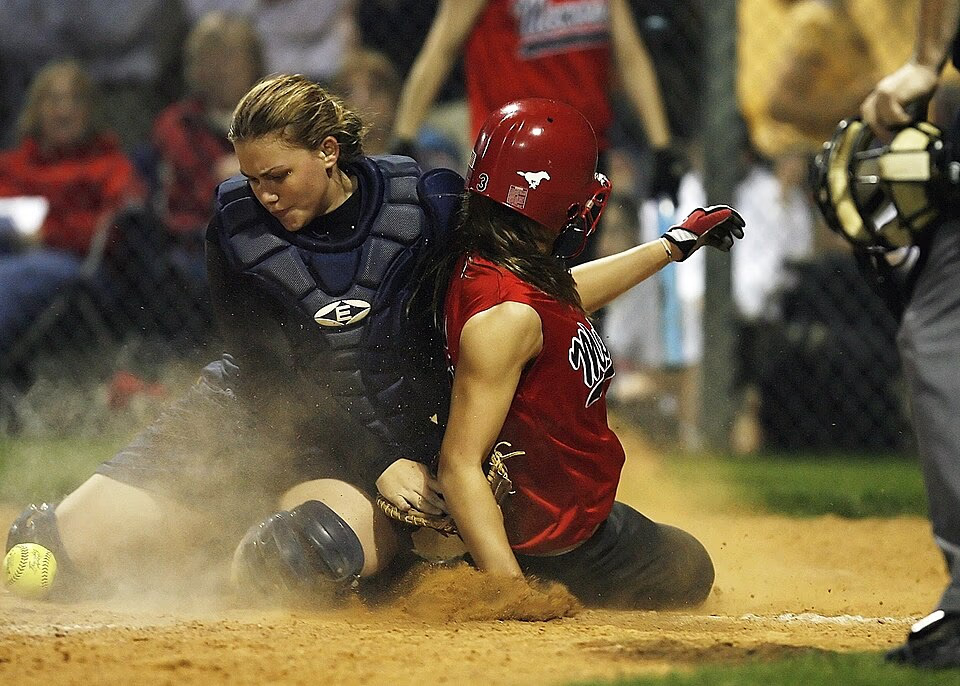
The must-avoid-contact and malicious-contact rules, together with the double base at first, are designed to reduce collisions between runners and fielders.; The look-back rule keeps base running orderly once the pitcher controls the ball in the circle.
Unsportsmanlike conduct by players or coaches — abusive language, throwing equipment, contact with an official — results in warnings, ejection, and, where applicable, further disciplinary action by the conference or the NCAA.; An ejected individual must leave the playing area; the head coach is r...
The rules limit the number of charged conferences — both defensive (coach visits to the pitcher) and offensive — a team may take in a game. Exceeding the defensive-conference limit requires the pitcher to be removed from the pitching position.
The team with more runs at the end of a regulation (or extra-innings) game wins.; A game ended early by the run-ahead rule is complete, and the score stands.; Called and suspended games: If a game is stopped for weather or darkness, the rules define when it is a complete game, when it is suspende...
Don't steal or run aggressively when a run-rule lead is in reach
When leading by enough that the run rule (run-ahead rule) could end the game, teams are expected to stop stealing bases, executing hit-and-runs, or using aggressive tactics to pile on. Continuing to do so is considered disrespectful to the opposing team and contrary to competitive fairness norms at the collegiate level.
NCAA softball uses a run rule (e.g., 8 runs after 5 innings). The threshold where restraint kicks in is judgment-based but widely understood.
Slap-hitters must go all-out on every slap attempt
Left-handed slap hitters are expected to commit fully and sprint through every slap, including balls likely to be fielded. Soft-pedaling the run, peeling off early, or not giving maximum effort is seen as disrespectful to the craft and to teammates depending on her speed.
Slap-hitting is a core and respected skill in softball, particularly at the NCAA level where team speed is a strategic pillar.
Don't talk about a no-hitter or perfect game while it's in progress
Players, coaches, and broadcasters avoid explicitly mentioning that a no-hitter or perfect game is ongoing, believing it will jinx the pitcher. Teammates stay away from her in the dugout and avoid the subject entirely until the final out.
Ready to dive deeper?
Run out every ball — never jog to first base
Players are expected to sprint to first base on every batted ball, regardless of how routine the out appears. Jogging on a pop-up or ground ball that results in an out is considered disrespectful to the game. Coaches and teammates view full effort on every play as non-negotiable.