


🏛️Official — World Aquatics
Loading OpenSourceSports…
Water Sports
1 players
outdoor
swimwear, cap, wetsuit
10 essential rules
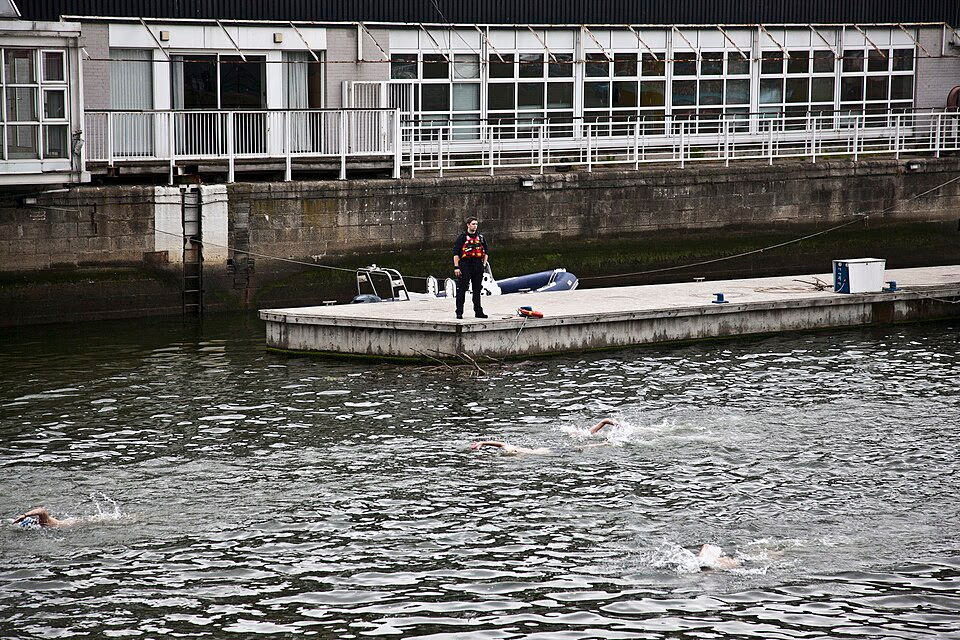
Open Water Swimming is the discipline of competitive long-distance swimming in rivers, lakes, seas, oceans, water channels, or any other body of open water, governed internationally by World Aquatics (renamed from FINA in January 2023). This rulebook reflects the World Aquatics Competition Regula...
The event runs over three rounds: Round One (1500 m), Round Two (1000 m, swum as one or two semi-final heats), and Round Three (500 m, a single final), each conducted under the same start, race, and finish rules as the standard race (Articles 7.2.1, 7.2.3, 7.3.1, 7.4.1, 7.5.1 of Part Three).; The...
An Athlete must follow the course, round every turn buoy in the correct order and direction, not exceed the course boundaries, and complete the full course; failure to do so may result in disqualification from the event (Articles 4.1.2, 4.1.2.1 of Part Three).; An Athlete must not receive support...
An Athlete finishes by touching the finish plate (or crossing the finish line where no plate is used); an Athlete who does not touch the plate is disqualified (Articles 5.3–5.4 of Part Three).; Any violation within the limits of the finish funnel may result in disqualification, and where a Video ...
The first Athlete of each team starts together in accordance with the standard start procedure, and each team member must complete their 1.5 km leg consecutively before the next teammate enters the water (Articles 6.1.3–6.1.6 of Part Three).; Where a relay changeover platform is used, the incomin...
Swimwear: at a water temperature of 18.0°C or above, an Athlete must wear one swimsuit in one or two pieces (not a wetsuit) that has been approved under Article 6 of Part One (Article 10.1 of Part Three).; Wetsuit: at a water temperature below 18.0°C, an Athlete must wear a wetsuit, with only one...
Course: the racecourse is laid out with a start/finish area, one or more turn buoys, and guidance buoys marking the swim line, as shown in the course diagram at Appendix 1 of Part Three. The course must be in water subject to only minor currents or tide and may be salt or fresh water (Article 13....
Individual events: at the Olympic Games and World Aquatics Championships each Member Federation may enter a maximum of two Athletes per individual event (Article 9.1 of Part Three).; Mixed Team Event: each Member Federation may enter one team of four Athletes — two men and two women, all of the s...
At the Olympic Games and World Aquatics Events, Athletes start from a fixed starting platform, with positions assigned by random draw; at other competitions the organiser may instead choose an in-water start (Articles 3.1.1–3.1.2 of Part Three).; On the Starter's command "take your marks," Athlet...
Placings are determined by the Chief Referee from the Automatic Officiating Equipment where available; times and placings recorded by this equipment take precedence over Finish Judges' and Timekeepers' records (Articles 12.3.3.1–12.3.3.2 of Part Three).; If Automatic Officiating Equipment is not ...
Yellow card (first infraction): the Chief Referee or an appointed Referee raises a yellow flag and displays the Athlete's number as an official warning; the infraction is recorded and all Technical Officials are notified (Articles 4.2.2.3–4.2.2.4 of Part Three).; Red card (second infraction): a s...
Don't deliberately grab, foul, or target a competitor's gear
Physical contact is inevitable and legal in open water competition, but intentionally grabbing a rival's limbs, yanking goggles, or clutching a suit to impede them is considered a serious violation of competitive integrity — even when officials miss it or assess only a minor penalty.
High-profile incidents at Olympic and World Championship events have reinforced this norm
Signal officials if a competitor appears to be in medical distress
Deeply rooted in swimming's safety culture: if you observe a fellow competitor showing signs of genuine distress — disorientation, non-movement, erratic behavior — you are expected to raise your arm and alert the nearest patrol boat or kayak, even at personal competitive cost.
Open water swimming carries real drowning risk; the sport's community treats this obligation as non-negotiable
Don't use the finish wall or timing pad to block a rival's touch
Deliberately angling your body or outstretching an arm to physically prevent a competitor from reaching the timing pad at the finish is considered one of the sport's clearest ethical violations, regardless of whether a penalty is assessed.
Became more prominent as photo-finish and touch-pad technology made margin-of-touch decisive
Ready to dive deeper?