








Section 1: Introduction
1.1 History and Governing Body
NASCAR (National Association for Stock Car Auto Racing) was founded on February 21, 1948, by William Henry Getty France Sr. in Daytona Beach, Florida. It is the sanctioning body for one of the most prominent forms of motorsport in the United States. NASCAR sanctions over 1,500 races at more than 100 tracks in the United States, Canada, Mexico, and Europe.
The NASCAR Rule Book is the official governing document for all NASCAR-sanctioned competition. The rules contained within apply to the NASCAR Cup Series (the premier series), the NASCAR Xfinity Series, and the NASCAR Craftsman Truck Series, with series-specific supplements addressing differences among the three national series. All participants — including drivers, crew chiefs, team owners, and crew members — are bound by the provisions of the NASCAR Rule Book and the terms of their NASCAR License.
1.2 The Three National Series
- NASCAR Cup Series: The premier series, featuring the highest level of competition. The season spans approximately 36 points-paying events plus the non-points All-Star Race.
- NASCAR Xfinity Series: A developmental series running approximately 33 points-paying events per season, serving as a stepping stone to the Cup Series.
- NASCAR Craftsman Truck Series: Features modified pickup trucks and runs approximately 23 events per season.
1.3 The Charter System
The NASCAR Cup Series operates under a Charter System, introduced in 2016. Under this system, NASCAR issues Charters to team owners, guaranteeing entry into Cup Series races and a share of industry revenues. As of the current season, 36 Charters exist, guaranteeing 36 of the 40 available starting positions to chartered teams. The remaining four positions are contested through time trials or NASCAR's selection process for open teams.
Charters are transferable and assignable with NASCAR's approval. A chartered team must field a full-time competitor in the NASCAR Cup Series to maintain Charter eligibility as defined in the NASCAR Charter Agreement.
1.4 The Next Gen Car
Beginning with the 2022 NASCAR Cup Series season, all Cup Series competition transitioned to the "Next Gen" car platform. The Next Gen car introduced significant changes including a new chassis architecture, five-speed sequential transmission, independent rear suspension, single-lug wheel fasteners (center-lock wheel design), and standardized components sourced from NASCAR-approved suppliers. The Next Gen platform is designed to improve competition parity, reduce costs through parts standardization, and enhance safety through updated structural design.
Section 2: Equipment
2.1 Car Eligibility and Body
All cars competing in the NASCAR Cup Series must conform to the specifications set forth in the NASCAR Rule Book and the applicable NASCAR-approved templates. The current approved manufacturers for the Cup Series are Chevrolet (Camaro ZL1), Ford (Mustang Dark Horse), and Toyota (Camry XSE). Car bodies must conform to the manufacturer-specific NASCAR-approved body templates. Any body panel, aerodynamic surface, or component not explicitly approved in the Rule Book or by a NASCAR Technical Bulletin is prohibited.
Cars must display the correct manufacturer hood logo, rear decklid logo, and quarter-panel logo consistent with their declared manufacturer. The car number must be displayed on both door panels, the roof, and the rear bumper in a font and size conforming to NASCAR specifications.
2.2 Chassis and Structure
The Next Gen car uses a common steel space-frame chassis supplied by NASCAR-approved manufacturers. The chassis must be constructed per the dimensional specifications in the NASCAR Rule Book. Significant structural components — including the roll cage, door bars, roof halo, and fuel cell containment structure — must conform to NASCAR-approved specifications and may not be altered beyond permitted adjustments. The roll cage must be constructed of minimum 1.75-inch diameter, 0.090-inch wall thickness chromoly or 4130 steel tubing in the primary hoop, per the specifications chart in the Rule Book.
2.3 Engine Specifications
NASCAR Cup Series cars use a naturally aspirated, pushrod V8 engine with a maximum displacement of 358 cubic inches (5.87 liters). The engine must conform to the specifications in the NASCAR Engine Rules, including:
- Cylinder block: Must be an approved NASCAR Cup Series spec block. The cylinder bore centers and deck height must conform to approved specifications.
- Compression ratio: Maximum 12.0:1 as measured per NASCAR procedures.
- Carburetor/Fuel delivery: Holley four-barrel carburetor (on most oval tracks); electronic fuel injection (EFI) is approved for select events.
- Restrictor plates / Tapered spacers: At Daytona International Speedway and Talladega Superspeedway, cars must run NASCAR-supplied tapered spacers to limit horsepower to approximately 510 hp. On intermediate and short tracks, engines produce approximately 670–750 hp.
- Rev limiter: A NASCAR-supplied engine control module (ECM) is mandatory. The ECM enforces pit road speed limits and functions as a rev limiter.
2.4 Weight Requirements
The minimum weight for a NASCAR Cup Series car, including the driver but without fuel, is 3,400 pounds (1,542 kg). Cars found below minimum weight following an event may be subject to disqualification. Weight may be added to the car in the form of ballast, which must be securely mounted and located per Rule Book specifications. Ballast may not be located in the driver's compartment in a manner that creates a safety hazard.
2.5 Suspension
The Next Gen car uses a double-wishbone front suspension and an independent rear suspension (IRS) — a significant change from the previous solid rear axle configuration. Suspension geometry adjustments (camber, toe, caster) are permitted within defined ranges. Spring rates, shock absorber settings, and sway bar configurations are adjustable within the parameters defined by NASCAR.
2.6 Transmission
A NASCAR-supplied five-speed sequential (H-pattern sequential) gearbox is mandatory in the Cup Series. Gear ratios are selectable from NASCAR-approved combinations specific to each track. Automatic transmissions are not permitted.
2.7 Fuel
The official fuel of the NASCAR Cup Series is Sunoco Green E15, an unleaded fuel containing 15% ethanol, supplied exclusively by Sunoco as the official fuel supplier. No other fuel may be used. The fuel cell (safety fuel tank) has a maximum capacity of 18 gallons (68.1 liters). The fuel cell must be an approved, commercially available bladder-type unit conforming to SFI Specification 28.1 or FT3/FT3.5 equivalent, enclosed in a steel container mounted in the approved location behind the rear axle.
2.8 Tires
Goodyear Eagle tires are the exclusive tire supplier for the NASCAR Cup Series. Tire compounds are selected by Goodyear and NASCAR specific to each track and event. Teams may not alter tire compounds, add traction compounds, or modify tires in any way. Tire pressure must be set within the ranges specified by NASCAR for each event. Teams receive a defined allocation of tires per event as published in the event entry information. Used tires must be returned to Goodyear following the event.
2.9 Wheels
The Next Gen car uses an 18-inch aluminum center-lock wheel (single-lug nut, 10-lug pattern on the hub) supplied by NASCAR-approved manufacturers. Wheel diameter is standardized at 18 inches. The center-lock design replaced the five-lug wheel used on previous-generation cars, affecting pit stop procedures significantly.
Section 3: Playing Area
3.1 Track Classifications
NASCAR Cup Series events are held on a variety of track configurations, classified as follows:
- Superspeedways: Tracks of 2.0 miles or greater in length. Currently includes Daytona International Speedway (2.5 miles / 4.023 km) and Talladega Superspeedway (2.66 miles / 4.281 km). These tracks require tapered spacer packages to reduce speeds for safety.
- Intermediate Tracks: Ovals between 1.0 and 2.0 miles in length, including tracks such as Charlotte Motor Speedway (1.5 miles), Las Vegas Motor Speedway (1.5 miles), and Michigan International Speedway (2.0 miles).
- Short Tracks: Ovals under 1.0 mile in length, including Bristol Motor Speedway (0.533 miles / 0.858 km) and Martinsville Speedway (0.526 miles / 0.847 km).
- Road Courses: Tracks incorporating both left and right turns, including Sonoma Raceway (1.99 miles / 3.2 km road course configuration), Watkins Glen International (2.45 miles / 3.94 km), and the Circuit of the Americas (3.41 miles / 5.49 km).
- Dirt Tracks: NASCAR Cup Series events are occasionally held on dirt surfaces, such as Bristol Motor Speedway when prepared as a dirt track for the Food City Dirt Race.
3.2 Pit Road
Pit road is a designated lane adjacent to the racing surface where teams service cars during competition. Each team is assigned a pit stall, the location of which is determined by qualifying position (fastest qualifier receives first choice of pit stall position, continuing in order). Pit stall boundaries are marked and cars must stop within their assigned stall during pit stops.
Pit road speed limits are established by NASCAR for each track and are enforced via the mandatory NASCAR ECM system. Speed limits vary by track:
- Superspeedways (Daytona, Talladega): 55 mph (88.5 km/h)
- Most intermediate and short tracks: 35–45 mph (56–72 km/h), as posted and announced in the driver/crew chief meeting prior to each event
- Road courses: Speed limits are set for specific pit lane segments and announced prior to the event
Drivers must maintain pit road speed from the moment they cross the designated pit road entry cone/marker until they cross the pit road exit cone/marker. Speed enforcement is automatic through the ECM system, and violations result in a drive-through or stop-and-go penalty.
3.3 Start/Finish Line and Scoring Loops
The start/finish line is the official scoring reference for lap completion, race start, and race finish. Inductive scoring loops embedded in the racing surface transmit transponder data to NASCAR's scoring and timing system. Each car carries a NASCAR-supplied transponder that must remain operational throughout the event. The transponder data is the official record for lap times, position, and laps completed.
3.4 Restart Zones
Designated restart zones are marked on the track, typically by painted lines or cones. For double-file restarts, the leader controls the restart and may accelerate anywhere in the designated restart zone. The leader must maintain a consistent speed until reaching the restart zone and may not make sudden deceleration to force following cars to bunch excessively. Cars in the outside lane (on double-file restarts) may not pass cars in the inside lane until the leader crosses the start/finish line (or the restart line, as designated for the specific track).
3.5 Apron and Out-of-Bounds
The apron is the lower portion of an oval track below the racing surface. On most ovals, the apron is delineated by a painted line (the "commitment line" in certain contexts). A car that drops onto the apron during a caution period may be subject to NASCAR's lap-down penalty procedures. On road courses, track limits are defined by white lines or kerbing; NASCAR may penalize drivers who repeatedly use areas outside the defined track limits to gain a competitive advantage.
Section 4: Players & Officials
4.1 Licensing Requirements
All participants in NASCAR-sanctioned events must hold a valid NASCAR License appropriate to their role. License categories include Driver, Crew Chief, Car Owner, Crew Member (Over-the-Wall), Crew Member (Non-Over-the-Wall), Spotter, and Official. Licenses are issued annually and may be revoked or suspended for violations of the NASCAR Rule Book. Applicants must meet NASCAR's eligibility criteria, which may include age requirements (minimum age of 18 for Cup Series drivers), physical examination requirements, and a driving record review for drivers.
4.2 The Driver
Only one driver per car is permitted per event. The driver listed on the entry form is the only person authorized to operate the car in competition. Driver substitutions after the entry deadline require NASCAR approval and may affect the car's eligibility for points. A driver must remain in the car for the duration of the event except in cases of medical necessity, as determined by the NASCAR medical team. If a driver is removed for medical reasons, the car may continue with a relief driver, but no points are awarded to the relief driver, and the car's points position may be affected per NASCAR's rules on relief drivers.
4.3 Crew Chief
The Crew Chief is responsible for all competition decisions made by the team, including car setup, strategy, and the conduct of crew members. The Crew Chief is the primary point of contact between the team and NASCAR officials. The Crew Chief must hold a valid NASCAR Crew Chief license and is accountable for NASCAR Rule Book compliance of the entire team. Penalties assessed to a team for car infractions may be levied against the Crew Chief in addition to, or instead of, the driver or car owner.
4.4 Over-the-Wall Crew
During pit stops, a maximum of five (5) crew members are permitted over the pit wall to service the car. These five positions are: front tire changer, front tire carrier, rear tire changer, rear tire carrier, and jackman. With the Next Gen car's center-lock wheel system, the jackman role was retained, and teams may optionally use a fueler position, but the total over-the-wall count may not exceed five at any time. Additional crew members may work on the car only from the pit lane side of the pit wall (they may not step over or cross the pit wall into the pit stall area). All over-the-wall crew members must wear helmets and fire-resistant suits when performing pit stops.
4.5 Spotter
Each car must have a licensed Spotter positioned in the designated spotter stand at the track. The Spotter communicates with the driver via two-way radio throughout the event, providing information about track conditions, cautions, and the positions of other cars. Spotters are required to use NASCAR-designated radio frequencies and equipment. The Spotter must remain in the designated spotter area and may not communicate in a manner that violates NASCAR's Rules Book provisions regarding competitor communications.
4.6 NASCAR Race Control Officials
NASCAR Race Control, located in a control tower or designated area at the track, is responsible for the conduct of the event. Key NASCAR officials include:
- NASCAR Race Director: The senior official responsible for all on-track competition decisions, including issuing cautions, determining restart procedures, and assessing on-track penalties.
- NASCAR Technical Officials: Responsible for pre-race and post-race inspection of cars to ensure compliance with the Rule Book.
- NASCAR Scoring Officials: Responsible for maintaining the official scoring and timing of the event.
- NASCAR Series Director: Oversees series-level compliance and administrative matters.
NASCAR officials' decisions are final. Teams wishing to appeal certain penalties may do so through the NASCAR National Motorsports Appeal Panel process as outlined in the Rule Book.
4.7 Team Owner Responsibilities
The car owner listed on the NASCAR entry form is ultimately responsible for the car's compliance with the Rule Book at all times. Car owners must maintain their NASCAR License in good standing and ensure all team members operating under their entry are properly licensed. Violations attributable to the car may result in penalties assessed against the car owner, Crew Chief, and/or driver, at NASCAR's discretion.
Section 5: Rules of Play
5.1 Race Entry and Qualifying
Teams must submit an official entry form by the NASCAR-established deadline for each event. The field for Cup Series events is 40 cars. Chartered teams (up to 36) are guaranteed entry. The remaining positions (typically four) are filled through qualifying time trials or NASCAR's selection criteria for open (non-chartered) teams. When qualifying is held, the fastest car earns the pole position. Starting positions for non-qualifying sessions may be determined by owner points or other criteria as published in the event entry information.
5.2 Race Start Procedure
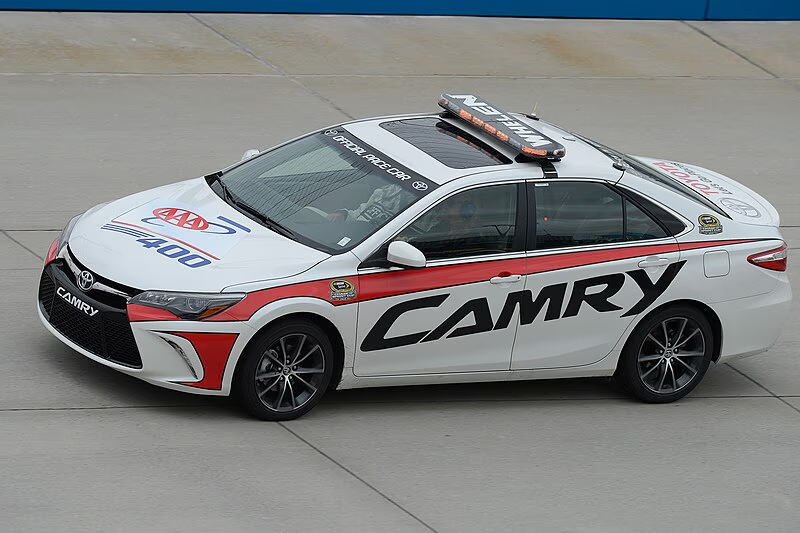
Events begin with pace laps under the pace car, during which drivers warm up tires and receive final instructions. The field takes the green flag when NASCAR Race Control deems conditions safe. The pace car exits the racing surface before the green flag is displayed. False starts (breaking formation before the green flag) are subject to penalty. The official start of the race is when the green flag is displayed at the start/finish line.
5.3 Stage Racing
Introduced for the 2017 season, NASCAR Cup Series races are divided into three stages. The first two stages end at pre-determined lap counts (published in the event entry information for each race), followed by the final stage which ends at the scheduled race distance. At the conclusion of each of the first two stages, a caution period is declared. The top 10 finishers at the end of each stage earn stage championship points (10 points for first place, 9 for second, ..., 1 for tenth). Stage winners also earn 1 playoff point. The race winner earns 5 playoff points in addition to the automatic playoff berth that a race win provides.
5.4 Caution Periods
NASCAR Race Control may display the yellow flag (caution) at any time due to an on-track incident, debris, inclement weather, or other hazardous conditions. Upon display of the caution:
- All cars must reduce speed and maintain their running order. No passing is permitted except to avoid an accident.
- The pace car enters the racing surface and leads the field.
- The free pass (Lucky Dog) is awarded to the first car one lap down at the time the caution is declared, moving that car to the tail of the lead lap. Only one free pass is awarded per caution period.
- Wave-arounds may be offered to other lapped cars at NASCAR's discretion in specific circumstances.
- Cars may pit during the caution period. Pit road opens when NASCAR Race Control announces "pit road is open."
- The lap count does not advance during caution periods (laps run under caution count toward the race distance, but laps are not scored while the pace car is leading).
5.5 Restarts
Restarts following caution periods use a double-file restart format. Lead-lap cars line up in the inside lane in running order; lapped cars line up in the outside lane behind the lead-lap cars. The leader controls the restart and may accelerate at any point within the designated restart zone. Outside-lane cars may not pass inside-lane cars until the leader reaches the start/finish line (or the designated restart line). The green flag is displayed at the start/finish line when the restart occurs. Any car that jumps the restart (accelerates before the restart zone) may be penalized.
5.6 Overtime (Green-White-Checkered)
If a caution is displayed within the final two laps of a stage or the final two laps of the race, NASCAR will attempt to complete the event under green-flag conditions using the Green-White-Checkered (GWC) overtime procedure. A maximum of three (3) overtime attempts are permitted. If the race cannot be completed under green-flag conditions after three overtime attempts, the event is declared official at the last completed green-flag lap, and finishing positions are determined accordingly. If the race distance has been completed but a caution comes out during the final two laps, the race ends under the yellow flag and positions at the time of the caution (or at the last completed green lap) are used to determine the finishing order.
5.7 Pit Road Procedures
Cars must enter and exit pit road in the designated entry and exit lanes. The following rules apply on pit road:
- Cars must maintain pit road speed from entry to exit cone/marker.
- Cars must stop within their assigned pit stall boundaries.
- No more than five crew members may be over the pit wall at any time.
- Fueling may only be performed when the jackman has raised the car (or as otherwise permitted by NASCAR procedure for the specific event).
- Tires that are removed from the car must be retained in the pit stall until the car has exited pit road.
- Cars may not be serviced while in motion on pit road (except for the fueler inserting/removing the fuel can while the car is briefly stationary).
- Unsafe release (releasing a car from the pit stall in a manner that creates a hazard for other cars or crew members on pit road) is a violation subject to penalty.
5.8 Race Ending Procedures
The checkered flag is displayed at the start/finish line as the race leader crosses to complete the scheduled race distance (or the final overtime lap). All other cars receive the checkered flag as they cross the line. Positions are determined by the transponder scoring data at the time of race completion. In the event of a tie (two cars deemed to have crossed simultaneously), the higher starting position car is awarded the better finish.
5.9 Race Suspension and Postponement
NASCAR Race Control may suspend a race at any time due to inclement weather, track conditions, or other safety concerns. A race is considered official after the completion of 50% of the scheduled race distance under green-flag conditions. If a race is suspended before 50% completion and cannot be resumed, it may be rescheduled. If suspended after 50% completion, the race may be declared official with the last completed green-flag lap serving as the finishing order.
Section 6: Scoring
6.1 Race Points — Regular Season
NASCAR Cup Series points are awarded to all cars that attempt to start each points-paying event. The points structure is as follows:
- 1st place: 40 points
- 2nd place: 35 points
- 3rd place: 34 points
- 4th place: 33 points
- 5th place: 32 points
- 6th place: 31 points
- 7th place: 30 points
- 8th place: 29 points
- 9th place: 28 points
- 10th place: 27 points
- 11th–35th place: 26 points decreasing by 1 point per position (26 for 11th, 25 for 12th, ..., 2 for 35th)
- 36th–40th place: 1 point
Additionally, bonus points are awarded as follows:
- Leading at least one lap: 1 bonus point
- Leading the most laps in the race: 1 bonus point
6.2 Stage Points
At the conclusion of each of the first two stages of a race, championship points are awarded to the top 10 finishers of that stage:
- Stage winner (1st): 10 points
- 2nd: 9 points
- 3rd: 8 points
- 4th: 7 points
- 5th: 6 points
- 6th: 5 points
- 7th: 4 points
- 8th: 3 points
- 9th: 2 points
- 10th: 1 point
6.3 Playoff Points
Playoff points are a separate currency used to determine seeding within the NASCAR Cup Series Playoffs. Playoff points are earned as follows and carry over into the Playoff rounds for drivers who qualify:
- Regular season race win: 5 playoff points (plus an automatic playoff berth)
- Regular season stage win: 1 playoff point per stage win
- Regular season points champion (non-winner): 15 playoff points added at Playoff entry
- Playoff round race win: 5 playoff points
- Playoff round stage win: 1 playoff point per stage win
6.4 The NASCAR Cup Series Playoff Structure
The NASCAR Cup Series Playoffs begin following the conclusion of the 26-race regular season and consist of 10 races across four rounds:
- Round of 16 (3 races): Darlington Raceway, Bristol Motor Speedway, Kansas Speedway
- Round of 12 (3 races): Talladega Superspeedway, Charlotte Motor Speedway Roval, Las Vegas Motor Speedway
- Round of 8 (3 races): Homestead-Miami Speedway, Martinsville Speedway, Texas Motor Speedway
- Championship 4 (1 race — Championship Race): Phoenix Raceway
Sixteen drivers qualify for the Playoffs. Playoff qualification is achieved by: (a) winning a regular season race and being within the top 30 in driver points at the regular season's conclusion, or (b) being among the top 16 in driver points among non-winners at the regular season's conclusion (if fewer than 16 race winners exist in the top 30). After each of the first three rounds (Rounds of 16, 12, and 8), four drivers are eliminated. In each round, drivers can advance by winning a race within the round (automatic advancement), or by accumulating enough combined playoff points and race points to be ranked within the top 12, 8, or 4 at the end of each respective round. The four drivers remaining in the Championship 4 compete at Phoenix Raceway; the driver who finishes highest among those four at Phoenix is crowned NASCAR Cup Series Champion.
6.5 Owner Points and Manufacturer Points
In addition to driver points, Owner Points and Manufacturer Points are tracked throughout the season. Owner Points follow the same structure as driver points and are used to determine charter eligibility and other owner-based awards. Manufacturer Points are awarded based on the highest finishing car of each manufacturer in each event and are used to determine the NASCAR Cup Series Manufacturers' Championship.
Section 7: Violations & Penalties
7.1 Penalty Assessment Authority
NASCAR has sole and exclusive authority to assess penalties for violations of the NASCAR Rule Book, NASCAR Bulletins, and any NASCAR-issued directives. Penalties may be assessed before, during, or after a NASCAR-sanctioned event. The NASCAR Penalty Review Committee reviews all potential violations identified by Technical Officials and Race Control and determines the appropriate penalty. Penalties are communicated to the affected team's Crew Chief and are publicly announced by NASCAR.
7.2 Technical Violations (Car Inspection)
Cars are subject to inspection before and after each event. Technical violations are classified by severity:
- P1 (Minor Violation): Typically a small monetary fine and/or loss of practice/qualifying time. Examples include minor body tolerances exceeded, improper signage, or minor equipment infractions.
- P2 (Moderate Violation): Fine, points deduction (driver and/or owner), and possible crew chief or team member suspension. Examples include body modifications outside approved tolerances or unapproved parts.
- P3 (Major Violation): Significant fine, major points deduction, and suspension of team members. Reserved for significant attempts to circumvent the Rule Book's intent.
- P4 (Severe/Charter-Level Violation): Maximum fine, maximum points deduction, extended suspensions, and possible loss of charter or other significant privileges. Reserved for egregious or intentional cheating.
Cars that fail post-race inspection and are found to have a non-approved performance advantage may be assessed an "encumbered finish," meaning the official finishing position is retained for points purposes but the team is subject to the full applicable penalty, which may include loss of race and/or stage points, playoff points, and associated bonuses earned in that event.
7.3 On-Track Penalties
NASCAR Race Control may assess on-track penalties during a race event, including:
- Drive-Through Penalty: The car must enter pit road at pit road speed and drive through its pit stall without stopping. Common for pit road speeding, too many crew members over the wall, and improper tire disposal.
- Stop-and-Go Penalty: The car must enter pit road, stop in its pit stall for a minimum time period (typically 1 second of complete stop), and then exit. Assessed for more serious on-track infractions.
- Black Flag (Disqualification): A car displaying the black flag must immediately report to pit road and cease competition. Failure to comply results in the scoring loop being turned off for that car (the car is no longer scored).
- Loss of Laps / Pass-Through: In certain situations, NASCAR may require a car to serve a pass-through penalty during a green-flag period, effectively costing the car time and track position.
7.4 Pit Road Violations
Common pit road violations and their standard penalties include:
- Pit road speed violation: Drive-through penalty for the first offense. Repeat violations in the same event may result in a stop-and-go or further penalty.
- Too many crew members over the wall (more than 5): Drive-through penalty.
- Unsafe release: Drive-through or stop-and-go penalty.
- Tire not retained in pit stall (tire off pit road): Drive-through penalty.
- Jackman or fueler over the wall before the car enters the pit stall: Drive-through penalty.
7.5 Restart Violations
Jumping a restart (accelerating before the restart zone) results in a drive-through penalty. The car may also be required to restart at the tail of the field in addition to the drive-through, at NASCAR's discretion, if the violation is deemed to have materially affected the restart.
7.6 Appeals Process
Teams wishing to appeal a NASCAR penalty must submit a written notice of appeal to NASCAR within the timeframe specified in the Rule Book (typically within 48 hours of the penalty announcement for post-event penalties). Appeals are heard by the NASCAR National Motorsports Appeal Panel (NMAP), which consists of independent members. The NMAP may uphold, reduce, or overturn a penalty. NMAP decisions are final and binding. On-track (during-race) penalties assessed by Race Control are not subject to the formal appeals process but may be reviewed by NASCAR's series officials for future consideration.
7.7 Substance Abuse Policy
NASCAR maintains a strict Substance Abuse Policy applicable to all licensed participants. Testing may be conducted at any NASCAR-sanctioned event or facility. Any participant found to have a prohibited substance in their system at a level exceeding NASCAR's defined thresholds is subject to immediate suspension of their NASCAR License and must complete a NASCAR-approved substance abuse program before reinstatement. The specific substances and testing protocols are defined in the NASCAR Substance Abuse Policy document, which is incorporated by reference into the Rule Book.
Section 8: Safety Considerations
8.1 Driver Safety Equipment — Mandatory Requirements
All NASCAR Cup Series drivers must wear the following safety equipment during competition and on-track activity:
- Helmet: A full-face helmet meeting the current Snell SA or SFI 31.1A/2020 (or higher) standard is mandatory. Open-face helmets are not permitted. Helmet certification labels must be visible and unaltered.
- Head and Neck Restraint (HANS Device): A HANS (Head and Neck Support) device or equivalent SFI 38.1-certified head and neck restraint is mandatory for all drivers. The device must be properly fitted and attached to the helmet via SFI-rated tethers. This requirement has been in effect since 2001 and is credited with substantially reducing the risk of basilar skull fractures.
- Fire Suit: A one- or two-piece SFI 3.2A/5 (or higher) rated fire-resistant driving suit is required. Fire suits must cover the driver's entire body except for hands, feet, and face. Suits must be in good condition with no tears, burns, or damage that compromises fire protection.
- Fire-Resistant Gloves: SFI 3.3/5 (or higher) rated fire-resistant driving gloves are required.
- Fire-Resistant Shoes and Socks: Fire-resistant driving shoes (SFI 3.3/5 or higher) and fire-resistant socks are required.
- Fire-Resistant Underwear: Nomex or equivalent fire-resistant long underwear (top and bottom) is mandatory to be worn under the fire suit.
- Window Net: A properly mounted and latched window net is required on the driver's side window. The window net must be in good condition and must be released quickly in the event of an emergency (quick-release mechanism required).
8.2 Car Safety Systems
The Next Gen car incorporates several mandatory safety systems:
- Roll Cage: A multi-point chromoly steel roll cage is mandatory, conforming to NASCAR's structural specifications. The roll cage includes a primary hoop, front hoop, roof halo bar, door bars (minimum six per side), and rocker panel protection bars.
- Fuel Cell: A safety fuel cell (bladder-type, SFI 28.1 or FT3/FT3.5 equivalent) is mandatory in place of a conventional fuel tank. The fuel cell is contained in a steel box mounted behind the rear axle.
- Fire Suppression System: An onboard fire suppression system (activating agent directed at the engine compartment, fuel cell area, and driver compartment) is mandatory. The system must be activated by a pull cable or button accessible to the driver and to safety personnel outside the car.
- Roof Flaps: Two aerodynamic roof flaps are mandatory on all NASCAR Cup Series cars. The flaps automatically deploy when airflow reverses over the roof (as in a spin), preventing the car from becoming airborne.
- Seat and Harness: A NASCAR-approved containment seat (custom-fitted, carbon fiber or aluminum with side-head containment wings) is required. The six-point harness (or NASCAR-approved equivalent) must be SFI 16.1-rated and no more than two years old.
- Kill Switch: An electrical master kill switch must be located on the dashboard and accessible to safety personnel through the driver's window. The kill switch must cut all electrical power and fuel flow.
- Tear-Off Panels: Windshield tear-off panels (multiple layers) are permitted and commonly used to maintain driver visibility during the race.
8.3 Track Safety Infrastructure
NASCAR works with track operators to ensure safety infrastructure meets required standards:
- SAFER Barriers (Steel and Foam Energy Reduction): SAFER barriers (also known as "soft walls") are required along the perimeter walls of all NASCAR Cup Series tracks. These barriers consist of steel tubing backed by foam blocks that absorb impact energy, significantly reducing the deceleration forces transmitted to the car and driver during wall impacts.
- CATCH Fence: Catch fencing is required around the perimeter of all NASCAR Cup Series tracks adjacent to spectator areas. The fencing is designed to retain debris and car components within the racing surface area in the event of a crash.
- Infield Care Center: A fully equipped medical care center (NASCAR Infield Care Center) staffed by NASCAR-contracted medical personnel must be present at all Cup Series events. The facility includes trauma care capabilities and is staffed throughout all on-track sessions.
- Safety Vehicles: Multiple Safety and Rescue Team vehicles, including fire suppression units, advanced life support units, and extrication-capable response vehicles, must be stationed on the infield at all times during on-track sessions.
8.4 Caution and Red Flag Procedures for Safety
NASCAR Race Control will immediately display the yellow caution flag or the red flag in response to any on-track incident presenting a safety hazard. The red flag requires all cars to immediately reduce speed and stop at a designated location on the racing surface (typically in front of the pit lane entrance) until NASCAR Race Control deems it safe to resume activity. Under a red flag, crew members may not work on cars unless specifically authorized by NASCAR for safety-related repairs (such as extinguishing a fire or clearing a safety concern). No car may pit during a red flag period without NASCAR authorization.
8.5 Pre-Event Safety Inspections
All safety equipment worn by the driver (helmet, HANS device, fire suit, gloves, shoes) is subject to inspection by NASCAR Technical Officials. Equipment that does not meet current NASCAR certification standards or that is found to be in a damaged or compromised condition may be rejected, requiring replacement before the driver is permitted to participate in on-track activity. Safety equipment certifications (Snell, SFI) have defined expiration periods; expired certifications are not accepted.
8.6 Post-Crash Medical Protocols
Following any significant on-track incident, NASCAR Safety Team personnel respond immediately. The driver may not exit the car until cleared by the Safety Team unless there is an immediate life-threatening hazard such as fire. The NASCAR Medical Director has authority to remove any driver from competition and require medical evaluation at any time. NASCAR employs a standardized concussion assessment protocol; any driver suspected of sustaining a concussion must be evaluated by NASCAR medical personnel and must receive clearance from the NASCAR Medical Director before returning to competition.