Section 1: Introduction
1.1 Governing Framework
Formula One World Championship racing is governed by the Fédération Internationale de l'Automobile (FIA) under the authority of the FIA International Sporting Code (ISC) and its appendices. As of the 2026 Championship, the FIA Formula 1 Regulations are published in three parts: Section A — General Regulatory Provisions, Section B — Sporting Regulations (governing competition conduct, race weekend format, and championship administration), and Section C — Technical Regulations (governing car design, construction, and specifications), alongside a separate FIA Formula One Financial Regulations document governing team expenditure (the Cost Cap).
The current governing document for competition conduct is the 2026 FIA F1 Regulations — Section B: Sporting Regulations, Issue 08, published 5 August 2026 and approved by the FIA World Motor Sport Council (WMSC) on 3 August 2026. It supersedes Issue 07 (25 June 2026). The 2026 season also represents a major technical reset: Section C introduces an entirely new Power Unit (PU) specification effective from the first event of the 2026 season, alongside revised aerodynamic, chassis, and dimensional rules.
1.2 History and Championship Status
The FIA Formula One World Championship has been held continuously since 1950, making it the longest-running top-level single-seater racing championship in the world. The championship awards two annual titles: the Drivers' World Championship and the Constructors' World Championship. The Constructors' Championship has been awarded since 1958.
The FIA Formula One World Championship is a series of Competitions held under the regulations of the FIA, on circuits or courses homologated for this type of competition, and in accordance with the FIA International Sporting Code and its Appendices.
1.3 Scope of Application
All Competitors, drivers, officials, and circuits participating in the FIA Formula One World Championship are bound by the FIA Statutes, the FIA International Sporting Code, the FIA Formula One Regulations (Sections A, B and C), the FIA Formula One Financial Regulations, the applicable FIA circuit homologation standards, and any Technical Directives issued by the FIA Single-Seater Department.
In cases of conflict between documents, the order of precedence is: FIA Statutes, FIA International Sporting Code, FIA Formula One Regulations, and the FIA Formula One Financial Regulations.
Section 2: Equipment
2.1 Source Documents
Car specifications are governed by Section C: Technical Regulations of the FIA Formula 1 Regulations. All dimensions and specifications cited below are drawn from that document unless otherwise noted.
2.2 Car Dimensions (Technical Regulations, Article 3)
The following dimensional limits apply to all cars competing in the 2026 World Championship:
- Maximum overall width: 1,900 mm (reduced from 2,000 mm in 2025)
- Maximum overall height: 950 mm (measured from the reference plane)
- Maximum wheelbase: 3,600 mm
- Minimum weight (car + driver, with dry-weather tyres): 768 kg
- Front wing maximum width: 1,800 mm
- Rear wing maximum width: 1,500 mm
No car may be lighter than the minimum weight at any time during a competition. Ballast may be added, provided it is secured so that tools are required for its removal, and its position is declared to the FIA scrutineers before the start of each event (Article 4.2).
2.3 Power Unit (Technical Regulations, Articles 5 and 8)
The 2026 season introduces a new Power Unit specification replacing the 2014–2025 hybrid formula. The key elements of the 2026 Power Unit (PU) are:
- Internal Combustion Engine (ICE): 1.6-litre V6 turbocharged engine, maximum 10,500 rpm, with a single turbocharger
- Electrical deployment target: Approximately 50% of total power to come from the Motor Generator Unit – Kinetic (MGU-K); the Motor Generator Unit – Heat (MGU-H) is eliminated in 2026
- MGU-K maximum power output: 469 kW (approximately 629 bhp) — a significant increase from the 2025 limit of 120 kW
- Energy Store (ES) minimum capacity: 4.0 MJ (usable), maximum 9.0 MJ
- Fuel flow maximum: 100 kg/hr above 10,500 rpm (Article 5.1.4)
- Fuel composition: 100% sustainable (non-fossil) fuel mandatory from 2026 (Article 19)
- Maximum fuel load per race: 70 kg (reduced from 110 kg in 2025, reflecting high electrical contribution)
The MGU-H component (Motor Generator Unit – Heat) is abolished from 2026 to reduce PU complexity and cost, as specified in Article 5.2. The 2026 PU homologation period runs from 2026 through 2030 with limited development tokens permitted annually.
2.4 Aerodynamics and Active Systems (Technical Regulations, Article 3)
A major 2026 innovation is the introduction of driver-controlled active aerodynamic devices:
- Front Wing Active Element (FWAE): A moveable flap on the front wing, adjustable by the driver between two pre-defined positions. Permitted at any time, unlike previous DRS systems.
- Rear Wing Active Element (RWAE): A moveable element on the rear wing, adjustable by the driver between two pre-defined positions. Also permitted at any time.
Both active elements must operate within defined geometry envelopes specified in Article 3.9. The combined aerodynamic effect, referred to operationally as "Overtake" mode, is intended to enable overtaking without a separate DRS zone activation procedure. The previous DRS (Drag Reduction System) with designated detection and activation zones, as used 2011–2025, is abolished from 2026.
2.5 Tyres (Sporting Regulations, Article B6)
Tyres are supplied exclusively by the single designated FIA tyre supplier (Pirelli SpA as of 2026 under the existing supply agreement). No car may be driven using tyres that have not been supplied by the appointed tyre supplier.
- Dry-weather compounds: Three slick compounds (C1 through C5 range) are nominated per event by the tyre supplier. Compounds are colour-coded: Hard (white), Medium (yellow), Soft (red).
- Intermediate tyre: Green-banded, for use on wet but not fully wet circuits.
- Full wet tyre: Blue-banded (referred to as "Extreme Wet"), for use in heavy rainfall.
- Tyre allocation per race weekend: 13 sets of dry-weather, 4 sets of intermediate, and 3 sets of full wet tyres per driver. Specific mandatory set returns are scheduled throughout the weekend (Article 24.4).
- Tyre pressure and temperature: Minimum starting pressures are set by the tyre supplier and communicated to teams via the FIA Technical Delegate. Running below minimum prescribed pressures is a technical infringement.
2.6 Safety Equipment
The following safety components are mandatory on all cars per the Technical Regulations:
- Halo device (Article 15.4): A titanium or homologated composite structure mounted at the cockpit opening, providing overhead driver protection. Mandatory since 2018; structural requirements are defined in Appendix D of the Technical Regulations.
- Safety harness: A six-point FIA-homologated harness (Article 14.3), minimum 75 mm shoulder strap width.
- Fire suppression system (Article 14.1): An onboard automatic fire extinguisher system with a minimum total agent weight specified by Article 14.1.2.
- Accident Data Recorder (ADR) and marshalling system (Article 8.5): Mandatory FIA-supplied ADR unit recording impact data, plus a light panel system for marshalling information visible to the driver.
- Roll structures (Article 15.2 and 15.3): A primary roll structure behind the driver's head and a secondary roll structure at the cockpit, each meeting defined load tests.
2.7 Driver Equipment
- Helmet: Must conform to one of the FIA-approved standards: FIA 8860-2018, FIA 8860-2018-ABP (Advanced Ballistic Protection), or FIA 8860-2024. Standard 8860-2018 is the minimum; Advanced Ballistic Protection is recommended and mandatory for new helmets from a date specified by the FIA (ISC Appendix L, Article 4.1). Article B1.8.2 of the Sporting Regulations requires all drivers taking part in any session to wear flame-resistant clothing, helmets, and Frontal Head Restraints as specified in the ISC.
- HANS device: A Head and Neck Support (HANS) device, or other FIA-approved Frontal Head Restraint (FHR), conforming to FIA 8858-2010 or 8858-2002 is mandatory (ISC Appendix L, Article 4; Sporting Regulations, Article B1.8.2).
- Race suit: Must conform to FIA Standard 8856-2018, providing a minimum thermal protection of 10 seconds of direct flame exposure (Nomex or equivalent, minimum two-layer construction).
- Gloves and boots: Must conform to FIA Standards 8856-2018 (gloves) and 8856-2018 (boots).
Section 3: Playing Area
3.1 Circuit Homologation
All circuits hosting a round of the FIA Formula One World Championship must hold a valid FIA Grade 1 circuit licence, issued in accordance with the FIA Circuit Licence Standards — Grade 1 (latest edition). The homologation is granted for a defined maximum car speed and is reviewed periodically. Circuit licences specify the exact track layout, safety barriers, run-off areas, marshalling posts, and medical facility standards that must be maintained.
3.2 Track Dimensions and Surface
While no single universal minimum track width applies across all Grade 1 circuits (layout is historically fixed at most venues), the FIA Circuit Licence Standards specify:
- Minimum track width in the racing line: typically 12 m at the narrowest point, with specific minimum widths at overtaking zones set per circuit homologation
- Track surface must provide adequate grip and be free from loose material prior to the start of any practice, qualifying, or race session
- White lines define the track edges; the full width of the line is considered part of the track (Sporting Regulations, Article B1.8.6)
3.3 Track Limits (Sporting Regulations, Article B1.8.6)
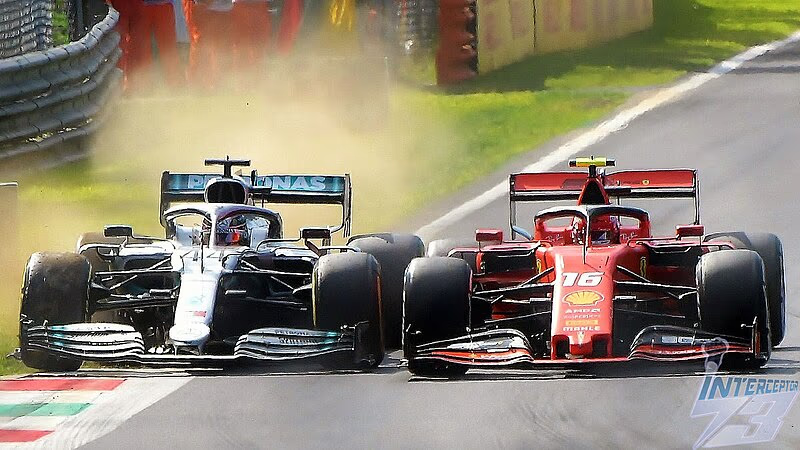
Under Article B1.8.6, drivers must make every reasonable effort to use the track at all times and may not leave the track without a justifiable reason. A driver is judged to have left the track if no part of the F1 Car remains in contact with it; white lines defining the track edges are considered part of the track, but kerbs are not. Should an F1 Car leave the track, the driver may re-join, but only when it is safe to do so and without gaining any lasting advantage; at the Race Director's discretion a driver may be given the opportunity to give back the whole of any advantage gained. Specific track limit enforcement corners are designated per event in the Race Director's Event Notes distributed to all teams and drivers before the start of each race weekend.
3.4 Pit Lane
The pit lane is divided into a fast lane and the working lane (pit boxes). Pursuant to Article B1.6 of the Sporting Regulations:
- Pit lane speed limit: 80 km/h is imposed in the Pit Lane during the whole Competition (Article B1.6.3a), though the Race Director may amend this limit for the safe and orderly conduct of the Competition. Any Competitor whose driver exceeds the limit during a free practice, qualifying, or sprint qualifying session is fined €100 for each km/h above the limit, up to a maximum of €1,000; during the race or sprint itself, the stewards may additionally impose a 5-Second Penalty, a 10-Second Penalty, a Drive-Through Penalty, or a Stop-and-Go Penalty on a driver who exceeds the limit.
- Pit entry and exit: Drivers must follow the designated pit entry and pit exit lines where marked. Crossing a solid white line at pit entry or exit may be penalised.
- No one other than authorised team mechanics and officials may enter the pit lane working area while cars are in motion (Article 28.6).
3.5 Start/Finish Line and Grid
The start/finish line is a fixed line painted across the full width of the track. Grid positions are marked by painted lines or boards indicating P1 through the total number of grid positions available — for the 2026 Championship, the grid procedure is based upon twenty-two (22) F1 Cars being eligible to take part in a Competition (Sporting Regulations, Article B2.4.2). Grid spacing (distance between rows) is defined per circuit in the circuit homologation dossier, typically a minimum of 8 m between front axle lines of successive rows.
3.6 Flag Points and Marshalling Sectors
Circuits are divided into marshalling sectors, each served by a marshal post. The deployment of flags (yellow, red, blue, chequered, etc.) and light panels at each post is coordinated by the Clerk of the Course. The Race Director has authority to display flags and signals to all cars simultaneously via the Marshalling System, as specified in Appendix H of the ISC and Article B1.8.4 of the Sporting Regulations.
Section 4: Players & Officials
4.1 Competitors (Constructors)
A "Competitor" in Formula 1 is the Constructor: the organisation that designs and builds the car. To compete in the World Championship, a Constructor must:
- Hold a valid FIA Competitors Licence (Super Licence category — Competitor)
- Be a signatory to the Concorde Agreement (the commercial agreement between the FIA, Formula One Group, and participating teams)
- Register with the FIA no later than the deadline specified for the season (Article 8.2)
- Enter a minimum of one and a maximum of two cars per event (Article 8.3)
For the 2026 Championship, the FIA F1 Regulations' race-weekend procedures (Sporting Regulations, Article B2.4.2) are expressly based on a grid of twenty-two (22) F1 Cars, reflecting the admission of an eleventh constructor, Cadillac F1 Team, approved by the FIA World Motor Sport Council to join the grid from 2026 — the first wholly new entrant since Haas in 2016. The Article also sets out fallback qualifying elimination procedures should fewer or more cars be eligible at a given Competition (e.g., five cars eliminated per qualifying segment where twenty cars are eligible).
4.2 Drivers — Sporting Regulations, Article B1.7 and Appendix L (FIA Super Licence)
All drivers competing in a World Championship event must hold a valid FIA Super Licence, the highest class of racing licence issued by the FIA. To be eligible for a Super Licence, a driver must:
- Hold a valid national driving licence
- Be at least 18 years of age
- Have accumulated a minimum of 40 Super Licence points over three consecutive seasons in eligible lower formulae (per the FIA Super Licence points eligibility table, updated annually)
- Have completed a minimum of 300 km in a current or recent-specification Formula 1 car during an official FIA test session or Friday practice session
- Be deemed medically fit to compete by the FIA Medical Delegate
Under Article B1.7.1, each Competitor may use a maximum of four (4) drivers in Races during a Championship, and any new driver may score points in the Championship. A change of driver requires the consent of the stewards and, per Article B1.7.2, must generally be made before the start of the (sprint) qualifying session for the driver concerned. Additionally, under Article B1.7.3c, during two (2) Competitions of the Championship each Competitor must run, for each of its entered F1 Cars, a driver who has not participated in more than two (2) Championship Races in their career — the FIA must be informed in writing seven (7) days before the relevant Competition.
4.3 Team Personnel
All team personnel present in the pit lane, garages, or on the grid during sessions must hold appropriate FIA or ASN accreditation. The Sporting Regulations define categories of permitted personnel:
- Team Manager: the designated representative of the Competitor who communicates with the Clerk of the Course and is responsible for team compliance
- Chief Mechanic and mechanics: responsible for car preparation and pit stop execution
- Engineers: may communicate with the driver via radio (subject to restrictions on driver coaching)
4.4 Race Director — Sporting Regulations, Article B1.3
The Race Director is appointed by the FIA and, per Article B1.3.3, has overriding authority (subject to the Clerk of the Course acting only with their express agreement) over the control of free practice, qualifying, sprint qualifying, sprint, and Race sessions, the stopping of any F1 Car, the stopping or suspension of a session, the starting procedure, and the use of the Safety Car. The Race Director's duties include:
- Issuing Event Notes to all Competitors before each event, detailing specific circuit procedures, track limit enforcement corners, and Safety Car delta times
- Controlling the deployment and withdrawal of the Safety Car and Virtual Safety Car
- Deciding whether conditions are suitable to start a session, suspend a session, or permit the race to run in wet-weather conditions
The Race Director must be in radio contact with the Clerk of the Course and the chairman of the Stewards at all times when F1 Cars are permitted to run on the track (Article B1.3.6).
4.5 Stewards — Sporting Regulations, Article B1.3
A panel of a minimum of three and a maximum of four stewards (one appointed chair), all holders of an FIA Super Licence, is nominated for each event by the FIA and the relevant ASN (Article B1.3.1–B1.3.2). Stewards have the authority to:
- Investigate any Incident referred to them by the Race Director, or noted by themselves (Article B1.9.1–B1.9.2)
- Impose penalties including time penalties, grid-position drops, drive-through and stop-and-go penalties, reprimands, and disqualification (Article B1.9.5)
- Accept or reject protests lodged by Competitors
Steward decisions are issued as numbered Decisions (e.g., "Stewards' Decision No. 7") and are published via the FIA's official messaging system (OMS). Under Article B1.9.7, certain categories of steward decision — including most Incident penalties under Article B1.9.5, grid drops under Article B8.2, and penalties under Article B1.9.4 — may not be appealed.
4.6 FIA Technical Delegate and Scrutineers
The FIA Technical Delegate nominated by the FIA is responsible for scrutineering and may carry out, or have carried out by scrutineers, any checks to verify the compliance of the F1 Cars entered in the Competition at any time until the end of the Competition, without prior request from the stewards or Clerk of the Course; the Technical Delegate has full authority over the national scrutineers (Article B1.2.3). All cars must pass scrutineering before they are permitted to participate in any session.
Section 5: Rules of Play
5.1 Race Weekend Format — Sporting Regulations, Article B2
The standard 2026 Formula One race weekend consists of three days (Friday, Saturday, Sunday) with the following session structure:
- Friday: Practice 1 (FP1) — 60 minutes; Practice 2 (FP2) — 60 minutes
- Saturday: Practice 3 (FP3) — 60 minutes; Qualifying (Q1/Q2/Q3)
- Sunday: Race
At Alternative Format Competitions (Sprint weekends), FP2 and FP3 are replaced by a Sprint Qualifying session and a Sprint session. Qualifying at an Alternative Format Competition starts no less than three and no more than four hours after the end of the Sprint (Article B2.4.1b).
5.2 Qualifying Format — Sporting Regulations, Article B2.4
Qualifying determines the grid order for the race using a three-segment knock-out format. The procedure is based upon twenty-two (22) F1 Cars being eligible to take part (Article B2.4.2), reflecting the 2026 grid of eleven constructors:
- Q1 (18 minutes): All 22 cars participate. The six (6) slowest cars are eliminated and start the race from positions 17–22 in the order of their Q1 times; the sixteen remaining cars' Q1 times are then deleted.
- Q2 (15 minutes, after a 7-minute break): The remaining 16 cars participate. The six (6) slowest cars are eliminated and start from positions 11–16; the ten remaining cars' Q2 times are then deleted.
- Q3 (12 minutes): The remaining 10 cars participate. Grid positions 1–10 are set by Q3 lap times.
Article B2.4.2 also sets out fallback elimination counts should a different number of cars be eligible at a given Competition — for example, five cars are eliminated per segment where twenty cars are eligible, or seven where twenty-four are eligible.
Tyre parc fermé begins at the start of Q3. Cars that participate in Q3 must start the race on the tyres used to set their fastest Q2 lap time. Cars exiting in Q1 or Q2 have free tyre choice for the race start (Article 24.6.d).
5.3 Parc Fermé — Sporting Regulations, Articles B3.5 and B3.6
Parc fermé conditions apply from the start of Qualifying until the start of the race. Under parc fermé, no work may be carried out on the car except that which is specifically permitted, including work required for safety reasons approved by the FIA Technical Delegate, changing a complete Power Unit (under PU allocation rules), and changing tyres between qualifying and the race.
5.4 Race Start Procedure — Sporting Regulations, Article B5
The pre-race procedure follows a defined sequence:
- A notification board is shown to indicate the number of minutes to the formation lap. Pit lane opens at this time.
- One minute before the formation lap, the pit lane exit closes. Cars must leave the grid for the formation lap no later than this signal.
- During the formation lap, drivers proceed at reduced speed and must respect the Pit Lane speed limit until they pass pole position; overtaking is only permitted if a car is delayed and cannot otherwise be avoided (Article B5.6).
- Cars take their grid positions. Once all cars are stationary, the five red lights illuminate one by one. When all five lights are on, the start signal is given by extinguishing all five lights simultaneously.
- If a driver's F1 Car is immobilised on the grid, they must raise their hands above their head, marshals wave yellow flags for that row, and the car is pushed into the Pit Lane once the Race Director deems it safe (Article B5.7.1).
5.5 Pit Stops — Sporting Regulations, Article B6
There is no mandatory pit stop requirement under most race conditions; however, the tyre regulations require that a driver who starts the race on dry-weather tyres uses at least two different dry-weather tyre specifications during the race, effectively mandating a minimum of one pit stop in dry conditions. Under wet race conditions, this obligation may be waived by the Race Director (Article 24.6.a).
During a pit stop:
- The car must not be released from its Designated Pit Stop Position in a way that could endanger Pit Lane personnel or another driver, or that is likely to cause damage (Article B1.6.2). Release into an unsafe gap may result in a penalty.
- All wheel guns and release mechanisms must confirm it is safe before the car is released.
- Refuelling during the race is prohibited. This has been the rule since the 2010 season (Article 28.11).
5.6 Overtaking and Racing Conduct — Sporting Regulations, Article B1.8
A driver may use any part of the track (within the defined track limits) during the race. Key conduct rules include:
- At no time may an F1 Car be driven unnecessarily slowly, erratically, or in a manner that could be deemed potentially dangerous to other drivers or any other person (Article B1.8.5).
- Drivers must make every reasonable effort to use the track at all times and may not leave the track without a justifiable reason (Article B1.8.6).
- Under Article B1.8.1, the driver must drive the F1 Car alone and unaided.
5.7 Safety Car Procedures — Sporting Regulations, Article B5.13
The Safety Car (SC) is deployed when conditions are not suitable for racing but do not warrant a race suspension. Upon SC deployment:
- SC boards or lights are shown at all marshal posts and on the Marshalling System panels in cockpits.
- All cars must reduce speed and form a queue behind the SC. No overtaking is permitted except in specific exempted circumstances, such as when the message "LAPPED CARS MAY NOW OVERTAKE" has been sent (Article B5.13.4).
- Cars may pit freely during an SC period, subject to the Pit Lane speed limit.
- Once the Race Director decides it is safe to end the SC period, the message "SAFETY CAR IN THIS LAP" is sent and the SC's orange lights are extinguished, signalling it will enter the Pit Lane at the end of that lap (Article B5.13.6).
5.8 Virtual Safety Car — Sporting Regulations, Article B5.12
The Virtual Safety Car (VSC) procedure allows neutralisation of a session for short periods without deploying the physical Safety Car. When the VSC is deployed, the message "VSC DEPLOYED" is sent to all Competitors and all FIA light panels display "VSC." All competing cars must reduce speed and stay above a minimum time set by the FIA ECU in each marshalling sector and at the safety car lines; overtaking is prohibited except in defined circumstances such as entering or leaving the pits (Article B4.1.4 / B5.12).
5.9 Race Suspension and Restart — Sporting Regulations, Article B5.14
The Race Director may suspend the race (red flag) if the track is blocked or conditions are dangerous. Red flags are shown at the start/finish line and at all marshal posts, and the message "RED FLAG - RACE SUSPENDED" is sent to all Competitors. All cars must immediately reduce speed, overtaking is forbidden, and cars must proceed to the Pit Lane (Article B5.14.2). If the race cannot be resumed, results are taken at the end of the penultimate lap before the lap during which the suspension signal was given.
5.10 Race Distance and Duration — Sporting Regulations, Article B2.5
The race distance is the least number of complete laps that exceeds 305 km, except at Monaco, where it is the least number of complete laps that exceeds 260 km (Article B2.5.2). The base race duration is two (2) hours from the start signal; should the race be suspended, the suspension time is added to this period up to a maximum total race duration of three (3) hours (Article B2.5.3). The race is classified provisionally once the leading car has completed the scheduled distance or, where applicable, the time limit has elapsed. Cars that have covered less than 90% of the number of laps covered by the winner (rounded down to the nearest whole lap) are not classified (Article B2.5.5).
Section 6: Scoring
6.1 Race Points
Points are awarded to the classified finishers of each World Championship race as follows:
| Position | Points |
|---|
| 1st (Winner) | 25 |
| 2nd | 18 |
| 3rd | 15 |
| 4th | 12 |
| 5th | 10 |
| 6th | 8 |
| 7th | 6 |
| 8th | 4 |
| 9th | 2 |
| 10th | 1 |
| 11th and below | 0 |
This points structure has been in use since the 2010 season.
6.2 Fastest Lap Bonus Point
One additional point is awarded to the driver who sets the fastest lap of the race, provided that driver is classified within the top 10 finishers. If the driver who sets the fastest lap finishes outside the top 10, no bonus point is awarded (this rule applies since 2019).
6.3 Sprint Race Points
Sprint sessions award points to the top 8 classified finishers as follows:
| Position | Sprint Points |
|---|
| 1st | 8 |
| 2nd | 7 |
| 3rd | 6 |
| 4th | 5 |
| 5th | 4 |
| 6th | 3 |
| 7th | 2 |
| 8th | 1 |
No fastest lap bonus point is awarded for Sprint sessions. Sprint points count towards both the Drivers' and Constructors' championships.
6.4 Reduced Points for Shortened Races
If a race is stopped and cannot be restarted, or is declared finished before 75% of the scheduled race distance has been completed:
- If fewer than two laps have been completed: no points are awarded
- If between two laps and 25% (rounded down) of the scheduled race distance: half points are awarded to the top 5 classified positions
- If between 25% and 75% of the scheduled race distance: half points are awarded to all classified positions
- If 75% or more of the scheduled race distance is completed: full points are awarded
6.5 Drivers' World Championship
The Drivers' World Championship is awarded to the driver who has accumulated the most points across all rounds of the championship. In the case of equal points at the end of the season, the driver with the most race wins is declared champion; if still equal, the driver with the most second-place finishes, and so on (Article 59.5).
6.6 Constructors' World Championship
The Constructors' World Championship is awarded to the Constructor which has accumulated the most points. Both cars' points from every event count towards the Constructors' championship. The tiebreaker rules mirror those for the Drivers' championship, applying to the Constructor's collective results (Article 60.4).
6.7 Classification as a Finisher — Sporting Regulations, Article B2.5.5
A driver is classified as a finisher (and thus eligible for championship points) if they have completed at least 90% of the number of laps covered by the winner, rounded down to the nearest whole lap.
Section 7: Violations & Penalties
7.1 Regulatory Framework — Sporting Regulations, Article B1.9
Penalties in Formula 1 are imposed by the stewards under Article B1.9 of the Sporting Regulations ("Incidents, Infringements & Penalties"), or administratively by the Race Director for defined infringements. Under Article B1.9.3, unless it is clear to the stewards that a driver was wholly or predominantly to blame for an Incident, no penalty will be imposed.
7.2 Race Penalties — Sporting Regulations, Article B1.9.5
In the event of an Incident during a Total Time Classified Session (i.e. a Sprint or the Race), the stewards may impose any one of the following penalties:
- 5-Second Penalty: The driver must enter the Pit Lane, stop in their Designated Pit Stop Position for at least five seconds, and re-join.
- 10-Second Penalty: As above, but a stop of at least ten seconds.
- Drive-Through Penalty: The driver must enter the Pit Lane and re-join without stopping.
- Stop-and-Go Penalty: A ten-second stop-and-go time penalty — the driver must enter the Pit Lane, stop in their Designated Pit Stop Position for at least ten seconds, and re-join.
- Time Penalty: A defined number of seconds added to the driver's total race time.
- Driver Reprimand: Any driver who receives five (5) reprimands in the same Championship, at least four (4) of which for a driving infringement, is given a ten (10) grid-place penalty upon the fifth (Article B1.9.5f).
- Competitor (F1 Team) Reprimand.
- Grid-Position Drop: A drop of any number of grid positions for the driver's next Sprint or Race within the subsequent twelve (12) months.
- Disqualification (DSQ): The driver and car are excluded from the results of the relevant session or race; any points scored are rescinded.
- Suspension from the driver's next Competition.
If either a Drive-Through Penalty or a Stop-and-Go Penalty is imposed during the last three laps of a session, the driver may cross the Line up to three times to serve it, and 20 seconds (Drive-Through) or 30 seconds (Stop-and-Go) is added to the driver's elapsed time instead (Article B1.9.6c).
7.3 Driving Infringements (Sporting Regulations, Articles B1.8 and B1.9)
- Collision causing a retirement: Typically investigated and may result in a time penalty or grid drop, depending on fault determination by the stewards.
- Forcing a driver off track / making contact: Investigated as an Incident under Article B1.9; penalties range from a time penalty to a grid drop.
- Unsafe release from pit stop: A breach of Article B1.6.2 (Pit Lane Safety); typically a 5-second penalty.
- Speeding in the pit lane: A fine of €100 per km/h over the limit (maximum €1,000) during practice or qualifying sessions, plus a possible stewards' penalty; during a Sprint or Race, a 5-Second, 10-Second, Drive-Through, or Stop-and-Go Penalty (Article B1.6.3).
- Entering a closed Pit Lane without justifiable reason: A penalty under Article B1.9.4 (practice/qualifying) or a mandatory Stop-and-Go Penalty (Sprint/Race), per Article B1.6.4.
- False start (jumping the lights): Investigated as an Incident under the false-start provisions of Article B5.11.
7.4 Technical Infringements
- Car below minimum weight: Disqualification from the relevant session or race results, per Technical Regulations Article 4.2.
- Illegal fuel / fuel composition: Disqualification from the race results.
- Exceeding fuel flow rate: Disqualification from the race results (Technical Regulations, Article 5.1.4; has been enforced — e.g., Sebastian Vettel DSQ at the Australian GP 2014).
- Power Unit component substitutions exceeding allocation: Grid penalty under Article B8.2.8 of the Sporting Regulations.
7.5 Power Unit Component Penalty Rules — Sporting Regulations, Article B8.2
For the 2026 Championship, the Power Unit component allocation is defined as follows per driver, per Championship (Article B8.2.2), unless the driver drives for more than one Competitor:
- Internal Combustion Engine (ICE): 3 units
- Turbocharger (TC): 3 units
- Exhaust sets (EXH): 3 units
- Energy Store (ES): 2 units
- Control Electronics units (PU-CE): 2 units (each)
- Motor Generator Unit – Kinetic (MGU-K): 2 units
- Power Unit ancillary components (PU-ANC): 5 units (each)
An additional unit of each element is permitted in the 2026 Championship, and for a PU Manufacturer's first year of supplying Power Units (Article B8.2.3). Under Article B8.2.8, exceeding these allocations triggers a grid-place penalty at the first Competition an additional element is used: a ten (10) grid-place penalty for the first additional element of each type, and a five (5) grid-place penalty for each subsequent additional element of that type, applied cumulatively.
7.6 Sporting Exclusion and Championship Points Deductions
Under the FIA International Sporting Code, the FIA World Motor Sport Council has authority to impose penalties on Competitors or drivers beyond the stewards' immediate powers, including exclusion from the championship, fines up to the amounts specified in the ISC, points deductions, and bans from attending events.
Notable precedents include Red Bull Racing being found to have exceeded the Cost Cap in 2021 (announced October 2022), resulting in a $7 million fine and a 10% reduction in aerodynamic testing time for 2023 under the Financial Regulations enforcement framework.
7.7 Protest Procedure
A Competitor wishing to protest a decision must lodge a formal protest with the Clerk of the Course no later than 30 minutes after the session or race results are published. A protest deposit (as specified in the national ASN or FIA schedule of fees) must be lodged with the protest. The stewards will convene to hear the protest and issue a decision. Appeals against stewards' decisions may be made to the FIA International Court of Appeal within a defined time limit, save for the categories of decision that Article B1.9.7 places beyond appeal.
Section 8: Safety Considerations
8.1 FIA Safety Mandate
The safety of drivers, team personnel, officials, and spectators is the primary consideration in the administration of the FIA Formula One World Championship. The FIA's Medical and Safety Commission oversees continuous development of safety standards, working in conjunction with the FIA Institute for Motor Sport Safety (FIMSS). All circuit, car, and equipment regulations are developed with safety as the paramount concern.
8.2 The Halo — Technical Regulations, Article 15.4
Mandatory since the start of the 2018 season, the Halo is a titanium structure fitted above the driver's cockpit designed to deflect debris and reduce the risk of fatal head impacts. Key specifications:
- Material: Titanium alloy (Grade 5 Ti-6Al-4V) or FIA-approved homologated composite alternative
- Structural load requirement: The Halo structure must withstand a static load of 125 kN applied vertically downward through a 1 m × 1 m pad centred on the highest point of the Halo (Article 15.4.3), and further lateral and rearward load cases
- The Halo has been credited with preventing or reducing fatal head injuries in multiple incidents, including Romain Grosjean's Bahrain 2020 fire and Charles Leclerc's collision at the 2022 Austrian GP
8.3 Safety Car and Virtual Safety Car Procedures — Sporting Regulations, Articles B5.12 and B5.13
The Safety Car (SC) is an FIA-designated vehicle that leads the field at reduced pace during dangerous conditions. Its deployment eliminates the speed differential between cars while incidents are cleared, reducing risk to marshals and recovery vehicles. Under Article B5.13.5, the Safety Car is used at least until the leader is behind it and all remaining cars are queued behind them.
The Virtual Safety Car (VSC), introduced in 2015, achieves neutralisation without a physical SC deployment. All drivers are required to stay above a minimum time set by the FIA ECU in each marshalling sector, ensuring a controlled speed reduction without marshals needing to enter a live track (Article B5.12 / B4.1.4).
8.4 Red Flag and Race Suspension — Sporting Regulations, Article B5.14
The Race Director will suspend a session (display red flags at the start/finish line and all marshal posts, and illuminate the orange lights on the start gantry) when:
- There is an accident or incident of a dangerous nature that cannot be safely dealt with under a Safety Car
- A significant portion of the track is blocked or compromised
- Weather conditions render racing unsafe (e.g., standing water, fog)
When red flags are shown, overtaking is forbidden, the Pit Lane exit is closed, and all cars must proceed slowly into the Pit Lane (Article B5.14.2). If the session cannot be resumed, results are taken at the end of the penultimate lap before the lap during which the suspension signal was given.
8.5 Medical Car and Medical Infrastructure
A fully equipped FIA Medical Car staffed by the FIA Medical Delegate (or a deputy) must be present on track throughout all sessions. Circuit medical centres must comply with FIA Grade 1 standards including:
- A fully equipped operating theatre capable of emergency surgery
- A minimum number of doctors with specific trauma/anaesthesia qualifications on site throughout the event
- A helicopter ambulance or equivalent rapid medical evacuation capability to a designated hospital with trauma and neurosurgery capability within a prescribed transfer time
8.6 Flag and Light Signal Meanings — ISC Appendix H; Sporting Regulations, Article B1.8.4
Official instructions are given to drivers by means of the signals laid out in the ISC; Competitors may not use flags or lights similar to these. In accordance with, and supplementary to, Article 2.5.5b of Appendix H of the ISC, Article B1.8.4 of the Sporting Regulations specifies driver obligations including:
- Chequered flag (black and white): End of session or race.
- Single Waved Yellow Flag: The driver must reduce speed and be prepared to change direction; stewards expect visibly earlier braking or a discernible reduction in speed in that marshalling sector.
- Double Waved Yellow Flag: The driver must reduce speed significantly and be prepared to change direction or stop; during a qualifying or sprint qualifying session, any lap time set while passing through the sector is deleted.
- Double Waved Yellow Flag during a Safety Car or VSC period: In addition to the above, the driver must stay above the minimum time set by the FIA ECU in that marshalling sector.
- Red flag: Session or race suspended. Stop immediately and return to pit lane safely.
- Blue flag (waved): A faster car (lapping car) is approaching from behind. Move aside and allow the faster car to pass within a reasonable distance.
- Black flag with car number: The specified car must return to the pit lane immediately; it has been disqualified from the session/race.
- White flag: A slow-moving vehicle (such as the Medical Car or a very slow car) is on the track ahead.
- Green flag: Track is clear; normal racing conditions resumed (end of hazard zone).
Flag signals are supplemented by LED marshal light panels at all marshal posts and by the Marshalling System in-cockpit display, improving visibility and response consistency.
8.7 Driver Medical Standards — FIA Super Licence Regulations, Article 4
All Super Licence holders must undergo a medical examination by an FIA-approved doctor prior to each season. Medical examination requirements include vision tests, cardiovascular assessment, and neurological screening. The FIA Medical Delegate at each event has authority to prevent a driver from competing on medical grounds. A driver involved in a significant accident must be cleared by the circuit Medical Officer and, for serious incidents, by the FIA Medical Delegate before being permitted to return to competition.
8.8 Circuit Safety Infrastructure Requirements (FIA Grade 1)
For FIA Grade 1 homologation, all circuits must provide:
- Barrier systems: ARMCO (steel) barrier, SAFER barrier (steel and foam energy reduction), or TecPro barrier in designated impact zones per the FIA Circuit Safety Technical Guidelines
- Run-off areas: Asphalt or gravel run-off designed to decelerate an out-of-control car before it contacts a barrier; dimensions are circuit-specific but must meet minimum stopping distances at maximum expected impact speeds
- Tyre barriers: Used in conjunction with ARMCO at lower-speed impact zones to absorb impact energy
- Marshal post spacing: Maximum 200 m between marshal posts in most track sections; closer spacing required at high-speed corners and start/finish areas
- Fire suppression: Fixed fire suppression installations at pit lane and start/finish line areas; mobile fire units at multiple points around the circuit
8.9 Fire Safety and Pit Lane Personnel Equipment — Sporting Regulations, Article B1.6.1
Fuel and fuel rigs in the pit lane must comply with FIA fuel rig specifications. Fuelling equipment must include FIA-approved dry-break coupling systems. Refuelling during the race is prohibited. Under Article B1.6.1d, all team personnel carrying out work on an F1 Car in the Pit Lane when it is in its Designated Pit Stop Position — including for the purpose of adjusting or replacing components, or serving a penalty during a qualifying, sprint qualifying, or race session — must wear helmets meeting or exceeding ECE 22.05, DOT, or JIS T8133-2015 class 2 standards, plus appropriate eye protection.