










Section 1: Introduction
The FIM MotoGP World Championship is the premier class of the FIM Grand Prix Motorcycle Racing World Championship, governed by the Fédération Internationale de Motocyclisme (FIM) in conjunction with Dorna Sports S.L., the exclusive commercial rights holder. The championship was inaugurated in 1949, making it one of the oldest continuously running motorsport world championships. The governing document is the FIM Grand Prix Motorcycle Racing World Championship Regulations (hereafter "the Regulations"), which is updated annually; the current edition in force is the 2025 FIM MWGP Regulations, with amendments effective for the 2025 season.
The FIM Grand Prix Motorcycle Racing World Championship comprises three classes conducted at each Grand Prix event:
- MotoGP — The premier prototype class; 4-stroke engines up to 1000cc.
- Moto2 — The intermediate class; spec 765cc 3-cylinder Triumph engine.
- Moto3 — The lightweight class; spec-framework 4-stroke single-cylinder engines up to 250cc.
All three classes compete at each Grand Prix event weekend. The FIM and Dorna jointly exercise regulatory authority; the FIM holds ultimate jurisdiction over sporting matters, while Dorna manages commercial and operational aspects. The Race Direction panel is the on-event body with authority to enforce the Regulations, issue penalties, and make decisions relating to safety and race management (Regulations, Article 1.3).
The World Championship title is awarded to the rider who accumulates the highest number of championship points across all rounds of the season. A separate Constructors' Championship and Teams' Championship are also contested, with points awarded through the same race and Sprint Race results.
All participants — riders, teams, manufacturers, and officials — are required to comply with the FIM Regulations, the Grand Prix Commission decisions, and any supplementary regulations issued by the promoter Dorna for individual events. Participation constitutes acceptance of these rules in their entirety (Article 2.1).
Section 2: Equipment
Technical specifications for the MotoGP class are defined in the MotoGP Technical Regulations, which form a schedule to the FIM MWGP Regulations. The following specifications apply to the MotoGP premier class for the 2025 season.
2.1 Engine Specifications
Per Article 2 of the MotoGP Technical Regulations:
- Engine type: 4-stroke internal combustion, naturally aspirated (no turbocharging or supercharging permitted).
- Maximum displacement: 1000cc.
- Maximum number of cylinders: 4.
- Maximum bore: 81mm (Article 2.1.1). Stroke is unrestricted within the bore and displacement limits.
- Valve actuation: pneumatic valve return systems are permitted.
- Engine configuration (inline, V, etc.) is unrestricted provided other rules are met.
- Fuel: commercial unleaded pump fuel conforming to the FIM Fuel Regulations. Fuel must be supplied by the official fuel provider (Petronas Lubricants International in 2025). Maximum RON 102 (Article 4.1).
- Maximum fuel tank capacity: 22 litres (Article 3.6).
2.2 Minimum Weight
The minimum weight of the motorcycle at any time during the event (without fuel, with all other fluids) is 157 kg (Article 3.1). If a motorcycle is found below minimum weight after a race, the rider may be excluded from the results.
2.3 Engine Allocation (Concession System)
To control costs, each MotoGP rider is allocated a fixed number of engines per season (Article 5):
- Standard allocation (Factory/Satellite teams): 7 engines per rider per season.
- Concession manufacturers: manufacturers designated as "Open" or "Concession" status may receive a higher engine allocation (up to 12 engines), softer tyre allocations, and additional wild card entries, subject to the current Concession criteria set by the Grand Prix Commission.
- Each engine is sealed and assigned a unique identification number by the Technical Director at first use.
- Use of an additional engine beyond the allocated number results in a 3-place grid penalty per extra engine used.
2.4 Electronics — Spec ECU
All MotoGP machines must use the standardised ECU (Electronic Control Unit) hardware supplied by the official electronics provider (currently Magneti Marelli/Prometeia). Teams supply their own software within permitted parameters. The following rider-aids are subject to unified software regulation (Article 6):
- Engine braking control (EBC)
- Traction control (TC)
- Anti-wheelie (AW)
- Launch control (LC)
- Pit lane speed limiter (mandatory functionality)
- Seamless-shift gearboxes (up and down) are permitted.
- Ride-height ("holeshot") devices: front ride-height devices are banned on all MotoGP machines with effect from the Dutch Grand Prix at Assen, following the Grand Prix Commission decision of 22 June 2026 amending Technical Regulation Article 3.9. Devices that actively adjust aerodynamics while the motorcycle is in motion remain prohibited under the same Article.
2.5 Tyres
Michelin is the sole official tyre supplier for the MotoGP class (appointed by the Grand Prix Commission effective 2016). Tyre specifications, allocation quantities, and compound selections for each event are determined by Michelin in consultation with Race Direction. Riders may not use tyres other than those officially supplied and approved for the relevant event (Article 7.1). Tyre warmers are permitted in the MotoGP class.
2.6 Rider Equipment
All rider equipment must meet or exceed FIM homologation standards (Article 8):
- Helmet: Must carry a valid FIM homologation label. Acceptable standards include ECE 22.06 (most recent edition), SNELL M2020, or equivalent FIM-approved standard.
- Suit: Full leather (or FIM-approved alternative) one- or two-piece race suit with mandatory back protector, shoulder, elbow, knee, and hip protectors. Must be FIM-homologated.
- Airbag system: A rider-wearable airbag vest or integrated suit airbag system is mandatory for all MotoGP, Moto2, and Moto3 riders (mandatory requirement introduced progressively; fully mandatory from 2018 for MotoGP). Must be FIM-homologated.
- Gloves: Racing gloves with knuckle protection; FIM-homologated.
- Boots: Racing boots providing ankle and shin protection; FIM-homologated.
Section 3: Playing Area
All circuits hosting a FIM Grand Prix must hold a valid FIM Grade A Circuit Licence (the highest grade), issued under the FIM Circuit Licence Regulations. Grade A is required for all Grand Prix events involving prototype machinery. Circuits are inspected annually and must comply with current FIM safety standards before a licence is renewed or issued.
3.1 Track Specifications
- Minimum track width: 12 metres throughout the circuit layout, with wider minimums required at defined high-speed sections per the FIM Circuit Licence Regulations.
- Track surface: Asphalt; must meet FIM grip and consistency standards. Concrete sections are permitted only where approved by the FIM.
- Race distance: Race distance for MotoGP is set so that total race time does not exceed approximately 45 minutes at the expected race pace. The minimum race distance is 100 km; the target distance is approximately 120 km. The exact number of laps is determined by the Race Director prior to each event and published in the Supplementary Regulations.
- Sprint Race distance: Introduced in 2023, the Saturday Sprint Race covers exactly half the number of laps of the Sunday race (rounded up if an odd number), with a maximum duration of approximately 25 minutes.
3.2 Run-Off Areas & Barriers
- Asphalt run-off areas are preferred and required at high-speed corners per current FIM Grade A standards. Gravel traps may exist at circuits with historical or physical constraints but must meet minimum depth and dimension requirements.
- Tecpro barriers (or equivalent FIM-approved energy-absorbing barriers) are mandatory at all points adjacent to the racing line where tyre barriers or catch-fencing previously existed, per the progressive implementation schedule from the FIM Safety Commission.
- Air fences are required at specific corner entry and exit points identified as high-risk in the circuit licence inspection report.
- Armco barriers must be set back a minimum distance from the tarmac edge and must be covered with FIM-approved foam protection wherever they are within 3 metres of the racing line.
3.3 Pit Lane
- All motorcycles must use the pit lane speed limiter (activated by a dedicated handlebar button) when in the pit lane. The maximum speed in the pit lane is determined per event by Race Direction; typically 60 km/h during sessions and race. The exact limit is published in Supplementary Regulations for each event.
- The pit lane entry and exit lines are clearly marked. Riders must enter and exit only at the designated points.
- Each team is allocated a defined pit box area. Team personnel are prohibited from entering the fast lane of the pit lane when motorcycles are in motion, except during designated pit stop procedures.
3.4 Medical & Support Facilities
A Level 2 Medical Centre (as defined by FIM Medical Code) must be present and fully operational at all times during official sessions. This includes surgical capability, anaesthesia, and intensive care facilities. A helipad capable of accepting medical helicopter operations must be available within the circuit perimeter or immediately adjacent. At least two fully equipped medical vehicles must follow the race.
Section 4: Players & Officials
4.1 Riders
To compete in any FIM Grand Prix class, a rider must hold a valid FIM International Racing Licence issued by their national federation and endorsed by the FIM (Article 10.1 of the Regulations). Riders must also be registered with Dorna and hold a valid contract with a participating team.
- Minimum age — MotoGP class: Riders must be at least 18 years of age before competing in the MotoGP premier class (Article 10.2).
- Minimum age — Moto2: 16 years of age.
- Minimum age — Moto3: 16 years of age (as of the year of competition).
- Riders must have demonstrated sufficient competitive experience, as assessed by the FIM and Dorna, before being granted a MotoGP licence. Promotion from lower classes or comparable international series is typically required.
- Each rider competing in the World Championship is assigned a permanent race number. Numbers 1–99 are available; the reigning World Champion may elect to use number 1 for the following season (Article 11). Number 88 is reserved as a tribute number. Numbers are registered with Dorna and retained for the rider's career unless they retire for more than two consecutive seasons.
4.2 Teams & Constructors
- A maximum of 2 riders per team may be entered in the MotoGP class at any one event.
- Teams must be registered with both the FIM and Dorna and hold valid Team and Constructor registrations for the relevant season.
- Factory teams are those directly operated or substantially supported by a registered Constructor. Satellite (independent) teams may run machinery supplied under agreement with a Constructor.
- Constructors registered in MotoGP for 2025 include (but are not limited to): Honda, Yamaha, Ducati, Suzuki (if re-entered), Aprilia, and KTM. Each Constructor is subject to the Concession system rules based on their recent competitive results.
4.3 Race Direction
The Race Direction panel is the supreme authority at each Grand Prix event. It is composed of three members (Article 1.3):
- The FIM Grand Prix Steward (FIM appointee)
- The Dorna MotoGP Safety Officer
- The Dorna MotoGP Race Director
Race Direction has authority to: start, interrupt, neutralise, or stop any session or race; impose penalties; declare wet conditions; deploy the Safety Car or Virtual Safety Car; and make all sporting decisions during the event weekend. Decisions of Race Direction during an event are final and not subject to appeal, except for technical matters referred to the Technical Director.
4.4 Technical Director & Stewards
- The FIM Technical Director oversees all technical scrutineering and compliance with the Technical Regulations. Decisions on technical matters may be appealed to the FIM Stewards within specified time limits.
- FIM Stewards (a panel of three, separate from Race Direction) handle appeals against Race Direction sporting decisions that are within the scope of appeal, and adjudicate disciplinary matters referred by Race Direction.
- Scrutineers conduct pre-event, pre-race, and post-race technical inspections of motorcycles, including weight checks, fuel samples, and component verification.
4.5 Wild Card Entries
Wild card entries (riders not competing in the full World Championship) may be permitted at individual Grands Prix subject to approval by Race Direction and Dorna. Standard constructors are limited in the number of wild card entries per season; Concession manufacturers receive additional wild card allocations as part of the Concession benefit package (Article 5.3).
Section 5: Rules of Play
5.1 Event Weekend Format
The standard MotoGP Grand Prix weekend format (introduced in its current form from 2023) comprises the following official sessions (Article 20 of the Sporting Regulations):
Friday
- Practice (P): 45 minutes. Free practice for all MotoGP riders. The combined results of Practice and Q1 determine grid positions for Q1. The fastest 10 riders in Practice advance directly to Q2.
Saturday
- Qualifying 1 (Q1): 15 minutes. The 12 riders not in the top 10 from Practice compete. The fastest 2 riders in Q1 advance to Q2.
- Qualifying 2 (Q2): 15 minutes. 12 riders (top 10 from Practice + 2 from Q1) compete for the top 12 grid positions for both the Sprint Race and the Sunday race. Starting positions 13–24 on the Sunday grid are determined by Q1 results.
- Sprint Race: Half-distance race (half the laps of Sunday's race, rounded up). Qualifying points only; separate championship points allocation applies (see Section 6). Grid order is based on Q2/Q1 results.
Sunday
- Warm-Up (WUP): 10 minutes. Open practice for all riders; no championship significance. The only Sunday morning session.
- Main Race: Full-distance Grand Prix race. Grid based on Q2/Q1 qualifying results.
5.2 Starting Procedure
The starting procedure for both the Sprint Race and the main race is as follows (Article 21):
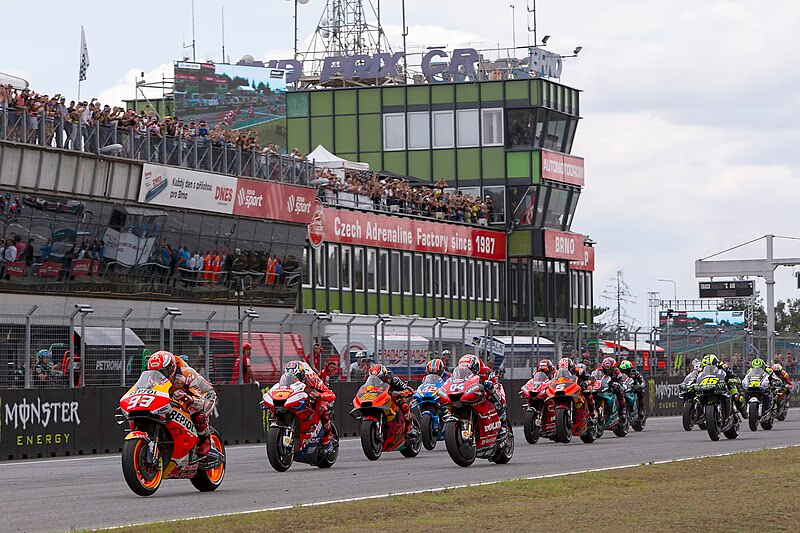
Grid layout was revised by the Grand Prix Commission on 22 June 2026, effective from the German Grand Prix onward and applying to all three classes: the rider-to-rider spacing within each row increased from 3 metres to 4 metres, extending the distance between each three-rider row from 9 metres to 12 metres, amending Article 21 of the Sporting Regulations. Each grid row continues to hold three riders.
- Riders form up on the starting grid in qualifying order.
- A one-minute board is shown; teams must clear the grid by the 30-second board.
- Five red lights illuminate sequentially. When all five are lit, there is a variable delay (between 0.2 and 3 seconds, random).
- All five red lights are extinguished simultaneously — this is the start signal.
- If a rider has a problem on the grid before the lights-out start, they must raise their arm. They will be allowed to start from the pit lane at the back of the field.
- A jump start (movement of the motorcycle before lights-out, detected by sensors embedded in the grid) results in a Long Lap Penalty to be served during the race.
5.3 Race Conditions — Wet Weather
- Race Direction may declare conditions "Wet" before or during a race, permitting riders to use wet-weather tyres.
- If conditions change during a race, Race Direction may deploy the Safety Car while riders pit to change tyres, or may suspend and restart the race.
- In a declared wet race, riders are free to change tyres and/or motorcycles at any time during the race from the pit lane. Only one pit stop is permitted per race unless Race Direction declares otherwise.
- A race that is stopped by red flag and cannot be restarted: if more than 2 laps (for a race of ≥5 laps) have been completed, results are taken from the last fully completed lap before the red flag. Points are awarded at 50% value if the race is stopped before 50% of the scheduled distance is completed (Article 22.3).
5.4 Flag Signals
The following flag signals are in use at all FIM Grand Prix events (Article 16):
- Chequered flag: End of session or race.
- Red flag: Session or race stopped immediately. All riders must slow down and return to the pit lane or designated stopping area.
- Yellow flag (single): Danger ahead; no overtaking in the affected marshal post sector. Reduce speed.
- Yellow flag (double waved): Great danger; be prepared to stop. No overtaking. Riders may be required to slow significantly.
- Green flag: All clear; end of hazard zone or race start signal from the pit lane exit.
- Blue flag: A faster approaching rider is about to lap; the rider being shown this flag must allow the leader to pass.
- Black flag with number board: Rider with the displayed number is disqualified and must immediately enter the pit lane and retire (Article 16.6).
- Black and white flag (diagonal halves) with number board: First and only warning to the rider for unsportsmanlike behaviour. A second infringement may result in a black flag.
- White flag: A slow-moving vehicle is on track (e.g., medical vehicle, marshal vehicle).
- Orange disc flag (meatball flag) with number board: Mechanical problem detected on the rider's motorcycle; rider must return to pit lane immediately.
5.5 Overtaking & Track Limits
Riders must keep at least one wheel within the track limits (defined by the white lines at the edge of the asphalt, or the kerb edge where applicable) when making or defending a pass. Track limit violations are monitored by Race Direction using timing sensors and video review. Repeated track limit infringements result in warnings and ultimately a Long Lap Penalty (see Section 7). Overtaking under yellow flag conditions is prohibited and results in a mandatory penalty.
Section 6: Scoring
Championship points are awarded to both riders and constructors following each race. The points system is defined in Article 99 of the FIM MWGP Sporting Regulations.
6.1 Main Race Points — MotoGP, Moto2, Moto3
Points are awarded to the top 15 classified finishers:
| Position | Points |
|---|---|
| 1st | 25 |
| 2nd | 20 |
| 3rd | 16 |
| 4th | 13 |
| 5th | 11 |
| 6th | 10 |
| 7th | 9 |
| 8th | 8 |
| 9th | 7 |
| 10th | 6 |
| 11th | 5 |
| 12th | 4 |
| 13th | 3 |
| 14th | 2 |
| 15th | 1 |
| 16th and beyond | 0 |
6.2 Sprint Race Points — MotoGP Class Only
Sprint Race championship points (introduced for the 2023 season) are awarded to the top 9 classified Sprint finishers:
| Position | Points |
|---|---|
| 1st | 12 |
| 2nd | 9 |
| 3rd | 7 |
| 4th | 6 |
| 5th | 5 |
| 6th | 4 |
| 7th | 3 |
| 8th | 2 |
| 9th | 1 |
| 10th and beyond | 0 |
Sprint Race points count toward the Riders' Championship and Constructors' Championship but not toward the Teams' Championship (Article 99.4).
6.3 Constructors' Championship
Constructors' Championship points are awarded based on the best-placed finishing motorcycle of each constructor in each race. Only the highest-scoring rider from each constructor counts toward the Constructors' Championship per event. The same points scale as the Riders' Championship is used (Article 99.2).
6.4 Teams' Championship
Teams' Championship points are the sum of points scored by both riders of each team in Sunday's main race only (Sprint Race points are excluded). The same 15-position points scale applies, and both riders' points are added together for each team per round (Article 99.3).
6.5 Reduced Points for Shortened Races
If a race is stopped by red flag and is not restarted (Article 22.3):
- If fewer than 5 laps are completed: no championship points are awarded.
- If 5 or more laps but less than 50% of the scheduled race distance is completed: 50% of standard points are awarded (rounded to the nearest whole number).
- If 50% or more of the scheduled race distance is completed: full championship points are awarded based on the classification at the last completed lap before the red flag.
6.6 Tie-Breaking
In the event of a tie in championship points at the end of the season, the tie is broken by counting the greater number of victories. If still tied, by the greater number of second places, and so on through each finishing position (Article 99.5).
Section 7: Violations & Penalties
Penalties are defined in Article 29 and related articles of the FIM MWGP Sporting Regulations. Race Direction is the primary authority for imposing in-race penalties. The FIM Stewards handle appeals and more serious disciplinary matters.
7.1 Long Lap Penalty (LLP)
The Long Lap Penalty was introduced into MotoGP in 2018 (effective Article 29.1). It is the standard penalty for most in-race infractions. The rider must, within 3 laps of notification (displayed on the rider's dashboard/pit board), exit the racing line and traverse a marked loop adjacent to the circuit that adds approximately 3–5 seconds to the rider's lap time. Failure to serve a Long Lap Penalty within the required number of laps results in escalation to a Ride-Through Penalty.
Infractions resulting in a Long Lap Penalty include (non-exhaustive):
- Jump start (false start detected by grid sensors)
- Overtaking under yellow flag conditions
- Exceeding track limits: after 3 officially noted track limit violations in a single session, a warning is issued; subsequent violations result in a Long Lap Penalty per additional violation.
- Causing a collision deemed minor by Race Direction
- Speeding in the pit lane (if less serious)
- Failure to respect the starting procedure correctly
7.2 Ride-Through Penalty (RTP)
A Ride-Through Penalty requires the rider to enter the pit lane, pass through it at the mandatory speed limit without stopping, and rejoin the race. This typically costs approximately 20–25 seconds. Infractions resulting in a Ride-Through Penalty include (Article 29.2):
- Speeding in the pit lane (for a more serious or repeat violation)
- Failure to serve a Long Lap Penalty within the required number of laps
- Serious breach of race procedure
7.3 Time Penalty
A time penalty (added to the rider's race time post-race) may be applied when a Ride-Through or Long Lap Penalty cannot be served during the race (e.g., the race ends before service is possible, or the infraction occurs in the final laps). The time penalty is determined by Race Direction based on the nature of the infraction and corresponds to the approximate time cost of the unserved penalty (Article 29.3).
7.4 Grid Penalties
Grid penalties (positions lost at the race start) are applied for the following (Article 29.4):
- Use of an additional engine beyond the season allocation: 3-place grid penalty per additional engine used.
- Impeding another rider during qualifying (blocking): typically a 3-place grid penalty.
- Change of motorcycle before the start for a reason not authorised by Race Direction.
7.5 Disqualification
Riders may be disqualified from race results (Article 29.5) for:
- Motorcycle found below minimum weight (157 kg) in post-race scrutineering.
- Use of prohibited technical components or fuel not complying with regulations.
- Failure to obey the black flag during the race.
- Repeated or serious unsportsmanlike conduct after a black-and-white flag warning.
- Technical non-compliance discovered in post-race inspection.
7.6 Black Flag Procedure (Race Disqualification)
When Race Direction decides to disqualify a rider during a race, the rider's number is displayed on the black flag board at the start/finish line and on the rider's dashboard display. The rider must stop racing immediately and return to the pit lane. Failure to observe the black flag is a serious disciplinary offence subject to referral to the FIM Stewards (Article 16.6).
7.7 Post-Event Appeals
Results-affecting penalties issued by Race Direction during an event that fall within the scope of appeal may be contested before the FIM Stewards within 30 minutes of the publication of official results (Article 35). A financial deposit is required to file an appeal. The FIM Stewards' decision is final and binding, except for technical matters which may be further appealed to the FIM Court of Appeal within the time limits prescribed in the FIM Judicial and Disciplinary Rules.
Section 8: Safety Considerations
Safety is the paramount concern of the FIM and Dorna. The FIM Safety Commission and the MotoGP Safety Officer work in conjunction with Race Direction, circuit operators, and the riders' safety representatives to continuously develop and enforce safety standards. The MotoGP Safety Commission meets regularly throughout the season; safety recommendations from the riders' safety representative (a rider elected by the paddock) are formally considered in this process.
The Grand Prix Commission's decision of 22 June 2026 — banning front ride-height ("holeshot") devices with effect from the Dutch Grand Prix at Assen, and widening grid-row spacing from 9 metres to 12 metres for all classes from the German Grand Prix onward — was adopted specifically on safety grounds, following a run of first-corner incidents earlier in the 2026 season (see Sections 2.4 and 5.2).
8.1 Mandatory Rider Safety Equipment
Per Article 8 of the Regulations, the following equipment is mandatory for all on-track activity (practice, qualifying, and race):
- Helmet: Full-face, FIM-homologated helmet meeting ECE 22.06 (current edition) or equivalent FIM-approved standard. Open-face or jet helmets are prohibited. The helmet must be fastened at all times on track.
- Race suit: Full-body leather (or FIM-approved textile) suit with integrated or attached certified protectors at minimum: back (to EN 1621-2 Level 2 or equivalent), shoulders, elbows, hips, and knees. Suits must be FIM-homologated. Two-piece suits must be connectable and fastened when racing.
- Airbag system: A FIM-homologated rider airbag — either integrated within the race suit or as a separate vest worn over the suit — is mandatory. The system must be capable of deploying in a crash event to protect the thorax, spine, and collarbone regions. Tethered and electronic (accelerometer-triggered) systems are both approved provided they carry valid FIM homologation.
- Gloves: FIM-homologated racing gloves with knuckle protection and wrist reinforcement.
- Boots: FIM-homologated racing boots covering the ankle and lower shin, with toe box and heel cup reinforcement.
- Neck brace: Not currently mandated by regulation but strongly recommended by the FIM Medical Commission and widely used in the paddock.
8.2 Medical Intervention Procedures
- A minimum of two medical vehicles (fully equipped for trauma intervention) must follow the pack at the race start and be available throughout the race. At least one must be a motorcycle.
- A FIM-standard Level 2 Medical Centre must be operational at all times during official sessions. Level 2 requires: a physician with emergency medicine or anaesthesiology qualification, surgical capability, blood supply, intensive care capacity, and radiology (X-ray minimum).
- A dedicated medical helicopter with a trauma team must be available at all Grand Prix events, with a clear landing zone within the circuit perimeter. The helicopter must be capable of transporting a patient on life support to a tertiary hospital within a defined transfer time agreed with local authorities.
- Crashed riders are assessed on-track by the medical team before being moved. A rider who has been involved in a significant crash must be cleared by the Chief Medical Officer (CMO) before being permitted to continue in the same session or race.
- The CMO has authority to withdraw a rider from competition on medical grounds, irrespective of the rider's own wishes (FIM Medical Code, Article 3).
8.3 Race Interruption for Safety — Red Flag
Race Direction may stop any session or race by deploying the red flag when conditions are deemed dangerous (Article 22). Situations warranting a red flag include: serious accident with rider on track and insufficient medical access, significant debris or fluid on track creating a dangerous hazard, severe weather reducing visibility below safe limits, or any other condition that Race Direction judges to create unacceptable risk. Upon red flag, all riders must immediately reduce speed and proceed cautiously to the pit lane entrance or a designated marshalling zone. Overtaking is strictly prohibited once the red flag is displayed.
8.4 Safety Car & Virtual Safety Car
- Safety Car (SC): Deployed during a race to neutralise the field while a hazard is dealt with. All riders must queue behind the Safety Car and are prohibited from overtaking. Pit stops for tyre changes are permitted while the Safety Car is deployed. The Safety Car returns to the pit lane when Race Direction deems the track safe; a green flag (or light panel) signals the restart.
- Virtual Safety Car (VSC): A procedure in which riders are required to reduce speed by a set amount (enforced via the Magneti Marelli ECU's delta-time system) without a physical Safety Car on track. Overtaking is prohibited during VSC conditions. The VSC is deployed for shorter or less severe hazards that do not require a full Safety Car deployment.
8.5 Circuit Safety Standards & Evolution
The FIM Circuit Safety Commission performs an annual inspection of all Grade A circuits prior to the award or renewal of a circuit licence. Safety improvements recommended by the Commission are binding conditions of the licence. The FIM publishes updated Circuit Licence Regulations periodically (most recently revised for the 2024/2025 cycle) to reflect advances in barrier technology, run-off design, and medical facility standards. Circuit operators are required to implement mandated upgrades within the timeline specified by the FIM; failure to comply results in withdrawal of the circuit licence and removal of the event from the calendar.
8.6 Rider Welfare & Concussion Protocol
The FIM has adopted a formal Concussion Protocol (updated 2022) aligned with international motorsport and sports medicine standards. Any rider suspected of sustaining a concussion in a crash must be assessed using the standardised Sport Concussion Assessment Tool (SCAT) by the circuit CMO before being permitted to return to competition. A rider removed from a session under the Concussion Protocol may not return to competition at the same event without CMO clearance, regardless of remaining session time.