


🏛️Official — NASCAR
Loading OpenSourceSports…
Motor Sports
1–2 players
both
car, cage, track
10 essential rules
NASCAR (National Association for Stock Car Auto Racing) was founded on February 21, 1948, by William Henry Getty France Sr. in Daytona Beach, Florida. It is the sanctioning body for one of the most prominent forms of motorsport in the United States. NASCAR sanctions over 1,500 races at more than ...
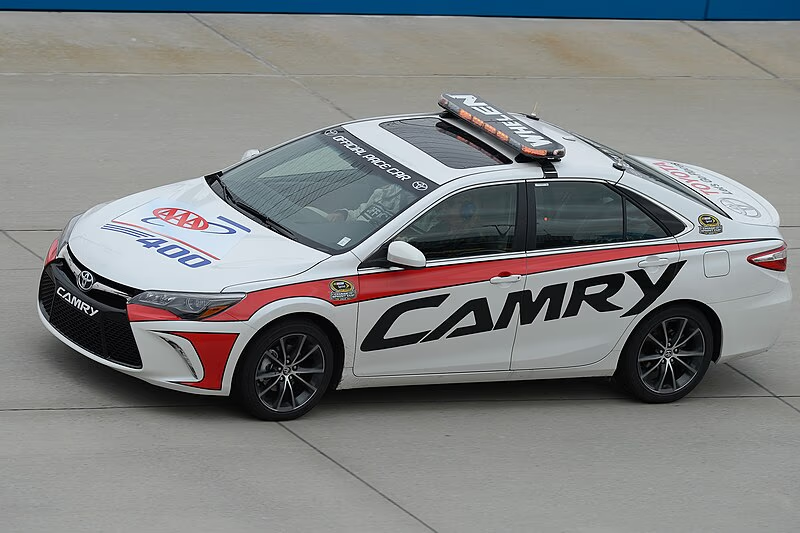
All cars competing in the NASCAR Cup Series must conform to the specifications set forth in the NASCAR Rule Book and the applicable NASCAR-approved templates. The current approved manufacturers for the Cup Series are Chevrolet (Camaro ZL1), Ford (Mustang Dark Horse), and Toyota (Camry XSE).
The Next Gen car uses a common steel space-frame chassis supplied by NASCAR-approved manufacturers. The chassis must be constructed per the dimensional specifications in the NASCAR Rule Book.
NASCAR Cup Series cars use a naturally aspirated, pushrod V8 engine with a maximum displacement of 358 cubic inches (5.87 liters).
The minimum weight for a NASCAR Cup Series car, including the driver but without fuel, is 3,400 pounds (1,542 kg). Cars found below minimum weight following an event may be subject to disqualification.
The Next Gen car uses a double-wishbone front suspension and an independent rear suspension (IRS) — a significant change from the previous solid rear axle configuration. Suspension geometry adjustments (camber, toe, caster) are permitted within defined ranges.
A NASCAR-supplied five-speed sequential (H-pattern sequential) gearbox is mandatory in the Cup Series. Gear ratios are selectable from NASCAR-approved combinations specific to each track.
The official fuel of the NASCAR Cup Series is Sunoco Green E15, an unleaded fuel containing 15% ethanol, supplied exclusively by Sunoco as the official fuel supplier. No other fuel may be used.
Goodyear Eagle tires are the exclusive tire supplier for the NASCAR Cup Series. Tire compounds are selected by Goodyear and NASCAR specific to each track and event.
The Next Gen car uses an 18-inch aluminum center-lock wheel (single-lug nut, 10-lug pattern on the hub) supplied by NASCAR-approved manufacturers. Wheel diameter is standardized at 18 inches.
NASCAR Cup Series events are held on a variety of track configurations, classified as follows: Superspeedways: Tracks of 2.0 miles or greater in length. Currently includes Daytona International Speedway (2.5 miles / 4.023 km) and Talladega Superspeedway (2.66 miles / 4.281 km). These tracks requi...
The Retaliation Code — 'Settle It on the Track'
If a driver intentionally wrecks you, you are entitled to pay them back on track. NASCAR culture has long treated retaliation as legitimate self-policing. NASCAR chairman Brian France's 'have at it boys' stance (c. 2010–2012) was a public acknowledgment of this long-standing custom. Drivers who never retaliate risk being seen as easy targets.
Dale Earnhardt was the archetype; the Gordon–Earnhardt feuds of the 1990s and the 2012 Bowyer–Gordon Phoenix incident are canonical examples.
Don't Wreck a Title Rival to Win a Championship
Using deliberate contact to eliminate a championship competitor from a race — rather than outrunning them — is widely condemned as a violation of competitive integrity. Aggressive racing is expected; manufacturing a wreck to gain points is not. Drivers who do it carry the stigma for years.
The 1990 season finale (Earnhardt–Martin at Atlanta) is the most debated historical example; subsequent championship controversies revisit this norm every few seasons.
One Defensive Move — No Weaving
A driver defending position may make one blocking move. Chopping back across the track after the attacker adjusts — weaving or making multiple moves down a straightaway — is considered dirty and dangerous. The attacking driver picks a lane; the defender counters once and commits.
Formula 1 eventually codified this into written regulations; NASCAR's version remains an unwritten norm consistently referenced after incidents.
Rookies Earn Their Place Before Racing Established Veterans Hard
New Cup Series drivers are expected to show restraint, learn the tracks, and avoid initiating conflicts with established veterans before building credibility. Racing overly aggressively — especially against champions — too early earns a lasting reputation as reckless and makes other drivers less willing to give them racing room.
Veteran drivers have called out rookies publicly; such confrontations occasionally become news stories when they spill out of drivers' meetings.
Don't Deliberately Spin the Leader to Steal a Win
Using the bumper to intentionally spin or loosen the car ahead — specifically to take a win rather than from unavoidable racing contact — is one of the most condemned acts in NASCAR. While aggressive bumping to push a drafting partner or make a move for position is accepted, a deliberate 'dump and drive' to steal a victory is a serious violation of the code.
Distinct from superspeedway bump-drafting, which is sanctioned; this refers to a calculated spin-out in the closing laps when the outcome is deliberately manufactured.
Ready to dive deeper?