
🏛️Official — IJF
Loading OpenSourceSports…
Combat Sports
1 players
indoor
mat, gi, belt
10 essential rules
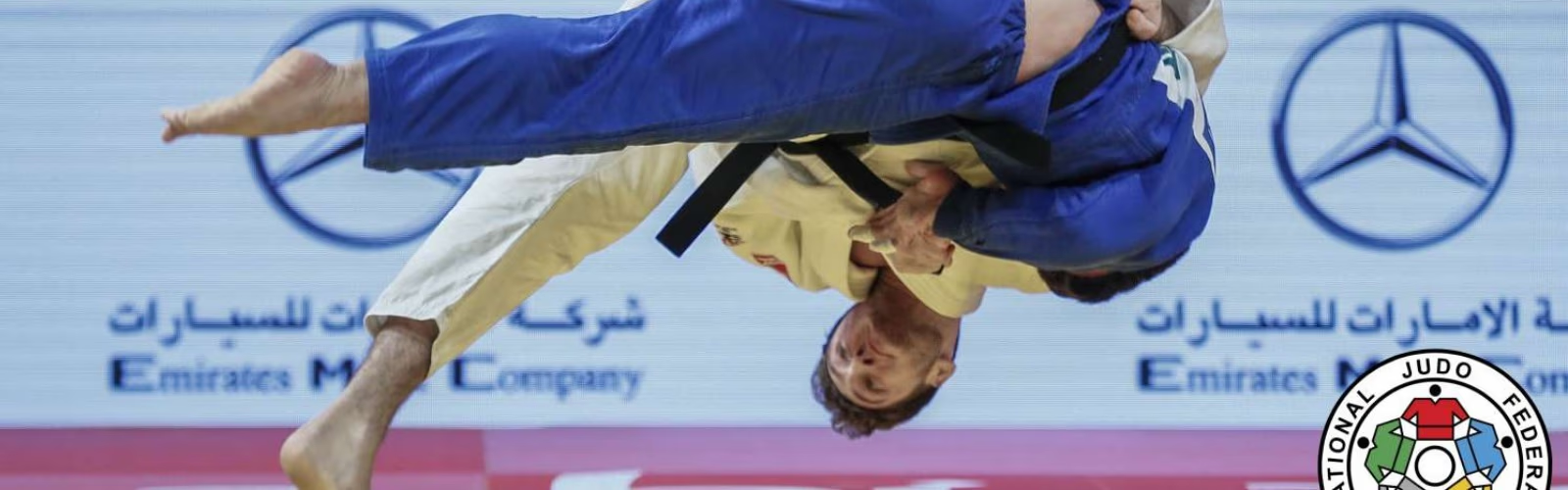
Judo was founded in 1882 by Professor Jigoro Kano in Tokyo, Japan. Drawing from the traditional Japanese martial art of jujutsu, Kano distilled its most effective techniques into a refined system built on two core principles: Seiryoku Zen'yo (maximum efficiency with minimum effort) and Jita Kyoei...
Athletes must bring both a white judogi and a blue judogi to competition. The color is assigned by draw: the first-called competitor wears white, the second wears blue.
Fingernails and toenails must be cut short to prevent injury.; Long hair must be tied back so it does not obstruct the opponent's face or interfere with gripping.; Hard objects (rings, piercings, bracelets, watches) are strictly prohibited during competition.
Scoreboard: Electronic scoreboard visible to athletes, coaches, and spectators displaying scores, penalties, osaekomi time, and match clock.; Video Review System: The IJF CARE (Computer Assisted Referee Evaluation) system provides instant video replay to assist referees on contested calls.; Timin...
All IJF-sanctioned competitions take place on a regulation tatami (competition mat) meeting the following dimensional requirements: Total Platform: Minimum 14 m × 14 m (46 ft × 46 ft), encompassing the contest area and the safety area — the IJF rules no longer define a separate "danger zone", whi...
Tatami mats must be IJF-approved, constructed from high-density foam (typically EVA or compressed polyurethane) with a textured, non-slip vinyl surface. Mat firmness must allow safe breakfalls (ukemi) while providing enough friction to prevent uncontrolled sliding.
Minimum ceiling height of 4 m (13 ft) above the mat surface (SOR 8.7).; Adequate lighting of at least 1,500 lux at mat level for competition and broadcast requirements (SOR 8.7).; Warm-up area adjacent to the competition hall with sufficient mat space for athletes to prepare (SOR 8.7).
Individual events are contested in seven weight categories per gender.
The Olympic mixed team event features national teams of six athletes: three men and three women. Matches are contested in a fixed weight order: Women −57 kg (SOR 2.2.2); Men −73 kg (SOR 2.2.2); Women −70 kg (SOR 2.2.2)
Each match is officiated by a panel of three: Mat Referee (Shushin): Stands on the contest area, directs the match, announces scores and penalties, and has primary authority over all decisions (IJF Refereeing Rules, Articles 1–4).; Two Side Judges (Fukushin): Seated at diagonal corners of the mat...
Each athlete is permitted one coach seated in the designated coaching chair. Coaches may offer verbal encouragement but may not physically approach the mat, interfere with officials, or use electronic devices to communicate tactical instructions during the match.
Release submissions in practice before your partner is injured
In randori you should feel when a choke or armlock is effective and release proactively — especially with less-experienced partners — before they are forced to tap. Cranking at full pressure and waiting for every tap is considered dangerous and contrary to judo's mutual welfare principle.
Most critical with newer judoka who may not yet know to tap, or who tap late due to ego or inexperience.
Never ask your sensei when you will receive your next belt
Belt rank is awarded solely at the instructor's discretion, when they judge a student ready. Asking when you will be promoted is considered disrespectful of the teacher's authority and signals misaligned priorities — rank should follow dedication, not be pursued as a goal.
Calibrate intensity — don't apply full power against beginners
Using strongest throws or submissions at full force against lower-ranked or inexperienced players is strongly frowned upon. Higher-ranked judoka are expected to match intensity to their partner's level — providing challenge while ensuring safety and mutual development.
Particularly applies to dangerous techniques — e.g., high-amplitude shoulder throws on beginners, or leg locks in clubs where they are restricted to higher grades.
Ready to dive deeper?
Do not publicly criticize referee decisions — accept the outcome
Judo culture expects athletes and coaches to accept officiating decisions without public complaint. Arguing on the mat, making dismissive gestures at referees, or publicly criticizing IJF officiating in post-match media is considered a serious breach of discipline and respect.
Formal protest procedures exist, but the cultural expectation is that disputes are handled quietly through official channels rather than public protest.
Accept ippon with composure — don't argue or sulk
When cleanly thrown for ippon, the loser is expected to accept the result calmly and without visible protest. Arguing with the referee, looking disgusted, or disputing the score is considered a serious breach of judo's ethos of self-control and respect for one's opponent.
Rooted in the broader Japanese martial arts value of composure (heijoshin); consistently taught in dojos worldwide.
Restrained celebration — no excessive shows after scoring or winning
Jubilant fist-pumping, screaming, or taunting after scoring ippon or winning is deeply frowned upon. Quiet acknowledgment is the accepted ceiling. The IJF formally penalizes extreme celebration, but the cultural norm extends well below the penalty threshold.
Some relaxation of this norm has occurred at the elite level in recent decades; IJF rule changes in the 2010s created ambiguity about where the line sits.