


🏛️Official — World Athletics
Loading OpenSourceSports…
Do not intentionally spike a competitor
Using spikes to deliberately step on, scrape, or trip a competitor — beyond inevitable incidental contact in crowded races — is one of the most condemned acts in track culture. Intentional spiking is viewed as dangerous and cowardly; it has resulted in disciplinary proceedings and public condemnation throughout the sport's history.
Maintain silence during field event attempts
Competitors, coaches, and spectators are expected to go quiet while an athlete is preparing and executing an attempt in high jump, pole vault, shot put, discus, hammer, and javelin. Noise during the approach is disrespectful and potentially dangerous, especially in pole vault where a disrupted approach can cause a fall.
Never celebrate before crossing the finish line
Easing up or gesturing in victory before breaking the tape is considered disrespectful to still-racing competitors and risks handing away a result. Usain Bolt's premature celebration in the 2008 Beijing 100m Olympic final is the most-cited cautionary example in sprint culture.
Don't deliberately obstruct or cut across a competitor
Beyond what officials penalize, there is a strong cultural expectation that athletes do not exploit ambiguous contact or tactical positioning to physically impede a rival. Intentionally refusing to provide a gap when a runner is trying to pass — while technically unpenalized — is viewed as violating the spirit of fair competition.
All throwing implements must be approved by World Athletics and appear on the official Approved Implements List. Specifications are set out in Technical Rule 33 (Shot Put), Technical Rule 34 (Discus), Technical Rule 36 (Hammer), and Technical Rule 38 (Javelin) (Technical Rule 32).
— Rule 33, Rule 34, Rule 36, Rule 38, Rule 32
Why people argue about this
People often assume that just because an implement is approved by World Athletics, it can be used in competitions without further inspection, but actually, each thrower must ensure their approved implement meets all specified technical requirements as detailed in Technical Rules 187 to 190 for the respective event.
Hurdles shall be made of metal or other suitable material with a wooden or plastic top bar. The maximum weight is 10 kg.
— Rule 22
Why people argue about this
People often assume that the metal part of the hurdles can be heavier than 10 kg, misunderstanding that only the top wooden or plastic bar is limited to a maximum weight of 10 kg, while the entire structure including the base and other components are not specified in terms of material or weight.
The vaulting pole may be made of any material or combination of materials and of any length or diameter. The surface may be smooth or have a wrapping of adhesive tape in a single layer over the entire length or part of the pole (Technical Rule 28).
— Rule 28
Why people argue about this
People often assume that the pole must be smooth all over, forgetting that it can have a single layer of adhesive tape wrapped around part of its length for added grip or flexibility, leading to arguments about whether taped sections are allowed and how they should look.
The baton shall be a smooth hollow tube made of wood, metal, or other rigid material. It must be circular in cross-section; length 28–30 cm, circumference 12–13 cm, weight at least 50 g (Technical Rule 24).
— Rule 24
Why people argue about this
People often assume that the baton's circumference is measured at its widest point, leading them to argue about whether a slightly larger baton fits within the 12-13 cm limit when it isn't specified where exactly around the tube this measurement should be taken.
Barrier height (men): 0.914 m; (women): 0.762 m (Technical Rule 23).; Top bar cross-section: 127 mm × 127 mm, rounded corners radius 5–6 mm (Technical Rule 23).; The water jump pit is 3.66 m × 3.66 m; maximum water depth at the barrier 0.70 m, sloping to 0 m at far end (Technical Rule 23).
— Rule 23
Why people argue about this
People often assume that the exact dimensions like 127 mm × 127 mm for the top bar cross-section are just random numbers chosen by World Athletics without considering their impact on performance or safety. Actually, these precise measurements are crucial as they directly influence how athletes approach and clear the barriers during steeplechase races.
Starting blocks shall be used for all races up to and including 400m (including the first leg of relays). Blocks must be constructed solely of rigid materials and must not provide any undue advantage.
— Rule 15
Why people argue about this
People often assume that only sprinters use starting blocks for races up to 400m, forgetting about events like the 4x100m relay where all four runners start together. The confusion arises because this rule specifically addresses the technical requirements of the blocks used by individual athletes in shorter sprints, not necessarily the entire team event.
Shoes must not give an athlete any unfair assistance or advantage. The construction of shoes must not be altered during competition.
Why people argue about this
People often assume that the rule only applies to spikes protruding from the bottom of shoes, forgetting that the entire shoe construction must be fair, including midsoles, uppers, and even the sole material itself, leading to misunderstandings about what exactly constitutes an "unfair advantage.
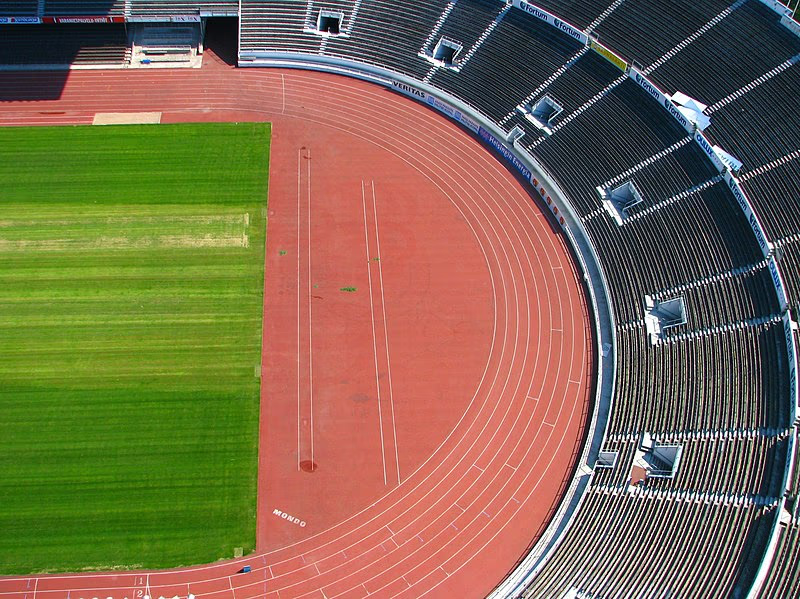
The standard outdoor athletics track has a circumference of 400 metres. The track shall have a minimum of six lanes for all World Athletics Series competitions; eight lanes are required for World Athletics Championships and Olympic Games track events.
— Rule 14
Why people argue about this
People often assume that the track circumference of 400 meters is solely for aesthetic reasons, forgetting that it's crucial for maintaining consistent race distances across different lanes. The confusion arises because they overlook how lane width and starting positions affect the total distance runners cover, which must remain exactly 400 meters to ensure fairness in competition.
The water jump shall be located on the inside or outside of the track. It is 3.66 m × 3.66 m, with maximum water depth at the barrier of 0.70 m sloping uniformly to 0 m at the far end.
— Rule 23
Why people argue about this
People often argue that the water jump can be placed anywhere within a 3.66m x 3.66m area without considering the need for symmetry or balance in the steeplechase course design, which is crucial for maintaining fair competition and athlete safety. The confusion arises because they overlook the technical rule emphasizing uniformity and not just placement flexibility.
All races up to and including 400m, and the first leg of relays up to and including the 4×400m, shall be run entirely in separate lanes. The 800m shall be run in lanes to the end of the first bend.
— Rule 14
Why people argue about this
People often assume that lanes are meant for safety purposes only and forget about their role in ensuring fair competition. The confusion arises because they misunderstand how lane placement affects race strategy and positioning on curves versus straights, leading to arguments over where runners should be positioned based on the event's distance.
The start and finish lines shall be 5 cm wide, painted white, and form part of the measured distance of the race. The finish post shall be placed at least 30 cm beyond the outer edge of the outermost lane (Technical Rule 16).
— Rule 16
Why people argue about this
People often assume that the 30 cm distance beyond the outer lane edge for the finish post is solely about safety, but actually, it's designed to ensure fair racing conditions by preventing runners from slipping or being pushed off course if they're not perfectly aligned with the line. They overlook the technical precision needed for accurate race measurement and fairness across all lanes.
The runway shall be a minimum of 15 m in length (no maximum) with a maximum cross-fall of 1:100. The landing area shall be a minimum of 5 m × 3 m.
Why people argue about this
People often assume that the 15-meter runway length is strictly for safety reasons, ensuring athletes have enough space to run without hitting barriers. However, the actual reason behind this rule is to maintain consistency in measurement and ensure fair competition across different venues by setting a standard baseline distance from takeoff to landing area.
The runway shall be a minimum of 40 m in length (45 m preferred) and minimum 1.22 m wide. The landing area shall be a minimum of 6 m × 6 m (excluding the front section nearest the box).
Why people argue about this
People often assume that the 40-meter runway length is solely for safety purposes, forgetting that it's also crucial for maintaining optimal air time and trajectory in pole vaulting. The actual confusion arises because they overlook how a shorter or wider runway can significantly affect an athlete’s performance by altering their takeoff angle and velocity.
The runway shall be a minimum of 40 m in length (45 m preferred) and minimum 1.22 m wide. The takeoff board is 20 cm wide and flush with the runway surface.
Why people argue about this
People often assume that the 1.22 m width for the runway is solely about safety, but in reality, it's also crucial for ensuring the precise distance measurement from the takeoff board to the landing area, which affects judges' scoring and athletes' performance. They overlook how this uniformity impacts the precision of the long jump and triple jump distances.
The circle is made of steel or iron, internal diameter 2.135 m ± 5 mm. The top of the rim shall be flush with the ground outside, and no higher than 26 mm above the ground inside.
Why people argue about this
People often assume that the exact height of 26 mm for the rim above ground is a strict requirement, leading them to argue about whether their shot put circle meets the standard when it's just slightly off by a fraction of a millimeter. They overlook the ±5 mm tolerance specified in the rule, which allows for some wiggle room that isn't always accounted for initially.
Discus: Internal diameter 2.500 m ± 5 mm. Throwing sector 34.92° (Technical Rules 34 and 36).; Hammer: Internal diameter 2.135 m ± 5 mm. Throwing sector 34.92°. A protective cage must surround the throwing area to protect officials, athletes, and spectators (Technical Rule 37). The cage must be c...
— Rule 37
Why people argue about this
People often assume that the protective cage is only necessary for safety during competition and forget its role in preventing interference from spectators outside of the designated throwing area, leading to misunderstandings about where it should be placed or who can use it.
The runway shall be a minimum of 30 m in length (33.5 m preferred) and 4 m wide, with a maximum cross-fall of 1:100. The scratch line is an arc of radius 8 m.
Why people argue about this
People often assume that the 4-meter width of the runway is solely for safety purposes, forgetting that it also helps in maintaining a consistent throwing angle across different throwers. The confusion arises because they overlook how this uniformity ensures fair play and accurate measurement of results.
Athletes in World Athletics Series competitions are required to wear approved competition numbers on both chest and back, as assigned by the competition organiser (Technical Rule 5). Numbers may not be folded, cut, or otherwise altered.
— Rule 5
Why people argue about this
People often assume that approved competition numbers can be folded or cut as long as they're still legible, misunderstanding that altering them in any way is strictly prohibited by the rule.
Each competition shall be under the technical control of the following officials (Competition Rule 12): Technical Delegate(s): Appointed by World Athletics for Series events; oversee technical preparation and compliance (Competition Rule 12).; Referee: A Chief Referee and separate Referees for Tr...
— Rule 12, Rule 19
Why people argue about this
People often assume that only serious disputes get reviewed by a Jury of Appeal, missing out on the fact that even minor issues like line markings can be protested if they affect performance or fairness, leading to confusion about which protests actually trigger this review process.
A Jury of Appeal shall be appointed for all World Athletics Series competitions, comprising a minimum of three members. The Jury rules on all protests lodged after the Referee's decision.
— Rule 12
Why people argue about this
People often assume that only athletes involved in a protest can be part of the Jury of Appeal, which leads them to think they need to personally invite other athletes or officials for the jury. Actually, this rule allows for an impartial panel to be appointed by World Athletics from various sources, not just those directly affected by the protest.
A Medical Delegate and medical personnel must be on site for all World Athletics Series events. Anti-Doping Control Officers operate under the World Athletics Anti-Doping Rules (separate from Technical Rules).
Why people argue about this
People often assume that having Medical and Anti-Doping Officials is a standard requirement for all track and field events, which leads them to misunderstand that these roles are governed separately under different sets of rules. The confusion arises because they see it as part of the broader Technical Rules when in fact, it's managed by its own set of World Athletics Anti-Doping Rules.
A Photo Finish Judge reads finishing positions from FAT equipment. A Video Review Official (VRO) may review incidents at World Athletics Series events using approved video evidence for specified ru...
— Rule 12
Why people argue about this
People often assume that Video Review Officials (VROs) have carte blanche to review every incident they see during a race, which isn't entirely true according to World Athletics rules. The confusion arises because Technical Rule 149 specifies that VROs can only use video evidence for certain rule violations at Series events, not just any discrepancy or controversy.
All races up to and including 400m (including hurdles at those distances) shall be started by the report of the starting pistol or approved device. Commands are: "On your marks" and "Set" (for races up to and including 400m).
Why people argue about this
People often assume that starting commands are optional for shorter races like 100m hurdles, misunderstanding that they're required by law up to and including the 400m. In reality, these commands are mandated not just as tradition but as a technical rule ensuring all athletes start at precisely the same moment.
The Triple Jump consists of a hop, a step, and a jump. The hop is made so that the athlete lands first on the same foot as the take-off foot; in the step, the athlete lands on the other foot; from there the jump is completed.
— Rule 31
Why people argue about this
People often assume that in a Triple Jump attempt, landing on either foot during the hop is acceptable as long as they land first with their take-off foot. However, the official rule strictly specifies that the athlete must land first on the same foot used for takeoff during the hop, leading to confusion and potential disputes if this isn't adhered to correctly.
The athlete must start an attempt from a stationary position within the circle or behind the scratch line. The athlete may touch the top of the stop board (Shot Put) but must not touch the top of the rim of the throwing circle or the ground outside.
Why people argue about this
People often assume that touching the top of the stop board in Shot Put is merely a courtesy gesture for officials rather than an actual technical requirement, leading them to argue it should be more lenient or optional. The confusion arises because this specific touch is explicitly stated as mandatory under rule 34, and its violation can result in disqualification.
A wind reading is required and recorded for all individual sprint and hurdle events up to and including 200m, and for long jump and triple jump. The wind gauge is placed parallel to the track for running events; parallel to the runway for jumps.
Why people argue about this
People often assume that wind readings are only necessary for sprinters in 100m races, forgetting about hurdles and long/ triple jumps altogether. The confusion arises because they overlook the specific mention of these events under World Athletics Technical Rules 17 and 30.
A false start occurs when an athlete starts before the starting signal. The World Athletics False Start Detection System triggers if an athlete produces a reaction time of less than 0.100 seconds after the gun.
— Rule 16
Why people argue about this
People often assume that a false start is only called when they see an athlete moving before the gun goes off with their naked eye, but actually, it's determined by the timing system detecting a reaction time of less than 0.100 seconds after the gunshot, which can happen even if you don't visibly notice anything wrong.
In lane races, athletes must stay within their designated lane from start to finish. An athlete who runs outside their lane, or steps on or over a lane line in a curve, shall be disqualified unless no material advantage is gained and no other athlete is obstructed (Technical Rule 14).
— Rule 14, Rule 17
Why people argue about this
People often assume that just touching a lane line is enough to disqualify an athlete, forgetting that it must be in a curve and result in no material advantage or obstruction for other athletes. They overlook the crucial detail that they need to step on or over the line in order to get disqualified under this rule.
In relay races, the baton must be passed within the exchange zone, which is 20 m in length. For the 4×100m, there is an additional 10 m acceleration zone prior to each exchange zone.
— Rule 24
Why people argue about this
People often assume that as long as they touch the baton within the exchange zone, it's fine—ignoring the crucial part where they must actually pass over a point inside each 20-meter exchange zone to be deemed legal. The confusion arises because the rule specifies passing over a specific point for verification, not just touching anywhere in the zone.
Athletes must not run around, under, or deliberately knock over hurdles. An athlete is disqualified if they trail a foot or leg below the plane of the top of any hurdle, or if they deliberately knock a hurdle over with their hand or foot.
— Rule 22
Why people argue about this
People often assume that if they touch a hurdle with their foot, it's only a disqualification if they knock it over completely. But actually, the rule states you mustn't run under or around the hurdles at all; touching one lightly is still technically illegal as long as your body isn’t below the top bar of any hurdle.
In the 3000m Steeplechase, athletes shall clear 28 hurdles and 7 water jumps (5 laps of a 400m track for men; adapted for women). Athletes must go over, or through the water at, each water jump.
Why people argue about this
People often assume that if they touch a water jump, it's still considered a successful clearance as long as they don't fall in. Actually, according to Technical Rule 23, athletes must go over or through each water jump at all times; touching is not enough - they have to fully clear it by going over it completely without falling in.
Athletes must take off on one foot. Each athlete is allowed three attempts at each height.
— Rule 27
Why people argue about this
People often assume that they can take off from either foot as long as they land on one, which leads to arguments about whether a particular jump was legal or not. The confusion arises because in High Jump, technically speaking, athletes must initiate their jump with just one foot, ensuring the technical rule is strictly adhered to for each attempt at a height.
The athlete may place the vaulting pole in the box at any angle. Once the vaulting pole has been placed in the box at the start of the attempt, the athlete may, while holding the pole, touch the ground beyond the stop board with the pole or a part...
— Rule 28
Why people argue about this
People often assume that touching the ground beyond the stop board with part of the pole is allowed only when the athlete's hands are free, but actually, it’s permitted as long as they’re holding onto the pole, regardless of where their hands are positioned. The confusion arises because the rule doesn’t specify whether the athlete must be fully unencumbered to make this touch.
The athlete takes off from behind or on the takeoff board. The jump is measured from the nearest mark in the landing area made by any part of the athlete's body to the takeoff line (extended), at right angles to the takeoff line.
— Rule 30
Why people argue about this
People often assume that if an athlete takes off behind or on their takeoff board, they're automatically disqualified based solely on where their body touches down in the landing area. However, the confusion arises because the official measurement is actually from the nearest mark made by any part of their body to the extended takeoff line, not just disqualification for taking off incorrectly.
At all World Athletics Series events, times must be recorded by Fully Automatic Timing (FAT) measured to 1/1000th of a second and displayed to 1/100th of a second. Where a photofinish system is used, a photograph showing the order of arrival must be used to determine results.
— Rule 19
Why people argue about this
People often assume that just because a photofinish system is used for timing doesn't mean they're allowed to round up times displayed in tenths of seconds. Actually, the official verdict specifies that when using a photofinish system, results must be determined by an actual photograph showing the order of arrival, not just rounded off times shown on display screens.
, total station or laser distance meter). Each measurement must be made immediately after each valid attempt.
— Rule 25
Why people argue about this
People often argue that they can only measure after each attempt is completed, which leads to rushed measurements. However, the actual rule allows for continuous measurement as long as it's done immediately after each valid attempt, thus avoiding the perception of rushing or missing out on critical data.
In competitions with more than eight athletes: All athletes take three attempts; the top eight after three rounds take three more attempts (six total). The best mark from all six attempts determines the final ranking (Technical Rule 25).; In competitions with eight or fewer athletes: All athletes...
— Rule 25
Why people argue about this
People often assume that athletes get to choose their order of attempts for height in long jump or triple jump, but they actually have to attempt heights in ascending order as specified by officials. The confusion arises because this is a specific detail not always highlighted in explanations and can lead to misunderstandings about the actual process of competition.
Athletes attempt heights in order. The winner is the athlete who clears the greatest height. Ties are broken as follows: The athlete with the fewest failures at the height at which the tie occurs is ranked higher (Technical Rule 26).; If still tied, the athlete with the fewest total failures thro...
— Rule 26
Why people argue about this
People often assume that in case of ties, athletes are ranked based solely on the number of failures at the tied height, but actually, they consider the total number of attempts up until that point to break the tie, reflecting fairness and consistency across all their jumps.
The Decathlon (men, 10 events over two days) and Heptathlon (women, 7 events over two days) are scored using the IAAF Scoring Tables for Combined Events (2022 edition, effective from 1 January 2023). Each performance is converted to points using t...
Why people argue about this
People often assume that the scoring system for combined events like Decathlon and Heptathlon is a straightforward conversion of performance times into points, but in reality, it's based on complex IAAF Scoring Tables that take into account various factors including event-specific values and rankings across different disciplines to determine overall scores.
In multi-round competitions (qualifying round → final), athletes may advance either by achieving an Automatic Qualifying Standard (Q) or as one of the next-best performers (q). The specific standards and numbers advancing are set for each World Athletics competition.
— Rule 25
Why people argue about this
People often think that Automatic Qualifying Standards (Q) are only for athletes who perform exceptionally well in their qualifying round, but actually, they apply to athletes who meet or exceed certain performance benchmarks set by World Athletics, regardless of where they finish in the initial rounds as long as they qualify through another means.
Any athlete who commits a false start is given a warning (Yellow Card). The first false start per race is charged to the field collectively; thereafter, any individual false start results in disqualification of that athlete.
— Rule 16
Why people argue about this
People often assume that a false start is only penalized individually, forgetting that if one athlete commits it, the entire field gets warned collectively as per the rule. The confusion arises because they overlook the collective warning aspect until more than one athlete triggers individual disqualification for subsequent false starts.
In lane races, running outside the assigned lane on a bend, or stepping on or over the lane line on a bend, results in disqualification unless the athlete was clearly impeded by another runner or a non-track obstruction. In field events requiring ...
— Rule 14
Why people argue about this
People often assume that lane violations are strictly about running outside lanes, forgetting that stepping on or over the lane line is equally penalized. They overlook the part where 'stepping' includes touching the line with their body parts other than feet and hands, which isn't always obvious to referees.
An athlete who jostles, runs across, or obstructs another athlete so as to impede progress may be disqualified. If the obstruction is caused by an athlete other than the affected athlete, the Referee may order a re-run excluding the offending athl...
— Rule 17
Why people argue about this
People often assume that jostling is only about physical contact, forgetting that it can also be as subtle as running across another athlete's path, causing them to lose their balance or progress. They overlook how a minor obstruction like this could lead to disqualification if the Referee deems it significant enough to affect an athlete’s performance.
A foul attempt (no valid performance) is recorded and counts as one of the athlete's allocated attempts in the following cases: Throws: Implement lands outside the sector lines; athlete touches the top of the rim or the ground outside the circle before the implement lands; athlete leaves the circ...
— Rule 25
Why people argue about this
People often think that if an athlete makes a foul attempt in their field events like javelin or discus, they get penalized by having to immediately start over from scratch with no points carried forward. But actually, it's recorded as one of their attempts and doesn't affect the score; they just use up one of their allotted tries for that event.
An athlete may be disqualified from an individual event for: three consecutive failures in High Jump or Pole Vault (all three attempts at a single height fail); deliberate destruction of competitio...
— Rule 7.7, Rule 7
Why people argue about this
People often assume that if an athlete fails three times in a row at high jump or pole vault, they're automatically disqualified for life, but actually, it's just one event per discipline where you can fail three consecutive attempts before being penalized. The rule is designed to prevent abuse of the system rather than punish athletes indefinitely.
A relay team is disqualified if: the baton is exchanged outside the exchange zone; a team member runs outside their lane in a manner that impedes another team; a team member deliberately interferes with another team; or an athlete runs an extra le...
— Rule 24
Why people argue about this
People often assume that just running outside their lane is enough to disqualify a team, but in fact, it's only if they run in a way that impedes another team or deliberately interferes with them. The rule about the baton exchange and lane violations are seen as separate issues by many, leading to confusion over which infractions trigger disqualification.
An athlete may be disqualified from the entire competition (all events) for: doping rule violations (subject to World Athletics Anti-Doping Rules); flagrant misconduct or breach of the spirit of fair play; failure to attend or compete without adeq...
— Rule 7
Why people argue about this
People often assume that disqualification under this rule only applies to doping issues, forgetting about flagrant misconduct or breaches of fair play. They overlook how serious failing to attend a competition can be in terms of integrity and fairness, thinking it's less severe than other violations like doping.
A protest regarding an event result must be made verbally to the Referee immediately after the event. A written protest must be submitted within 30 minutes of the official posting of the result.
— Rule 12
Why people argue about this
People often assume that they have 30 minutes from when they see the result posted to submit their protest, which is incorrect. The actual window for a written protest is within 30 minutes of the official posting of the event results after it has already occurred and been announced verbally by the referee.
World Athletics Technical Rule 37 requires that a protective cage be used for all hammer competitions (and strongly recommends one for discus at World Athletics Series events). The cage must be able to stop a 7.260 kg hammer ball travelling at 32 ...
— Rule 37
Why people argue about this
People often assume that protective cages are only for hammer competitions, missing out on the recommendation for discus at World Athletics Series events. They overlook the fact that while World Athletics mandates a cage for hammers, they strongly suggest its use in discus events as well, leading to misunderstandings about which throws require such safety measures.
The water jump barrier must be fixed firmly to the ground. The water surface must be clear of debris before each race.
— Rule 23
Why people argue about this
People often assume that as long as there's no debris visible before a race, the water jump barrier is safe. But they misunderstand the technical requirement of it being firmly fixed to the ground - something that can't be seen from afar and requires closer inspection during setup.
The landing area must be a minimum of 6 m × 6 m (not including the front extension) and the padding must meet World Athletics specifications. The box and plant area must be free of debris.
— Rule 28
Why people argue about this
People often assume that as long as they have a 6m x 6m area for the landing, their pole vaulting box is fine, without realizing they need to meet World Athletics' exact specifications for padding and ensure there's no debris in the plant area. They might also overlook the requirement for a front extension of at least 6 meters within their overall 12-meter-wide landing area.
The Technical Delegate and Referee jointly have authority to suspend or delay competition in the event of lightning, severe wind, heavy rain, or other conditions that threaten the safety of athletes or officials. If competition is suspended, athle...
Why people argue about this
People often assume that if competition is suspended due to adverse weather, athletes automatically get a medal without competing. However, the actual rule states that if competition is halted, athletes who have already participated keep their results and those who haven't compete in the missed events are not penalized for not having completed them.
World Athletics requires that all World Athletics Series events have on-site medical support including qualified physicians, paramedics, and equipment for emergency cardiac intervention (including ...
— Rule 6
Why people argue about this
People often assume that only professional athletes need to worry about doping controls at World Athletics events, which leads them to ignore the requirement for medical support requirements. However, under Rule 8.5, all athletes participating in these series are indeed required to undergo doping control with their medical team present, not just elite or professional athletes.
World Athletics Anti-Doping Rules, in force from 1 January 2021 and updated in alignment with the World Anti-Doping Code 2021, require all athletes at World Athletics Series events to be subject to doping control. Athletes selected for in-competit...
Why people argue about this
People often assume that only athletes who test positive for banned substances are subject to doping controls, which leads them to misunderstand that all selected athletes at World Athletics events must undergo these tests regardless of suspicion or performance metrics. The rule doesn't focus on results but rather requires participation in the testing process itself.
Race walking events (20 km, 35 km) conducted in extreme heat conditions are subject to additional safety protocols per World Athletics Technical Regulation and the Heat Stress Policy. Refreshment/sponging stations must be provided at defined intervals.
Why people argue about this
People often assume that race walkers are immune to heat exhaustion in extreme conditions just because they're walking, not running. But the rule actually emphasizes safety measures like refreshment stations because even at a slow pace, prolonged exposure to high temperatures can still be dangerous for athletes.
All throwing implements must be approved by World Athletics and appear on the official Approved Implements List. Specifications are set out in Technical Rule 33 (Shot Put), Technical Rule 34 (Discus), Technical Rule 36 (Hammer), and Technical Rule 38 (Javelin) (Technical Rule 32).
— Rule 33, Rule 34, Rule 36, Rule 38, Rule 32, Rule 22, Rule 28, Rule 24, Rule 23, Rule 15, Rule 5
Why people argue about this
People often assume that just because an implement is used in a track and field event, it must be approved by World Athletics without considering all the detailed specifications outlined for each throwing event like shot put, discus, hammer, and javelin. They overlook the specific technical rules detailing exact dimensions, materials, and other criteria set for each approved implement.
The standard outdoor athletics track has a circumference of 400 metres. The track shall have a minimum of six lanes for all World Athletics Series competitions; eight lanes are required for World Athletics Championships and Olympic Games track events.
— Rule 14, Rule 16, Rule 27, Rule 28, Rule 33, Rule 37, Rule 38, Rule 23
Why people argue about this
People often assume that all track events must be held in lanes of at least eight, which is a common misconception since only World Athletics Championships and Olympic Games require eight-lane tracks, while most series competitions stick to six lanes for efficiency and cost reasons.
Athletes in World Athletics Series competitions are required to wear approved competition numbers on both chest and back, as assigned by the competition organiser (Technical Rule 5). Numbers may not be folded, cut, or otherwise altered.
— Rule 5, Rule 12, Rule 19
Why people argue about this
People often assume that competition numbers can be folded or cut as long as they're assigned by the organiser, misunderstanding that altering them in any way is strictly prohibited, even if it's done at the request of an athlete.
All races up to and including 400m (including hurdles at those distances) shall be started by the report of the starting pistol or approved device. Commands are: "On your marks" and "Set" (for races up to and including 400m).
— Rule 15, Rule 16, Rule 24, Rule 14, Rule 17, Rule 22, Rule 23, Rule 27, Rule 28, Rule 30, Rule 31
Why people argue about this
People often assume that after hearing the starting pistol, athletes are supposed to run immediately, which leads to arguments about when they should begin their race. Actually, the official commands "On your marks" and "Set" give athletes time to get into position properly before running, something not always understood or followed strictly by all competitors.
At all World Athletics Series events, times must be recorded by Fully Automatic Timing (FAT) measured to 1/1000th of a second and displayed to 1/100th of a second. Where a photofinish system is used, a photograph showing the order of arrival must be used to determine results.
— Rule 19, Rule 25, Rule 26, Rule 39
Why people argue about this
People often assume that FAT timing is always used at World Athletics events, forgetting about photofinish systems where a photo still decides the winner even if times are recorded by FAT. The confusion arises because they overlook the fact that sometimes the visual confirmation of a photofinish can override the precise time measurement provided by FAT for determining official results.
Any athlete who commits a false start is given a warning (Yellow Card). The first false start per race is charged to the field collectively; thereafter, any individual false start results in disqualification of that athlete.
— Rule 16, Rule 14, Rule 17, Rule 25, Rule 7, Rule 7.7, Rule 24, Rule 12
Why people argue about this
People often assume that a false start is just about timing - if you're even slightly ahead of your competitors at the gun, it's a false start. But actually, the rule focuses on whether ANY athlete in the race starts before the official sound or light signal, not just the first one who moves. This can lead to debates over what constitutes "even slightly.
World Athletics Technical Rule 37 requires that a protective cage be used for all hammer competitions (and strongly recommends one for discus at World Athletics Series events). The cage must be able to stop a 7.260 kg hammer ball travelling at 32 ...
— Rule 37, Rule 23, Rule 28, Rule 6
Why people argue about this
People often assume that protective cages are only for show, a superfluous safety measure that doesn't significantly impact competition outcomes. In reality, they're crucial in preventing injuries from flying parts of the hammer during throws, which can be extremely dangerous and costly if someone gets hit by an errant metal rod or discus.