


🏛️Official — World Athletics
Loading OpenSourceSports…
Athletics
1 players
both
track, lane, javelin
10 essential rules
Track and Field is governed internationally by World Athletics (formerly the International Association of Athletics Federations, IAAF), headquartered in Monaco. The primary rules document is the World Athletics Technical Rules, published in editions aligned with the two-year competition calendar....
All throwing implements must be approved by World Athletics and appear on the official Approved Implements List. Specifications are set out in Technical Rule 33 (Shot Put), Technical Rule 34 (Discus), Technical Rule 36 (Hammer), and Technical Rule 38 (Javelin) (Technical Rule 32).
Hurdles shall be made of metal or other suitable material with a wooden or plastic top bar. The maximum weight is 10 kg.
The vaulting pole may be made of any material or combination of materials and of any length or diameter. The surface may be smooth or have a wrapping of adhesive tape in a single layer over the entire length or part of the pole (Technical Rule 28).
The baton shall be a smooth hollow tube made of wood, metal, or other rigid material. It must be circular in cross-section; length 28–30 cm, circumference 12–13 cm, weight at least 50 g (Technical Rule 24).
Barrier height (men): 0.914 m; (women): 0.762 m (Technical Rule 23).; Top bar cross-section: 127 mm × 127 mm, rounded corners radius 5–6 mm (Technical Rule 23).; The water jump pit is 3.66 m × 3.66 m; maximum water depth at the barrier 0.70 m, sloping to 0 m at far end (Technical Rule 23).
Starting blocks shall be used for all races up to and including 400m (including the first leg of relays). Blocks must be constructed solely of rigid materials and must not provide any undue advantage.
Shoes must not give an athlete any unfair assistance or advantage. The construction of shoes must not be altered during competition.
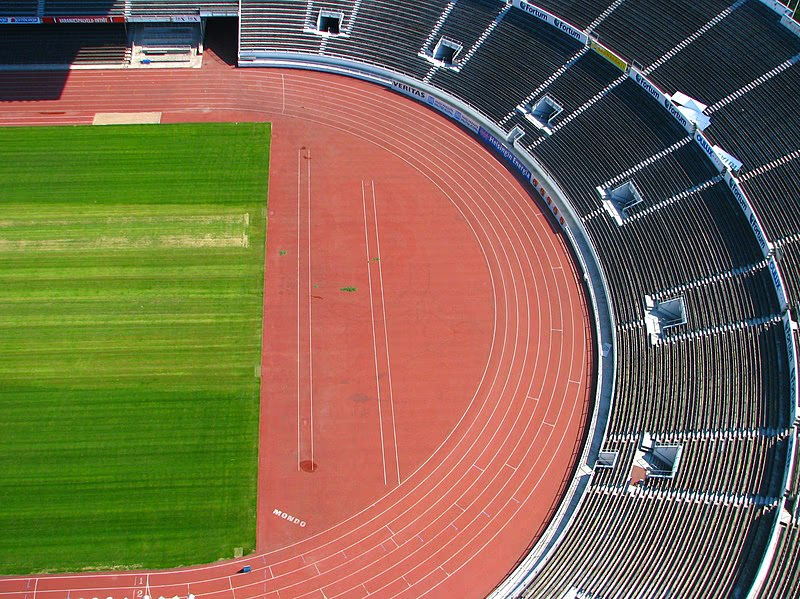
The standard outdoor athletics track has a circumference of 400 metres. The track shall have a minimum of six lanes for all World Athletics Series competitions; eight lanes are required for World Athletics Championships and Olympic Games track events.
The water jump shall be located on the inside or outside of the track. It is 3.66 m × 3.66 m, with maximum water depth at the barrier of 0.70 m sloping uniformly to 0 m at the far end.
All races up to and including 400m, and the first leg of relays up to and including the 4×400m, shall be run entirely in separate lanes. The 800m shall be run in lanes to the end of the first bend.
Do not intentionally spike a competitor
Using spikes to deliberately step on, scrape, or trip a competitor — beyond inevitable incidental contact in crowded races — is one of the most condemned acts in track culture. Intentional spiking is viewed as dangerous and cowardly; it has resulted in disciplinary proceedings and public condemnation throughout the sport's history.
Accidental spiking in crowded race situations is accepted as an inherent risk of the sport. Deliberate acts are universally condemned and may constitute assault.
Maintain silence during field event attempts
Competitors, coaches, and spectators are expected to go quiet while an athlete is preparing and executing an attempt in high jump, pole vault, shot put, discus, hammer, and javelin. Noise during the approach is disrespectful and potentially dangerous, especially in pole vault where a disrupted approach can cause a fall.
More strictly enforced at elite level; standard expectation at World Athletics championships and Olympic finals.
Never celebrate before crossing the finish line
Easing up or gesturing in victory before breaking the tape is considered disrespectful to still-racing competitors and risks handing away a result. Usain Bolt's premature celebration in the 2008 Beijing 100m Olympic final is the most-cited cautionary example in sprint culture.
Also a practical risk: coasting can allow a close rival to close the gap or trigger a DQ if it causes contact.
Ready to dive deeper?
Don't deliberately obstruct or cut across a competitor
Beyond what officials penalize, there is a strong cultural expectation that athletes do not exploit ambiguous contact or tactical positioning to physically impede a rival. Intentionally refusing to provide a gap when a runner is trying to pass — while technically unpenalized — is viewed as violating the spirit of fair competition.
Most contested in the 800m and 1500m where physical contact is common. 'Boxing in' is accepted tactics; deliberately denying an obvious gap is not.