




Section 1: Introduction
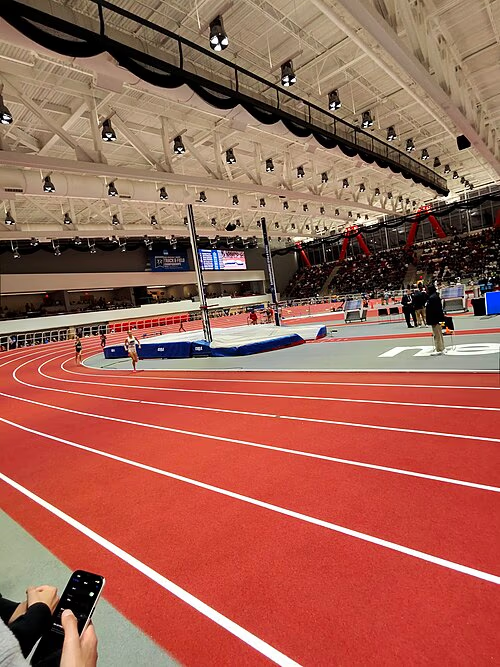
NCAA Indoor Track and Field is the winter-season collegiate variant of track and field, contested December through March on indoor 200-meter banked or flat tracks, culminating in the NCAA Division I Indoor Track and Field Championship in early March. NCAA Indoor T&F uses the World Athletics technical baseline with NCAA-specific modifications including indoor-specific events, banked-track rules, altitude-conversion adjustments, and NCAA Championship qualifying. The current edition is the 2025-26 NCAA Indoor Track and Field Rules Book. For the outdoor variant see the sibling Track and Field (NCAA Outdoor); for the international framework see World Athletics Competition Rules.
Section 2: Equipment
- Throwing implements: shot put, weight throw (replaces hammer indoors); same NCAA-approved spec as outdoor
- Indoor-specific: weight throw — men 35 lb (15.88 kg) / women 20 lb (9.07 kg) — replaces the hammer for indoor competition
- Hurdles: men's 60m hurdles 1.067m / women's 60m hurdles 0.838m
- Spike length: typically max 6mm for indoor (track surface dependent), no longer than 9mm
- Personal pole-vault poles meeting World Athletics spec
- Personal high-jump and pole-vault landing equipment per venue
Section 3: Playing Area
- 200-meter oval track (smaller than outdoor 400m), 4-6 lanes typical
- Track may be banked (curves rise toward the outer edge to allow faster running) or flat
- Sprint and hurdle straightaway: separate 60m straight track or use of the oval straight
- Field event areas: shot put circle, weight throw circle, jump pits, pole vault pit
- Indoor venue must meet NCAA championship spec for ceiling clearance, jump-pit dimensions, throwing-cage requirements
- Class A certification required for NCAA championship venues
Section 4: Players & Officials
- Officials: meet referee, starters, recall starters, finish judges, lap counters, field-event judges, implement inspectors, wind-gauge operators (when used)
- FAT (Fully Automatic Timing) required at championship
- NCAA D1 Indoor Championship: top 16 individual + top 8 relays advance per event from the descending-order list
- Combined events at indoor: Heptathlon (men) + Pentathlon (women) — different from outdoor's Decathlon/Heptathlon
Section 5: Rules of Play
NCAA D1 Indoor Championship Events
- Sprints: 60m, 200m, 400m
- Middle/long distance: 800m, Mile (1609m), 3000m, 5000m
- Hurdles: 60m hurdles
- Jumps: long jump, triple jump, high jump, pole vault
- Throws: shot put, weight throw
- Combined: heptathlon (M) / pentathlon (W)
- Relays: 4×400m, distance medley relay (DMR — 1200/400/800/1600)
Banked Track Rules
- Lane assignments and lane-line rules apply with adjusted radius for banked turns
- Stagger lines accommodate banked-track geometry
- Stepping inside the lane on a banked turn carries DQ if it impedes another runner
Altitude and Conversions
- Indoor altitude factor: NCAA publishes altitude-conversion tables for performances at high-altitude venues (5,000+ feet); marks may be wind-noted but timing is FAT
- 200m vs 400m oval: NCAA accepts marks from both for qualifying, with conversion factors published
Section 6: Scoring
- Individual events: lowest time wins (FAT to 0.01 sec); jumps/throws: longest mark wins; combined events: highest score per published World Athletics tables
- NCAA team scoring: 10-8-6-5-4-3-2-1 (top 8 score); relays score double
- Tiebreakers: photo finish for ties; second-best mark for tied jump/throw
Section 7: Violations & Penalties
- False start: zero-tolerance DQ (consistent with World Athletics 2009-onward)
- Lane infringement: stepping inside lane line on a curve, impeding another runner = DQ
- Relay exchange violation: outside the 20m exchange zone = relay DQ
- Field event: foot fault, leaving circle improperly, implement landing outside sector, javelin not landing tip-first
- Jump: crossing takeoff board, knocking bar from standards (3 misses = elimination)
- Equipment: unapproved spikes, prohibited apparel = warning + correction; subsequent = DQ
Section 8: Safety Considerations
Indoor venue safety: ceiling clearance for pole vault and high jump verified; throwing cages required for weight throw; sector marshals positioned. Pole-vault and high-jump landing-mat dimensions and minimum thickness per NCAA spec. Banked-track safety: handrail and edge-protection at outer track edge. Concussion protocol: removal + graduated return-to-play assessment for any actual or suspected concussion (pole-vault head impacts and field-event implement strikes are primary risks). Required: certified athletic trainer at every meet; team physician + EMT/ambulance + AED at championship-level. Emergency action plan with cervical-spine and head-injury protocols at every venue.