


















Section 1: Introduction
1.1 Overview and Governing Body
Modern pentathlon has been part of the Olympic programme since the 1912 Stockholm Games, making it one of the longest-running Olympic sports. The sport was created by Baron Pierre de Coubertin, the founder of the modern Olympics, to test the skills of a 19th-century military courier who must ride an unfamiliar horse, fight with sword and pistol, swim across a river, and run to deliver a message. The Union Internationale de Pentathlon Moderne (UIPM), founded in 1948, governs the sport worldwide under the UIPM Competition Rules and Regulations.
1.2 Historical Evolution
The sport has undergone significant format changes since its Olympic inception:
- 1912–1992: Five separate events spread over 5 days (pistol shooting, fencing, swimming, horse riding, cross-country running)
- 1996–2008: Compressed to 1 day, events still held separately
- 2012–2016: Introduction of the Combined Event (Laser Run), merging shooting and running into a single discipline with a handicap start
- 2020 Tokyo: Format refined with Laser Run as the decisive finale
- 2024 Paris: Final Olympics with equestrian (show jumping on an unfamiliar horse). Following a controversial incident at Tokyo 2020, the IOC and UIPM agreed to replace riding.
- 2028 Los Angeles onwards: Equestrian replaced by an Obstacle Course (ninja warrior-style discipline). The new format was tested at the 2024 Paris Games as a demonstration and becomes official for LA 2028.
1.3 The Five Disciplines (Current Format, 2028+)
- Fencing: Épée round-robin — tests combat skill and tactical awareness
- Swimming: 200 m freestyle — tests aquatic speed and endurance
- Obstacle Course: Ninja warrior-style course — tests agility, balance, strength, and coordination (replaces equestrian from 2028)
- Laser Run (Combined): Alternating 800 m running laps with laser pistol shooting series — tests endurance, shooting accuracy under fatigue, and mental composure
1.4 Olympic Qualification
- Field size: 36 athletes per gender (18 men, 18 women) at the Olympic Games
- Qualification pathway: UIPM World Rankings, Continental Championships, World Championships, and Universality places
- Maximum per country: 2 athletes per country per gender event
- Age: Athletes must be at least 18 years old in the year of competition
Section 2: Equipment
2.1 Fencing Equipment
- Weapon: Épée (thrusting sword). Standard FIE-approved épée with a maximum total weight of 770 g (27.2 oz) and blade length of 90 cm (35.4 in) maximum. Button (point) requires 750 g of pressure to register a touch.
- Protective equipment: FIE-certified fencing mask (1600 N bib), fencing jacket (350 N), plastron (underarm protector, 800 N), fencing glove, and chest protector (mandatory for women).
- Body wire: Connects the épée to the electronic scoring system via a wire running under the jacket sleeve to a reel at the piste end
- Electronic scoring: Hits are registered by the pressure-sensitive button on the épée tip completing an electrical circuit. Colored lights on the scoring apparatus indicate valid touches.
2.2 Swimming Equipment
- Swimwear: Must comply with World Aquatics (formerly FINA) regulations. Men: jammers or briefs. Women: one-piece swimsuit. No full-body suits (banned since 2010).
- Goggles: Permitted. No restrictions on type or brand.
- Cap: Required. Must display the athlete's country code or name for identification.
- Start blocks: Standard World Aquatics-approved starting blocks with adjustable rear wedge
2.3 Laser Pistol and Shooting Equipment
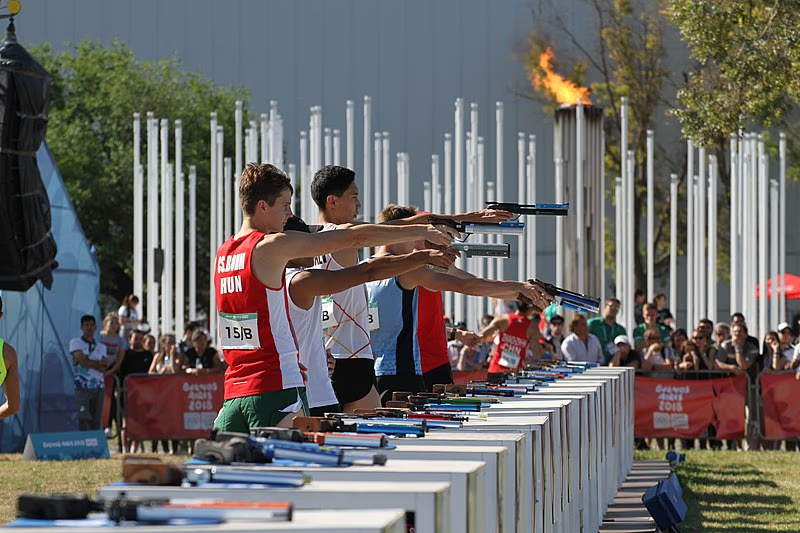
- Laser pistol: Fires an infrared beam (no projectile, no ammunition). The beam registers on an electronic target. Maximum weight 1.5 kg (3.3 lb). Semi-automatic firing (one trigger pull per shot).
- Grip: No restrictions on grip modifications, orthopedic grips, or palm rests, provided the total pistol weight does not exceed 1.5 kg
- Target: Electronic target display with 5 hit zones. Each hit zone illuminates when struck by the laser. Target resets after each successful hit. Target diameter approximately 59.5 mm (2.3 in) per hit zone.
- Shooting stance: One-handed shooting (pistol held in one hand). Free stance — no restrictions on body position.
2.4 Running Equipment
- Footwear: Standard running shoes. No restrictions on brand or type. Spikes are not typically permitted on paved courses.
- Attire: National federation competition uniform. Race number bib must be visible on the front.
- Timing chip: Transponder attached to the shoe or bib for electronic timing at each shooting station and at the finish line
2.5 Obstacle Course Equipment (2028+)
- Attire: Form-fitting athletic wear suitable for climbing, swinging, and balancing. Grip gloves may be permitted (subject to UIPM regulations).
- Obstacle specifications: Standardized obstacles approved by the UIPM, including climbing walls, balance beams, hanging obstacles, cargo nets, and traversal challenges. Specific obstacles and configurations are defined in the UIPM Obstacle Course Rules (still under development for the LA 2028 format).
- Safety harness: May be required for elevated obstacles depending on course design
Section 3: Playing Area
3.1 Fencing Venue
- Piste: Standard fencing piste, 14 m (46 ft) long and 1.5–2 m (5–6.5 ft) wide, with metallic or conductive surface for electronic scoring
- Multiple pistes: Multiple pistes set up simultaneously to accommodate the round-robin format within the competition time frame (typically 4–6 pistes running concurrently)
- Scoring display: Electronic scoring apparatus at each piste with colored lights indicating valid touches
- Warm-up area: Separate warm-up pistes must be available for athletes awaiting bouts
3.2 Swimming Venue
- Pool: 50 m Olympic pool or 25 m short-course pool (25 m pool requires 200 m = 8 lengths). Must meet World Aquatics standards.
- Lane assignment: Athletes are assigned lanes based on seeding (fastest seeds in center lanes)
- Timing: Electronic touchpad timing to 1/100th of a second
- Water temperature: 25–28°C (77–82°F) per World Aquatics regulations
3.3 Obstacle Course Venue (2028+)
- Course design: A purpose-built obstacle course approximately 100–200 m in length featuring sequential obstacles of increasing difficulty
- Obstacle types: Climbing walls, cargo net traversals, balance beams over water or padding, hanging ring sequences, warped walls, salmon ladders, and rope swings. The exact obstacle set is standardized by UIPM for each competition.
- Completion criteria: Athletes must successfully complete each obstacle to advance. Failure at an obstacle results in penalty points or a mandatory bypass with time penalty.
- Safety features: Crash mats, water pits, and padded landing zones beneath elevated obstacles
3.4 Laser Run Course
- Running circuit: 4 laps of 800 m each (3,200 m total running distance). Flat or gently undulating course, typically within or adjacent to the stadium for spectator viewing.
- Shooting range: Positioned at the start/finish area of each lap. Athletes run to the range, shoot, then depart for the next running lap. Shooting station has individual positions for each athlete (one target per athlete).
- Target distance: 10 m (32.8 ft) from the shooting line to the electronic target
- Shooting lane width: Minimum 1 m (3.3 ft) per athlete
- Transition zone: Clearly marked area where athletes enter and exit the shooting range
3.5 Venue Philosophy
The UIPM strongly encourages all disciplines to be held at a single venue or within a compact venue cluster to create a stadium-show atmosphere and allow spectators to follow the entire competition. The Laser Run, as the final event with its handicap start, serves as the dramatic climax where the first athlete across the finish line wins the gold medal.
Section 4: Players & Officials
4.1 Competitors
- Individual competition: 36 athletes per Olympic event (18 men, 18 women). All athletes compete in all five disciplines on the same day.
- Age requirement: Minimum 18 years old in the calendar year of competition
- Qualification: Athletes qualify through the UIPM World Ranking system, Continental Championships, and qualification events. Host nation and Tripartite Commission invitations ensure global representation.
- Maximum per nation: 2 athletes per country per gender
- Physical demands: Pentathletes must be elite-level in multiple disparate sports — fencing reflexes, swimming speed, obstacle agility, shooting precision under fatigue, and running endurance. Athletes typically train 6–8 hours per day across multiple disciplines.
4.2 Officials by Discipline
- Fencing: FIE-licensed referees oversee each piste. A Fencing Director coordinates the round-robin schedule and resolves disputes. Bout committee tracks victories and results.
- Swimming: World Aquatics-certified officials including a starter, stroke judges, turn judges, and timekeepers
- Obstacle Course: UIPM-trained obstacle judges at each obstacle to determine successful completion or failure. Chief Obstacle Judge oversees the course.
- Laser Run: Range officers supervise the shooting stations and ensure safe handling of laser pistols. Running marshals monitor the course. Timing officials record transitions and finish times.
4.3 Competition Management
- UIPM Technical Delegate: The most senior official at the competition. Responsible for ensuring all UIPM rules are followed, approving the schedule and venues, and making final decisions on protests.
- Competition Committee: Composed of the Technical Delegate, discipline directors, and a representative of the athletes. Handles protests and appeals.
- Anti-doping: WADA-compliant testing conducted at all UIPM events. In-competition and out-of-competition testing. Athletes are subject to the UIPM Anti-Doping Rules.
- Results system: Centralized electronic results system tracks points across all disciplines, calculates handicap times for the Laser Run, and produces real-time rankings for broadcast.
Section 5: Rules of Play
5.1 Fencing — Ranking Round
- Format: Full round-robin — every athlete fences every other athlete in one-touch épée bouts
- Bout duration: 1 minute per bout. If no touch is scored within 1 minute, both athletes are recorded as having lost (double defeat).
- Scoring: A victory = 1 point. A defeat (including double defeat) = 0 points. Total victories are tallied after the round-robin.
- Points conversion: The athlete who achieves 70% victories receives a baseline of 250 points. Each additional victory above 70% adds points; each victory below 70% subtracts points. The exact formula is defined in the UIPM Competition Rules.
- Bonus Round: After the ranking round, athletes are seeded into a bonus round (single-elimination bracket) for additional points. Each bout in the bonus round is one-touch, 45 seconds. Winners earn bonus points, losers receive no deduction.
- Rules applied: FIE épée fencing rules govern all bouts, including right of attack, target area (entire body), and electronic scoring
5.2 Swimming — 200 m Freestyle
- Distance: 200 m freestyle (any stroke permitted, though front crawl is universally used for speed)
- Pool: Athletes swim in heats, seeded by personal best times. The fastest seeds swim in the final heat for competitive motivation.
- Timing: Electronic touchpad timing to 1/100th of a second
- Points conversion: A baseline time of 2:30.00 = 250 points. For every 0.33 seconds faster, 1 point is added. For every 0.33 seconds slower, 1 point is deducted. For example: 2:00.00 ≈ 341 points; 3:00.00 ≈ 159 points.
- Rules applied: World Aquatics rules govern the swim, including start procedures, stroke legality, turn rules, and disqualification criteria (false start, illegal turn, etc.)
5.3 Obstacle Course (2028+)
- Format: Timed run through a sequential series of obstacles. Each athlete runs the course individually.
- Completion: Athletes must complete each obstacle to continue. Falling off or failing an obstacle results in either a time penalty (typically 10 seconds) or a mandatory restart of that obstacle (with accumulated time).
- Maximum attempts: Athletes may have a limited number of attempts at each obstacle (typically 2–3) before receiving a bypass penalty and moving to the next obstacle.
- Points conversion: Time-based scoring converted to points using a formula similar to the swimming conversion. The baseline time and conversion rate are set by the UIPM for each standardized course configuration.
5.4 Laser Run — Combined Running and Shooting
- Handicap start: Athletes start in order of their cumulative points from fencing, swimming, and obstacle course. The leader starts first. Each point difference = 1 second of time deficit. This system means the first athlete to cross the finish line wins the gold medal, creating a dramatic, television-friendly finish.
- Structure: 4 shooting series, each followed by an 800 m running lap (shoot-run-shoot-run-shoot-run-shoot-run).
- Shooting series: At each shooting stop, the athlete must hit 5 targets. Each hit extinguishes one of the 5 lit zones on the electronic target. The athlete shoots as many times as needed to hit all 5 targets.
- Time limit per shooting series: 50 seconds. If 5 targets are not hit within 50 seconds, the remaining targets are automatically extinguished and the athlete departs for the running lap. This effectively penalizes poor shooting with lost time.
- Target distance: 10 m from the shooting line
- Running laps: 4 × 800 m on a flat course. Athletes run from the shooting range, complete the lap, and return to the range for the next shooting series.
- Finish: After the 4th running lap, athletes cross the finish line. The first to cross wins the overall competition.
5.5 Competition Day Schedule
All five disciplines are completed in a single day (approximately 5–6 hours of competition time). A typical schedule:
- Morning: Fencing ranking round and bonus round (2–3 hours)
- Midday: Swimming heats (1 hour)
- Afternoon: Obstacle course (1 hour)
- Late afternoon/evening: Laser Run finale (30–40 minutes)
Section 6: Scoring
6.1 Points-Based System
Each discipline produces a point score. Points from fencing, swimming, and obstacle course are summed to determine the Laser Run start order. The overall winner is determined by the Laser Run finish order (not by total points).
6.2 Fencing Points
- Baseline: 250 points for achieving 70% victories in the ranking round
- Adjustment: Points added or subtracted based on victory percentage above or below 70%
- Bonus round: Additional points earned through the single-elimination bracket (typically 20–40 bonus points available)
- Typical range: 180–300 points depending on performance in a field of 36 athletes
6.3 Swimming Points
- Baseline: 250 points for a time of 2:30.00
- Conversion: 1 point per 0.33 seconds faster or slower than the baseline
- Typical range: 280–340 points for elite pentathletes (typical times 1:55–2:15)
- No minimum score: Points are never negative; athletes completing the swim always receive points
6.4 Obstacle Course Points (2028+)
- Time-based: Completion time (including penalty time for failed obstacles) converted to points
- Baseline and conversion rate: Determined by the UIPM for the specific standardized course used at each competition
- Penalty for failed obstacles: Fixed time addition (typically 10 seconds per failure) added to the course completion time
6.5 Laser Run (Overall Result)
- Handicap start: The athlete with the most cumulative points (from fencing + swimming + obstacle course) starts first. Each point difference between athletes = 1 second of time gap at the start.
- Winning: The first athlete to cross the finish line wins the gold medal, regardless of total points accumulated in earlier disciplines. The Laser Run is designed so that the race result IS the final result.
- Example: If Athlete A has 780 points and Athlete B has 760 points, Athlete A starts 20 seconds ahead of Athlete B. If Athlete B is faster in the Laser Run by more than 20 seconds, Athlete B overtakes and wins.
6.6 Tiebreaking
- Ties in the Laser Run are resolved by photo finish (time recorded to 1/100th of a second)
- Ties in fencing are broken by the indicator (touches scored minus touches received)
- Ties in swimming are broken by the photo finish timing
Section 7: Violations & Penalties
7.1 Fencing Violations
- Corps-à-corps (body contact): Penalty touch awarded to the opponent if the contact is deliberate. Accidental contact results in halt and restart.
- Covering target: Deliberately using the non-weapon hand to cover valid target area — penalty touch
- Turning back to opponent: Penalty touch. In épée, the entire body is target, but turning the back is still considered dangerous.
- Refusal to fight: If both athletes are passive and no touch is scored in the 1-minute bout, both are recorded as losers (double defeat)
- Equipment failure: If equipment fails during a bout, the athlete is given time to replace it. Repeated failures may result in the bout being awarded to the opponent.
7.2 Swimming Violations
- False start: One false start per athlete. Second false start = disqualification from that heat (applies World Aquatics rules).
- Stroke violation: Any stroke is permitted in freestyle, but touching the wall during turns must follow World Aquatics rules (one hand touch for backstroke, two-hand touch for breaststroke/butterfly if those strokes are used).
- Lane violation: Interfering with another swimmer by crossing lane lines = disqualification from the heat
- Unsportsmanlike conduct: Warning or disqualification from the swimming discipline
7.3 Laser Run Violations
- Shooting station: Athletes must stand behind the shooting line. Stepping over the line during a shooting series results in a warning. Repeated offense = 10-second time penalty.
- Pistol handling: The laser pistol may only be pointed at the target. Pointing the pistol in any other direction (even though it fires only a laser beam) results in a warning for unsafe handling.
- Time limit: Failure to hit all 5 targets within 50 seconds does not result in a penalty — the targets automatically extinguish and the athlete departs. The time lost while shooting is the inherent penalty.
- Interference: Deliberately obstructing, pushing, or impeding another athlete during running = yellow card (warning) or red card (time penalty).
- Course cutting: Leaving the marked running course to gain an advantage = disqualification
7.4 General Violations
- Unsportsmanlike conduct: Yellow card (first warning), red card (point/time penalty), black card (disqualification and removal from the competition)
- Anti-doping: WADA anti-doping rules apply. Positive tests result in disqualification of all results and potential suspension of 2–4 years.
- Failure to compete: An athlete who does not start or complete any one of the five disciplines is marked as DNF (Did Not Finish) for the overall competition and receives no ranking
- Late arrival: An athlete who arrives late for their scheduled discipline may be permitted to compete at the discretion of the Technical Delegate, but will receive no extra time or accommodation
Section 8: Safety Considerations
8.1 Fencing Safety
- All fencing equipment must pass FIE safety checks before competition, including mask strength tests, jacket penetration resistance, and weapon inspection
- Body wires and electrical connections are inspected before each bout
- A fencing doctor or paramedic must be present at the fencing venue throughout the competition
- Broken blades: if a blade breaks during a bout, the bout is halted immediately and the athlete is given a replacement weapon
8.2 Swimming Safety
- Standard pool safety per World Aquatics: lifeguards on duty, water temperature monitored, lane ropes in place
- Pool depth must be a minimum of 1.35 m (4 ft 5 in) at the starting end (no diving-related injuries at proper depth)
- Medical team with resuscitation equipment must be present poolside
8.3 Laser Pistol Safety
- Laser pistols are inherently safe — they fire no projectile and the infrared beam is eye-safe at the operating power level
- Despite the absence of physical danger, athletes must treat the pistol as if it were a live firearm for training discipline: never point at people, always point downrange
- Range officers supervise the shooting station and may remove an athlete for unsafe handling
- The laser system replaced lead pellet pistols (used until 2008) and air pistols (2008–2011) specifically to eliminate projectile safety concerns and enable the combined Laser Run format
8.4 Obstacle Course Safety (2028+)
- All obstacles are designed with certified crash mats, padded surfaces, and water pits beneath elevated elements
- Maximum fall height is limited by UIPM regulations (typically no more than 3 m / 10 ft above a padded surface)
- Safety spotters may be positioned at obstacles with the highest failure rate
- Course inspection by the UIPM Technical Delegate is mandatory before competition
- Athletes must complete a course familiarization session before competition day
8.5 General Medical Provisions
- A comprehensive medical team must be available throughout the entire competition day, covering all venues
- An ambulance must be on standby with access to the venue
- Heat management protocols for outdoor events: cooling stations, ice towels, modified schedules if temperatures exceed 32°C (90°F)
- Athletes may withdraw from any discipline on medical advice without penalty to their competition status for future events (they receive a DNF for the current competition only)





