
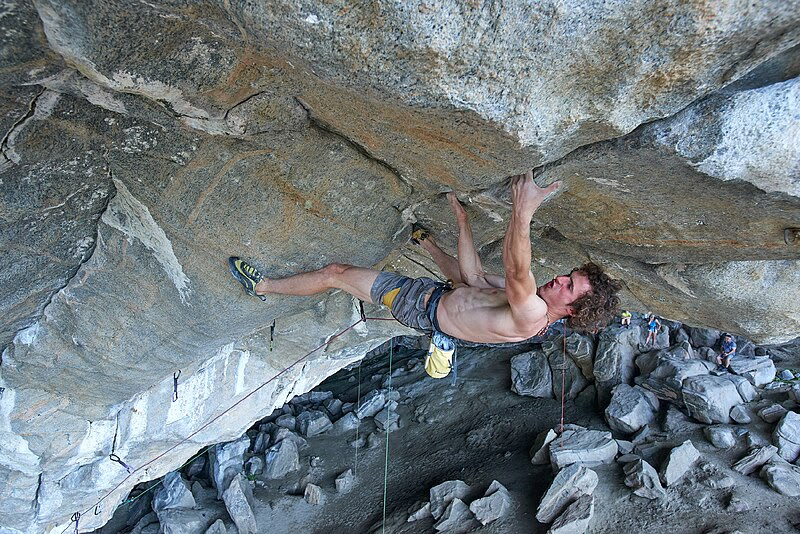


















Section 1: Introduction
1.1 Overview and Governing Body
Sport climbing made its Olympic debut at the postponed 2020 Tokyo Games in 2021, bringing competitive climbing to the world's biggest stage for the first time. The International Federation of Sport Climbing (IFSC), founded in 2007 as a spin-off from the UIAA (International Climbing and Mountaineering Federation), governs all international competitive climbing under the IFSC Rules. The IFSC is headquartered in Turin, Italy, and oversees competition in over 90 member national federations.
1.2 Olympic Disciplines
Three disciplines form the foundation of competitive sport climbing. The Olympic format has evolved between its first two appearances:
- Lead Climbing: Athletes attempt to climb as high as possible on a tall, overhanging wall within a time limit. Roped for safety. The route is designed so that no climber is expected to reach the top easily — the highest hold reached determines the score.
- Bouldering: Athletes solve short, intensely difficult "problems" on a low wall without ropes, protected by crash mats. Multiple problems per round, scored by tops (completions) and zones (intermediate holds reached), with fewer attempts ranking higher.
- Speed Climbing: A pure race up a standardized 15 m wall with identical holds and route worldwide. Head-to-head elimination bracket format. World-class times are under 5 seconds for men and under 6.5 seconds for women.
1.3 Olympic Format Evolution
- Tokyo 2020: Only 2 medal events (men/women). All three disciplines combined into a single event. Athletes competed in all three, with final rankings determined by multiplying placements (e.g., 1st in lead × 3rd in boulder × 2nd in speed = 6). Lowest product wins. This format was controversial because speed specialists are typically not competitive in lead/boulder and vice versa.
- Paris 2024: 4 medal events. Speed became a standalone event with its own medal. Boulder & Lead were combined into a single event with a points-based scoring system. This allowed specialists to compete in their strengths.
- LA 2028: Expected to continue the Paris 2024 format with Speed as a standalone event and Boulder & Lead combined.
1.4 Competition Circuit
- IFSC World Cup: Annual series of international events (typically 12–16 events per season) awarding ranking points for Olympic qualification
- IFSC World Championships: Annual championship with medals in each discipline and combined events
- Continental Championships: Regional competitions contributing to Olympic qualification pathways
- Olympic qualification: Based on IFSC rankings, continental quotas, and host nation allocation. Typically 20 athletes per gender per event at the Olympics.
Section 2: Equipment
2.1 Climbing Shoes
- Design: Specialized tight-fitting shoes with smooth rubber soles (no tread pattern) designed to maximize friction and precision on small footholds. Downturned (cambered) toe profile for hooking and pulling on holds.
- Restrictions: No minimum or maximum sole thickness. No mechanical aids (springs, suction devices, magnets) permitted within the shoe. Shoes must not leave marks or residue on the wall or holds.
- Athletes' choice: Athletes typically carry multiple pairs — softer shoes for bouldering (sensitivity on small holds), stiffer shoes for lead (endurance and edging), and speed-specific shoes (maximum rubber contact for the standardized wall).
2.2 Chalk
- Dry chalk: Magnesium carbonate (MgCO₃) in powder or block form. Carried in a chalk bag worn on the waist (lead) or placed at the base of the wall (bouldering).
- Liquid chalk: Magnesium carbonate suspended in alcohol solution. Applied to hands before the attempt; the alcohol evaporates, leaving a chalk layer. Permitted and commonly used, especially in bouldering.
- Prohibited substances: Rosin, pine tar, sticky sprays, or any adhesive substance that enhances grip beyond chalk is prohibited. Tape is permitted on fingers (for skin protection) but must not enhance friction.
2.3 Harness and Rope (Lead and Speed)
- Harness: Standard climbing harness meeting EN 12277 or UIAA safety standards. Worn for Lead and Speed climbing. Athletes provide their own harness.
- Rope (Lead): Dynamic climbing rope provided by the organizer. Typically 10–11 mm diameter. Belayed by trained and certified staff using assisted-braking belay devices.
- Auto-belay (Speed): Mechanical auto-belay device attached to the top of the speed wall. Automatically takes up slack as the climber ascends and lowers them safely upon release. Inspected before each session.
- Quickdraws (Lead): Pre-placed on the wall by the route setters. Athletes clip the rope through quickdraws as they ascend. Failure to clip a quickdraw before climbing above it may result in a safety-related attempt termination.
2.4 Attire
- National federation competition uniform at Olympic events
- Competition bib or number must be visible on the back (lead/boulder) or front (speed)
- No jewelry that could catch on holds or equipment
- Hair must be secured so it does not obscure the competitor number or interfere with climbing
- No headphones, communication devices, or electronic devices permitted during competition
Section 3: Playing Area
3.1 Speed Wall
- Height: 15.0 m (49.2 ft)
- Angle: 5 degrees overhanging from vertical
- Route: Completely standardized — identical hold types, sizes, positions, and spacing at every IFSC competition worldwide. The route was designed in 2007 and has never been changed, allowing direct comparison of times across all events and eras.
- Lanes: Two parallel lanes (Lane A and Lane B) set side by side, separated by a partition. Athletes race head-to-head, one in each lane.
- Timing: Electronic timing system triggered by the climber's hand leaving the start pad at the base and stopped when the climber strikes the finish pad at the top. Recorded to 1/1000th of a second (0.001 s).
- Start pads: Pressure-sensitive pads at the base of the wall. Both feet must be on the start pad, both hands on designated start holds. The climber launches when the start signal sounds.
- Finish pad: A large, touch-sensitive pad at the top of the wall, approximately 30 × 30 cm. The timer stops when any part of the climber's hand strikes the pad.
3.2 Lead Wall
- Height: 12–15+ m (39–49+ ft). Routes typically extend at least 15 m in climbing distance (including traverses and overhangs).
- Angle: Varying angles of overhang, typically 15–45 degrees from vertical in different sections. The wall profile may include slabs (less than vertical), vertical sections, and steeply overhanging sections.
- Route: Uniquely set for each competition by the IFSC-certified route setting team. Routes are designed to be progressively more difficult, with the crux (hardest section) near the top. The goal is that only the best climbers reach the top.
- Hold variety: Routes use a wide variety of hold types: crimps (small edges), slopers (rounded holds), pinches, jugs (large positive holds), pockets, volumes (large geometric features bolted to the wall), and underclings.
- Quickdraws: Pre-placed at intervals along the route. Athletes must clip the rope into each quickdraw as they pass it. Skipping a quickdraw is a safety violation.
3.3 Boulder Wall
- Height: 4.0–4.5 m (13.1–14.8 ft) maximum
- Angle: Varies by problem — from slightly less than vertical (slab) to severely overhanging (45+ degrees). Roof sections (horizontal or nearly horizontal) are common.
- Problems: 4 or 5 problems set per round (qualification, semifinal, final). Each problem is a distinct sequence of moves with a designated start position, zone hold (intermediate checkpoint), and top hold (finish).
- Safety mats: High-density foam crash mats covering the entire landing zone beneath the wall. Minimum thickness 40 cm (15.7 in). Mats extend at least 2 m beyond the climbing area in all directions.
- Hold marking: Start holds, zone hold, and top hold are clearly marked with tape or color-coded for each problem
3.4 Isolation Zone
A critical element of competitive climbing venues:
- Purpose: Athletes are held in a designated isolation area before their competition round to prevent them from seeing other competitors climb the routes/problems. This ensures all athletes face the routes with equal information.
- Facilities: Must include warm-up walls (smaller climbing walls with generic holds), rest areas, refreshments, and toilet facilities
- Communication blackout: No electronic devices, communication with coaches outside isolation, or access to video feeds of the competition. Athletes may not observe other competitors' attempts.
- Observation period: Before each round, athletes are brought from isolation to the competition wall for a limited observation period (typically 2–6 minutes for bouldering, 6 minutes for lead) where they study the route/problems from the ground without touching the wall.
Section 4: Players & Officials
4.1 Competitors
- Individual sport: All events are individual competitions
- Olympic field: Typically 20 athletes per gender per event (Speed; Boulder & Lead Combined)
- Qualification: Based on IFSC World Rankings, Continental Championships, and the IFSC Olympic Qualification Series. Host nation guaranteed at least one spot.
- Maximum per country: Typically 2 athletes per country per event at the Olympics
- Age: Athletes must be at least 16 years old in the year of the competition (18 for Speed at the Olympics)
4.2 Route Setters
Route setters are among the most important officials in sport climbing — they design the problems and routes that determine the competition:
- Chief route setter: IFSC-certified. Leads the route setting team and has final authority on route/problem design.
- Setting team: Typically 4–8 setters who work together to design, test, and refine routes. Setters physically climb the routes during the setting process to verify difficulty and movement quality.
- Forerunners: Test climbers (typically national-team-level athletes not competing) who climb the routes/problems before competition to verify difficulty, safety, and quality. Their feedback may result in holds being changed or routes being modified.
- Design goals: Routes should create separation between competitors (not everyone tops, not everyone fails at the same point). Problems should reward skillful climbing technique rather than pure strength or reach.
4.3 Judges and Officials
- IFSC judges: Certified judges positioned at each boulder problem and on the lead wall. For bouldering, judges verify the start position, zone attainment, and top attainment. For lead, judges track the highest hold reached.
- Chief Judge: Overall authority on competition rules and scoring decisions. Handles protests and appeals in conjunction with the IFSC Jury.
- Speed timing judges: Oversee the electronic timing system, verify false starts, and confirm finish times
- Isolation officials: Monitor the isolation zone to ensure compliance with communication and observation rules
- Video review: Available for disputed holds in lead and bouldering. Cameras cover every angle of the climbing wall.
Section 5: Rules of Play
5.1 Speed Climbing
- Qualification: Each athlete climbs the standardized route twice (2 attempts). The best time is their qualification result. The fastest 16 athletes advance to the head-to-head bracket.
- Bracket: Seeded bracket (1 vs 16, 2 vs 15, etc.). Best of 1 race per matchup in early rounds; best of 1 in all rounds. Winner advances, loser is eliminated. Continues through quarterfinals, semifinals, and the gold-medal race.
- Start procedure: Both athletes set up on start pads. An electronic start sequence provides "Ready" (hands on designated holds, feet on pad), a random pause (1–3 seconds), then the start tone. The athlete's time begins when their hand leaves the start pad.
- False start: If an athlete leaves the start pad before the tone, it is a false start. Under current IFSC rules, one false start per lane per race is permitted. The second false start by the same athlete = loss of that race.
- World records: Men's world record is approximately 4.79 seconds. Women's world record is approximately 6.24 seconds (records continue to fall as the discipline evolves).
5.2 Lead Climbing
- Time limit: 6 minutes from the start signal. A warning buzzer sounds at 5 minutes.
- One attempt only: Athletes get a single attempt on the route. Once they fall or their time expires, their attempt is over.
- Starting: Athletes start with both hands on designated start holds and both feet on start footholds or the ground. The clock starts on the official signal.
- Clipping: Athletes must clip the rope into each quickdraw in sequence as they ascend. Climbing significantly above a quickdraw without clipping it may result in the judge stopping the attempt for safety reasons.
- Scoring: Judged by the highest hold reached. Each hold on the route is assigned a sequential number. If the climber controls the hold (both hands have been on it and it is being used for upward progress), they are credited with that hold number. A "+" is added if the climber made a controlled movement toward the next hold but did not reach it.
- TOP: If the climber reaches and controls the final hold (top of the route), they score "TOP" — the maximum possible result.
5.3 Bouldering
- Problems per round: 4 problems in the final (5 in qualification at World Cup events). Each problem is a separate challenge with its own start, zone, and top.
- Time limit: 4 minutes per problem in World Cup events; 5 minutes per problem at the Olympics. A countdown clock is visible to the athlete.
- Start position: Both hands on designated start holds, both feet off the ground. The judge confirms the start position is correct before the clock begins.
- Zone hold: An intermediate hold partway up the problem. Reaching the zone hold (controlling it with at least one hand) is scored and counts toward the ranking. The zone rewards athletes who make progress even if they don't complete the problem.
- Top hold: The final hold at the top of the problem. The athlete must control the top hold with both hands in a stable position for the judge to confirm "TOP."
- Attempts: Athletes may make as many attempts as they want within the time limit. Each attempt (starting from the ground and falling or stepping off) is counted. Fewer attempts = better ranking when tops/zones are equal.
- Reading time: Athletes observe each problem from a designated viewing area during the observation period. No touching the wall or holds during observation.
5.4 Boulder & Lead Combined (Paris 2024+ Format)
- Two-discipline event: Athletes compete in both bouldering and lead climbing rounds
- Scoring: Points-based system. Each athlete receives points based on their ranking in each discipline (bouldering and lead). Points from both disciplines are summed for a combined ranking.
- Qualification: All athletes compete in bouldering qualification and lead qualification. Top athletes advance to the final round.
- Final: Bouldering final followed by lead final. Combined points determine the medal rankings.
- Advantage over Tokyo format: The multiplication scoring used in Tokyo was replaced because it disproportionately punished a single bad result. The additive points system is considered more equitable.
Section 6: Scoring
6.1 Speed Scoring
- Qualification: Fastest time from 2 attempts determines seeding position. Times recorded to 1/1000th of a second.
- Bracket: Winner of each head-to-head race advances. If an athlete falls, their opponent wins the race. If both athletes fall, the one who climbed higher (or fell later) wins.
- False start: First false start = re-run. Second false start by the same athlete = loss of that race.
- Photo finish: Electronic timing determines the winner. In the event of a system failure, backup video timing is used.
6.2 Lead Scoring
- Hold number: Each hold on the route is assigned a sequential number from the start. The highest hold controlled by the climber is their score.
- Plus (+): If the climber made a controlled, positive movement toward the next hold but did not reach it, a "+" is added to their score (e.g., 32+ is better than 32 but worse than 33).
- TOP: Controlling the final hold. All climbers who TOP are ranked equally for that route (with tiebreaking by time to TOP if needed).
- Rankings: Higher hold number = higher ranking. Among athletes with the same hold number, "+" beats no "+".
- Tiebreaking: If athletes are tied after the final, their scores from previous rounds (qualification, semifinal) are compared. If still tied, the tie stands and both receive the higher ranking.
6.3 Bouldering Scoring
- Primary criteria: Number of TOPS (problems completed). More tops = higher ranking.
- Secondary criteria: Number of ZONES reached. Among athletes with equal tops, more zones = higher ranking.
- Tertiary criteria: Number of attempts to reach tops. Among athletes with equal tops and zones, fewer attempts to top = higher ranking.
- Quaternary criteria: Number of attempts to reach zones. Fewer zone attempts = higher ranking if all above are equal.
- Example: Athlete A: 3T 4Z 5a(T) 6a(Z) beats Athlete B: 3T 4Z 7a(T) 8a(Z) — same tops and zones, but A needed fewer attempts.
6.4 Combined Scoring (Paris 2024+)
- Points system: Each athlete receives ranking points based on their placement in each discipline (bouldering rank + lead rank). Lower combined points = higher combined ranking.
- Example: An athlete ranked 2nd in bouldering and 3rd in lead receives 5 points. An athlete ranked 1st in bouldering and 5th in lead receives 6 points. The first athlete ranks higher overall.
- Tiebreaking: If combined points are equal, the athlete with the higher single-discipline ranking (best individual result) breaks the tie.
Section 7: Violations & Penalties
7.1 Attempt Termination
An attempt is terminated (the climber must stop and is scored at their current point) in the following situations:
- Fall: The climber detaches from the wall (caught by rope in lead, lands on mat in bouldering)
- Time limit exceeded: The clock runs out (6 minutes for lead, 4–5 minutes per boulder problem)
- Using an artificial aid: Using a bolt, screw, quickdraw, wall edge, or any feature not intended as a hold. The attempt is terminated at the last legitimately held position.
- Using a hold from an adjacent route: Touching or using a hold that belongs to a different route or problem. Attempt is voided.
- Skipping a quickdraw (Lead): Climbing significantly above an unclipped quickdraw creates a dangerous fall potential. The judge may stop the attempt for safety.
- Starting incorrectly (Bouldering): Not using the designated start holds in the correct position. The attempt does not count, but the athlete may restart within the time limit.
7.2 Speed Violations
- False start: Leaving the start pad before the start tone. First false start per athlete per race = re-run. Second false start by the same athlete = loss of that race.
- Lane interference: Reaching across the partition into the opponent's lane (extremely rare due to wall design). Loss of the race.
- Equipment failure: If the auto-belay system malfunctions or the timing system fails, the race is re-run. Equipment failures are not counted as attempts.
7.3 Isolation Zone Violations
- Communication breach: Receiving information about the routes or problems from outside the isolation zone (via phone, messaging, coaching signals). Penalty: yellow card (warning) or disqualification depending on severity and whether the information conveyed was substantive.
- Electronic device use: Using a phone, tablet, or any device capable of receiving external communication while in isolation. Penalty: yellow card or disqualification.
- Leaving isolation: An athlete who leaves the isolation zone without permission is not allowed to return and receives a DNF for the remaining problems/routes.
7.4 Protests and Appeals
- Protests must be filed verbally to the Chief Judge within 5 minutes of the disputed score being displayed
- A written protest with a protest fee (refundable if upheld) must follow within 30 minutes
- Video review is the primary evidence for resolving disputed holds, touches, and times
- The IFSC Jury (composed of the Chief Judge, Technical Delegate, and athletes' representative) makes the final ruling
- Appeal beyond the Jury is possible to the IFSC Appeals Tribunal, but only on procedural grounds (not judgement calls)
Section 8: Safety Considerations
8.1 Lead Climbing Safety
- Belayers: Trained, IFSC-certified belayers provided by the organizer. Belayers use assisted-braking belay devices (e.g., GriGri) and follow standardized belaying protocols to ensure safe catch during falls.
- Rope inspection: All ropes are inspected before each competition session. Ropes are retired after a set number of sessions or after any significant fall.
- Quickdraw placement: Route setters ensure quickdraws are placed at appropriate intervals so that fall distances are within safe limits. The first quickdraw must be low enough that a fall before clipping it does not result in a ground fall.
- Fall zone: The area beneath the climbing wall must be clear of obstacles, equipment, and personnel. Only the belayer and the judge are permitted in the immediate fall zone.
8.2 Bouldering Safety
- Crash mats: High-density foam mats covering the entire landing zone. Minimum thickness 40 cm (15.7 in). Mats must extend at least 2 m beyond the climbing area in all directions. No gaps between mats.
- Wall height: Maximum 4.5 m to ensure falls are within a manageable height for matted landings
- Spotters: In World Cup competition, designated spotters may be positioned near the wall during early problems to guide falling athletes away from mat edges. In finals, athletes typically self-spot with mat positioning.
- Problem design: Route setters must ensure that the trajectory of a fall from any point on the problem lands the climber on the crash mats. Problems that would result in falls toward the audience, off the edge of the mat, or into wall features are redesigned.
8.3 Speed Climbing Safety
- Auto-belay: Mechanical auto-belay devices are inspected and certified before each competition. Backup safety lines may be used during testing. The auto-belay must lower the climber at a controlled speed (maximum 2 m/s descent rate).
- Start pad: Positioned at a height that allows the athlete to reach the first holds without jumping, minimizing the risk of foot slippage at the start
- Wall surface: Inspected for loose holds, spinning t-nuts, or damaged panels before each session. The standardized route holds are replaced on a regular schedule to maintain consistency.
- Partition: A physical barrier between the two speed lanes prevents athletes from interfering with each other and protects against debris from the adjacent lane.
8.4 Hold and Wall Safety
- Hold inspection: All holds are inspected for spinning (loose t-nuts), cracks, sharp edges, or damage before each competition session. Damaged holds are replaced immediately.
- Wall panels: Structural integrity of wall panels and support framework is inspected before each event. Load testing may be required for temporary or modular walls.
- Volume attachment: Large volumes (geometric features bolted to the wall) must be secured with multiple bolts and tested for rotational stability under load.
- Brushing: Holds are cleaned (brushed with nylon or boar-hair brushes) between rounds to remove excess chalk buildup that could affect grip quality. Route setters determine which holds are brushed.
8.5 Medical and Environmental
- Medical team on-site with capability to treat common climbing injuries: finger pulley injuries, skin tears, minor falls
- Ambulance on standby for serious injuries (rare but possible: ankle sprains from bouldering falls, head impacts)
- For outdoor events: UV protection, hydration stations, and heat management protocols
- Athletes may tape fingers and use hand cream between attempts but may not apply tape during a climbing attempt





