


🏛️Official — UIPM
Loading OpenSourceSports…
Individual Sports
1 players
both
piste, face mask, glove
10 essential rules
Modern pentathlon has been part of the Olympic programme since the 1912 Stockholm Games, making it one of the longest-running Olympic sports. The sport was created by Baron Pierre de Coubertin, the founder of the modern Olympics, to test the skills of a 19th-century military courier who must ride...
Weapon: Épée (thrusting sword). Standard FIE-approved épée with a maximum total weight of 770 g (27.2 oz) and blade length of 90 cm (35.4 in) maximum. Button (point) requires 750 g of pressure to register a touch.; Protective equipment: FIE-certified fencing mask (1600 N bib), fencing jacket (350...
Swimwear: Must comply with World Aquatics (formerly FINA) regulations. Men: jammers or briefs. Women: one-piece swimsuit. No full-body suits (banned since 2010).; Goggles: Permitted. No restrictions on type or brand.; Cap: Required. Must display the athlete's country code or name for identification.
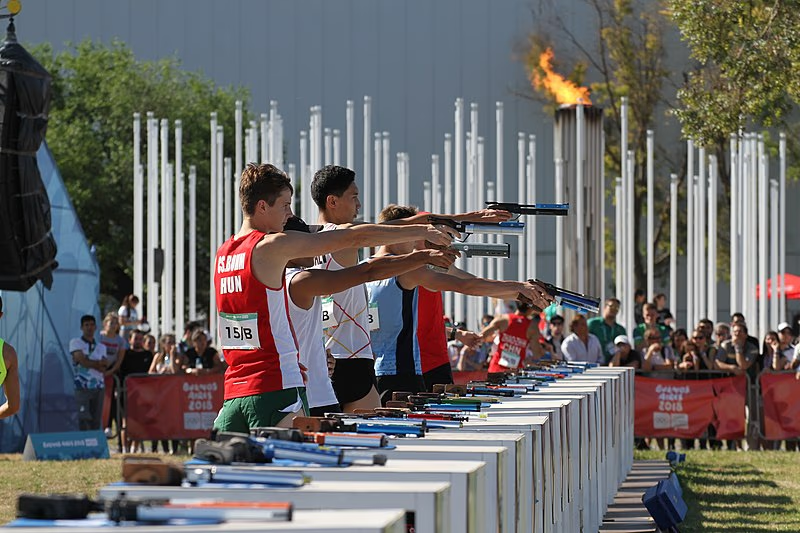
Laser pistol: Fires an infrared beam (no projectile, no ammunition). The beam registers on an electronic target. Maximum weight 1.5 kg (3.3 lb). Semi-automatic firing (one trigger pull per shot).; Grip: No restrictions on grip modifications, orthopedic grips, or palm rests, provided the total pis...
Footwear: Standard running shoes. No restrictions on brand or type. Spikes are not typically permitted on paved courses.; Attire: National federation competition uniform. Race number bib must be visible on the front.; Timing chip: Transponder attached to the shoe or bib for electronic timing at e...
Attire: Form-fitting athletic wear suitable for climbing, swinging, and balancing. Grip gloves may be permitted (subject to UIPM regulations).; Obstacle specifications: Standardized obstacles approved by the UIPM, including climbing walls, balance beams, hanging obstacles, cargo nets, and travers...
Piste: Standard fencing piste, 14 m (46 ft) long and 1.5–2 m (5–6.5 ft) wide, with metallic or conductive surface for electronic scoring; Multiple pistes: Multiple pistes set up simultaneously to accommodate the round-robin format within the competition time frame (typically 4–6 pistes running co...
Pool: 50 m Olympic pool or 25 m short-course pool (25 m pool requires 200 m = 8 lengths). Must meet World Aquatics standards.; Lane assignment: Athletes are assigned lanes based on seeding (fastest seeds in center lanes); Timing: Electronic touchpad timing to 1/100th of a second
Course design: A purpose-built obstacle course approximately 100–200 m in length featuring sequential obstacles of increasing difficulty; Obstacle types: Climbing walls, cargo net traversals, balance beams over water or padding, hanging ring sequences, warped walls, salmon ladders, and rope swing...
Running circuit: 4 laps of 800 m each (3,200 m total running distance). Flat or gently undulating course, typically within or adjacent to the stadium for spectator viewing.; Shooting range: Positioned at the start/finish area of each lap. Athletes run to the range, shoot, then depart for the next...
The UIPM strongly encourages all disciplines to be held at a single venue or within a compact venue cluster to create a stadium-show atmosphere and allow spectators to follow the entire competition...
Never publicly blame your drawn horse
Athletes are randomly assigned horses they have never ridden, with only 20 minutes of familiarization before competing. Criticizing the horse in post-round interviews, on social media, or to officials is considered among the worst sportsmanship failures in the sport. The horse did not choose you; adapting is the competitor's responsibility.
Horses are loaned by local organizers at each competition. Adapting to an unfamiliar animal under pressure is considered a core test of the pentathlete.
Ready to dive deeper?