


















Section 1: Introduction
1.1 Overview and Governing Body
Shooting has been part of every modern Olympic Games since 1896 (absent only in 1904 and 1928), making it one of the original Olympic sports. The International Shooting Sport Federation (ISSF), founded in 1907 and headquartered in Munich, Germany, governs the sport under the ISSF Official Statutes, Rules and Regulations. Olympic shooting comprises three disciplines — Rifle, Pistol, and Shotgun — with 15 medal events at the Games, including mixed team events added in 2020.
1.2 Olympic Events
- Rifle: 10 m Air Rifle (men/women/mixed team), 50 m Rifle 3 Positions (men/women)
- Pistol: 10 m Air Pistol (men/women/mixed team), 25 m Rapid Fire Pistol (men), 25 m Sport Pistol (women)
- Shotgun: Trap (men/women/mixed team), Skeet (men/women/mixed team)
- Mixed team events pair one male and one female shooter from the same nation
1.3 History and Traditions
Target shooting has roots in military marksmanship training dating back centuries. The sport was championed by Pierre de Coubertin, himself an accomplished pistol shooter, for inclusion in the first modern Olympics at Athens 1896. Traditionally strong nations include India, China, South Korea, Germany, Italy, the United States, and Russia. The sport has undergone significant format changes since 2012, with the introduction of elimination-style finals that dramatically increased spectator appeal.
1.4 ISSF Structure
The ISSF oversees more than 160 national member federations organized under continental confederations. The ISSF Technical Committee develops rules and equipment standards, revised on a quadrennial cycle aligned with the Olympic Games. The ISSF World Cup circuit runs annually with multiple stages across the globe, and ISSF World Championships are held every four years in non-Olympic years.
Which section governs what. The ISSF publishes one combined rule book whose parts are numbered, so citations below name the part: Section 6 General Technical Rules for all Shooting Disciplines, 7 Rifle Rules, 8 Pistol Rules, 9 Shotgun Rules. Note the book calls itself Edition 2025 even though the current print took effect on 1 July 2026 — the edition year and the effective date are not the same thing, and third-party copies of the rules frequently conflate them.
Section 2: Equipment
2.1 Air Rifle (10 m)
- Calibre: 4.5 mm (.177 cal) only (ISSF Section 7)
- Maximum weight: 5.5 kg (12.1 lb) including all accessories
- Power source: Pre-charged pneumatic (PCP) or spring-piston; CO2 and gas-powered rifles are prohibited (ISSF Section 7)
- Sights: Aperture (metallic/diopter) sights only — no optical magnification, no laser sights, no electronic aiming aids (ISSF Section 7)
- Trigger: Electronic triggers permitted; no minimum trigger weight for air rifle (ISSF Section 7)
- Stock: Custom stocks permitted (thumb-hole, adjustable butt plate and cheek piece); stock must not extend beyond the hand when holding the pistol grip (ISSF Section 7)
- Pellet: single .177 calibre wadcutter or flat-head pellet per shot (ISSF Section 7)
2.2 Sport Rifle (50 m)
- Calibre: 5.6 mm (.22 LR) rimfire only (ISSF Section 7)
- Maximum weight: 8.0 kg (17.6 lb) including all accessories
- Sights: Aperture sights only (same as 10 m); no telescopic or optical sights (ISSF Section 7)
- Trigger: No minimum trigger weight (ISSF Section 7)
- Used in the 50 m Rifle 3 Positions event (prone, standing, kneeling) (ISSF Section 7)
2.3 Air Pistol (10 m)
- Calibre: 4.5 mm (.177 cal), single-shot (ISSF Section 8)
- Maximum weight: 1.5 kg (3.3 lb)
- Grip: Must not extend above the wrist (no wrist support); the angle between the grip and barrel axis is regulated (ISSF Section 8)
- Trigger: Minimum trigger weight 500 g (1.1 lb)
- Barrel length: Maximum 420 mm (16.5 in) including any barrel extensions
- Open sights only (no aperture, no optical) (ISSF Section 8)
2.4 Rapid Fire Pistol (25 m) and Sport Pistol (25 m)
- Rapid Fire Pistol (men): .22 Short calibre, semi-automatic, 5-round magazine. Maximum weight 1.26 kg (2.78 lb). Trigger minimum 1000 g (2.2 lb).
- Sport Pistol (women): .22 LR calibre, semi-automatic, 5-round magazine. Maximum weight 1.4 kg (3.1 lb). Trigger minimum 1000 g (2.2 lb).
- Both: grip must not extend above the wrist; open sights only (ISSF Section 8)
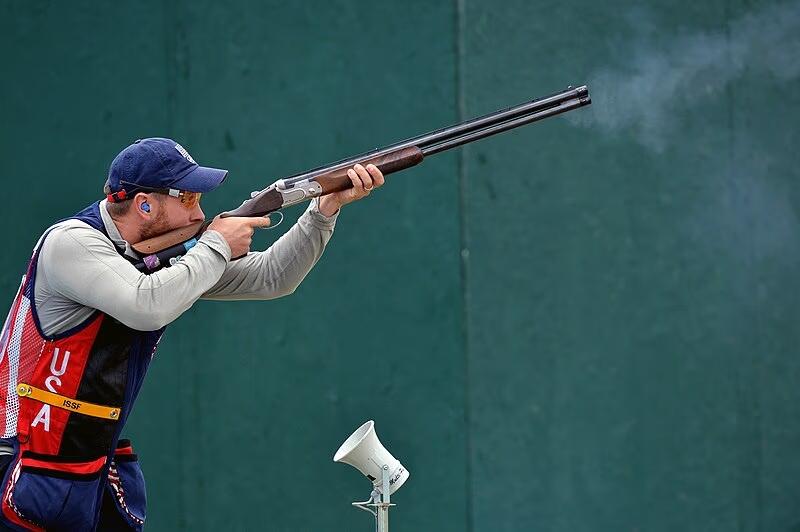
2.5 Shotgun (Trap and Skeet)
- Gauge: 12-gauge maximum (most common); smaller gauges permitted but not competitive at elite level (ISSF Section 9)
- Action types: Over-under (most common), semi-automatic, or side-by-side (ISSF Section 9)
- Ammunition: Maximum load 24 g (0.85 oz) of shot. Maximum shot size 2.5 mm (No. 7½). Lead shot standard (steel shot in some jurisdictions for environmental reasons).
- Barrel length: No maximum restriction; typical competition barrels 71–81 cm (28–32 in) (ISSF Section 9)
- Adjustable stocks, recoil pads, and barrel porting permitted within ISSF equipment rules (ISSF Section 9)
2.6 Shooting Clothing
- Shooting jacket (rifle/pistol): Maximum material thickness regulated by ISSF (measured by stiffness gauge). Provides stabilization for standing and kneeling positions. Must not be so rigid as to constitute a brace or external support (ISSF Section 6).
- Shooting trousers: Maximum stiffness regulated; must allow natural movement (ISSF Section 6)
- Shooting shoes: Maximum sole height 18 mm; sole must be flexible (no rigid platforms). Ankle height restricted to prevent additional support (ISSF Section 6).
- Shooting glove: Single glove on the supporting hand (rifle); maximum padding thickness regulated (ISSF Section 6)
- All clothing items subject to ISSF equipment control checks before competition (ISSF Section 6)
Section 3: Playing Area
3.1 10 m Air Rifle/Pistol Range
- Distance: 10 m (32.8 ft) from firing line to target face
- Indoor facility: Temperature-controlled, enclosed, with consistent lighting (minimum 1500 lux at the target) (ISSF Section 6)
- Firing points: Minimum 1.0 m (3.3 ft) wide per athlete. Separated by partitions to prevent visual distraction.
- Targets: Electronic Scoring Targets (EST) standard at international level; paper targets with scoring gauges used at lower levels (ISSF Section 6)
- Target center height: 1.40 m (4.6 ft) above the floor for rifle (standing); adjustable for pistol
- Spectator galleries separated from the firing line by glass or physical barriers (ISSF Section 6)
3.2 50 m Rifle Range
- Distance: 50 m (164 ft) from firing line to target (ISSF Section 6)
- Outdoor or indoor: Outdoor ranges typical; covered firing points to protect athletes from weather (ISSF Section 6)
- Firing points: Minimum 1.25 m (4.1 ft) wide. Shooting mats provided for prone position.
- Wind flags at intervals along the range to help athletes read wind conditions (a critical variable at 50 m) (ISSF Section 6)
- EST systems with wired or wireless score transmission to the firing point displays (ISSF Section 6)
3.3 25 m Pistol Range
- Distance: 25 m (82 ft) from firing line to targets (ISSF Section 6)
- Rapid Fire Pistol: 5 targets in a row, 0.75 m (2.5 ft) apart (center to center). Targets turn to face the shooter for timed series (electronic turning mechanism).
- Sport Pistol: Single target per firing point; precision and rapid-fire stages (ISSF Section 6)
- Outdoor range with covered firing line; backstop and bullet traps behind targets (ISSF Section 6)
3.4 Trap Range
- Trench: 15 target-throwing machines arranged in 5 groups of 3 (left, center, right) in a trench 15 m (49 ft) in front of the shooting stations (ISSF Section 9)
- Shooting stations: 5 stations in a line, 3 m (9.8 ft) apart. Athletes rotate through all 5 stations during a round.
- Targets (clays): Standard clay targets (110 mm / 4.3 in diameter) launched at varying horizontal angles (up to 45° left or right) and a fixed elevation. Target speed 65–70 m/s at launch (ISSF Section 9).
- Target distance: travel 65–80 m from the trap before falling to ground (ISSF Section 9)
3.5 Skeet Range
- High house: On the left, releases targets at 3.05 m (10 ft) height, travelling left to right (ISSF Section 9)
- Low house: On the right, releases targets at 1.07 m (3.5 ft) height, travelling right to left
- Crossing point: Targets from both houses cross at a defined point above the center of the field (station 8 area) (ISSF Section 9)
- Shooting stations: 8 stations arranged in a semicircle between the two houses. Stations 1–7 are at ground level; station 8 is at the center of the semicircle (ISSF Section 9).
- Athletes shoot singles (one target from one house) and doubles (simultaneous targets from both houses) depending on the station (ISSF Section 9)
Section 4: Players & Officials
4.1 Athlete Qualifications
- Athletes must hold a valid ISSF license and be registered by their national federation
- Olympic quotas allocated through ISSF World Championships, continental championships, and ISSF quota places. Maximum 2 athletes per nation per individual event.
- Minimum Qualification Scores (MQS) must be achieved at recognized competitions within the qualification period
- Mixed team events: one male and one female athlete from the same nation
- Minimum age: 18 for Olympic participation (some national federations have lower minimums for domestic competition)
4.2 Officials
- Range Officer / Chief Range Officer (CRO): Has absolute authority over safety on the firing line. Controls all firing commands (Load, Start, Stop, Unload). May halt firing at any time for safety reasons (ISSF Section 6).
- Jury members: Equipment inspectors verify firearms, ammunition, and clothing compliance. Rule interpreters adjudicate protests and disputes. Typically a 3-person jury per discipline (ISSF Section 6).
- Classifiers / Scorers: Monitor electronic scoring systems; resolve scoring disputes (e.g., shots on the line between two scoring rings). For paper targets, classify shots using ISSF-calibrated scoring gauges (ISSF Section 6).
- Register Officer: Manages athlete check-in, bib assignments, and equipment control scheduling (ISSF Section 6)
- Technical officials (shotgun): Referee per squad (calls hit/miss for each target), assistant referee, target-setting jury (verifies machine settings and target trajectories) (ISSF Section 6)
4.3 Coaching and Support
- Coaches may observe from designated areas but may not communicate with athletes during firing (no coaching during competition) (ISSF Section 6)
- Spotting scopes may be used by the athlete (rifle/pistol) to observe shot placement on the target between shots (ISSF Section 6)
- Team managers handle administrative matters, protests, and equipment logistics (ISSF Section 6)
- Personal technicians may make equipment adjustments during designated preparation periods but not during competition firing (ISSF Section 6)
Section 5: Rules of Play
5.1 10 m Air Rifle
- Qualification: 60 shots in 75 minutes from the standing position (ISSF Section 7)
- Final: Top 8 shooters advance. 24 shots in the final, fired in 2-shot series. After the first 12 shots, the lowest-scoring athlete is eliminated every 2 shots until 2 remain. The last 2-shot series determines gold and silver (ISSF Section 7).
- Athletes shoot from the standing position only (no rest, no support except the shooting jacket) (ISSF Section 7)
- Preparation and sighting time: 15 minutes before qualification begins (ISSF Section 7)
5.2 50 m Rifle 3 Positions
- Qualification: 3×40 shots — 40 kneeling (30 min), 40 prone (30 min), 40 standing (40 min). Total 120 shots (ISSF Section 7).
- Final: Top 8 advance. Final consists of 15 shots kneeling (5 series of 3), 15 shots prone (5 series of 3), then standing shots with elimination (similar to air rifle final format) (ISSF Section 7).
- Positions: Kneeling (one knee down, sitting on the foot), prone (lying flat, body aligned with the rifle), standing (upright, rifle held without support) (ISSF Section 7)
- Position changes during the final include a timed changeover period for the athlete to adjust equipment (ISSF Section 7)
5.3 10 m Air Pistol
- Qualification: 60 shots in 75 minutes from the standing position, one-handed (the non-shooting hand must not touch or support the pistol or shooting arm) (ISSF Section 8)
- Final: Top 8 advance. 24 shots in elimination format (same structure as air rifle final) (ISSF Section 8)
- Athletes stand at an angle to the target, extending the shooting arm toward the target (ISSF Section 8)
5.4 25 m Rapid Fire Pistol (Men)
- Qualification: 60 shots total — 2 stages of 30 shots each. Each stage: 6 series of 5 shots. Time limits per series: 8 seconds (2 series), 6 seconds (2 series), 4 seconds (2 series). Targets turn to face the shooter; athlete must fire 1 shot at each of 5 targets within the time limit (ISSF Section 8).
- Final: Top 6 advance. Series of 5 shots in 4 seconds with elimination after designated series (ISSF Section 8).
- Athletes must lower their arm to a 45° “ready position” between series; raising the arm before the targets turn is a violation (ISSF Section 8)
5.5 25 m Sport Pistol (Women)
- Qualification: 60 shots — 30 precision (6 series of 5 shots, 5 minutes per series) + 30 rapid fire (6 series of 5 shots, 3 seconds per shot) (ISSF Section 8)
- Final: Top 8 advance. Rapid-fire series with elimination (ISSF Section 8).
5.6 Trap (Shotgun)
- Qualification: 125 targets — 5 rounds of 25 targets over 2 days. In each round, athletes rotate through 5 stations, shooting 5 targets per station. One target per shooting turn; one or two shots per target (ISSF Section 9).
- Final: Top 6 advance. 50 targets in the final, shot in 5 rounds of 10. Elimination after designated rounds (ISSF Section 9).
- Athlete calls “Pull” to release the target; must fire before the target passes the effective range (approximately 40 m) (ISSF Section 9)
- Referee calls “Hit” (visible piece broken from the target) or “Lost” (miss). Disputes resolved by the jury (ISSF Section 9).
5.7 Skeet (Shotgun)
- Qualification: 125 targets — 5 rounds of 25 targets over 2 days. Athletes rotate through 8 stations, shooting combinations of singles and doubles depending on the station (ISSF Section 9).
- Final: Top 6 advance. 60 targets in the final. Elimination after designated series (ISSF Section 9).
- Targets launched immediately on the athlete’s “Pull” call (fixed delay random 0–3 seconds for trap; immediate for skeet) (ISSF Section 9)
- Athletes must fire at each target within the designated shooting zone; shooting beyond the boundary markers results in a “No Bird” or miss (ISSF Section 9)
Section 6: Scoring
6.1 Rifle and Pistol Scoring
- Qualification: Integer scoring (whole numbers). The target has 10 concentric rings; the center ring scores 10, the outermost scores 1. A miss scores 0. Maximum per shot: 10 (ISSF Section 6).
- Finals: Decimal scoring with tenths. The 10-ring is subdivided: a perfect center shot scores 10.9, with 10.0 being the outermost edge of the 10-ring. This gives 0.1-point resolution, critical for elimination rounds (ISSF Section 6).
- Inner tens (X-count): In qualification, shots in the innermost circle of the 10-ring (the “X-ring”) are recorded as tiebreakers (ISSF Section 6)
- Maximum qualification score: 600 for 60-shot events (air rifle/pistol), 1200 for 120-shot events (3 Positions) (ISSF Section 6)
6.2 Shotgun Scoring
- Each target is scored as a hit (1) or miss (0) (ISSF Section 9)
- A “hit” requires a visible piece to break from the clay target as determined by the referee (ISSF Section 9)
- Maximum qualification score: 125 (125 targets, 1 point each) (ISSF Section 9)
- “No Bird”: a target that malfunctions, is launched incorrectly, or is broken before the shot — the target is re-thrown (ISSF Section 9)
6.3 Electronic Scoring Targets (EST)
- EST systems use acoustic sensors to detect the exact impact point of the pellet/bullet by measuring sound-wave timing from multiple microphones (ISSF Section 6)
- Scores displayed instantly on a monitor at the athlete’s firing point and on broadcast screens (ISSF Section 6)
- EST systems are calibrated before each competition and verified against reference shots (ISSF Section 6)
- If an EST malfunction occurs, backup scoring (paper targets or manual inspection) may be used (ISSF Section 6)
6.4 Elimination Finals Format
- Top 8 (rifle/pistol) or top 6 (shotgun) from qualification advance to the final (ISSF Section 6)
- Qualification scores are not carried over; the final starts from zero (since 2018 rule change) (ISSF Section 6)
- Athletes fire in designated series; after a set number of shots, the lowest-scoring athlete is eliminated (ISSF Section 6)
- Eliminations continue until 2 athletes remain; the final series determines gold and silver (ISSF Section 6)
- Medal ceremony positions: 1st (gold), 2nd (silver), 3rd (bronze — two bronze medals awarded, one per eliminated semifinalist) (ISSF Section 6)
Section 7: Violations & Penalties
7.1 Equipment Violations
- Shooting jacket/trousers stiffness: Measured by ISSF stiffness gauge before competition. If material exceeds the stiffness limit, the garment must be replaced before the athlete can compete (ISSF Section 6).
- Trigger weight below minimum: Firearm must be adjusted to comply before the athlete may start; if discovered during competition, the shot(s) fired may be annulled (ISSF Section 6)
- Unauthorized modifications: Any modification to the firearm not permitted by ISSF rules (e.g., adding weights, aerodynamic aids, optical sights in events that prohibit them) results in equipment disqualification until the firearm is corrected (ISSF Section 6)
- Ammunition violations: Use of ammunition exceeding the permitted load (shotgun) or calibre results in DSQ (ISSF Section 6)
7.2 Firing Violations
- Cross-fire: Shooting at another athlete’s target (rifle/pistol) — the shot is scored as a miss (0) for the shooter and the affected athlete receives a re-fire opportunity (ISSF Section 6)
- Exceeding time limit: Shots fired after the time expires are scored as misses (0) (ISSF Section 6)
- Premature firing (rapid fire): Raising the pistol before the targets turn — the series is scored as a warning; repeated offense results in a 2-point deduction (ISSF Section 6)
- Accidental discharge: First offense is a warning (yellow card). Second offense is a 2-point deduction (green card). Third offense may result in DSQ (red card) (ISSF Section 6).
- Slow fire: If an athlete delays unreasonably, the CRO may issue a warning; continued delay results in a time limit being imposed (ISSF Section 6)
7.3 Conduct Violations
- Disruptive behavior on the firing line (loud conversation, excessive movement, coaching): warning, then 2-point deduction (ISSF Section 6)
- Refusing to comply with Range Officer commands: immediate removal from the firing line and potential DSQ (ISSF Section 6)
- Unsportsmanlike conduct (protesting aggressively, damaging equipment): formal warning to DSQ depending on severity (ISSF Section 6)
- Doping violations handled per WADA code: provisional suspension and results invalidation (ISSF Section 6)
7.4 Protest Procedure
- Protests regarding scoring must be filed within 15 minutes of the score being displayed (ISSF Section 6)
- Protests regarding equipment or rule violations must be filed before the end of the competition (ISSF Section 6)
- Protest fee required (refunded if the protest is upheld); jury decision is final at the competition level (ISSF Section 6)
- Appeals beyond the competition jury may be made to the ISSF Jury of Appeal (ISSF Section 6)
Section 8: Safety Considerations
8.1 Range Officer Authority
- The Range Officer / Chief Range Officer has absolute authority over all safety matters on the range (ISSF Section 6)
- All athletes, coaches, and spectators must obey Range Officer commands immediately and without question (ISSF Section 6)
- The Range Officer may halt firing at any time for any safety concern; no shots fired during a halt count (ISSF Section 6)
- Range Officer uses standardized commands: “Load,” “Start,” “Stop,” “Unload,” “Show Clear” (ISSF Section 6)
8.2 Firearm Handling
- Muzzle direction: Firearms must be pointed downrange at all times. Pointing a firearm in any other direction — loaded or unloaded — is grounds for immediate DSQ (ISSF Section 6).
- Actions open: When not on the firing line or when not actively firing, all firearm actions must be open (bolt open, cylinder open, breech broken). A chamber flag (bright-colored indicator inserted in the chamber) is recommended (ISSF Section 6).
- Loading: Firearms may only be loaded on the firing line after the Range Officer’s “Load” command (ISSF Section 6)
- Unloading: Firearms must be unloaded and shown clear to the Range Officer before leaving the firing line (ISSF Section 6)
- Dry firing: Permitted only when pointed downrange and only during the designated preparation/sighting period or during competition (ISSF Section 6)
8.3 Personal Protective Equipment
- Hearing protection: Mandatory for all persons on the range (athletes, officials, spectators). Earplugs, earmuffs, or electronic hearing protection.
- Eye protection: Mandatory for all shotgun events; recommended for rifle and pistol events. Shooting glasses with impact-resistant lenses.
- Range officials and media personnel in the range area must also wear hearing and eye protection
8.4 Range Safety Procedures
- No live ammunition permitted outside the designated firing areas (no ammunition in equipment rooms, warm-up areas, or spectator areas) (ISSF Section 6)
- Range closed and secured during scoring, target changes, and maintenance periods — no personnel downrange when firing is possible (ISSF Section 6)
- Backstops and bullet traps inspected and maintained to prevent ricochets or bullet escape (ISSF Section 6)
- Emergency ceasefire procedure: any person may call “Cease Fire” if an unsafe condition is observed; all firing stops immediately (ISSF Section 6)
- Medical personnel and first-aid equipment present at all sanctioned competitions (ISSF Section 6)
- Shotgun ranges: fall-out zone must be clear of personnel and structures; maximum pellet travel distance considered in range design (ISSF Section 6)
8.5 Environmental and Lead Safety
- Indoor ranges require ventilation systems that direct air from the firing line toward the backstop to prevent lead exposure from airborne particles
- Lead contamination mitigation: regular soil testing at outdoor ranges; bullet traps designed to capture and contain lead fragments
- Athletes handling ammunition should wash hands before eating or drinking
- Some jurisdictions require non-toxic (steel or bismuth) shot for shotgun events held near waterways or wetlands





