


🏛️Official — INDYCAR
Loading OpenSourceSports…
Motor Sports
1–2 players
outdoor
car, helmet, race suit
10 essential rules
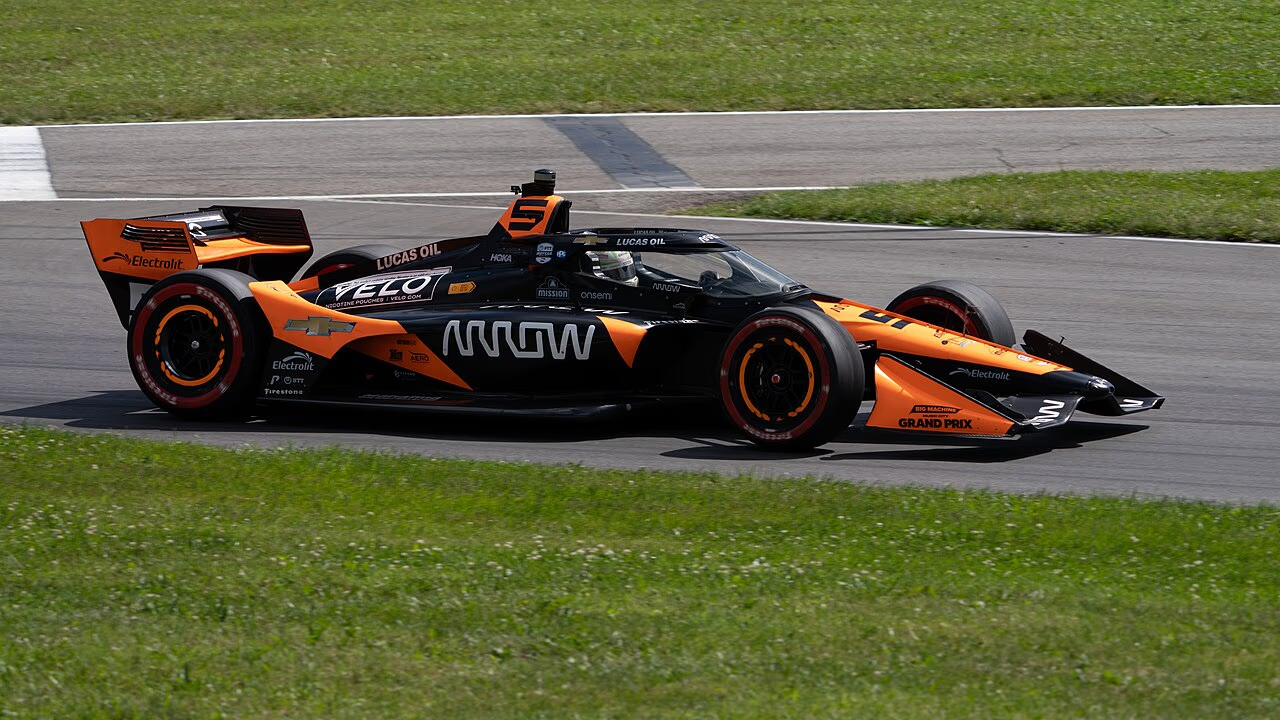
The NTT INDYCAR SERIES is the premier open-wheel motor racing championship in North America. It is sanctioned and governed by INDYCAR, the company that owns and operates the series, and competition is conducted under the annually published INDYCAR Rulebook, which covers the rules and regulations ...
Aeroscreen: The titanium-framed ballistic screen protects the driver's head from debris and impacts while keeping the open-cockpit character of the car.; Survival cell: The carbon-fiber monocoque, with front, rear, and side impact structures, is engineered to absorb crash energy and protect the d...
Full-course caution: When an incident or debris makes the track unsafe, a full-course yellow is called, the pace car is deployed, and the field closes up at reduced speed behind it. Pit-stop rules during cautions (when the pits open, the order of cars) are defined in the rulebook.; Local yellow: ...
SAFER barriers: Energy-absorbing barriers line oval walls and high-risk points on road and street courses to soften impacts.; Run-off and barriers: Road courses use gravel traps and run-off; street courses use tire packs and reinforced walls where run-off is limited.; Debris management: Full-cour...
INDYCAR is unusual among major championships in racing on three fundamentally different kinds of circuit within a single season: Ovals: Ranging from the 2.5-mile Indianapolis Motor Speedway superspeedway to short ovals under one mile. Cars run the low-downforce superspeedway aero kit on the faste...
Drivers must meet fitness standards appropriate to the physical demands of oval and road/street racing.; Pit crew members are required to wear fire-resistant gear and helmets while working on pit lane.; Mandatory orientation and refresher programs ensure drivers are prepared for the specific dema...
Helmet and head-and-neck restraint: An approved racing helmet plus a head-and-neck restraint (HANS-type) device are mandatory.; Fire-resistant gear: Multi-layer fire-resistant suit, underwear, gloves, socks, and shoes meeting motorsport standards.; Restraint system: A multi-point harness secures ...
Drivers must hold a valid INDYCAR license for the category. New drivers, and drivers returning to a circuit type, complete a Rookie Orientation Program or refresher, particularly for oval and superspeedway running.; Indianapolis 500 participation requires completion of the Indianapolis-specific o...
A typical event weekend consists of practice sessions, qualifying, and the race. Session lengths and the number of practices vary by circuit type and are set in the event bulletin.
Race Director: The senior race official, responsible for the conduct of the event — starts, restarts, caution and red-flag decisions, and the application of penalties during the race.; Stewards: A panel that reviews incidents, hears the entrant's position, and issues or confirms penalties; certai...
Avoidable contact: Contact judged to be avoidable that affects another competitor draws penalties ranging from a position penalty to a drive-through.; Blocking: Reactive moves to defend position that force another driver to take evasive action are penalized.; Jumping a start or restart / passing ...
Never squeeze a competitor into the wall at oval speeds
Deliberately or carelessly forcing another driver toward the outside wall on an oval at 220+ mph is considered one of the gravest breaches in IndyCar culture. Drivers are expected to leave racing room even under hard competition. The potential for catastrophic injury at these speeds elevates this beyond mere etiquette to a near-absolute imperative.
Most strictly observed at superspeedways — Indianapolis, Pocono, Michigan — where wall contact at speed is frequently fatal.
Clear the racing line immediately for a car on a flying qualifying lap
When a driver is on a hot qualifying lap, all others on track are expected to yield immediately and move fully off the racing line. Impeding a qualifying run — particularly during the high-stakes Indianapolis 500 qualification weekends with bumping — can unfairly eliminate a rival and is considered a serious breach drawing stern paddock criticism.
IndyCar's unique oval qualifying formats (Fast Nine Shootout, bump day) make this especially consequential compared to most other series.
Do not retaliate by deliberately wrecking another driver
Even when a driver feels genuinely wronged by a rival's aggressive or dirty move, intentionally causing a crash as payback is universally condemned in IndyCar. Open-wheel speeds make deliberate wrecking potentially lethal, and drivers who pursue on-track revenge lose the respect of the entire paddock regardless of the original provocation.
Ready to dive deeper?