














Section 1: Introduction
1.1 Overview and Governing Body
Handball is governed by the International Handball Federation (IHF), founded in 1946 and headquartered in Basel, Switzerland. The sport operates under the IHF Rules of the Game, most recently amended effective 1 July 2025. With over 200 member federations, handball ranks among the most widely played team sports in the world, particularly dominant in Europe, North Africa, and East Asia.
1.2 Olympic History
Outdoor 11-a-side handball appeared at the 1936 Berlin Olympics. Indoor 7-a-side handball became a permanent men's Olympic event in 1972 (Munich) and a women's event in 1976 (Montreal). The sport has been contested at every Summer Games since. Major international competitions include the IHF World Championship (biennial), Continental Championships (European, Asian, African, Pan American), the IHF Super Globe (club), and the Champions League organized by continental federations.
1.3 Spirit of the Game
Handball combines elements of basketball (dribbling, fast breaks), soccer (goalkeeping, team formations), and water polo (shooting from elevated positions). It is a fast-paced, high-scoring contact sport where physical strength, agility, and tactical awareness are equally vital. The emphasis is on fluid transitions between attack and defence, with typical elite matches producing 50 to 60 combined goals.
Section 2: Equipment
2.1 The Ball
The handball is spherical, made of leather or synthetic leather, with a non-shiny, non-slippery surface. Three official sizes exist:
- Size 3 (Men): Circumference 58–60 cm (22.8–23.6 in), weight 425–475 g (15–16.8 oz)
- Size 2 (Women): Circumference 54–56 cm (21.3–22 in), weight 325–375 g (11.5–13.2 oz)
- Size 1 (Youth): Circumference 50–52 cm (19.7–20.5 in), weight 290–330 g (10.2–11.6 oz)
Resin (a sticky adhesive substance) may be applied to the ball to improve grip. Its use is permitted at most levels but is increasingly regulated or banned in some venues due to residue on floors and walls. The IHF requires host venues to specify resin policy before tournaments (IHF Rule 3).
2.2 Goals
Goals have internal dimensions of 3 m wide x 2 m high (9.84 ft x 6.56 ft). Goal posts and crossbar are 8 cm (3.1 in) square in cross-section, painted in alternating two-colour bands (typically black and white or red and white) visible from both sides. A net is attached that allows the ball to remain inside the goal. Goals must be securely anchored to the floor or rear wall and must not tip or shift during play (IHF Rule 1).
2.3 Player Equipment
- Footwear: Non-marking indoor court shoes are mandatory. Outdoor soles and studded shoes are prohibited (IHF Rule 4).
- Jerseys: Numbered 1–99. Field players wear matching jerseys of a uniform colour distinct from the opposing team. Goalkeepers wear a jersey colour distinct from both their own field players and the opponents (IHF Rule 4).
- Protective gear: Soft protective padding (e.g., elbow pads, knee pads) is permitted. Hard braces, casts, or splints are prohibited unless padded and approved by the referees. Mouthguards are recommended but not mandatory (IHF Rule 4).
- Accessories: Jewellery, watches, and any hard or sharp accessories are strictly prohibited during play (IHF Rule 4).
Section 3: Playing Area
3.1 Court Dimensions
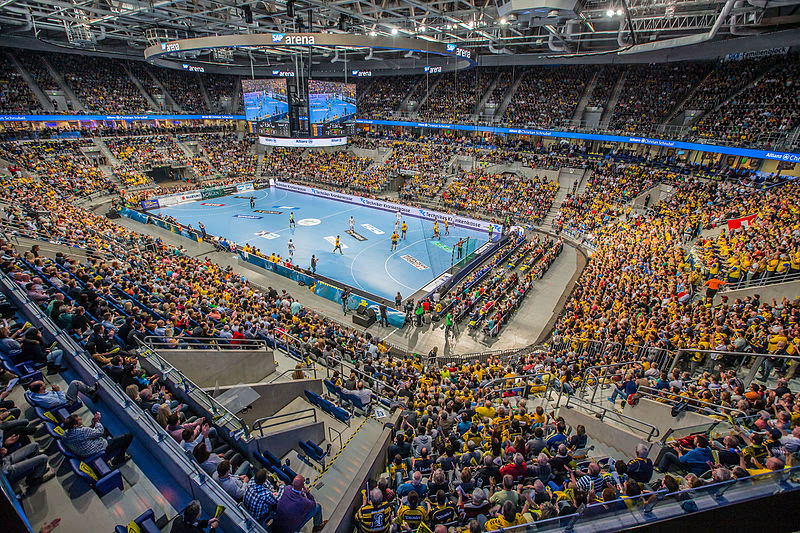
The playing court measures 40 m x 20 m (131 ft x 66 ft), with a safety zone of at least 1 m along the sidelines and 2 m behind each goal line. The court surface is typically hardwood, synthetic, or rubberised flooring and must be flat and non-slip (IHF Rule 1).
3.2 Key Court Markings
- Goal area line (6 m arc): A quarter-circle arc drawn 6 m (19.7 ft) from each goal post, connected by a straight line 3 m from the goal line parallel to it. Only the goalkeeper may occupy this zone during active play (IHF Rule 1).
- Free-throw line (9 m arc): A dashed arc 9 m (29.5 ft) from the goal, used for free-throw restarts after fouls between the 6 m and 9 m lines (IHF Rule 1).
- 7-metre line: A 1 m (3.3 ft) long line parallel to the goal line at 7 m (23 ft) distance, used for penalty throws (IHF Rule 1).
- Goalkeeper restraining line (4 m line): A 15 cm (5.9 in) line 4 m from the goal, marking the closest point the goalkeeper may advance during a 7 m throw.
- Centre line: Divides the court into two halves. Used for throw-offs to start each half and after every goal (IHF Rule 1).
- Substitution lines: Marked 4.5 m (14.8 ft) on either side of the centre line along the sideline closest to the team benches. Players must enter and exit the court between these lines (IHF Rule 1).
3.3 Team Bench and Officials Table
Each team's bench area is positioned along the same sideline as the substitution area. The officials' table (timekeeper and scorekeeper) is at the centre of the sideline. A team may register up to 16 players (IHF Rule 4:1) and, following the amendment effective 1 July 2025, up to 5 team officials per match — an increase from the previous limit of 4 — for a combined maximum of 21 persons in the playing and coaching contingent present at the bench (IHF Rule 4:2).
3.4 Coaching Zone
Amended effective 1 July 2025, the coaching zone (IHF Rule 1:11) was extended and now begins 3.5 m from the centre line and ends 8 m from the respective outer goal line, including, as far as possible, the area directly behind the team bench. Team officials must remain within this zone while communicating with players and referees during play, other than for permitted exceptions such as attending to an injured player on court (IHF Rule 1:11).
Section 4: Players & Officials
4.1 Team Composition
Each team consists of up to 16 players; no more than 7 may be on the court at once. A player identified as a goalkeeper may become a court player at any time, and a court player may become a goalkeeper, so there is no fixed split between the two. Seven players are on the court at any time — 6 field players and 1 goalkeeper. Teams must have at least 5 players to start a match (IHF Rule 4).
4.2 Player Positions
- Goalkeeper (GK): Defends the goal within the 6 m area. May use any body part (including feet) to stop the ball. May leave the goal area but then becomes a regular court player subject to field-player rules.
- Centre back (CB): The primary playmaker. Organises the attack from the centre of the 9 m line, distributing the ball and directing offensive patterns.
- Left and right backs (LB/RB): Positioned on either side of the centre back. Often the primary shooters with powerful long-range shots from 9–10 m.
- Left and right wings (LW/RW): Play on the flanks near the sidelines and goal line. Rely on speed and agility for fast breaks and sharp-angle shots close to the goal line.
- Pivot / Line player (LP): Operates along the 6 m line within the defensive formation. Sets screens for backcourt players, receives passes for close-range shots, and creates space by disrupting the defence.
4.3 Substitutions
Substitutions are unlimited and occur as "flying substitutions" — the outgoing player must leave the court before the incoming player enters, both through the substitution zone. No stoppage of play is required. Faulty substitution (entering early or outside the zone) results in a 2-minute suspension for the incoming player (IHF Rule 4).
4.4 The Empty-Goal Tactic
A distinctive feature of modern handball is the option to replace the goalkeeper with a seventh court player (sometimes called a "specialist" or wearing a goalkeeper jersey over a court player uniform). This creates a 7-vs-6 numerical advantage on attack but leaves the goal completely undefended. If the opposing team gains possession, they can shoot at an empty goal from any distance. This high-risk tactic is increasingly common at the elite level, particularly when a team is trailing in the final minutes. Some teams employ it systematically throughout entire matches, accepting occasional empty-net goals in exchange for the sustained attacking advantage (IHF Rule 4).
4.4 Match Officials
- Two court referees: Hold equal authority and may independently call any infraction. They position themselves at court and goal-line positions and swap roles throughout play (IHF Rule 17).
- Timekeeper: Controls the official game clock, signals timeouts, and manages 2-minute suspensions (IHF Rule 17).
- Scorekeeper: Maintains the official score sheet, records goals, warnings, suspensions, and disqualifications (IHF Rule 17).
- Delegates (IHF/continental events): Supervise the match from the officials' table with authority to intervene on matters of rules interpretation (IHF Rule 17).
4.5 Team Officials
Effective 1 July 2025, each team may register up to 5 team officials per match, increased from the previous limit of 4 (IHF Rule 4:2). Team officials occupy the team bench and the coaching zone described in Section 3.4, and are subject to the same progressive disciplinary sanctions — warning, 2-minute suspension, and disqualification — as players for misconduct toward opponents, officials, or the sport (IHF Rule 4:2).
Section 5: Rules of Play
5.1 Match Duration
A standard match consists of two halves of 30 minutes each with a 10-minute halftime break (15 minutes at major tournaments). The clock is a running clock that only stops on referee signal (team timeouts, injuries, disciplinary actions). Following the amendment to IHF Rule 2 (comment) effective for the 2025/26 season, the match clock and venue scoreboard must display time as a single continuous upward count rather than resetting at the start of each period: 0–30 minutes for the first half, 30–60 minutes for the second half, 60–70 minutes for the first extra-time period, and 70–80 minutes for the second extra-time period. Venues whose scoreboard software could not yet support continuous display were granted a transitional exception for the 2025/26 season, with full compliance required from the 2026/27 season onward (IHF Rule 2, comment). If the match is tied in elimination rounds, extra time is played: two periods of 5 minutes with a 1-minute break. If still tied, a second extra-time period (2 x 5 minutes) follows. If still tied after the second extra-time period, a 7-metre throw shootout decides the result: each team nominates 5 throwers, and, under the amended procedure, the shootout ends immediately once a goal difference emerges after both teams have taken an equal number of throws, rather than requiring every nominated throw to be completed (IHF Rule 2, comment).
5.2 Ball Handling
- 3-second rule: A player holding the ball stationary may do so for a maximum of 3 seconds before passing, shooting, or dribbling (IHF Rule 7).
- 3-step rule: A player may take a maximum of 3 steps while holding the ball. After dribbling (bouncing the ball with one hand), the player may take another 3 steps (IHF Rule 7).
- Double dribble: Once a player has dribbled and picked up the ball, they may not dribble again. Doing so results in a turnover (free throw to the opposition) (IHF Rule 7).
- Kicking: Field players may not intentionally play the ball with any part of the leg below the knee. Goalkeepers within their 6 m area may use any body part, including feet and legs (IHF Rule 7).
5.3 Goal Area Rules
Only the goalkeeper may stand in or enter the 6 m goal area. A court player may jump into the goal area to shoot, provided the ball is released before the player lands inside the area (known as an "in-flight" or "diving" shot). If a court player enters the goal area without the ball to gain advantage, it is a free throw. If an offensive player enters to gain advantage while in possession, it is a turnover. If a defensive player enters the goal area to gain advantage, a 7 m throw is awarded (IHF Rule 6).
5.4 Throw-Off, Throw-In, and Restarts
- Throw-off: Taken from the centre of the court to start each half and after every goal. The throwing team's players must be in their own half; the opposing team must be at least 3 m away (IHF Rule 10).
- Throw-in: Awarded when the ball crosses the sideline. Taken from the point where the ball left the court, with one foot on the sideline (IHF Rule 10).
- Goalkeeper throw: Awarded when the ball crosses the outer goal line last touched by the goalkeeper or an attacking player. The goalkeeper restarts from inside the goal area (IHF Rule 10).
- Free throw: Awarded for most rule violations. Taken from the spot of the infraction (or the 9 m line if the violation occurred between the 6 m and 9 m lines). Opponents must be 3 m away (IHF Rule 10).
5.5 Passive Play
Teams must demonstrate a recognisable attempt to attack and score. If the referees judge a team is stalling, a passive play warning is signalled (forearm raised). After the warning, the attacking team is permitted approximately 6 passes to attempt a shot. If no shot is taken, the ball is turned over via free throw to the defending team. The warning is reset after any shot attempt, turnover, or free throw (IHF Rule 7).
5.6 Fast Break and Counter-Attack
The fast break (or counter-attack) is one of the most effective scoring methods in handball. After gaining possession — from a goalkeeper save, interception, or turnover — teams attempt to advance the ball quickly before the opposing defence can organise. The first wave (1-on-0 or 2-on-1 situations) occurs within seconds and produces high-percentage scoring chances. If the first wave is defended, a second wave with additional runners may follow. Teams that excel at fast-break transitions often outscore defensively-oriented opponents by 5–8 goals per match.
5.7 Offensive Formations and Tactics
Teams typically operate from one of several standard offensive formations against a set defence:
- 6-0 defence / standard attack: The most common setup where 3 backcourt players (left back, centre back, right back) attack from outside the 9 m line while 2 wings and 1 pivot work along the 6 m line.
- 7-vs-6 superiority play: Teams may substitute the goalkeeper for an additional court player, creating a 7-on-6 numerical advantage in attack. This is increasingly used in the final minutes when trailing, or even throughout the match as a tactical choice. The risk is an empty goal if the opposing team regains possession.
- Double pivot: Two line players operate along the 6 m line, creating more screening and passing options but reducing the number of long-range shooters.
5.8 Team Timeout
Each team is allowed three 1-minute team timeouts per match (maximum two per half). A team official places a green card on the officials' table to request a timeout, which is granted at the next interruption when that team has possession (IHF Rule 2).
Section 6: Scoring
6.1 Goal Validity
A goal is scored when the entire ball crosses the goal line between the posts and beneath the crossbar. The goal counts only if no violation by the attacking team preceded the throw (e.g., stepping into the goal area, offensive foul). Each goal is worth 1 point (IHF Rule 9).
6.2 Scoring from Different Positions
Goals can be scored from a variety of positions, each requiring distinct technique:
- Back-court shot (9–10 m): Powerful overarm throws from the left back, centre back, or right back positions. These shots must beat both the defence wall and the goalkeeper, typically aimed at the corners.
- Wing shot: Shots from acute angles near the goal line. Wings typically shoot while airborne, diving into the goal area to maximise the angle. Shot placement is more important than power from this position.
- Pivot/line shot: Close-range shots from the 6 m line after receiving a pass while positioned between defenders. Spin shots, underhand shots, and behind-the-back shots are common from the pivot position.
- Fast-break goal: Open-play goals scored during transition, typically 1-on-0 or 1-on-1 with the goalkeeper.
- 7 m penalty: Direct shot from the penalty line, accounting for approximately 10–15% of goals in elite matches.
6.3 Typical Scoring Patterns
Elite matches typically produce combined scores of 50–65 goals. Goals can be scored from long-range shots (backcourt players at 9–10 m), diving shots into the goal area (wings and line players), fast breaks (counter-attacks), 7 m penalty throws, and direct free throws (rare but legal if the angle permits).
6.3 Match Result
The team with the most goals at the end of regulation time wins. In group-stage formats, a draw is a valid result. In knockout rounds, tied matches proceed to extra time and, if necessary, a 7 m throw shootout, decided as soon as one team leads after an equal number of throws by each side (see Section 5.1 for the current shootout procedure) (IHF Rule 2, comment).
Section 7: Violations & Penalties
7.1 Progressive Punishment System
The IHF uses a progressive punishment system for personal fouls and unsportsmanlike conduct:
- Warning (yellow card): Given for the first minor foul or unsportsmanlike act. Each team may receive a maximum of 3 warnings collectively; after 3, further infractions result directly in 2-minute suspensions (IHF Rule 16).
- 2-minute suspension: For significant fouls, repeated minor infractions, illegal defensive actions, and unsportsmanlike conduct. The penalised player must leave the court for 2 minutes, and the team plays short-handed. A third 2-minute suspension for the same player results in automatic disqualification (IHF Rule 16).
- Disqualification (red card): For assault, dangerous play, serious unsportsmanlike conduct, or a third 2-minute suspension. The disqualified player is out of the match, and the team plays short-handed for 2 minutes before substituting (IHF Rule 16).
- Report (blue card): Shown alongside a red card for particularly severe offences (e.g., assault). The incident is referred to the IHF Disciplinary Commission for further sanctions, which may include multi-match suspensions (IHF Rule 16).
7.2 Defensive Fouls
- Body contact fouls: Holding, pushing, tripping, hitting, or charging an opponent: free throw plus possible progressive punishment (IHF Rule 8).
- Destroying a clear chance: Grabbing a player's throwing arm, tackling from behind, or otherwise fouling a player with a clear path to goal: 7 m throw plus 2-minute suspension (IHF Rule 8).
- Endangering an opponent: Tackling at high speed, contacting the head or neck, or any action that puts an opponent's physical safety at risk: immediate 2-minute suspension or disqualification depending on severity (IHF Rule 8).
- Back-pass rule: Deliberately playing the ball to one's own goalkeeper inside the goal area: 7 m throw to the opposition. This prevents teams from stalling by passing back to the goalkeeper in a protected zone (IHF Rule 8).
- Defensive wall formation: When defenders line up at the 6 m line to block shots, only legal body contact (chest and front of body) is permitted. Extending arms to block shots outside of normal body width, or holding attacking players in the wall, constitutes a foul (IHF Rule 8).
7.3 The 7-Metre Throw (Penalty)
Awarded when a clear scoring opportunity is illegally destroyed anywhere on the court. The thrower stands behind the 7 m line and may shoot using any technique. The goalkeeper must remain behind the 4 m restraining line until the ball is released. All other players stand outside the 9 m line. The thrower must shoot within 3 seconds of the referee's whistle (IHF Rule 14).
7.4 Goalkeeper Headshot Protection
Amended IHF Rules 8:8d and 8:8e, effective 1 July 2025, standardised the sanction for shots that strike the goalkeeper's head. Previously, hitting the goalkeeper's head with the ball on a 7 m throw or on a free throw taken after the final signal was punished with automatic disqualification (red card). Under the amended rules, such headshot situations — including an unhindered shot in open play — are instead punished with a 2-minute suspension for the shooting player, unless the goalkeeper's own head movement toward the ball was a genuine attempt to block the shot, in which case no offence is called. The amendment standardises what had previously been an inconsistent set of sanctions applied to headshots occurring in different phases of play (IHF Rule 8:8d, 8:8e).
Section 8: Safety Considerations
8.1 Court and Equipment Safety
The court surface must be non-slip and uniformly flat. Goals must be anchored securely to prevent tipping. All court markings must use non-toxic, non-slip paint or tape. The ball must be in good condition with no protruding seams (IHF Rule 1).
8.2 Player Safety
- Jewellery, watches, and hard accessories are prohibited to prevent lacerations and injuries during contact (IHF Rule 8).
- Fingernails must be kept short (IHF Rule 8).
- Glasses must be secured with a sports strap or replaced with sport-specific eyewear (IHF Rule 8).
- Mouthguards, soft knee pads, and elbow pads are recommended, especially for youth players (IHF Rule 8).
- Head protection is allowed if it conforms to the IHF specifications (soft, form-fitting) (IHF Rule 8).
8.3 Medical Provisions
A qualified medical team must be present at all sanctioned matches. A player who is bleeding must leave the court immediately and may only return once the bleeding has stopped and the wound is securely covered. The referees may order an injured player to leave the court if continuing would be dangerous to the player or others. Each team is permitted one team official to enter the court for medical attention during a stoppage (IHF Rule 4).
8.4 Resin Considerations
Where resin is permitted, venues must provide cleaning materials and designate areas for resin application. The floor around the substitution area and officials' table must be cleaned regularly to prevent slip hazards from resin residue. Some venues ban resin entirely due to facility maintenance concerns, and teams must comply with local venue policy (IHF Rule 4).
8.5 Goalkeeper Safety
Goalkeepers face particular injury risks due to close-range shots at speeds exceeding 100 km/h (62 mph). While no special protective equipment is mandated beyond the standard jersey, goalkeepers may wear a soft groin protector, long-sleeved jersey, and padded shorts. Goalkeepers are not permitted to wear hard-shell protection (cricket-style pads, helmets, or rigid guards) as these could injure attacking players during contact at the goal area (IHF Rule 4). See Section 7.4 for the 2025/26 disciplinary standardisation covering shots that strike the goalkeeper's head (IHF Rule 8:8d, 8:8e).
8.6 Venue Requirements
IHF-sanctioned competitions require a minimum ceiling height of 7 m (23 ft) above the playing surface. Lighting must provide a minimum of 1,500 lux uniformly across the court for televised events and 500 lux for lower-tier competitions. Spectator barriers must maintain a minimum distance from the court boundaries. The venue must provide separate warm-up areas for both teams, anti-doping control stations, and media facilities at major tournaments (IHF Rule 1).